Quick answers
What did SEBI say about WhatsApp stock-tip groups?
On 22 October 2026 (PR 65/2026) SEBI cautioned against invitation-only groups run by unregistered people, often on overseas numbers, that share buy and sell calls as free education, with members posting planted profit claims. It said not to join them, not to open accounts on apps recommended there, and to deal only with SEBI-registered intermediaries.
How do I check whether an adviser or broker is registered?
SEBI says registration status can be verified on SEBI's intermediaries page (linked in this guide), which includes a searchable list of recognised intermediaries such as registered investment advisers. Search it yourself and match the name, not only a number sent in a chat.
How do I know a trading app is genuine?
SEBI's Investor Support page (linked in this guide) lists authorised mobile trading apps of registered stock brokers and other intermediaries. If an app is not listed, do not invest through it. Install apps only from official app stores.
What is an @valid UPI ID?
Since 1 October 2025, SEBI-registered brokers and mutual funds have exclusive UPI IDs ending in @valid (with .brk for brokers, .mf for mutual funds). A thumbs-up in a green triangle appears when you pay through one. SEBI Check can also verify a bank account with its IFSC code or an @valid UPI ID.
Why am I asked to pay a fee to withdraw my profit?
That is a common last stage of the scam: I4C's CyberDost says genuine brokers do not need a deposit to release existing funds. Stop paying; the fees do not release the money.
I have already paid. What now?
Call 1930 and file at cybercrime.gov.in the same day, tell your bank, save the chats, and do not pay a recovery agent. Recovery cannot be promised.
Which number is for what?
1930 and cybercrime.gov.in for money lost to fraud; your bank for the account; SEBI investor helpline 1800-266-7575 or 1800-22-7575 for questions about intermediaries and complaints; SCORES for complaints against registered intermediaries.
Can scammers really buy SIM cards and OTPs?
In a November 2026 Vadodara case, police say four men supplied SIM cards and WhatsApp activation OTPs to a fake share-market group and that 87 complaints in several states, Rs 33.04 crore, are linked to them; the accused are alleged and not convicted. Never sell, rent or lend your SIM card, OTP or bank account.
The message usually looks harmless. Someone adds you to a WhatsApp group, or sends an invite from a number you do not know. The “teacher” promises free lessons on the share market, members post screenshots of profits, and after a few days there is a link to a trading app. This week the market regulator, SEBI, put out a notice on exactly this, and on 24 October Delhi reports described two people who say they lost more than Rs 1.2 crore between them to the same pattern. This guide explains how it works, how to check a person or an app in a few minutes, and what to do if you have already put money in.
In short
- Do not act on stock tips from a group you were invited to by strangers. SEBI’s notice of 22 October 2026 (PR 65/2026) says the operators are unregistered people, mostly on overseas numbers, and that praise and profit screenshots in the group may be planted.
- Check before you trust. Registered intermediaries are listed on SEBI’s website, and the trading apps of registered intermediaries are listed on SEBI’s investor site.
- Check before you pay. A broker’s or mutual fund’s UPI ID ends in “@valid”, and SEBI Check can verify a bank account with its IFSC code or an @valid UPI ID.
- If you are asked for more money to withdraw your money, stop. I4C’s CyberDost says a genuine broker does not need a deposit to release your own funds.
- If you have already paid, call 1930 and file at cybercrime.gov.in the same day. No one can promise to get the money back.
What SEBI said on 22 October
SEBI’s press release is titled “Caution to Investors against Stock Tips offered through Invitation-only WhatsApp Groups”. It says certain unregistered persons offer stock tips and trading calls in such groups, pose as market experts, mostly use overseas WhatsApp numbers, and share buy and sell calls “in the name of free investor education”. To make the calls look credible, some members, acting with the operators, post false profit claims and praise the “expert”. SEBI calls this astroturfing: a crowd that looks real but is not.
It also describes what happens after a group is shut. Members get a message, usually from a new number, saying the earlier group was banned because of “Social Media Platform’s risk control measures” and inviting them to a new one with “daily recommendations”. SEBI treats that message as a red flag.
How the scam usually runs
These stages come from SEBI’s notice, from I4C’s CyberDost advisory of 9 July 2026 as reported by Outlook Money, and from the 24 October report in The420 on the two Delhi complaints. The Delhi accounts are the complainants’ version and the cases are under investigation.
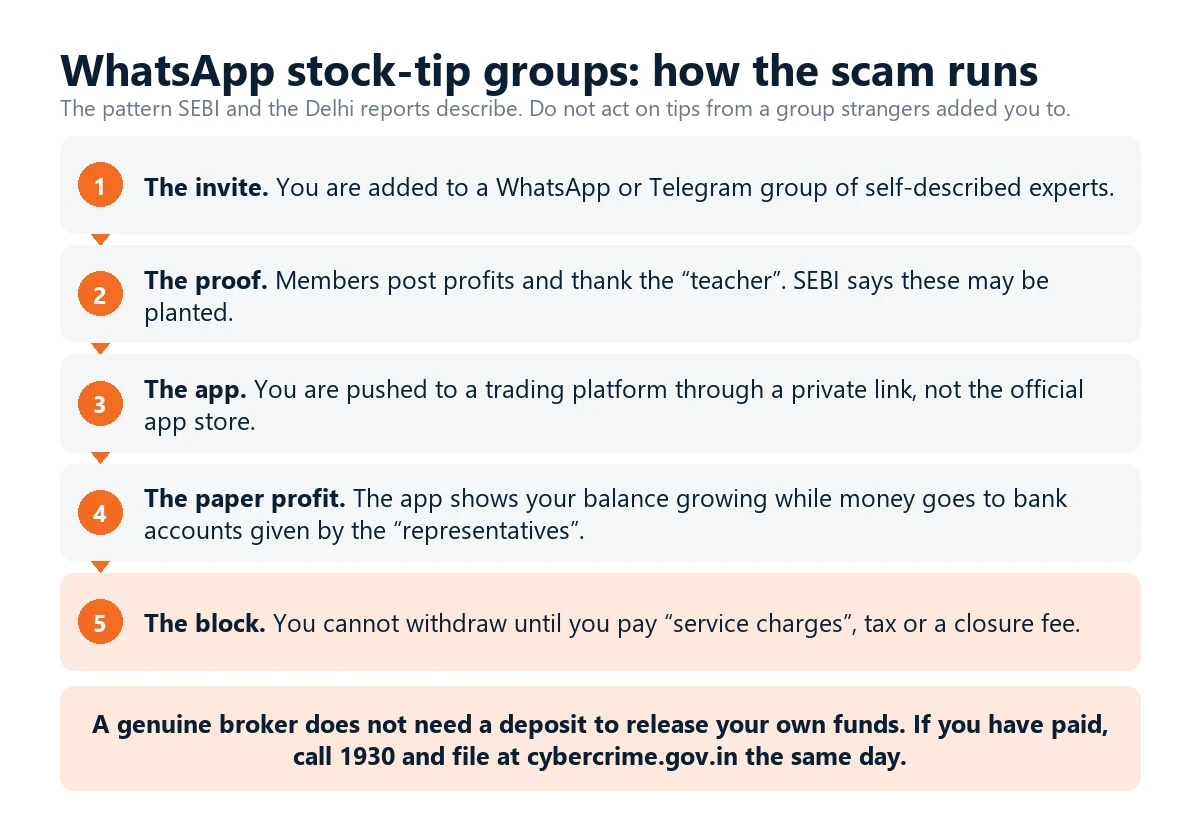
- The invite. You are added to a WhatsApp or Telegram group of self-described experts, often with a name that sounds official, or offered “free education”.
- The proof. Members post profits, thank the “teacher” and share trade confirmations. SEBI says these may be planted.
- The app. You are pushed to a trading platform through a private link. I4C advises downloading trading apps only from official app stores. In the Delhi reports the schemes were pitched as IPO investments, pre-market trading or specialised trading accounts, with promised daily returns of 3 to 10 per cent in one of them.
- The paper profit. The app shows your balance growing. Money goes in several instalments, as reported, to bank accounts given by the “representatives”, not to an exchange or a registered broker.
- The block. When you try to withdraw, access is cut or you are told to pay “service charges”, margin money, tax, commission or an account-closure fee first. One Delhi complainant says a demand of Rs 66 lakh was made as service charges against a displayed balance of about Rs 5.5 crore. Paying the fee does not release the money.
Warning signs that repeat
- You did not ask to join, and the group is invitation-only or run from an overseas number.
- “Guaranteed” or fixed returns, “VIP” tips, “pre-market” access, or an IPO allotment that is promised.
- A trading app that comes as a link, not from the official app store, or that you cannot find on SEBI’s list.
- Payment to a personal or company bank account, or a UPI ID that does not end in @valid.
- A message that the old group was banned, followed by a new invite.
- Any demand for money to withdraw money.
Five checks that take a few minutes
1. Is the person registered? SEBI says registration status can be verified on SEBI’s intermediaries page. Its list of recognised intermediaries includes registered investment advisers, which you can search by name or registration number; when we opened it on 26 October 2026 it showed 1,065 advisers. A registration number alone proves little if you are only given it in a chat, so search it yourself, and match the name, not just the number. Remember that a registered person does not run a free tips group for strangers.
2. Is the app listed? SEBI’s Investor Support page lists authorised mobile trading apps of stock brokers on BSE, NSE, NCDEX, MCX and MSEI, and of other intermediaries such as investment advisers, research analysts and mutual funds. If the app you were sent is not there, do not put money in it.
3. Does the UPI ID end in @valid? SEBI’s press release PR 64/2025 of 1 October 2025 says UPI IDs of SEBI-registered investor-facing intermediaries carry an exclusive “@valid” handle issued by NPCI, with .brk for brokers and .mf for mutual funds (for example abc.brk@validhdfc). A thumbs-up inside a green triangle appears when you pay through it, and SEBI says its absence is a caution that you may be paying an unauthorised entity. SEBI also describes it as an additional payment option, so a broker may still accept other modes; confirm those with the next step.
4. Does the bank account match? SEBI Check (also in SEBI’s Saarthi app) lets you check an @valid UPI ID, or a bank account number with its IFSC code for NEFT, RTGS or IMPS, against registered intermediaries. SEBI urges investors to verify before paying. If the check fails, do not pay. We opened the page but did not run a live check.
5. Does it still sound too good? A rising balance on a screen is not money in an account you control. Check by withdrawing a small amount, early, before the amount you have put in grows. This last step is our suggestion, not an official one, and if the withdrawal is refused or a fee is demanded, treat that as the answer.
If you have already joined, or paid
- Stop paying. Do not send a “release fee”, tax, margin or closure charge, and do not take a loan to cover it.
- Call 1930 and file at cybercrime.gov.in, with the bank account or UPI ID that received the money, transaction references, the group name, phone numbers and screenshots. The earlier the report, the more chance a bank has to act on the receiving account. It is never a guarantee.
- Call your bank on its official number and tell it about the transfers.
- Leave the group, but save the chats first. Do not share your holdings or trading account details with anyone in it, as SEBI advises.
- Be careful with “recovery” offers. After a loss, you may be contacted by people promising to get the money back for a fee. Our suggestion is to treat these as part of the same scam.
- Know where SEBI fits. SEBI’s SCORES portal takes complaints against listed companies, registered intermediaries and market infrastructure institutions, and expects you to approach the entity as well. Our reading is that a fraud by an unregistered group falls outside that, so start with 1930 and the police. SEBI’s investor helpline is 1800-266-7575 or 1800-22-7575, 9 am to 6 pm on days other than Sundays and declared Maharashtra holidays; it answers questions but gives no investment advice.
A Vadodara case: the SIM cards and OTPs behind such groups
In early November 2026, Vadodara Cyber Crime Police said they had arrested four men in a case that started with one complaint. According to ETV Bharat Gujarati, India Today and The 420, a complainant lost Rs 1.57 crore between 8 February and 21 April 2026 to a fake share-market and IPO investment group: he saw screenshots in the name of a SEBI-registered firm, was added to WhatsApp groups called Wall Street Dharma D9 and Shark Club D9, was sent a link to a trading account that showed profits, and was persuaded further by a person who posed as a police officer. Police say the inquiry then linked 87 complaints in several states, totalling Rs 33.04 crore, to the accused, who allegedly supplied the SIM cards, the OTPs for WhatsApp activation and a route for USDT. ETV Bharat says 359 SIM cards were used; India Today and The 420 say more than 400. The OTPs were used from Hong Kong, Malaysia and the US, which shows how far the people behind a group can be from the victims. The four are alleged and not convicted.
The lesson for you is twofold. At the front of the chain, check any firm and any app on SEBI’s own lists, because a screenshot in a registered firm’s name proves nothing. At the back, never sell, rent or lend your SIM card, an OTP or a bank account, however small the commission; police say that is what such groups run on. Read our case study of the Vadodara network and our case on the SD Pay and Apna Pay scheme, and call 1930 the same day if you have paid. For how fraud rings use ordinary people’s bank accounts and SIM cards, and what to do if yours was misused, read our guide to mule bank accounts and SIM cards.
For families
- Older relatives with savings, and anyone newly retired, are often the target. Ask them to show you any group or app before they pay.
- Agree a simple rule: no money goes to a person or app met through a chat group until a second person has checked it against SEBI’s lists.
- The same pressure to act fast and stay silent appears in digital-arrest calls and in urgent requests that seem to come from someone you know. Our guide on festival-season payment scams covers the first hour after any payment fraud, and this financial-crisis guide is for people who are short of money and tempted by quick returns.
Before you open an unfamiliar trading app or website, see what any site can read from your device without asking. Our page on what a website can learn about you shows it in your own browser.
What we could not confirm
- The Delhi accounts of 24 October come from one news report (The420). It gives no FIR numbers and the cases are under investigation. We do not know the outcome.
- We opened the SEBI press release as a PDF and the SEBI pages cited, but did not run a live SEBI Check or search for a particular adviser.
- SEBI’s October 2025 release said brokers covering over 90 per cent of investors, and all mutual funds, had adopted @valid. We have not found a current figure.
- The cybercrime.gov.in page returned a response but did not display content for us; the reporting route is taken from I4C’s advisory as reported.
- We looked for Instagram, Facebook and LinkedIn videos on this notice and found no public post we could verify; none is listed. The YouTube videos are awareness films or a news report and were not watched in full.
- The Vadodara figures (359 or more than 400 SIM cards, 87 complaints, Rs 33.04 crore) are police figures as reported by three outlets and may change; we name none of the accused, who are alleged and not convicted.
This is general safety information, not investment, legal or financial advice. We will update this page as SEBI or the police add detail. Updated 10 November 2026.
What needs attention
- SEBI's 22 October 2026 notice describes invitation-only WhatsApp groups run by unregistered people who share trading calls as free education.
- Praise, profit claims and trade confirmations in such groups may be planted by members working with the operators (astroturfing).
- A message saying the old group was banned and inviting you to a new one is, in SEBI's words, a red flag.
- Delhi reports of 24 October describe two complainants who say they lost over Rs 1.2 crore in total; the cases are under investigation.
- Withdrawal blocks followed by fee demands (service charges, margin, tax, closure) are the common final stage in the reports we read.
- SEBI's @valid UPI handle and SEBI Check were launched on 1 October 2025 to help investors check payees.
- Vadodara police say a Rs 1.57 crore complaint led them to a network that used 359 or more than 400 SIM cards and linked 87 complaints, Rs 33.04 crore in all, to four men; they are alleged and not convicted.
- In that case the victim was added to WhatsApp groups, shown screenshots in the name of a SEBI-registered firm and persuaded by a person who posed as a police officer.
Controls that reduce risk
- Leave invitation-only tip groups and do not act on their tips.
- Check registration on SEBI's intermediaries page and the app on SEBI's Investor Support page before putting money in.
- Pay only to @valid UPI IDs or accounts that SEBI Check confirms.
- Try a small withdrawal early and treat a fee demand as your answer (our suggestion).
- Call 1930 and file at cybercrime.gov.in the same day if you have paid.
- Show any group or app to a second person before paying (family rule, our suggestion).
- Never sell, rent or lend your SIM card, OTP or bank account for any reason (police appeal in the Vadodara case, November 2026).
Common unsafe practices
- Joining a stock-tip group because a stranger or an unknown number added you.
- Believing member profit screenshots and trade confirmations.
- Installing a trading app from a private link instead of an official app store.
- Paying a personal or company bank account instead of a registered broker's verified account.
- Paying a fee, tax or margin to withdraw money that is already yours.
- Waiting a few days before calling 1930, or deleting the chats before saving them.
- Sharing your holdings or trading account details with the group.
- Selling, renting or lending your SIM card, an OTP or a bank account to someone for a commission; police say these are what such groups run on.