

Quick answers
What makes a scaffold safe?
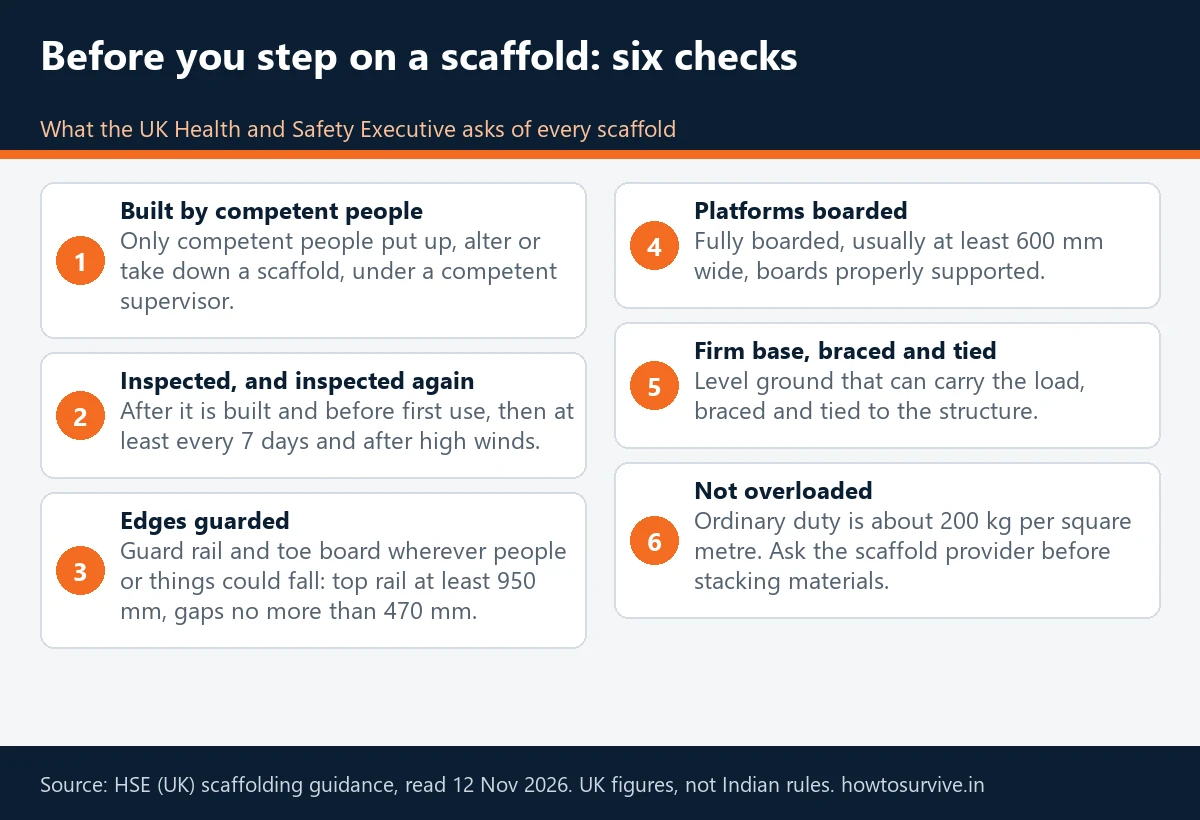
Competent people build and alter it, it is inspected before use and at least every 7 days, every open edge has a guard rail and a toe board, platforms are fully boarded, the base is firm and level, it is braced and tied to the structure, and it is not overloaded. These are the UK Health and Safety Executive's points, not Indian rules.
How high should a scaffold guard rail be?
The HSE says a top rail at least 950 mm above any fall edge, with intermediate rails so that no gap is larger than 470 mm, and a toe board. These are British figures; check the rule that applies to your site.
How often should a scaffold be inspected?
After it is put up and before first use, at intervals of no more than 7 days, and again after anything that could affect safety, such as high winds (HSE, UK). A competent person inspects and the report records defects and what was done.
Who is allowed to build or change a scaffold?
Only competent people, under a competent supervisor (HSE, UK). A trainee works under a trained scaffolder.
How much weight can a scaffold platform carry?
The HSE says to assume general-purpose duty, 2 kN per square metre or about 200 kg per square metre, unless the scaffold provider says otherwise. Tell the provider before you stack materials.
What happened at the Loop Parkway Bridge?
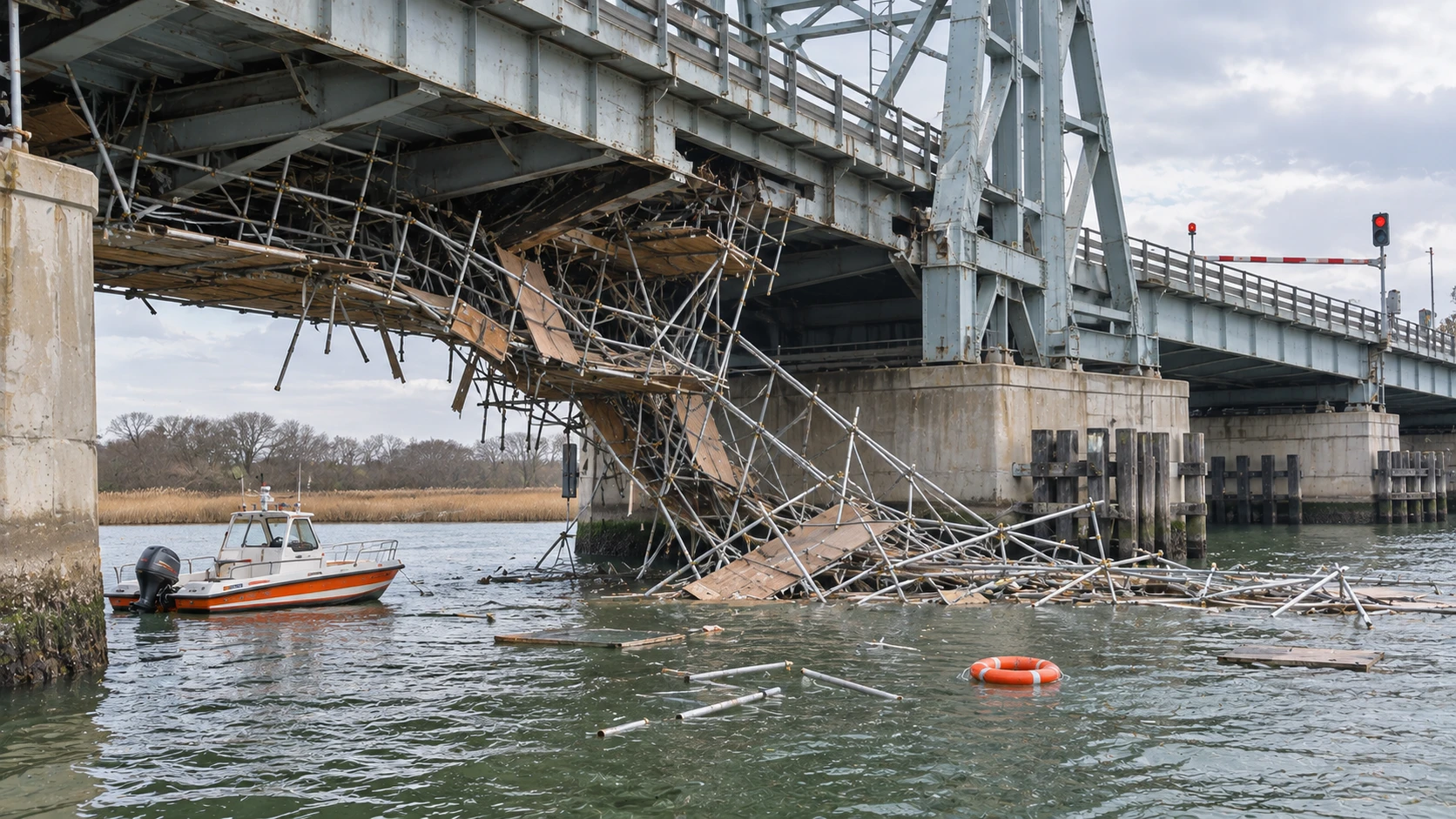
On Wednesday 11 November 2026, at about noon, scaffolding under eight contract workers gave way on the drawbridge at Point Lookout, New York. At least two fell into the water; one died at a hospital and another was still missing in the latest reports we could open. Six others were hurt. No cause has been announced and OSHA will investigate.
What should I do if a scaffold looks unsafe?
Step off, tell the supervisor and ask who inspected it and when. If you are passing by and see missing boards, sagging planks or loose ties, keep clear and tell the site manager or the local authority. This is our advice, not a quoted rule.
Do Indian rules cover scaffolds?
The Indian construction-worker rules do deal with scaffolds, but we did not open their text, so we quote none. This page uses British guidance and says so.
On Wednesday 11 November 2026, at about noon, eight contract workers were on the Loop Parkway drawbridge at Point Lookout, on Long Island in New York, when the scaffolding under them gave way. At least two fell into the water. One was taken to a local hospital and died there, a second was still missing in the latest reports we could open, and six others were hurt, police said, not seriously. No cause has been announced. We cover that case in full on our Loop Parkway Bridge page. This page on scaffolding safety is for anyone who works on a scaffold or lives or walks beneath one, in India or anywhere: what a safe scaffold looks like, and what to ask before you step on. The checks below come from the UK Health and Safety Executive, the only detailed public scaffold guidance we could open. They are not Indian rules. Checked 12 November 2026.
In short
- Scaffolding safety starts with who builds it. The HSE says scaffolds must be designed, erected, altered and dismantled only by competent people, under a competent supervisor.
- It must be inspected before first use, then at least every 7 days, and again after anything that could weaken it, such as high winds.
- Every open edge needs a guard rail and a toe board. The HSE’s figures: top rail at least 950 mm above the edge, no gap larger than 470 mm between rails.
- Platforms must be fully boarded, usually at least 600 mm wide, on a firm, level base, braced and tied to the structure, and not loaded beyond what it was designed for.
- If anything looks wrong, step off and tell the supervisor. Ask who inspected it and when. That is our advice, not a rule we quote.
- The risk is real. The US safety regulator OSHA counts 52 fatal falls to a lower level from scaffolding in the United States in 2020.
What happened on the Loop Parkway Bridge
Newsday, CBS New York and News 12 Long Island report that eight workers were on the bridge job when the scaffolding failed, that at least two went into the water, and that fire departments, the Nassau County Police Marine Unit and other agencies went to the scene. After nearly four hours the fire service handed over to State Police for recovery. OSHA, the American workplace safety regulator, will investigate, a Nassau fire marshal told Newsday, and the State Transportation Department said it was gathering information from the contractor. We do not name the contractor or any worker. The reports differ on the time, on which waterway the bridge crosses and on how many fell, and none says what failed. Until an investigation reports, nobody can say whether the problem was the scaffold, the way it was loaded or something else. Our page lists the differences. What the case shows is the setting: scaffolding hung over water, on a job where a fall means a fall into a channel.
What the HSE asks of every scaffold
The Health and Safety Executive is the British workplace regulator. Its scaffolding page is plain and specific, and its numbers are British, so check the Indian rule and the manufacturer’s instructions for the scaffold you actually use.
- Competent people. Every scaffold gang needs at least one competent scaffolder, and trainees work under one. Complex structures need more training still.
- Inspection. After installation and before first use, at intervals of no more than 7 days, and again after anything that could affect safety, such as high winds. The scaffold user or hirer is responsible, a competent person inspects, and the report records defects and what was done.
- Guard rails and toe boards. Wherever people or materials could fall: a top rail at least 950 mm above any edge, intermediate rails so that the unprotected gap is no more than 470 mm, and a toe board to stop people and materials falling or rolling off. Rails must be rigid and fixed to a supporting structure.
- Platforms and access. Fully boarded, usually at least 600 mm wide, boards properly supported and overhanging by no more than four times their thickness. A staircase or ladder tower is the preferred way up.
- Base, bracing and ties. A firm, level base that can carry the scaffold and its load, with no voids, drains or soft ground under it. The scaffold is braced and tied into a permanent structure, ties are fitted as it goes up and removed in stages as it comes down, and if a tie must be removed for work an equivalent one is fitted nearby.
- Loading. The HSE tells people to assume ordinary general-purpose duty, 2 kN per square metre or about 200 kg per square metre, unless the scaffold provider says otherwise. Scaffolds are not usually designed for heavy platform loads, so tell the provider before you stack materials.
- While it is being built, altered or taken down, it should carry warning signs and access to the danger zone should be physically blocked.
Questions a worker or supervisor can ask
These are our suggestions, built from the list above.
- Who put up this scaffold, and are they trained for it?
- Who last inspected it, and when? Is there a record?
- Is every open edge guarded, and is there a toe board?
- Are the boards complete, supported and not cracked? Is there a gap in the platform?
- Is it tied to the structure? Is the ground under the base firm?
- How much material is on it, and was it designed for that?
- Has the wind picked up, or has anything been altered since the last inspection?
A worker who is not sure should step off and ask before going on. A contractor should not ask a worker to use a scaffold that nobody has inspected.
Over water, roads and people
The HSE page we opened does not cover scaffolding over water or traffic, and we found no source on life jackets or nets for scaffold work above a channel, so we do not give a rule. We can say what common sense and the Loop Parkway case suggest: when a scaffold hangs over water, the risk of a fall includes drowning, and rescue is harder. On a bridge or building by a public road, a fall can also hit people below, so the area underneath should be closed off. If you walk or park beside a scaffold and see missing boards, sagging planks or loose ties, keep clear and tell the site manager or the local authority. For falls from a ladder, a roof or the stairs at home, see our guide to falls in India.
If someone falls
- Call 112, and 108 for an ambulance. Our guide to how to call 112, 101 or 108 says what to tell the control room.
- Do not move the person unless there is danger such as fire or a further fall. Our guide to road accident first aid covers how to wait for the ambulance.
- If someone has fallen into water, do not jump in after them. Throw or reach something that floats and call for the rescue team. Our related card below has the full guide on saving a drowning person without risking your own life.
What we could not confirm
We did not open the Indian rules for construction workers, so this page quotes none. The numbers are British guidance from the HSE, read on 12 November 2026, and one American statistic from OSHA’s scaffolding page. We found no public Indian text of the same detail in the pages we could open. The Loop Parkway facts rest on three newspapers; the cause is not known, and the second worker was not reported found in the latest text we could open. This page is general safety information, not a legal checklist.
Do this today
- If you work on scaffolds, ask who inspected yours and when.
- Check that every open edge has a rail and a toe board.
- Do not stack heavy material on a scaffold without asking the provider.
- Tell your supervisor about any missing board or loose tie, and step off until it is fixed.
What needs attention
- The UK regulator asks for competent builders, inspection before use and at least every 7 days, edge guards, boarded platforms, a firm base, ties and a load limit.
- On 11 November 2026 scaffolding gave way under eight contract workers on the Loop Parkway drawbridge; one died, one was still missing in the latest reports and six were hurt.
- No cause has been announced and OSHA will investigate; nobody can say yet what failed.
- OSHA counts 52 fatal falls to a lower level from scaffolding in the United States in 2020.
- We found no public Indian text of the same detail in the pages we could open, so no Indian rule is quoted.
Controls that reduce risk
- Ask who built the scaffold and who inspected it.
- Check every open edge for a rail and a toe board.
- Tell the supervisor about missing boards or loose ties and step off until fixed.
- Do not overload a platform.
- Keep 112 and 108 on your phone.
Common unsafe practices
- Using a scaffold nobody has inspected since it was altered or since the last wind.
- Leaving an open edge without a rail and toe board.
- Stacking heavy material on a platform without asking the provider.
- Using a gap in the boards or a cracked plank.
- Removing a tie to get at the work and not replacing it.
- Jumping into water after a worker who has fallen.





Leave a comment