
After almost every big building fire in India, the news carries the same terrible detail: some people jumped. It is easy to say they panicked. The truth is harder. In most cases they were trapped by heat and smoke, and the window looked like the only place left with air.
It is not cowardice or “losing your head”
When a room fills with hot smoke, breathing hurts, your eyes stream and it gets very hard to think. The body’s survival instinct takes over and pushes you towards anything that looks like a way out. For someone standing at a window with fire behind them, jumping is a last attempt to get away from the heat and take a breath. People do not jump because they want to die. They jump because they cannot breathe where they are.
What the data can and cannot show
We could not find any official Indian dataset that separates deaths from jumping or falling during a fire from other fire deaths. NCRB’s annual Accidental Deaths & Suicides in India report records fire-accident deaths as a whole. So treat any claim about what share of fire victims die after jumping as unverified, unless it comes from the investigation of a specific fire.
What smoke and heat do to the body
- Carbon monoxide in smoke causes dizziness, weakness and confusion. The longer you breathe it, the harder a clear decision becomes.
- Heat and too little oxygen set off the body’s stress response. The heart races and breathing speeds up, which pulls in even more smoke.
- Fear narrows your thinking. The fight-or-flight response takes over from slow, careful reasoning, so a person fixes on one way out and stops looking for others.
- In the end, the window starts to look like the only exit, even from a height that can kill.
Surat, 2019: the Takshashila fire
- 22 students died. Most were killed by fire and smoke. Three students died after jumping from the terrace, and several others jumped to escape.
- The only way up to the top floor was a wooden staircase, and the fire burnt it away. The building had no fire safety equipment.
Fear did not kill these students. A building with one wooden stair and nothing to fight a fire did.
Delhi, 2022: the Mundka fire
- Police said at least 27 people were killed. Some people jumped through windows and others climbed down on ropes.
- Smoke spread through the whole building and cut off the way out for people on the upper floors.
People jump when the building leaves them no other way out.
What stops people from ever reaching the window
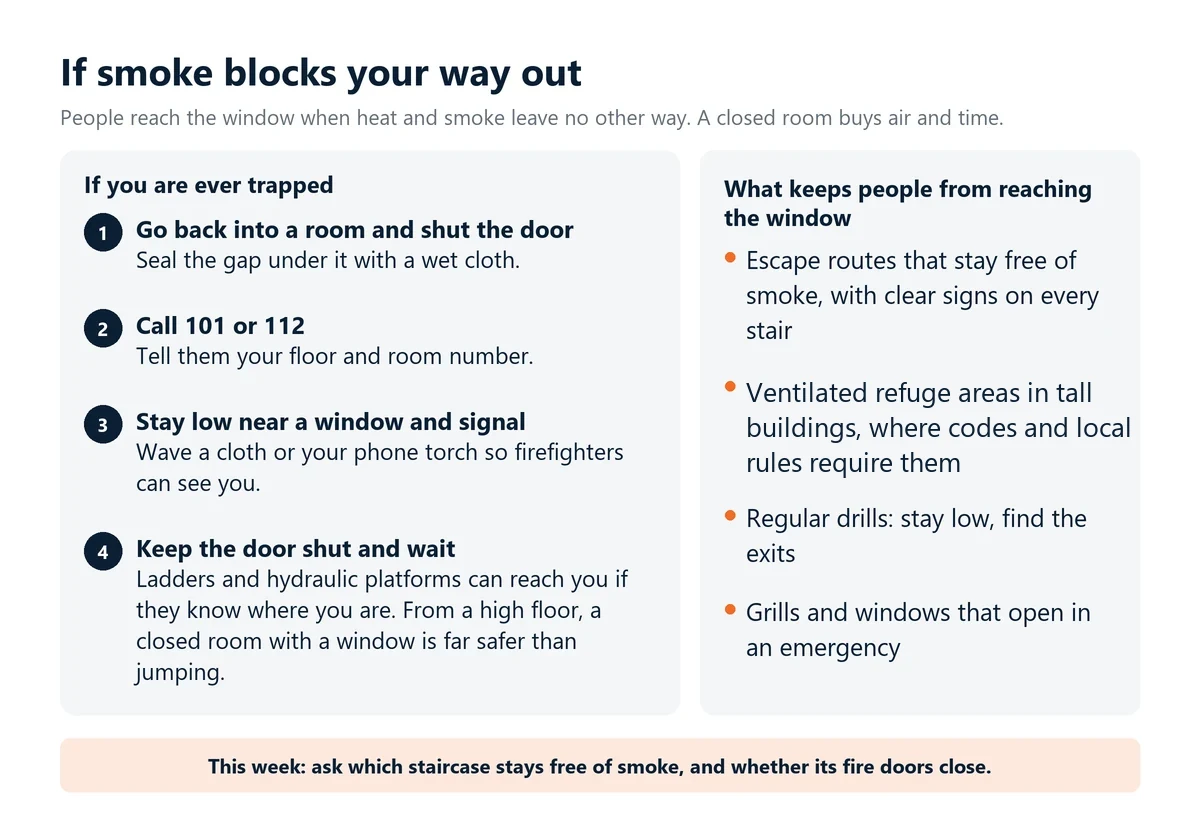
- Escape routes that stay free of smoke, with clear signs on every staircase.
- Ventilated refuge areas in tall buildings, where NBCS 2026, Part F (Annex D) asks for refuge spaces or refuge areas in tall buildings and your state or local rules adopt it. BIS withdrew NBC 2016 on 30 April 2026 and replaced it with SP 7:2026; our guide to fire safety laws in India explains the change.
- Regular drills that teach people to stay low under smoke and find the exits.
- Balcony grills and windows that open in an emergency, not ones sealed shut.
- Fire-awareness drives in the community, so people know what to do and panic less.
If you are ever trapped
- If smoke blocks the stairs, go back into a room and shut the door. Seal the gap under it with a wet cloth.
- Call 101 or 112 and tell them your floor and room number.
- Stay low near a window and wave a cloth or your phone torch so firefighters can see you.
- Keep the door shut and wait. Fire brigade ladders and hydraulic platforms can reach you if they know where you are. From a high floor, a closed room with a window is far safer than jumping.
What fire-safety research says about doors, smoke and staying put
Two bodies of research explain why a closed door and a sealed room are safer than a jump. Both come from the United States, where the tests were done, so treat the exact numbers as an illustration. The principle holds for Indian buildings as well.
A closed door changes the room. In test houses run by UL’s Fire Safety Research Institute, closed-door bedrooms stayed below 100 degrees Fahrenheit on average, while open-door rooms went past 1,000 degrees. Carbon monoxide was about 100 parts per million in the closed-door bedroom and 10,000 parts per million in the open-door one. The institute’s Close Before You Doze page advises closing as many doors as you can, whether you are trapped or leaving safely, because it gives other people more time. It also says not to open windows to clear smoke, since fresh air feeds the fire.
If you cannot get out of a high-rise. The US National Fire Protection Association’s high-rise apartment tip sheet gives this order:
- Stuff wet towels or sheets around the door and vents to keep smoke out.
- Call the fire department and tell them exactly where you are.
- Open a window slightly and wave a bright cloth to show your location. Be ready to close it if the smoke gets worse.
- Expect a wait. The sheet warns that evacuating a high-rise can take a long time, so keep talking to the fire department about the status.
The same sheet tells residents to feel a door before opening it, to close every door behind them as they leave, to avoid lifts unless the fire department says otherwise, and to know every exit stair on their floor in case the nearest one is blocked.
Why thinking gets hard. The US Centers for Disease Control page on carbon monoxide lists headache, dizziness, weakness, upset stomach, vomiting, chest pain and confusion as common signs. It adds that people who are asleep or intoxicated can die before any symptoms. This is why the decision to stay in a sealed room has to be made early, while you can still think clearly.
A short checklist before the next fire
- Count the doors between your flat and each of the two stairs, so you can find them in the dark.
- Keep a torch and two towels near the bedroom you would shelter in.
- Keep your flat number and floor easy to say to the 101 or 112 operator.
- Sleep with your bedroom door closed, and close children’s doors at bedtime.
- Ask your building committee whether the stair doors really close and are never locked or blocked.
Local fire service rules and your building’s design decide the final advice. If your society holds a drill, take part and ask the fire officer how long a rescue would take at your height.
The real lesson
Every jumping death in a fire is a failure of the building and the system, not of the person at the window. If people have time, air and a way out, they will not choose the window. We cannot take away fear, but preparation can stop it from turning deadly.
What you can do this week
- Ask your building committee which staircase stays free of smoke in a fire, and whether its fire doors close properly.
- Push for evacuation drills and working signs on every stair.
- Learn to stay low under smoke and to close doors behind you as you leave. A shut door buys you air and time.
Next time you read that people jumped from a burning building, ask the real question: why was there no second way out? HowToSurvive.in is here to help you ask it before the fire, not after.
References
- BIS, National Building Construction Standards 2026, Part F: Fire and Life Safety
- NCRB, Accidental Deaths and Suicides in India (annual)
- US CDC, Carbon Monoxide Poisoning Basics
- News reports on the 2019 Surat Takshashila fire and the 2022 Mundka fire
What needs attention
- People who jump are usually trapped by heat and smoke with no exit left, not acting on panic
- Carbon monoxide in smoke causes dizziness and confusion, so clear decisions get harder by the minute
- At Takshashila, Surat, the only stair to the top floor was wooden and burnt away; three students died after jumping
- At Mundka, Delhi, smoke filled the whole building and some people jumped from windows
- India has no official count of deaths from jumping or falling during fires
Controls that reduce risk
- Keep at least two clear escape routes from every floor where people work, study or sleep
- Keep staircase fire doors shut and stairwells free of storage
- Fit grills and windows with a section that opens from inside, and keep the key nearby
- Keep refuge areas open in tall buildings, as NBC 2016 Part 4 and local rules require
- Hold evacuation drills that include moving low under smoke
Common unsafe practices
- Calling it panic instead of asking why there was no second way out
- Locking terrace doors or fitting window grills that cannot be opened from inside
- Using stairwells for storage, or leaving one wooden stair as the only route
- Opening a door into a smoke-filled corridor without feeling it for heat first
- Never practising how to stay low and find the exit in smoke
Leave a comment