
Quick answers
What is fire load?
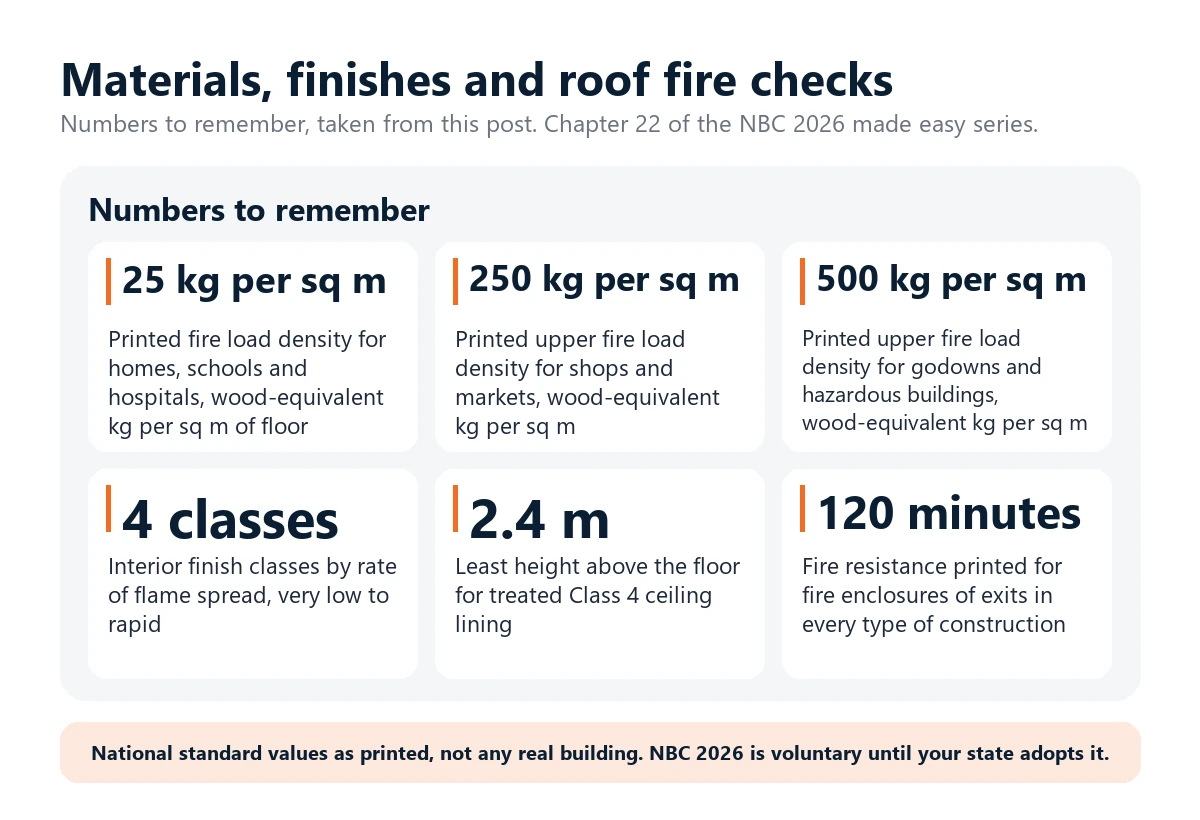
It is the total energy that could be released in a fire in a room, floor or building. Fire load density is that energy per sq m of floor, shown in NBC 2026 as wood-equivalent kg per sq m. The standard is voluntary until your state adopts it.
How much fire load does NBC 2026 print for different buildings?
In wood-equivalent kg per sq m: 25 for homes, schools and hospitals, 25 to 50 for halls and offices, up to 250 for shops, up to 150 for factories and up to 500 for godowns and hazardous buildings. These are planning figures, not measurements of a real building.
What are the interior finish classes in NBC 2026?
Four classes by rate of flame spread: Class 1 very low, Class 2 low, Class 3 medium and Class 4 rapid. Class 1 may be used anywhere. Class 4 is for treated ceiling lining only, at least 2.4 m above the floor, and never in kitchens, corridors or staircases.
Can a false ceiling be made of any material?
No. Clause 3.4.4 says the false ceiling, including all fixtures used to suspend it, needs to be of non-combustible material. Your fire officer decides for your building.
Does the standard say anything about curtains or foam furniture?
Not by name in the pages we checked. It says decor and finishing materials should not generate toxic smoke or fumes, and Annex A lists polyurethane at 2.00 wood equivalent. It does not say which class a curtain or cushion belongs to.
Is NBC 2026 mandatory?
No. It is voluntary until a state or local authority adopts it. Your state's building rules and the fire department decide what applies to your building.
NBC 2026 sorts wall and ceiling finishes into four flame-spread classes, because a fire spreads through what a building is made of and what is kept inside it. This sits in the fire prevention clauses of Part F. A false ceiling and its hangers must be non-combustible. Wall and ceiling finishes are sorted into four classes by how fast flame spreads over them. Floors and roofs carry minimum fire resistance in minutes. The amount of fuel stored is described as fire load, and the printed figures run from 25 wood-equivalent kg per sq m in homes to up to 500 in godowns. The standard is voluntary until your state adopts it. This is an extra chapter in our series on the 2026 national building standards. Checked 15 November 2026.
In short
- Fire load: the total energy that could be released in a fire in a room, floor or building. Fire load density is that energy per sq m of floor.
- Printed fire load figures: 25 for homes, schools and hospitals, 25 to 50 for halls and offices, up to 250 for shops, up to 150 for factories and up to 500 for godowns and hazardous buildings, in wood-equivalent kg per sq m.
- Finishes: four classes, from very low to rapid flame spread. Class 1 may go anywhere. Class 4 is for treated ceiling lining only and never in kitchens, corridors or staircases.
- False ceilings: the ceiling and all its hanger fittings must be non-combustible.
- Roofs and floors: Table 1 gives minutes of fire resistance by type of construction, for example 120, 90, 60 and 60 for a roof not higher than 5 m.
- Plastics store a lot of heat: in the standard’s own table, a kilo of polyurethane holds about as much heat as two kilos of wood.
- It is voluntary for now. Your state rules and your fire officer decide for your building.
Why the building and its contents both matter
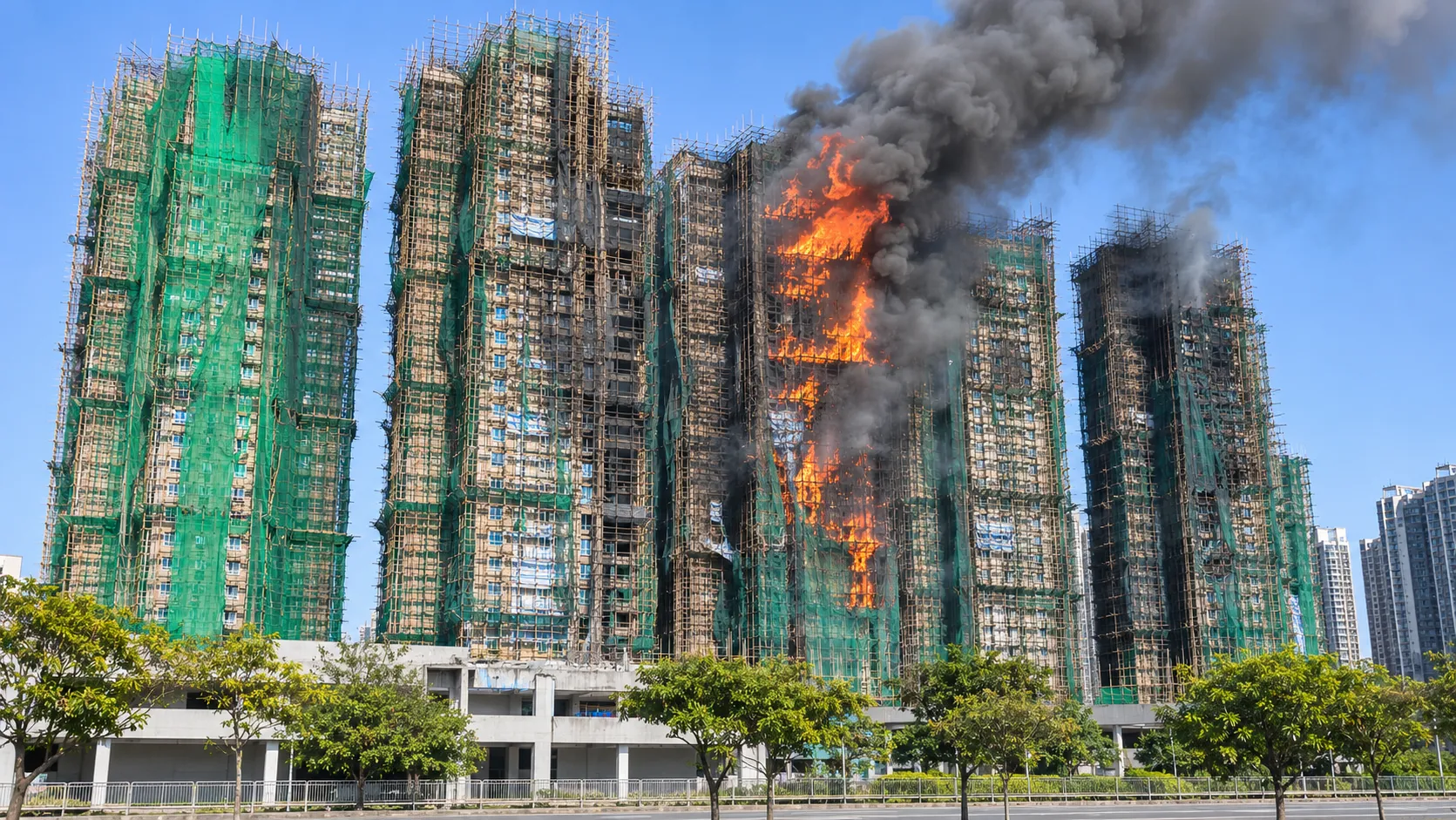
Clause 3.4.1 says that the design of a building and the materials used in it are important factors in making it resist a complete burn-out and in preventing the rapid spread of fire, smoke and fumes. It also says that non-combustible materials should be used for construction. In everyday terms, a fire does not care whether a thing is a wall, a curtain or a carton. If it burns, it feeds the fire. That is why this part of the standard looks at the shell of the building, at what lines its walls and ceilings and at how much is stored inside.
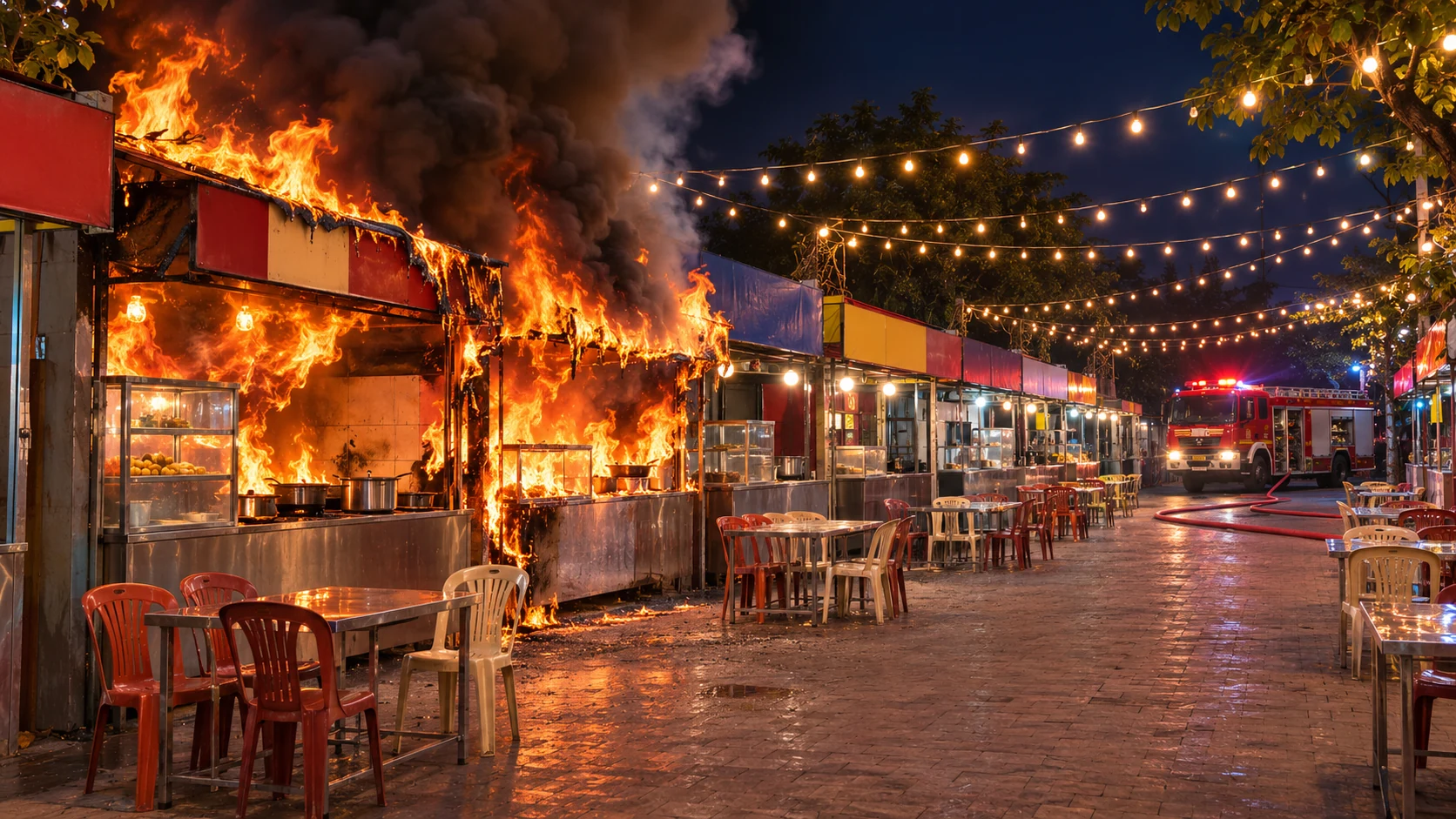
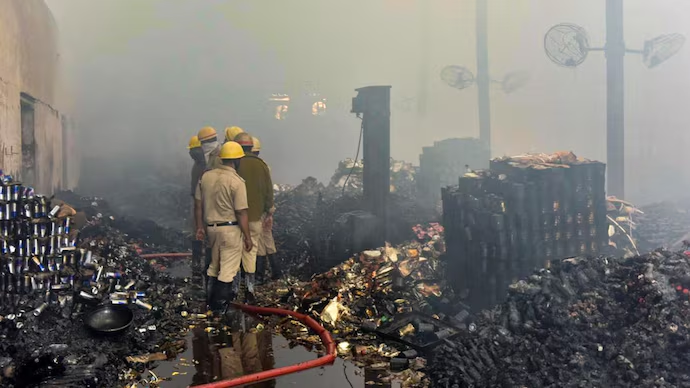
For real fires in shops and godowns, read warehouse fire safety in India, warehouse and distribution centre fire risks and our guide on why small electrical faults cause big fires in Indian homes and shops, which is in the related cards below. A small spark usually becomes a big fire because there is plenty to burn close by.
Fire load in plain words
Clause 2.25 defines fire load as the total amount of energy that could be released during a fire in a given compartment, floor or building, usually in mega joules. Clause 2.26 defines fire load density as that figure divided by the floor area. The standard also states it in a more friendly way, as wood equivalent: how many kilograms of wood would give the same heat, for each sq m of floor. Think of it as a count of how much firewood is lying in your room.
| Building use | Fire load density printed in the standard (wood-equivalent kg per sq m) |
|---|---|
| Homes and apartments | 25 |
| Institutional buildings such as hospitals, and educational buildings such as schools | 25 |
| Assembly buildings (halls, cinemas) | 25 to 50 |
| Offices and other business buildings | 25 to 50 |
| Shops and markets | Up to 250 |
| Factories | Up to 150 |
| Godowns and hazardous buildings | Up to 500 |
Scope: the table at clause 2.26 as printed, read from the page image on 15 November 2026, with building uses written out in words by us. Every figure is in wood-equivalent kg per sq m of floor, and the words “up to” are the standard’s. These are planning figures for each use, not measurements of any real building. The table’s own letters for hospitals and schools do not match the letters in clause 3.1.1, so we use words and not letters.
Look at the spread. A home is printed at 25 and a godown at up to 500, which is twenty times as much fuel on the same floor area. Shops are printed at up to 250. That is why a shop or godown that fills up with stock behaves very differently from the same floor used as a living room. We give no fire load figure from clause 3.4.1. That clause states fire load in kcal per sq m, a different unit from the mega joules and wood-equivalent kg of clauses 2.25 and 2.26, and we have not tried to convert between them.
Calorific values: how much heat common materials hold
Annex A, Table 12, lists the calorific value of common materials “for guidance”. The first column is in thousand kJ per kg. The second is the wood equivalent: the kilograms of wood that hold the same heat as one kilogram of the material. Wood is the yardstick, at 17.6 and 1.00. These are a few rows we checked on the page images, not the whole table.
| Material | Heat content (thousand kJ per kg) | Wood equivalent (kg of wood per kg) |
|---|---|---|
| Wood, hard or soft | 17.6 | 1.00 |
| Paper, average | 15.4 | 0.88 |
| Cotton, dry | 15.8 | 0.90 |
| Leather | 17.6 | 1.00 |
| Nylon and polyester | 22.0 | 1.25 |
| Polyvinyl chloride (PVC) | 20.9 | 1.19 |
| Polyurethane (foam is made from it) | 35.2 | 2.00 |
| Rubber | 37.4 | 2.13 |
| Polystyrene | 41.8 | 2.38 |
| Polyethylene | 48.4 | 2.75 |
Paper, cotton and leather sit close to wood. Plastics do not. Polyurethane is printed at 2.00, polystyrene at 2.38 and polyethylene at 2.75. In plain words, a kilo of polyurethane, which is what foam mattresses and cushions are made from, holds about as much heat as two kilos of wood. A cushion is light, so it does not weigh much, but a showroom full of foam holds a lot of fuel. The table is about heat content only. It does not say how fast a material catches fire or how much smoke it gives. That is our general reading and not a statement in the standard. Curtains are not listed as such. The fabrics they are made from are: dry cotton at 15.8, nylon and polyester at 22.0.
Interior finishes: four classes of flame spread
Clause 3.5.10.1 explains the worry. Combustible finishes on walls, on the building facade and on ceilings tend to spread a fire, and even if the structure is fire resistant, serious danger to life may result. It also says that the finishing materials used for various surfaces and decor should not generate toxic smoke or fumes. Clause 3.5.10.2 then divides surfacing material into four classes by the rate of spread of flame: Class 1 very low, Class 2 low, Class 3 medium and Class 4 rapid.
| Surface class | Flame spread | Where the standard allows it |
|---|---|---|
| Class 1 | Very low | Any situation |
| Class 2 | Low | Any situation except walls, the building facade, staircases and corridors |
| Class 3 | Medium | Only in living rooms and bedrooms (not in rooms on the roof), and only as a lining to solid walls and partitions; not on staircases, corridors or the facade |
| Class 4 | Rapid | Treated ceiling lining only, at least 2.4 m above the floor; never in kitchens, corridors or staircases |
Scope: clauses 3.5.10.2 to 3.5.10.4 as printed, with the use table at 3.5.10.3 read from the page image on 15 November 2026. The standard adds that panelling or lining may be allowed only in a limited area, and not in a vestibule. The page does not say which test puts a material in a class. It points to a good-practice standard for that. So the practical question to ask a supplier is: which class is this panel, and which test report says so.
Three more points from the same clause. Class 4 materials include untreated wood fibreboard, which may be used as ceiling lining only with fire-retardant treatment. Some materials contain bitumen, and the standard says those give off dense smoke when burning and should be excluded. Class 4 material is not to be used for ceilings where the space above is used for return air in air-conditioned buildings. Where frames, walls, partitions or floors are lined with combustible material, the surfaces on both sides must meet the class, because a fire can start and spread inside a hidden cavity without the people inside knowing. Aluminium composite panels on a building facade are to be avoided, and if used need at least 70 percent mineral core and must pass the tests named in the standard.
False ceilings
Clause 3.4.4 is short and firm. The false ceiling, including all the fixtures used to hang it, must be of non-combustible material, so that the ceiling resists fire and does not carry it across the floor. That covers the board or tile and also the hangers and fittings. A ceiling that is neat to look at but hides a combustible lining, or hangs on combustible fittings, is the case this clause is written for.
A false ceiling also hides things. Wiring, ducts and pipes run above it, and a fire there can grow unseen, which is the same worry as the hidden cavity in clause 3.5.10.5. Our chapter on sprinklers covers the rule for sprinklers in a false ceiling void. For the cables above, see our guide on small electrical faults in the related cards below and our maintenance guide for building owners.
Roofs, floors and the shell of the building
Table 1 in clause 3.5.1 gives the fire resistance, in minutes, that each part of a building should have, by type of construction. Type 1 is the highest column and Type 4 the lowest. The ratings are about how long the roof or floor should keep doing its job in a fire, not about how the roof sheet itself burns. These are a few rows we read from the page image.
| Element in Table 1 (minutes) | Type 1 | Type 2 | Type 3 | Type 4 |
|---|---|---|---|---|
| Floor construction | 120 | 90 | 60 | 60 |
| Roof, 5 m or less in height to its lowest member | 120 | 90 | 60 | 60 |
| Roof, more than 5 m but less than 6.7 m | 60 | 60 | 60 | 60 |
| Fire enclosures of exits | 120 | 120 | 120 | 120 |
Scope: Table 1 as printed, in minutes, for the four types of construction. The row for a roof of 6.7 m or more in height to its lowest member shows two stacked values in each cell, a 0 and a 60 with an asterisk, and we could not read it with confidence, so we leave it out. Clause 3.4.2 adds that when no tested or certified rating exists for a part, guidance can be taken from Annex C.
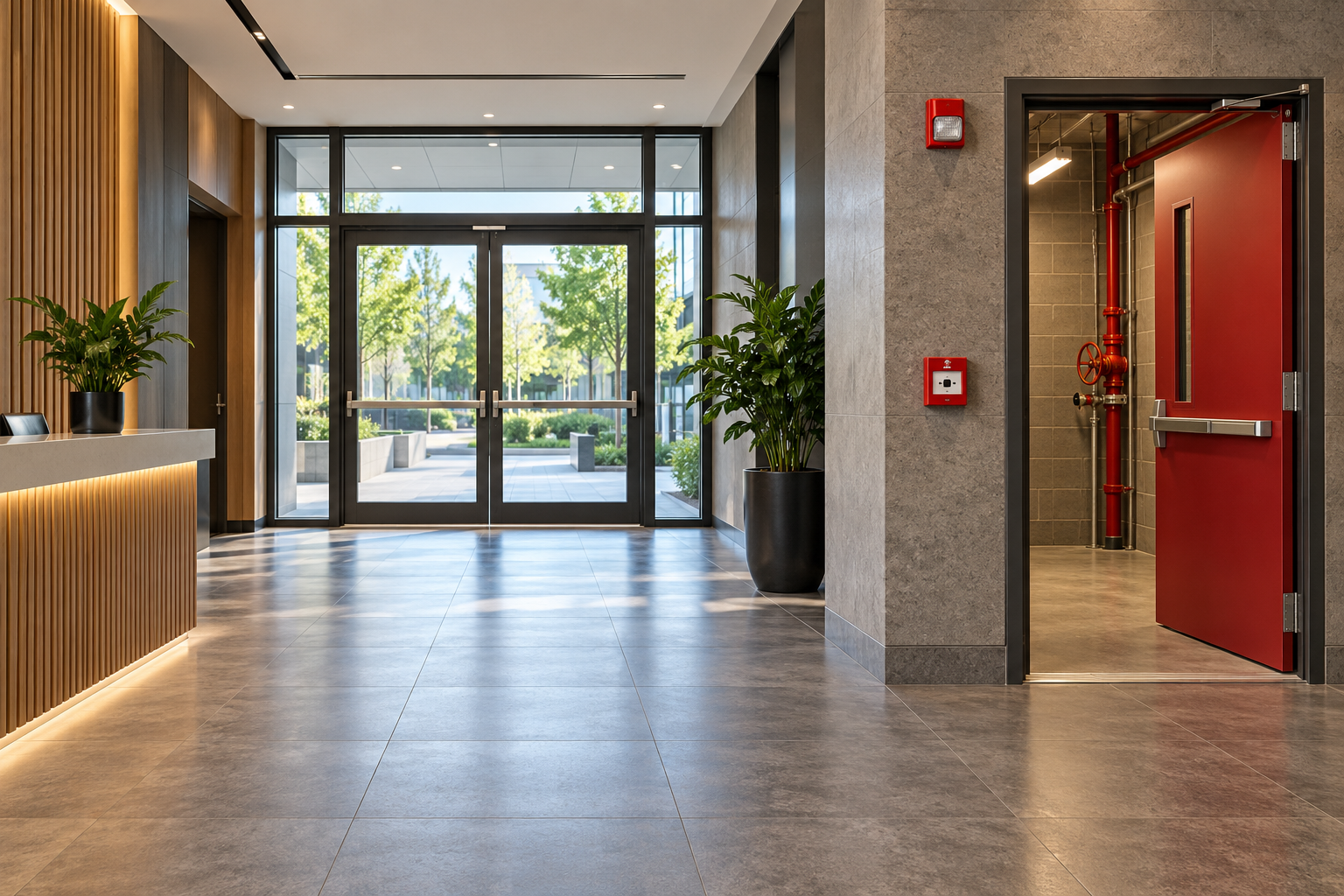
Fire enclosures of exits are printed at 120 minutes in every column. Clause 3.4.1 asks for the inner walls of staircase enclosures to be brick or reinforced concrete, or another material, rated at least 120 minutes. In plain words, the stairs are built to survive a long fire so that people can use them. Stock, cartons and décor kept on the stairs or in the lobby put the fire in the one place that was built to stay clear. Read fire door ratings in India for the doors on these routes.
What the standard says about foam, curtains and decor
In the pages we checked, the standard does not give a rule that names foam furniture or curtains. What it does say is this. Finishing materials and decor should not generate toxic smoke or fumes (clause 3.5.10.1). Surfaces are graded by flame spread, and the use table speaks of walls, facades, ceilings, staircases and corridors (clause 3.5.10.3). Polyurethane and common fabrics have the heat contents shown above. It does not say which class a curtain or a cushion belongs to, so we do not either. Treat that as an open question to put to the supplier or the fire officer.
Worked examples
These are simple illustrations of how to read the printed figures, not the legal answer for any real building. A real building is decided by its approved plan, the version of the rules your state uses and your fire officer.
A shop floor. A shop of 120 sq m. At the top printed figure of 250 wood-equivalent kg per sq m, the planning fire load is 250 x 120 = 30,000 kg of wood equivalent. The same floor as a home, at 25, is 3,000 kg. The numbers are only a way to see that a stocked shop holds ten times the fuel of a lived-in room of the same size.
A foam stock room. A room holds 100 kg of polyurethane foam, such as bed cushions. Using the wood equivalent of 2.00 from Table 12, that is the heat of about 200 kg of wood. The pile feels light to carry but not light in a fire.
A new ceiling. A showroom owner wants a cheaper ceiling lining made of untreated wood fibreboard. The standard puts untreated wood fibreboard in Class 4, which may be used as a ceiling lining only with fire-retardant treatment, at least 2.4 m above the floor, and never in a kitchen, corridor or staircase. The owner should ask for the treatment certificate before fitting it. The hangers must be non-combustible in any case.
What this means for residents and owners
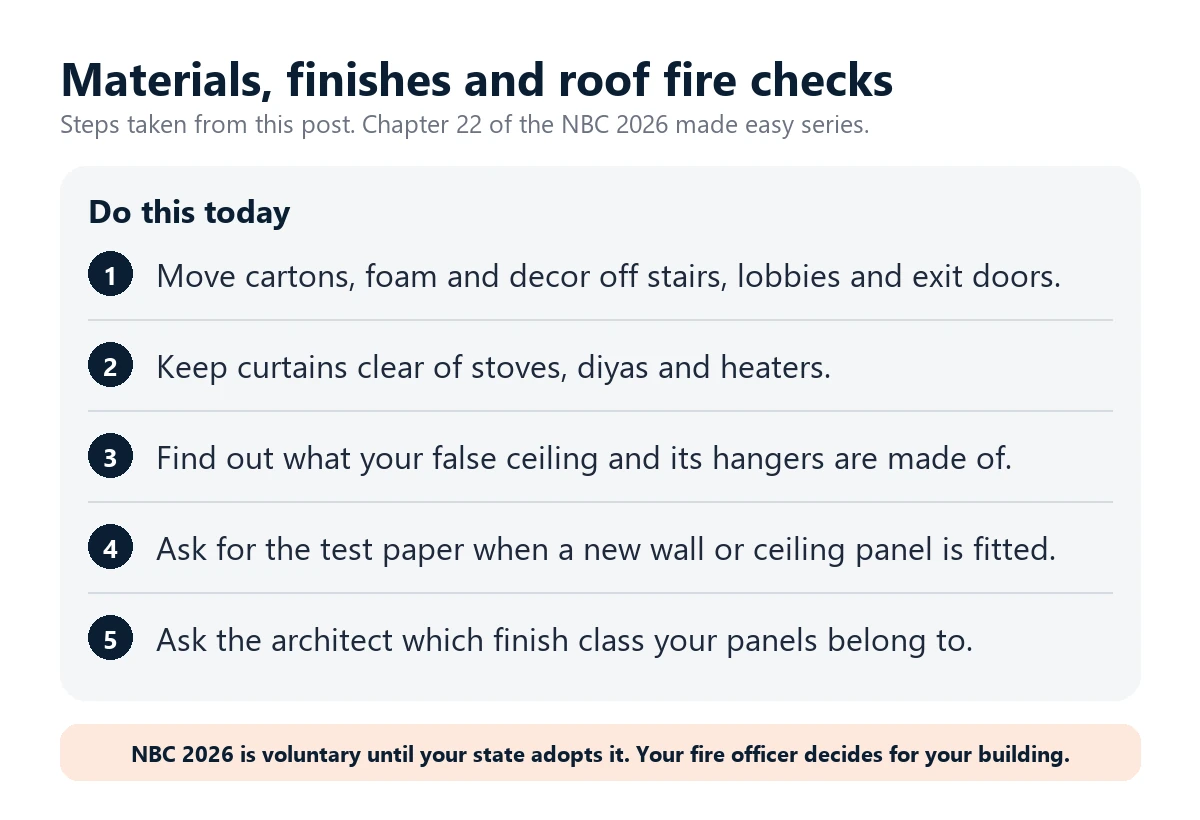
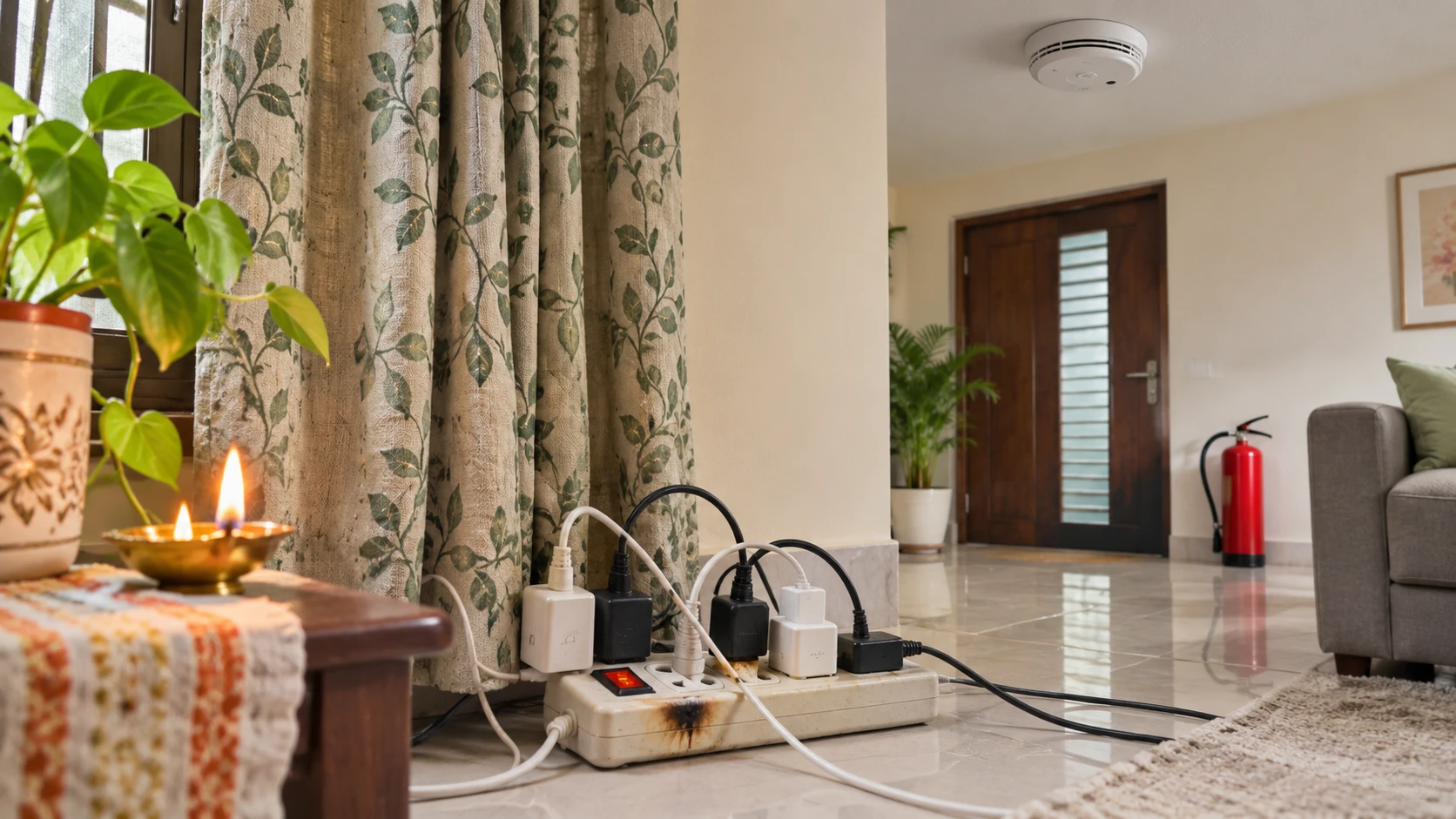
- Home and flat owners: keep curtains clear of the stove, the diya and the heater, and do not store cartons and old foam on the landing or stairs. See our home fire safety checklist and festival-season home fire safety.
- Shop and showroom owners: ask what your false ceiling and its hangers are made of, and what class of panel is on your walls. Ask for the test paper when a new lining is fitted.
- Godown owners: remember that godowns are printed with the highest fire load. Keep stacks tidy, keep aisles open and keep plastics and foam away from doors and stairs. See warehouse fire safety in India.
- Everyone: do not keep flammable stock, packing or décor on stairs, in lobbies or near the exit door. Fit and test a detector, as in how to use smoke detectors at home.
Ask your fire officer
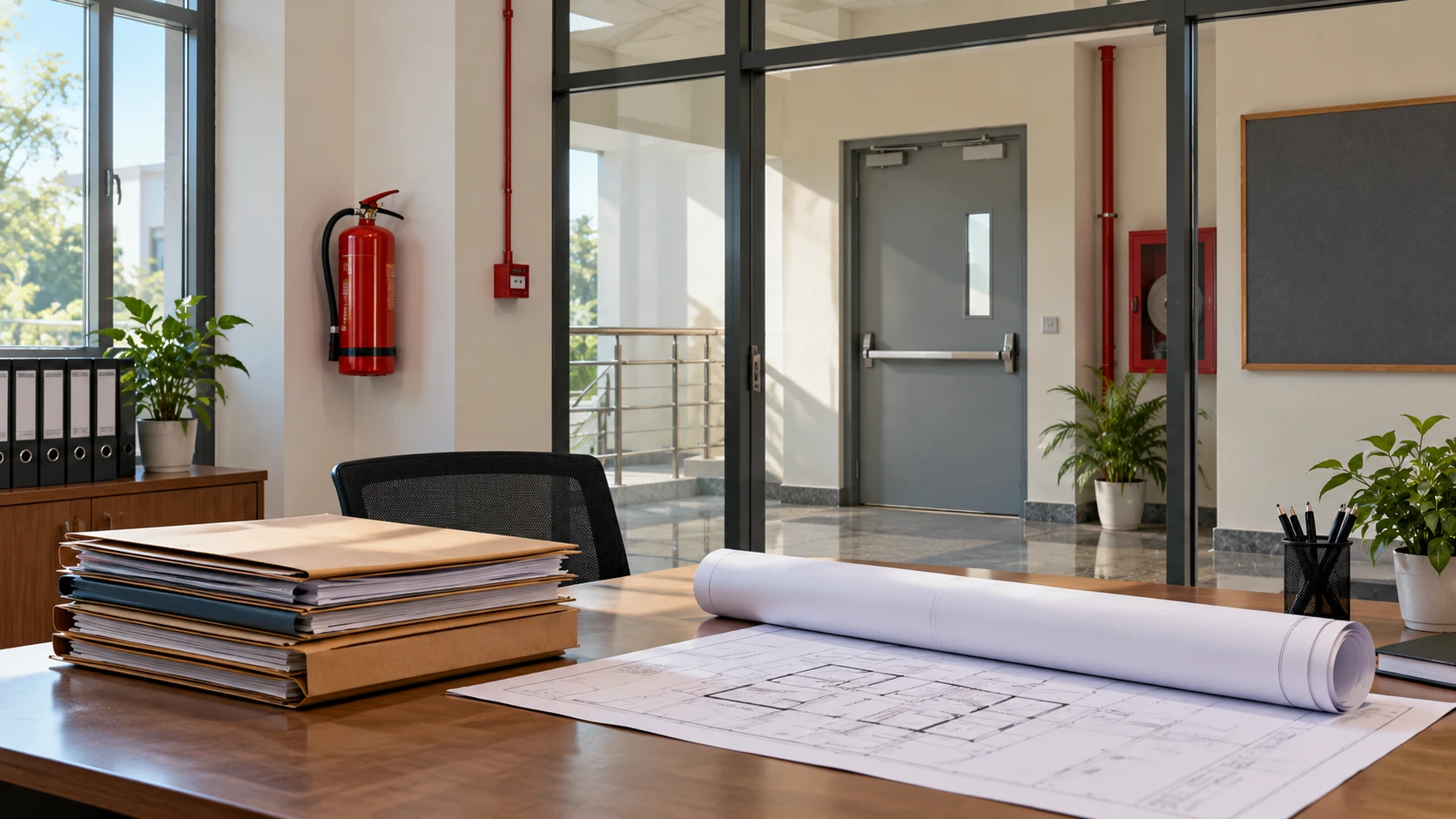
You can ask your local fire officer or the building’s architect these questions. They are fair questions for a society, shop, hotel or school to put.
- Is our false ceiling, including its hangers, made of non-combustible material, and where is that written?
- Which class of flame spread do the wall and ceiling finishes belong to, and do we have the test reports?
- Is the building’s construction rated for the roof and floor minutes that apply to it?
- Has any lining, panel or decor been added since the plan was approved?
- Which version of the standard or which state rule applied when this was approved?
Where this stands in law
The National Building Construction Standards 2026, Part F, is voluntary. It binds a building only once a state or local authority adopts it, through its byelaws or its Fire Act. Until then your state’s building rules and the fire department decide what applies. Older buildings may have been approved under earlier rules. Our guide to fire safety laws in India explains the layers. This guide is general safety information. It is not legal or engineering advice, and it does not tell you whether a particular building complies.
What we could not confirm
- Some clause text of Part F did not extract reliably from the file. The numbers here are only those we checked on the page images.
- The roof row for 6.7 m or more in Table 1, which is printed with two stacked values. We left it out.
- Fire load in kcal per sq m in clause 3.4.1. The unit differs from the rest of the standard, so we give no figure from it.
- Any storage or housekeeping rule from clause 3. We did not verify one, so we do not state one.
- Which test puts a material in a flame spread class, and which class curtains, foam or a given panel belongs to.
- How a state that has adopted the standard may have changed these rules. We read the national standard only.
- Any real building’s position. That needs its approved drawings.
- The listed videos. They were checked for public status and embedding and loaded in the YouTube player on a local test page, but were not watched in full.
Do this today
Walk through your shop, godown or home with three questions. What is hanging near a flame or a heater, what is stored on or near the stairs, and what is our ceiling made of? Move what should not be there. Ask the person who fitted your ceiling and panels for the material details. Then read our maintenance guide for building owners. The other chapters in this series cover more topics in the same plain way.
What needs attention
- Fire load is the energy that could be released in a fire; fire load density is that per sq m of floor.
- Printed fire load figures run from 25 for homes, schools and hospitals to up to 500 for godowns and hazardous buildings, in wood-equivalent kg per sq m.
- Interior finishes are sorted into four classes by flame spread; Class 4 is for treated ceiling lining only.
- A false ceiling and its hangers must be non-combustible.
- Table 1 sets roof and floor fire resistance in minutes by type of construction; fire enclosures of exits are 120 minutes in every column.
- In Annex A, polyurethane holds about as much heat per kg as two kg of wood.
- The standard is voluntary until a state adopts it.
Controls that reduce risk
- Ask what the false ceiling and its hangers are made of.
- Ask the supplier which flame spread class a new panel belongs to and for the test paper.
- Keep stairs, lobbies and exit doors free of stock and decor.
- Keep curtains clear of flames and heaters.
- Keep stacks tidy and keep plastics and foam away from exits.
- Ask your fire officer about your state's rules.
Common unsafe practices
- Fitting a cheap ceiling or panel without asking what it is made of.
- Assuming a hidden lining behind a wall or ceiling does not matter.
- Storing cartons, foam or decor on stairs and in lobbies.
- Hanging curtains close to a stove, diya or heater.
- Treating a light pile of foam or plastic as little fuel.
- Adding lining or decor after approval and never asking again.
- Treating this guide as proof that a building complies.







Leave a comment