
Quick answers
When does NBC 2026 ask for sprinklers?
It depends on building use, height and floor area, in Tables 7A to 7J of Part F. In the printed rows, offices start at 500 sq m, hospitals up to 45 m at 501 sq m, and hotels, schools, halls, shops and storage at 1,001 sq m. The standard is voluntary until your state adopts it.
Do apartment buildings need sprinklers under NBC 2026?
Table 7A asks for them above 60 m. Every apartment row up to 60 m says not required, even at 1,001 sq m and above. Those rows still ask for extinguishers and hose reels. Your state rules and fire officer decide for your building.
Are sprinklers needed in a school?
Table 7B asks for them from 1,001 sq m on a floor, and for buildings 45 m to 60 m high. A school of 24 m to 45 m, or under 24 m with 501 to 1,000 sq m, is not asked for them in the printed rows.
Do godowns need sprinklers?
Table 7H asks for them from 1,001 sq m, and at any size where there is rack storage. Storage up to 1,000 sq m with plain floor stacking is not asked for them. Some goods, such as plastic packing in racks, are sent to other standards.
What stops sprinklers working?
A closed valve, a painted or blocked head, stock stacked too close, coverage of only part of the building and no maintenance. The standard says heads are never to be painted and warns against sprinklering only part of a building.
Is NBC 2026 mandatory?
No. It is voluntary until a state or local authority adopts it. Your state's building rules and the fire department decide what applies to your building.
NBC 2026 does not set one sprinkler rule for all buildings. It ties automatic sprinklers to the building use, its height and the area of a floor, in Tables 7A to 7J of Part F. In the printed rows, hotels, schools, assembly halls, shops and godowns are first asked for sprinklers at 1,001 sq m on a floor, offices at 500 sq m and apartments only above 60 m. Factories and hazardous buildings follow rows of their own. The standard is voluntary until your state adopts it. This is the tenth chapter in our series on the 2026 national building standards. Checked 15 November 2026.
In short
- What a sprinkler does: a head on a ceiling pipe opens near the fire and sprays water on the spot below. Water starts early, before people or the fire brigade can act.
- How the standard decides: one table per building use, 7A to 7J. Each row has a height or floor area band, and a column that says required or not required for sprinklers.
- The first triggers: 500 sq m for offices, 501 sq m for hospitals up to 45 m, 1,001 sq m for hotels, schools, halls, shops and godowns, above 3,001 sq m for moderate-hazard factories, any size for high-hazard factories and hazardous buildings.
- Sprinklers are one of eight installation columns. Rows with no sprinklers still ask for other protection, such as extinguishers and hose reels.
- They only work if kept working. A shut valve, a painted head or goods stacked up to the ceiling can defeat them.
- It is voluntary for now. Your state rules and your fire officer decide for your building.

What an automatic sprinkler does
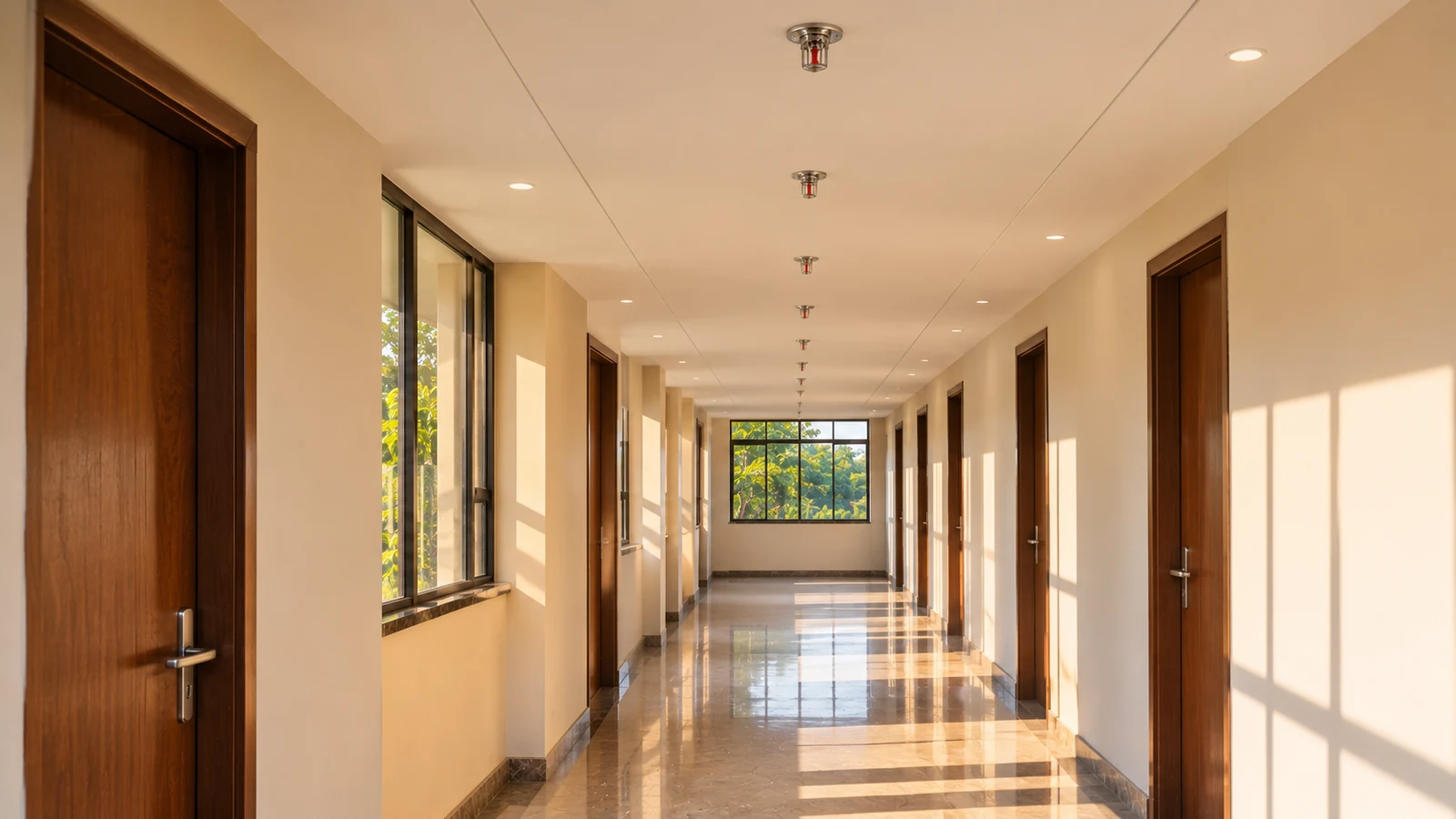
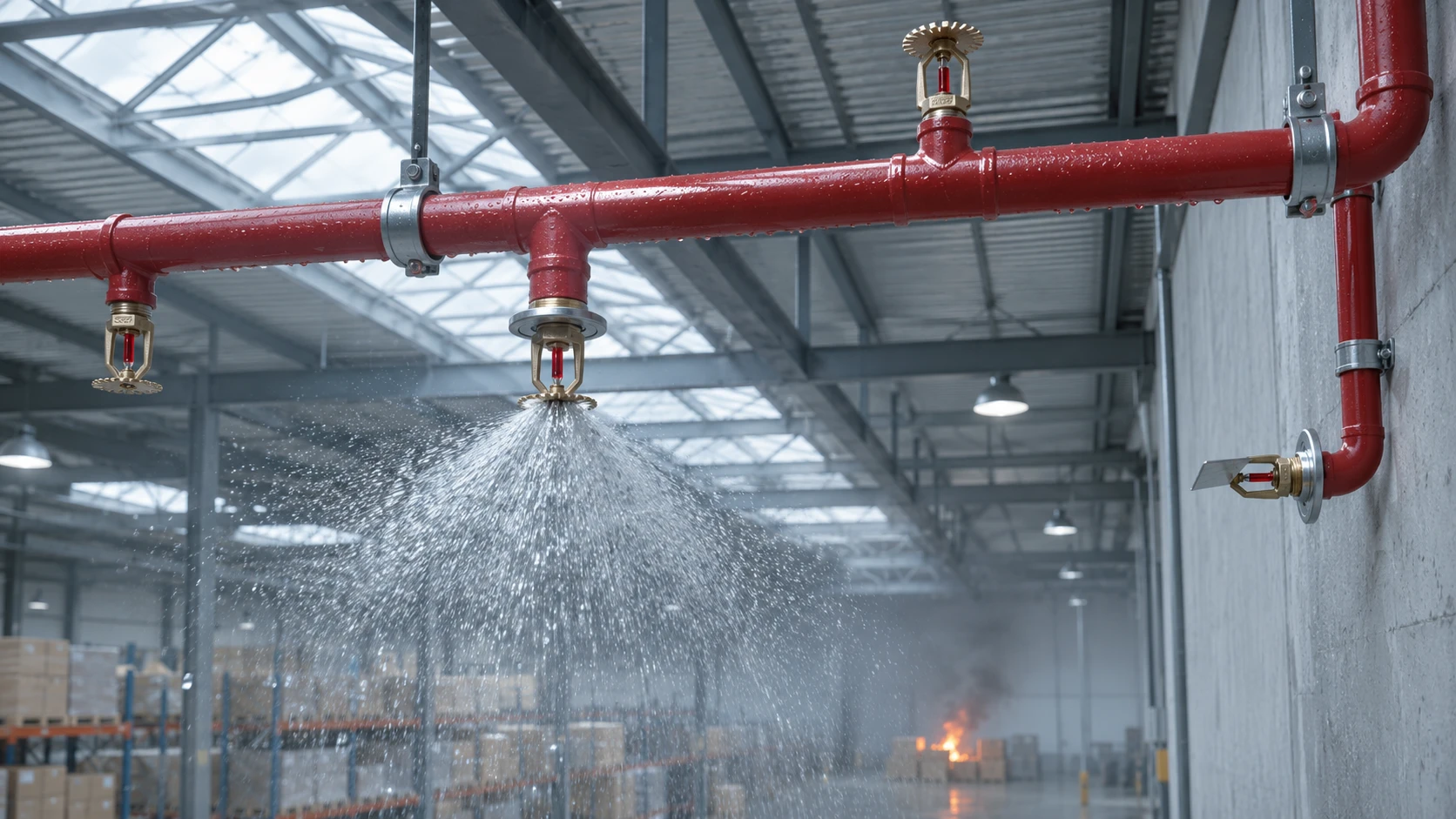
In plain words, a sprinkler is a head fixed to a water pipe in the ceiling. When the air around one head gets hot enough, that head opens and sprays water below it. Heads away from the fire stay shut. This is general background and not the wording of the standard. Our guides explain the detail: how fire sprinklers work and why they sometimes fail and the four types of sprinkler heads. The myth that sprinklers make a fire worse is answered in our myth versus fact post, in the related cards below.
A sprinkler is not a fire alarm and it is not a hydrant. It works by itself, with no one pressing a button. That is why the standard treats it as a main layer of protection for larger buildings, next to detection, hose reels and the fire brigade. For how it differs from gas and foam systems, see sprinkler versus fire suppression systems.
How NBC 2026 decides: Tables 7A to 7J
Part F of the standard has a table for each building use: residential, educational, institutional, assembly, business, mercantile, industrial, storage and hazardous. Each table lists rows by height or by floor area. Every row carries a protection level label, such as HL-3 or CL-4. We have not decoded those labels here, so we do not use them to explain anything. Next to each row there are eight columns: extinguishers, hose reels, down comer, wet riser, yard hydrant, sprinklers, detection and alarm, and public address. Each one says required or not required.
Small buildings sit above all this. A building up to 500 sq m and under a stated height may rely on self-certification by a certified and State approved building professional. The height is 24 m for homes, schools and hospitals, 9 m for assembly buildings and 15 m for offices and shops. Clause 5.1.3(a) then says sprinklers are installed throughout the building wherever the tables ask for them.
Where the first sprinkler row starts
| Building use | Sprinklers first asked for | Lower rows with no sprinklers |
|---|---|---|
| Apartment houses | Above 60 m | Every row up to 60 m, whatever the floor area |
| Hotels | 1,001 sq m on a floor, or 24 m to 60 m high, or any 3 or 4 star hotel | Up to 24 m with 501 to 1,000 sq m |
| Five star hotels | Every printed row, up to 60 m | None printed |
| Educational | 1,001 sq m on a floor, or 45 m to 60 m high | 24 m to 45 m, or under 24 m with 501 to 1,000 sq m |
| Hospitals, up to 45 m | 501 sq m on a floor and above; also 45 m to 60 m | Up to 500 sq m is the self-certification band |
| Nursing homes; custodial and mental institutions | Not asked for in any printed row | All printed rows |
| Assembly (halls, cinemas) | 1,001 sq m on a floor, or above 15 m | 9 m to 15 m, or under 9 m with 501 to 1,000 sq m |
| Business (offices) | 500 sq m and above, or 15 m and above | None above the self-certification band |
| Mercantile (shops, malls) | 1,001 sq m on a floor | 15 m to 30 m, or under 15 m with 501 to 1,000 sq m |
| Industrial, low hazard | Not by area | All printed rows |
| Industrial, moderate hazard | Above 3,001 sq m | Up to 3,000 sq m |
| Industrial, high hazard | Every row, from the smallest (up to 250 sq m) | None |
| Storage | 1,001 sq m, or any rack storage | Up to 1,000 sq m |
| Hazardous | Every printed row | None printed |
Scope: NBC 2026 Tables 7A to 7J as printed, read from page images on 15 November 2026, summarised by us and not copied in full. Floor areas are the area on one floor. Hotels above 60 m, and other very tall rows, point to separate notes that we have not read, so they are left out. Read the table itself, with its notes, for your building.

What the table does not ask for
Look at the lower rows. Apartment houses are not asked for sprinklers in any row up to 60 m, even at 1,001 sq m and above. A school between 24 m and 45 m, or a school under 24 m with 501 to 1,000 sq m on a floor, is not asked for them either. The same goes for a hall or a shop of 501 to 1,000 sq m. Nursing homes, and custodial and mental institutions, carry no sprinkler requirement in any printed row. Low-hazard factories carry none by area, and storage up to 1,000 sq m carries none unless it has rack storage.
That does not mean those buildings have no fire protection. Every row we read still asks for extinguishers and hose reels, and most ask for detection and alarm. A not-required sprinkler box is a statement about that building band in that table, not a statement that the building is safe. A fire officer or an insurer may still ask for sprinklers on other grounds.
The notes under the tables matter too. The notes under the assembly table, for instance, ask for sprinkler protection in live-cooking kitchens, boiler and furnace rooms, laundry rooms and transformer rooms inside the building, even where the main row does not. The note on industrial buildings asks for areas with combustible storage, fuel storage, boilers or furnaces to be protected to a higher level, labelled CL-6 in the table. The storage table applies to stacks no higher than 3.7 m on the ground. Rack storage with plastic or combustible packing, lithium battery storage and similar goods are sent to other Indian Standards and a water calculation.
Where the sprinklers go: clause 5.1.3
Besides the tables, clause 5.1.3 sets out how a system is installed. We read these points from the printed page.
- Cover everything, not a part (a, b): sprinklers go throughout the building. The standard warns that sprinklering only some areas is risky, because a fire can build up in an unprotected area and then reach the protected one as a large fire.
- False ceilings (c): sprinklers are also fitted in a false ceiling void deeper than 800 mm.
- Substation and DG set areas (d): sprinklers may be left out.
- Very high spaces (e): in areas 17 m high or more, such as atria, sprinklers can be ineffective and may be avoided.
- Pressure (f): the system pressure should not go above 12 bar. Beyond that, high-pressure sprinklers are needed.
- Floor area per riser (g): one riser and its control valve may serve up to 4,500 sq m on a floor for most uses. For industrial and hazardous buildings the authority advises, based on the type of risk.
- Monitoring (k): the flow switches are watched by the fire alarm panel.
- Keep water away from lifts and electrical rooms (m), and sprinkle ramps at every level (n).
- Not for everything (p): water sprinklers do not suit some buildings, for example areas that make electronic equipment. Another kind of protection is used there.
- Looks and heads (q, r): the pipes may be coloured to match interiors but need a red band about 100 mm wide every 3 m. The heads are never to be painted. A pendent sprinkler with no false ceiling needs a plate about 250 mm across around it.
Pump and tank sizes are not covered in this chapter. Our chapter on water and first-aid fire fighting covers them.
What stops sprinklers working
The standard gives the rules. It cannot keep a system working on the day of a fire. These are the common failures. Some come from the clauses above and some from practice.
- A closed valve. A control valve shut after repair or testing and never reopened can leave the whole pipe without water.
- Blocked heads. A new partition, a hoarding, a banner or a false ceiling added later can sit between the head and the floor, so the spray never reaches the fire.
- Goods stored too close. Stock stacked right up to the ceiling can shield the fire from the spray. Our guides on warehouse fire safety in India and warehouse and distribution centre fire risks cover safe stacking.
- Painted or coated heads. The standard says heads are never to be painted. Whitewash or paint from a renovation can stop one opening.
- Partial coverage. A system that covers only some floors, as clause 5.1.3(b) warns, leaves the fire a place to grow.
- No maintenance. A system that is never tested, never flushed and never inspected cannot be counted on. Read fire safety maintenance for building owners and backflow preventer testing.
Worked examples
These are simple illustrations of how to read the national tables, not the legal answer for any real building. A real building is decided by its approved plan, the version of the rules your state uses and your fire officer.
A mid-size hotel. A hotel is 18 m high, with 900 sq m on each floor, and it is not a 3, 4 or 5 star hotel. That is the row for up to 24 m with 501 to 1,000 sq m, and sprinklers are not required. Make the same building a 3 star hotel and the 24 m to 60 m or 3 and 4 star row applies, which asks for sprinklers whatever the size. Keep it a budget hotel but add a wing so a floor is 1,100 sq m, and the 1,001 sq m row applies, which also asks for them.
A school block. A school block of 12 m has 1,200 sq m on each floor. The row for 1,001 sq m and above asks for sprinklers. If each floor is 800 sq m, the 501 to 1,000 sq m row does not. Many schools grow floor by floor over years, so a block can cross the line without anyone checking again. That is a good question for the school head to ask.
A godown. A godown has one floor of 1,500 sq m. The storage row for 1,001 to 2,000 sq m asks for sprinklers. If the same godown is 900 sq m and has plain floor stacking, no sprinklers are asked for. Put racks inside it and the row for any height with rack storage applies, which asks for sprinklers at any size. If the racks hold plastic or combustible packing, the notes send you to other standards and a water calculation.
A small office floor. An office is 10 m high with 600 sq m on a floor. Offices have the lowest area trigger in the tables: the row from 500 sq m asks for sprinklers. A 400 sq m office of the same height sits in the self-certification band.
What this means for residents and owners
- Residents: look at the ceilings in the lobby and corridors. If there are small heads, they should be clean, unpainted and clear. If you see a closed valve with a tag in the stair or pump room, tell the manager.
- Hotel and office owners: ask your architect which row of the table your building falls in and when it was last checked. If a floor has grown, check it again.
- School heads: count the area of your largest floor. See the school fire safety plan and our chapter on schools, colleges and hospitals.
- Godown and shop owners: keep stock well below the heads and keep aisles clear. Do not add racks without asking whether the rules change.
- Everyone: read high-rise fire safety for residents and office workers and what to do in a fire in a hotel, hostel, PG or guest house. Our chapter on homes, apartments and hotels covers the rules for them.
Ask your fire officer
You can ask your local fire officer or the building’s architect these questions. They are fair questions to put to a society, school, hotel or owner.
- Which row of the national tables, or of our state’s rules, covers this building, and where is that written?
- Is the building sprinklered throughout, or only in part?
- When were the control valves, the pump and the heads last checked, and by whom?
- Are there heads painted, covered or blocked by stock, partitions or a later ceiling?
- Which version of the standard or which state rule applied when this was approved?
Where this stands in law
The National Building Construction Standards 2026, Part F, is voluntary. It binds a building only once a state or local authority adopts it, and until then your state’s building rules and the fire department decide what applies. Older buildings may have been approved under earlier rules. Our guide to fire safety laws in India explains the layers. This guide is general safety information. It is not legal or engineering advice, and it does not tell you whether a particular building complies.
What we could not confirm
- What the protection level labels (HL and CL) mean in full. We did not decode them.
- The rows for the tallest buildings that point to separate notes. We did not read those notes.
- How a state that has adopted the standard may have changed these rows. We read the national standard only.
- The effect of the other notes under each table. We read only the notes quoted above.
- Any real building’s row. That needs its approved drawings.
- The listed videos. They were checked for public status and embedding but not watched in full.
Do this today
Look up at the ceiling in your lobby, corridor or godown. Note whether the heads are clean, unpainted and clear of stock. Ask the manager when the system was last tested, and read our maintenance guide for building owners together. The chapter on water and first-aid fire fighting in this series covers the water side.
What needs attention
- NBC 2026 does not give one sprinkler rule; Tables 7A to 7J set it by building use, height and floor area.
- Offices start at 500 sq m, hospitals up to 45 m at 501 sq m, and hotels, schools, halls, shops and storage at 1,001 sq m on a floor.
- Apartment houses are asked for sprinklers only above 60 m, and low-hazard factories are not asked for them by area.
- High-hazard industrial rows and every printed hazardous row ask for sprinklers at any size.
- Clause 5.1.3 asks for sprinklers throughout, in false ceiling voids deeper than 800 mm, with pressure not above 12 bar, and heads never painted.
- Not-required in a row does not mean no fire protection: extinguishers and hose reels are required in every row read.
- The standard is voluntary until a state adopts it.
Controls that reduce risk
- Find the table and row for your building use, height and largest floor area.
- Ask the architect or fire officer which row applies and where it is written.
- Look up at the heads: clean, unpainted and clear of stock.
- Ask when the valves, the pump and the heads were last checked.
- Keep stock below the heads and aisles clear.
- Ask your fire officer about your state's rules.
Common unsafe practices
- Assuming one rule for every building.
- Forgetting that a building can cross a floor area line after an extension.
- Treating a not-required sprinkler row as no protection needed.
- Closing a control valve after work and not reopening it.
- Painting heads or stacking goods up to the ceiling.
- Sprinklering only part of a building.
- Treating this guide as proof that a building complies.







Leave a comment