
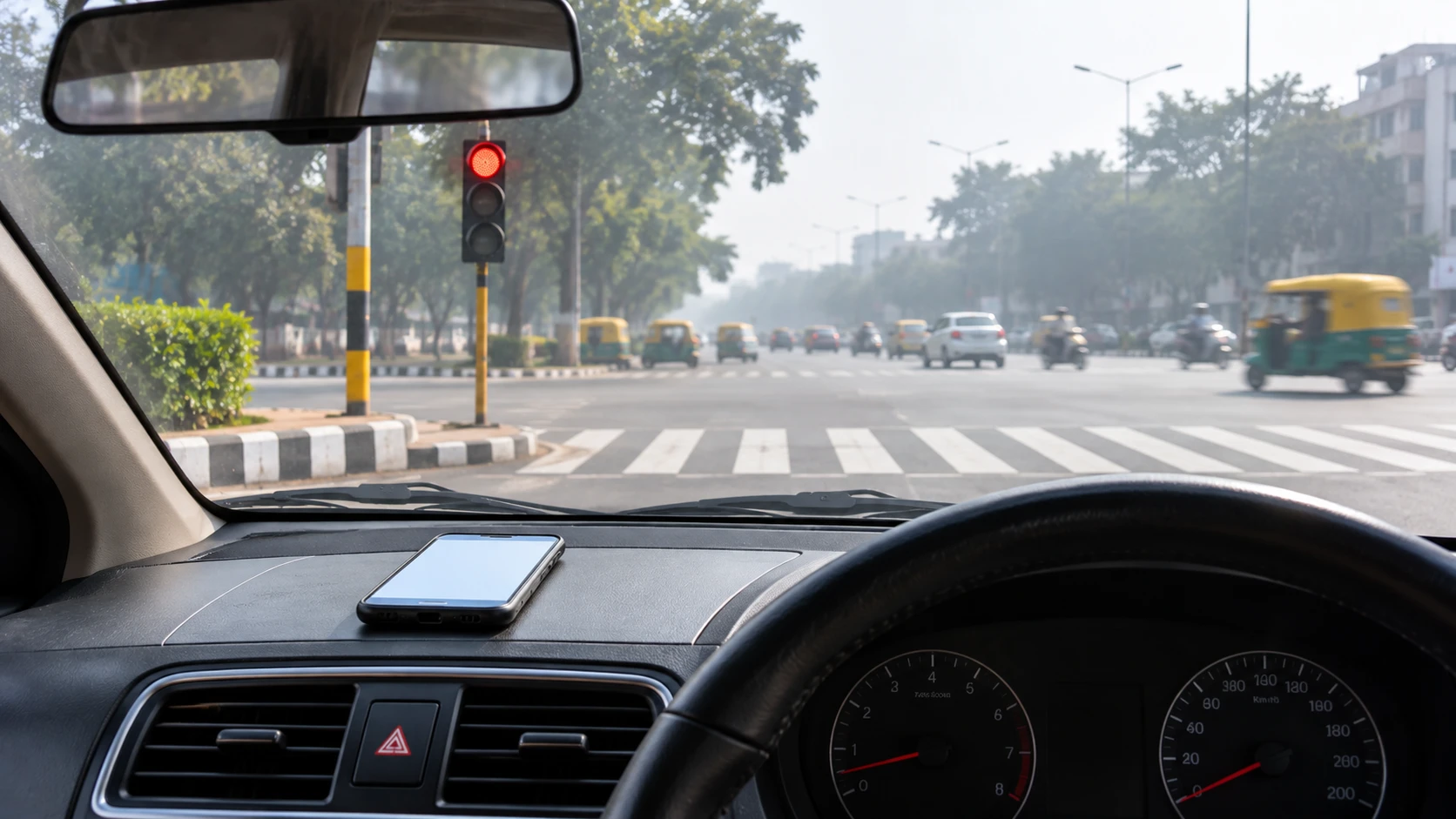
Quick answers
Is it illegal to use a phone while driving in India?
Yes. Section 184 of the Motor Vehicles Act, as amended in 2019, says in its Explanation that the use of handheld communication devices while driving amounts to driving in a manner dangerous to the public.
What is the penalty for using a phone while driving?
Section 184 now provides for a first offence imprisonment of not less than six months and up to one year, or a fine of not less than Rs 1,000 and up to Rs 5,000, or both. For a second offence within three years the fine is Rs 10,000, with imprisonment up to two years. The Act lets the handheld-device offence be compounded, with the amount set by the state, which we did not check.
Is a hands-free call allowed?
The Explanation speaks of handheld devices and the Act text we read does not define hands-free or a phone in a holder. A call still takes your attention. Our advice is not to take calls while the vehicle is moving.
Can I use a map app while driving?
The safest way is to set the route before you start, with the phone in a holder, and not to touch it while moving. The Act does not say anything about map apps in the text we read.
Does jumping a red light count as dangerous driving?
Yes. The Explanation to section 184 lists jumping a red light and violating a stop sign as driving in a manner dangerous to the public.
What about driving on the wrong side of the road?
The Explanation lists driving against the authorised flow of traffic. It also lists passing or overtaking other vehicles in a manner contrary to law.
Can the police fine me on the spot for phone use?
The 2019 Act allows section 184 to be compounded only to the extent of the use of handheld communication devices, which is a settlement by paying a fine. The amount and procedure depend on the state, and we did not check them.
What is the best way to stop using the phone while driving?
Set the route before you start, put the phone out of reach, use the driving mode, pull over to call or reply, and let a passenger handle messages. On a two-wheeler, never hold the phone between helmet and shoulder.
Everyone knows the scene. A rider at the signal with the phone between helmet and shoulder. A car that creeps through the red because “there is nobody coming”. A scooter against the flow on the wrong side of the divider to save two minutes. We tend to call these bad habits. The Motor Vehicles Act calls them dangerous driving, and since 2019 it says so in a list. This page explains what the list says, what the penalty is, and some simple ways to stop. It is general information, not legal advice. Checked 10 November 2026.
In short
- Section 184 punishes driving at a speed or in a manner dangerous to the public. The 2019 amendment added that it also covers driving that causes a sense of alarm or distress to people in the vehicle, other road users and people near the road.
- Using a handheld communication device while driving is on the list. So are jumping a red light, violating a stop sign, overtaking contrary to law and driving against the authorised flow of traffic.
- The penalty for a first offence is imprisonment of six months to one year, or a fine of Rs 1,000 to Rs 5,000, or both. A second offence within three years can mean up to two years, or a fine of Rs 10,000, or both.
- Set the route before you start, put the phone out of reach, and pull over to call.
- A text or a glance is not “just a second”: at 50 km/h a vehicle moves about 14 metres every second, so a five-second look at a screen is about 70 metres driven blind. That is our own arithmetic.
What section 184 says now
Section 184 of the 1988 Act punished driving at a speed or in a manner dangerous to the public, having regard to the place, its use and the traffic. In the old text the penalty for a first offence was up to six months or a fine up to Rs 1,000, and for a repeat offence within three years up to two years or a fine up to Rs 2,000. The Motor Vehicles (Amendment) Act, 2019, published in the Gazette of India on 9 August 2019, changed this. It added the words about alarm or distress, and made the first-offence punishment imprisonment which may extend to one year but not less than six months, or a fine of not less than Rs 1,000 and up to Rs 5,000, or both. The fine for a repeat offence became Rs 10,000. The Road Transport Ministry’s list of sections applicable from 1 September 2019 includes this change.
The most useful part of the amendment is the Explanation, which says that each of these shall amount to driving in a manner dangerous to the public:
- jumping a red light;
- violating a stop sign;
- use of handheld communication devices while driving;
- passing or overtaking other vehicles in a manner contrary to law;
- driving against the authorised flow of traffic; or
- driving in any manner that falls far below what would be expected of a competent and careful driver, where it would be obvious to such a driver that it would be dangerous.
The same Act also amended section 200, which deals with compounding, so that section 184 can be compounded, that is settled by paying a fine without going to court, only to the extent of the use of handheld communication devices. The amount and the procedure are for the state, and we did not check them for any state. Section 199B also lets the Centre raise fines by up to ten per cent every 1 April, and we did not check whether that has been notified.
What the law does not spell out
The Explanation says “handheld” and does not define a hands-free call or a phone fixed in a holder. We did not find that spelled out in the Act text we read. So we do not tell you a mounted phone is safe or unsafe in law. What we can say is that a conversation takes your attention even when your hands are free, and that touching a mounted phone for a route change is still handling it. Our advice is simple: set the route first, and do not touch the phone while the wheels are turning.
How to stop: five habits that work
- Set the route before you start. Put the address into the map app while parked, with the engine off.
- Put the phone out of reach. In the glove box, the bag on the back seat, or the pocket of a jacket zipped shut. If it is in sight, you will look at it.
- Use the “driving” or “do not disturb” mode that most phones have, so that messages wait.
- Pull over to call or reply. A safe lay-by, a petrol pump, a side lane with the engine off. Two minutes at the side is nothing against the risk.
- Give the phone to a passenger. Let them answer, read or choose the song.
On a two-wheeler, do not hold the phone between helmet and shoulder and do not read a message at the signal. At the signal, stay stopped until it turns green; the person behind you is often looking at their own phone.
For families, employers and fleets
- Parents. Children copy what they see from the back seat. If you answer a call while driving, they will too once they have a licence.
- Employers. If your staff or drivers are expected to answer calls on the road, you are asking them to break a rule that can mean jail. Make the policy explicit: calls wait.
- Delivery and ride-hailing riders. Orders and navigation arrive on the same phone. Fix the holder, accept the order only when stopped and avoid handling the screen on the move. This is our advice; we did not check any platform’s rules.
What not to do
- Do not read or type a message at a red signal when the lane starts moving.
- Do not “just” take a call; ask the caller to wait and call back.
- Do not jump a red light because the junction looks empty.
- Do not drive against the flow on a divided road to save a detour.
- Do not overtake on a blind bend or where the road marking forbids it.
Do these today
- Turn on the driving mode on your phone.
- Agree a family rule: no phone use in a moving vehicle, by driver or rider.
- Clip the phone in a holder only if you need navigation, and set it before you start.
- Read our pages on driving home at night after a wedding or family function and road accidents during Diwali, and our guide to drunk driving in India, which covers the law side.
What we could not confirm
We read section 184 in the Gazette text of the 2019 Act and in the 1988 text on India Code, not in a consolidated current version. We did not check the compounding amounts for any state, the yearly fine revision under section 199B, or whether a mounted phone counts as handheld. The figure of 14 metres a second at 50 km/h is our arithmetic, not an official statistic. We found no video that passed our player test, so there is no video row. This page is general information, not legal advice.
What needs attention
- The 2019 amendment lists six kinds of driving that amount to dangerous driving, including handheld phone use.
- The first-offence punishment became imprisonment of six months to one year or a fine of Rs 1,000 to Rs 5,000, or both; the old ceiling was six months or Rs 1,000.
- The repeat-offence fine rose from up to Rs 2,000 to Rs 10,000.
- The Act does not, in the text we read, define hands-free use or a phone in a holder.
- A five-second glance at 50 km/h is about 70 metres driven blind (our arithmetic).
Controls that reduce risk
- Set the route before you start.
- Turn on the driving mode on your phone.
- Put the phone out of reach, or give it to a passenger.
- Pull over to call or reply.
- Agree a family rule: no phone in a moving vehicle.
Common unsafe practices
- Holding a phone between helmet and shoulder.
- Reading or typing a message at a signal and driving off on green.
- Taking "just one call" while driving.
- Jumping a red light because the junction looks empty.
- Driving against the flow of traffic to save a detour.
- Employers expecting staff to answer calls on the road.
Leave a comment