
What happened here
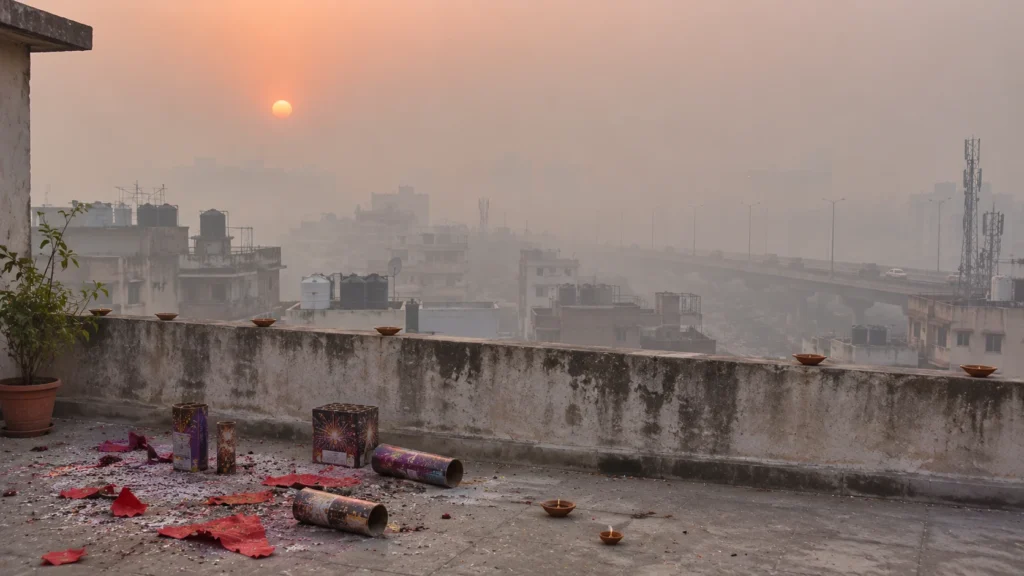
Delhi's air on and after Diwali 2026: CPCB's 24-hour AQI was 369 on 7 November, 376 on Diwali day (8 November), 344 on 9 November and 299 on 10 November, so Very Poor for three days and then Poor. No daily average reached Severe, but press reports count 14 to 20 neighbourhood stations above 400 at times. GRAP Stage III was in force from 6 November, the Supreme Court allowed only certified green crackers on 7 and 8 November and restored the full ban from 9 November, and crackers were reported burst despite the limits. Many stations had missing PM2.5 hours on Diwali night, which may have lowered the published figures. The health impact and enforcement figures have not been published. The page gives the official numbers, what the bands mean and what to do.
Quick answers
What was Delhi's AQI after Diwali 2026?
CPCB's daily bulletin gives Delhi's 24-hour average AQI at 4 pm as 376 on Diwali, 8 November, 344 on 9 November and 299 on 10 November. The first two are Very Poor (301 to 400) and the last is Poor (201 to 300). Individual stations were higher: press reports counted 20 of 59 above 400 at 10 pm on 8 November.
Did Delhi's air reach the Severe band?
Not in CPCB's daily city averages for 8, 9 and 10 November. It did at many neighbourhood stations at certain hours, according to press reports of CPCB data. The figures may understate it because many stations had missing PM2.5 readings on Diwali night.
Which GRAP stage was in force after Diwali 2026?
CAQM's website lists Stage III as effective from 6 November 2026, with no revocation date shown on 10 November. Its list includes curbs on dust-generating construction and demolition, on older diesel goods vehicles and on BS III petrol and BS IV diesel cars, and hybrid classes for children. Check CAQM for the current stage.
Were firecrackers allowed in Delhi on Diwali 2026?
Only certified green crackers, for two days. As reported by LiveLaw, a Supreme Court order of 2 November allowed them from 6 am to 8 pm on 7 November and from 7 am to 10 pm on 8 November, and restored the full ban from 9 November. Newspapers reported crackers being burst despite the limits.
Was Delhi's air worse than other big cities?
Yes, on the CPCB bulletin. On 9 November Delhi was 344 (Very Poor) while Mumbai was 172, Kolkata 153, Chennai 199, Bengaluru 133 and Hyderabad 119 (all Moderate). Pune, Ahmedabad and Surat were Poor.
Why do different reports give different Delhi numbers?
They use different hours. The bulletin is a 24-hour average to 4 pm; real-time readings are hourly; station readings are for one place. A figure should always be quoted with its hour and source.
Is there a health-impact figure?
Not yet. The Supreme Court asked the authorities to file an affidavit on the rise in hospital admissions in Delhi-NCR up to 30 November. We found no official figure by 10 November.
What should I do on a Very Poor day?
Stay indoors where you can, avoid outdoor exertion, use a close-fitted N95 or N99 mask if you must go out, and burn nothing indoors. Our guide to bad AQI days gives the advice for each band.
Is there a Delhi safety guide?
Yes. Our Delhi city safety guide has emergency numbers, the nearest help and local risks.
What happened
On Diwali, Sunday 8 November 2026, Delhi’s air was already in the Very Poor band, and it stayed there for three days. The Central Pollution Control Board (CPCB) publishes a daily bulletin with each city’s AQI as the average of the past 24 hours at 4 pm. For Delhi it gave 369 on Saturday 7 November, 376 on Diwali day, 344 on Monday 9 November and 299 on Tuesday 10 November. The first three are Very Poor (301 to 400) and the last is Poor (201 to 300). No Delhi daily average reached the Severe band (401 to 500).
City-wide averages hide the worst spots. Press reports of CPCB’s real-time station data put 20 of Delhi’s 59 stations above 400 at 10 pm on Diwali night, with Sonia Vihar at 463 and Jahangirpuri at 450 (PTI, as reported by Outlook and Down To Earth). A Hindustan Times snapshot at 7 am on 9 November, reported by Outlook, counted 15 stations in the Severe band, with Sonia Vihar at 449. The counts differ because the hours differ. Many stations also had no PM2.5 reading for hours on Diwali night, so the published figures may understate what the air was like (see below).
What the official figures show
- Delhi, CPCB bulletin: 7 November 369 (Very Poor, all 59 stations reporting), 8 November 376 (Very Poor, 59 of 59), 9 November 344 (Very Poor, 47 of 59), 10 November 299 (Poor, 58 of 59). PM2.5 was named as a prominent pollutant on all four days, with PM10 also named on 7 and 10 November. We read the four bulletins on 10 November 2026.
- Towns around Delhi, 9 November: Faridabad 350, Gurugram 345, Noida 332 and Ghaziabad 324, all Very Poor; Meerut 269, Poor. Rohtak was 378 and Bahadurgarh 400, both Very Poor. On 10 November Gurugram (323) and Noida (301) were still Very Poor while Ghaziabad (244), Faridabad (290) and Meerut (262) were Poor.
- Other large cities, 9 November: Mumbai 172, Kolkata 153, Chennai 199, Bengaluru 133 and Hyderabad 119 were Moderate (101 to 200). Pune 292, Ahmedabad 223 and Surat 204 were Poor. Delhi and its neighbours were the worst of the large cities.
- Severe in the bulletin: In the four bulletins only one city average was Severe: Ballabgarh, Haryana, at 409 on 7 November. The highest city value on 8 November was Ballabgarh at 398, on 9 November Bahadurgarh at 400 and on 10 November Panchgaon at 380 (all Very Poor).
- GRAP: The Commission for Air Quality Management (CAQM) lists Stage III of the Graded Response Action Plan as effective from 6 November 2026, with no revocation date shown when we read its site on 10 November. Newspapers say it was invoked ahead of Diwali on forecasts of worsening air. CAQM’s Stage III list includes shutting dust-generating construction and demolition work, stone crushers and mining, curbs on older diesel goods vehicles and on BS III petrol and BS IV diesel cars, and hybrid classes for children.
The response and the cracker rules
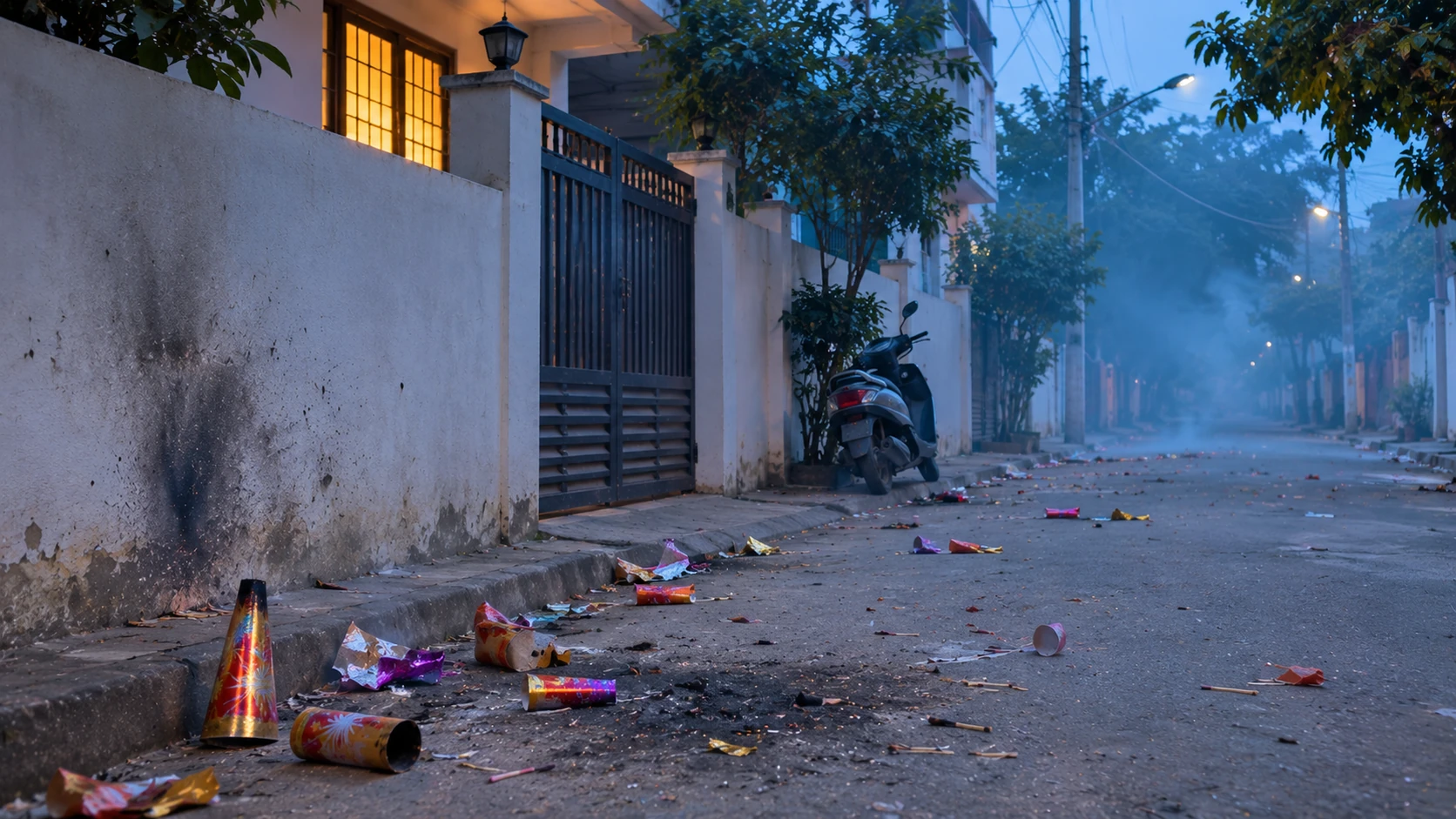
The firecracker rules were set before Diwali. Delhi’s year-round ban on making, storing, selling and using firecrackers dates from a Supreme Court order of 3 April 2025 (Business Standard). On 2 November 2026, a bench of Justices MM Sundresh and Prasanna B Varale allowed approved green crackers in Delhi-NCR for a short period, as reported by LiveLaw: bursting from 6 am to 8 pm on 7 November and from 7 am to 10 pm on 8 November, with the complete ban restored from 9 November. Only crackers approved by CSIR-NEERI could be sold, in sealed boxes with QR codes, at designated places, and strings of crackers (ladis) and crackers containing barium stayed banned. We have read LiveLaw’s report, not the order text. Outlook gives the bursting hours differently, so check the order itself.
The same report says the court told CPCB and the state pollution boards to report air quality every day from 2 to 30 November, and told the authorities to file an affidavit on how many more patients hospitals and health centres in Delhi-NCR admitted after the festival. That affidavit is the official source for the health impact, and it has not been published yet.
Crackers were burst despite the limits. PTI, quoted by Outlook, reported crackers in Pitampura, Burari, Mayur Vihar and Lutyens’ Delhi, and residents reporting poor visibility and difficulty breathing. We found no official figure for challans, seizures or arrests, and no DPCC or Delhi government statement on enforcement for Diwali 2026.
Where reports differ and what we do not know
- The AQI figure: There are several correct numbers. CPCB’s bulletin gives 376 for 8 November and 344 for 9 November (4 pm, 24-hour average). Real-time snapshots were 370 at 9 pm and 373 at 11 pm on 8 November, and 367 at 3 am on 9 November (Down To Earth, from CPCB real-time data). CPCB’s 24-hour figure to 9 am on 9 November was 370. They measure different hours and should not be set side by side as if they were one reading.
- Missing readings: Business Today reports that 125 station-hours of PM2.5 were missing from CPCB’s records on Diwali night, that DPCC released them on the evening of 9 November, that the highest was 3,744 micrograms per cubic metre at Mundka at 2 am, and that, counting them, CPCB’s own method gives about 384 for the 24 hours to 9 am against the published 370, and about 360 for the 4 pm bulletin against the published 344 (a Hindustan Times estimate). The 9 November bulletin itself counts only 47 of 59 Delhi stations. We have not recalculated the AQI ourselves and have not opened DPCC’s own release.
- Stations above 400: 20 of 59 at 10 pm on 8 November (PTI), 15 in a 7 am snapshot on 9 November (Hindustan Times, via Outlook) and 14 of 51 reporting stations at 10 am (PTI, in our blog on bad AQI). These are different hours, and they are not the city average.
- Cracker hours: LiveLaw gives 6 am to 8 pm on 7 November and 7 am to 10 pm on 8 November. Outlook gives two shorter windows each day. We follow LiveLaw, which reports the order itself, and say we have not read the order.
- Private platforms: Some private AQI platforms showed far higher numbers for Delhi. These are not the CPCB index and use other methods, so we do not use them.
- Not known: How many people needed medical care because of the air, the DPCC’s full hourly record, the number of cracker violations and penalties, why the air improved to Poor by 10 November, and when CAQM will lift Stage III.
What this case teaches
Diwali smog is a season, not a surprise, and Delhi had done what the rules allow before it: Stage III was in force from 6 November, the court allowed only certified green crackers for two days, and the ban returned on 9 November. The air was still Very Poor for three days, with neighbourhood stations well above 400. That tells readers to plan for the pollution, not rely on the restrictions to remove it.
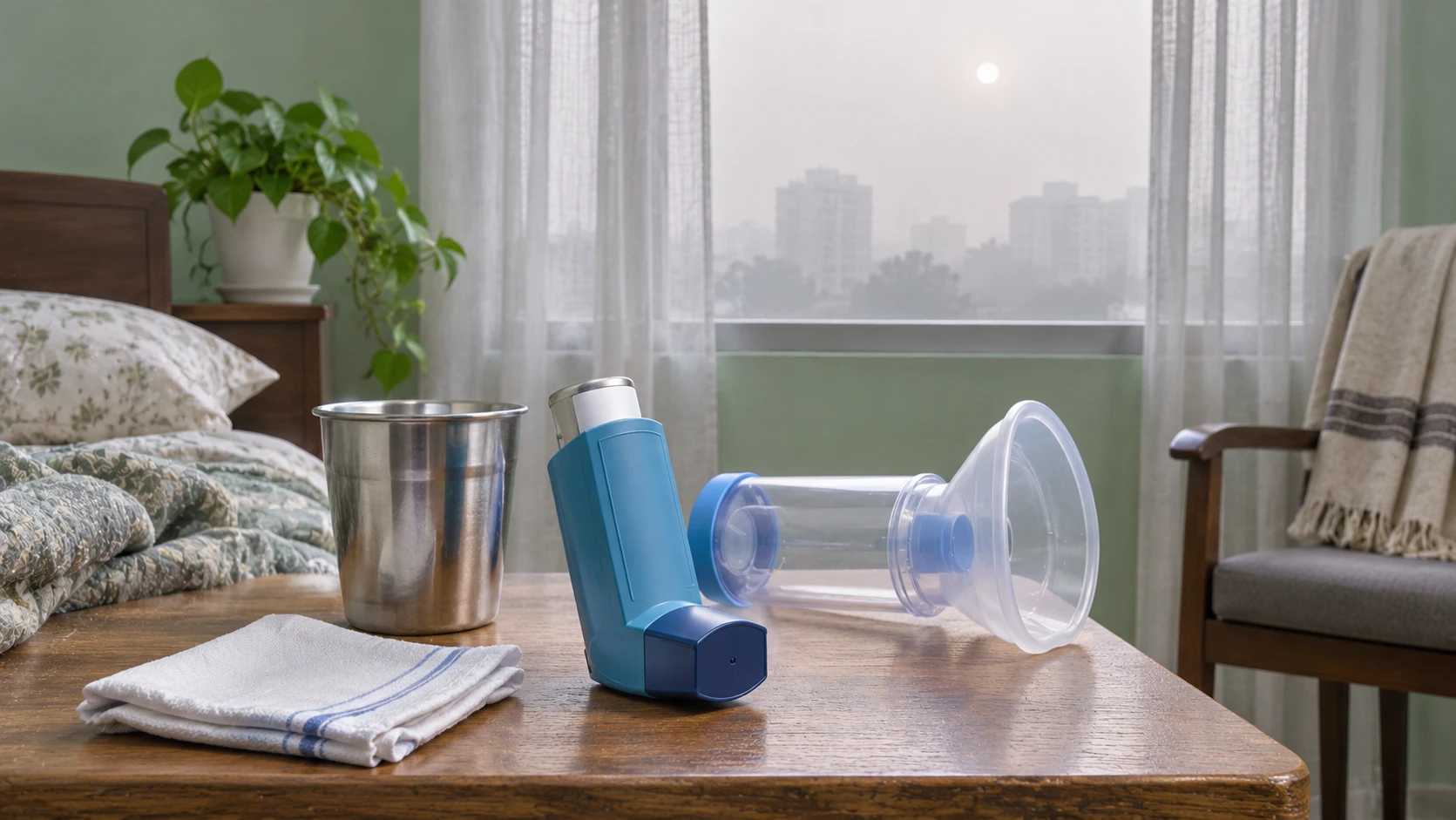
Use the number for your own station and the band it falls in. Our guide to bad AQI days and N95 masks sets out what each CPCB band means and what the health ministry’s NCDC advises: on a Very Poor day, avoid outdoor activity, use a close-fitted N95 or N99 mask if you must go out, and burn nothing indoors; on a Poor day, avoid outdoor exertion if you can. If breathing becomes difficult, see what to do in an asthma or allergy attack in smog, and call 112 or 108 if someone is struggling to breathe.
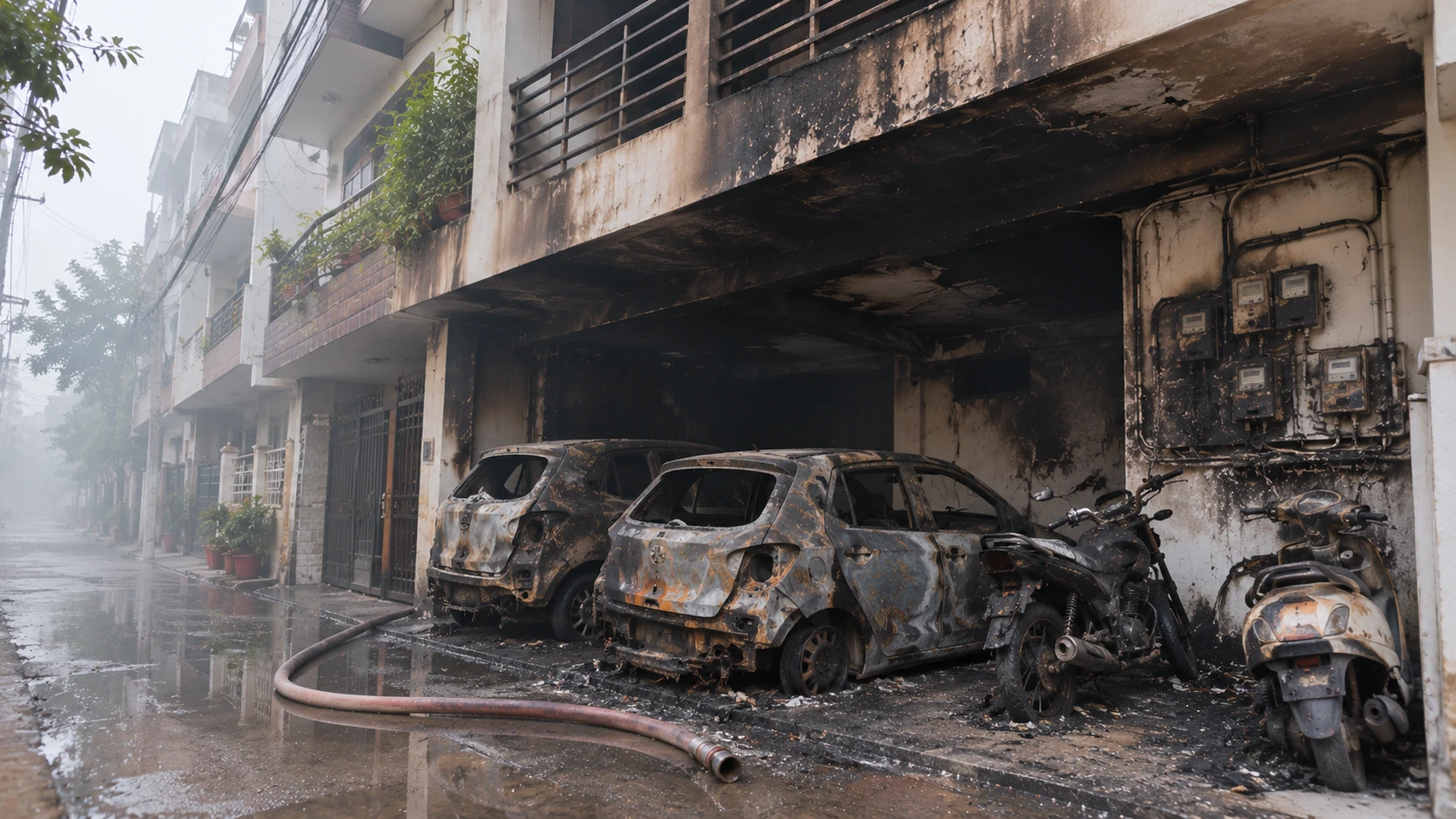
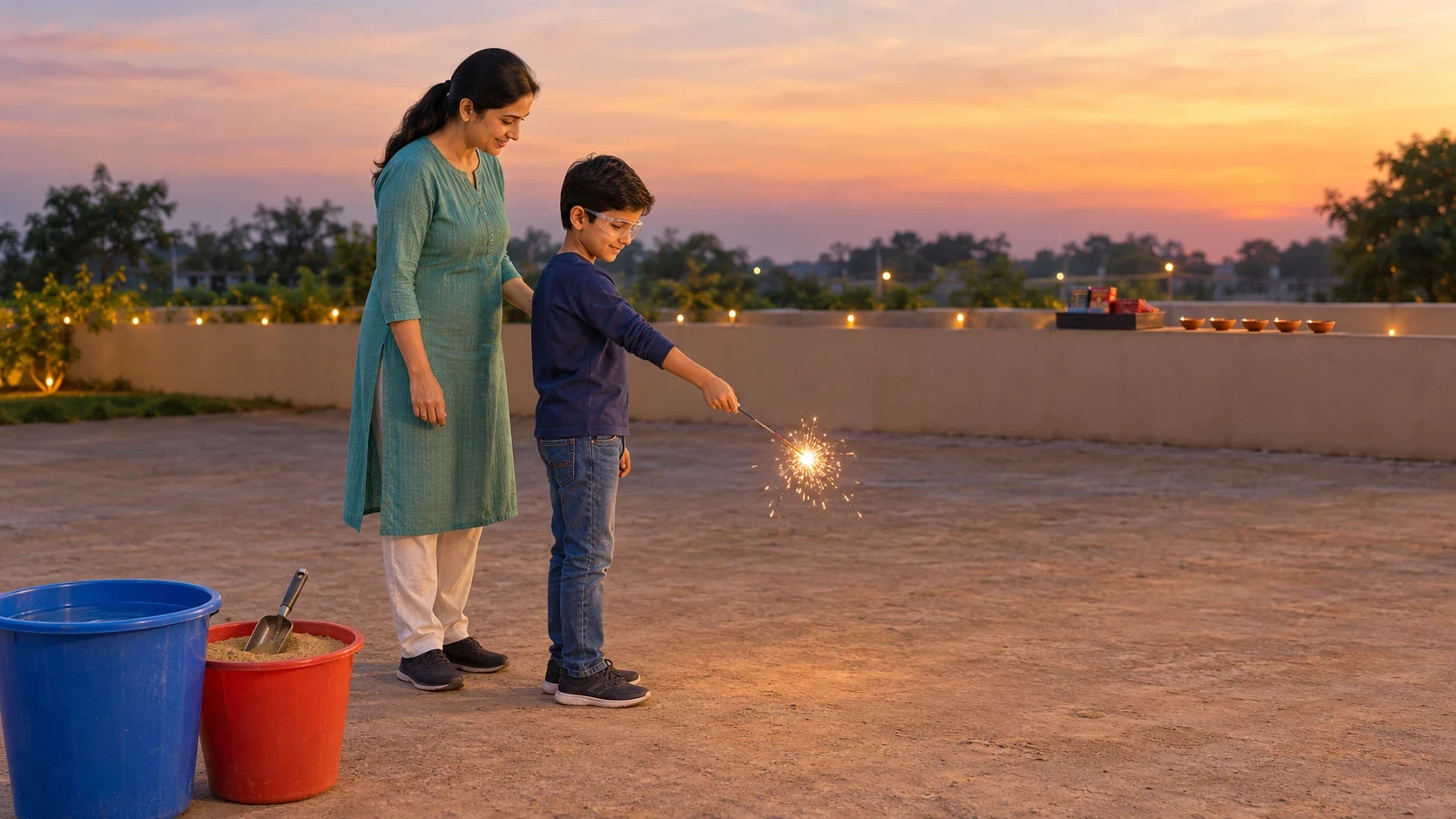
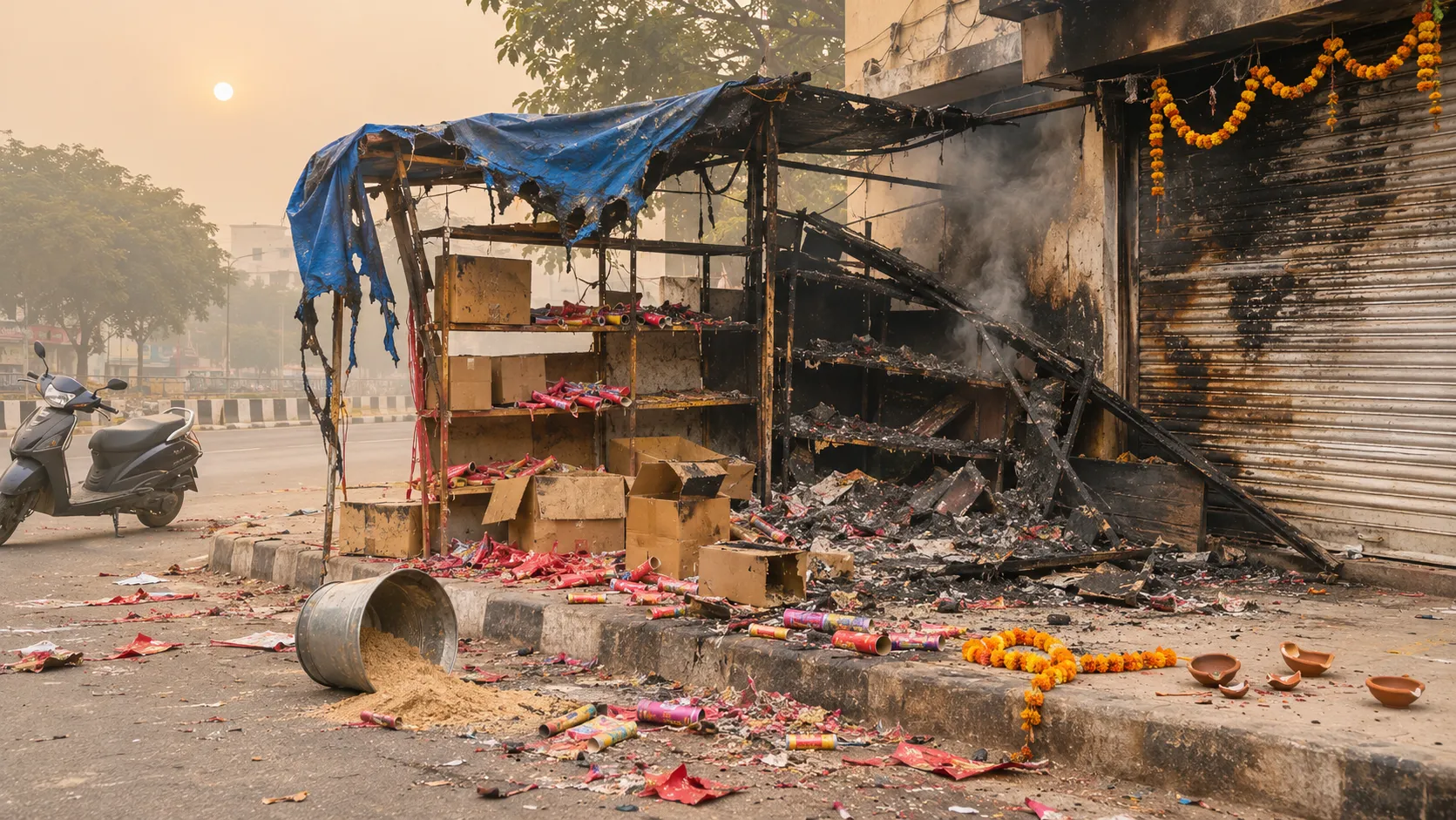
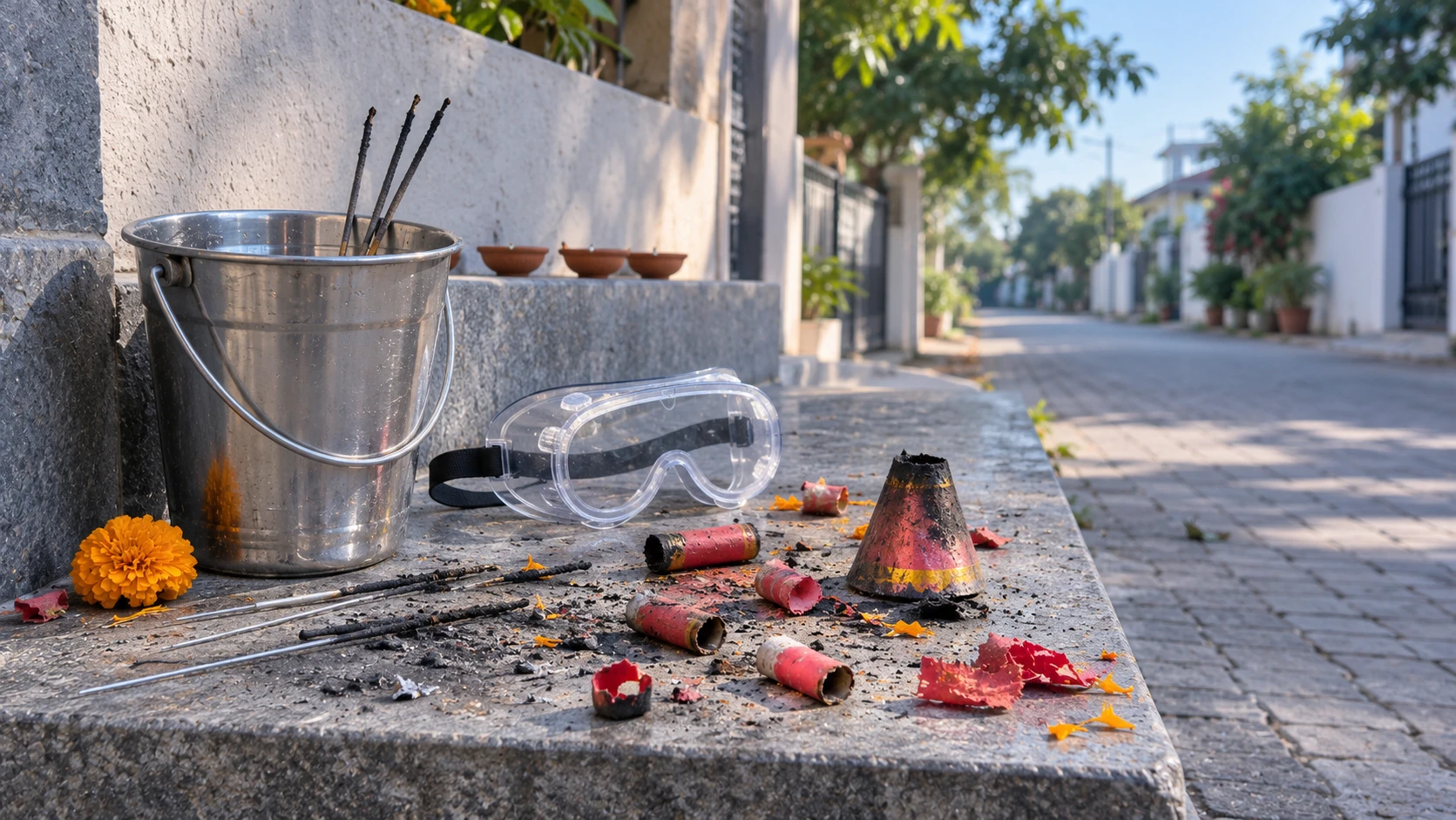
For the festival itself, see our guides to Diwali safety, burns and first aid, firecracker eye injury and burns and Diwali fire accidents in India, and the Delhi cases from the same week: a boy killed by a flower-pot cracker in Narela, the Uttam Nagar parking-area fire and the Najafgarh garment factory fire. Delhi’s emergency numbers and nearest help are in our Delhi safety guide.
- The Supreme Court allows certified green crackers in Delhi-NCR on 7 and 8 November only and orders the full ban back from 9 November; CPCB and state boards are to report AQI daily to 30 November (LiveLaw)
- CAQM puts GRAP Stage III in force across Delhi-NCR; its website lists it as effective from this date (CAQM)
- CPCB's 4 pm bulletin gives Delhi 369, Very Poor; green crackers allowed from 6 am to 8 pm (LiveLaw)
- Green-cracker window 7 am to 10 pm. AQI is 371 at 7 pm and 10 pm, with 20 of 59 stations Severe by 10 pm (PTI via Outlook); the 4 pm bulletin gives 376, Very Poor (CPCB)
- Many Delhi stations show no PM2.5 reading for hours; real-time AQI is 373 at 11 pm and 367 at 3 am (Down To Earth, Business Today)
- A 7 am snapshot counts 15 stations Severe, Sonia Vihar 449; the full cracker ban is back in force (Outlook, LiveLaw)
- CPCB's bulletin gives Delhi 344, Very Poor, with 47 of 59 stations reporting; DPCC releases the missing hourly readings (CPCB, Business Today)
- CPCB's bulletin gives Delhi 299, Poor; Gurugram and Noida are still Very Poor (CPCB)
Why consequences escalated
- CPCB's 24-hour AQI for Delhi was Very Poor on 7, 8 and 9 November 2026 (369, 376 and 344) and Poor on 10 November (299).
- No Delhi daily average in the bulletins reached the Severe band, but press reports count 14 to 20 neighbourhood stations above 400 at different hours.
- GRAP Stage III was in force from 6 November and CAQM showed no revocation date on 10 November.
- The Supreme Court allowed certified green crackers on 7 and 8 November only, as reported by LiveLaw, and restored the full ban from 9 November.
- Crackers were reported burst in several parts of Delhi despite the limits; no official enforcement figure was found.
- Many stations had missing PM2.5 readings on Diwali night, so published figures may understate the air; a newspaper estimate puts the 24-hour figure to 9 am on 9 November at about 384 against the published 370.
- Delhi and its neighbouring towns were worse than the other large cities in the same bulletin.
- The health impact is not yet known; the court asked for a hospital admissions affidavit by 30 November.
Failures and risk multipliers
- Treating one hourly or one station reading as the day's AQI; the bulletin figure is a 24-hour, city-wide average.
- Reading a station with no data as clean air; on Diwali night many Delhi stations showed blanks.
- Quoting a private platform's number as if it were CPCB's index.
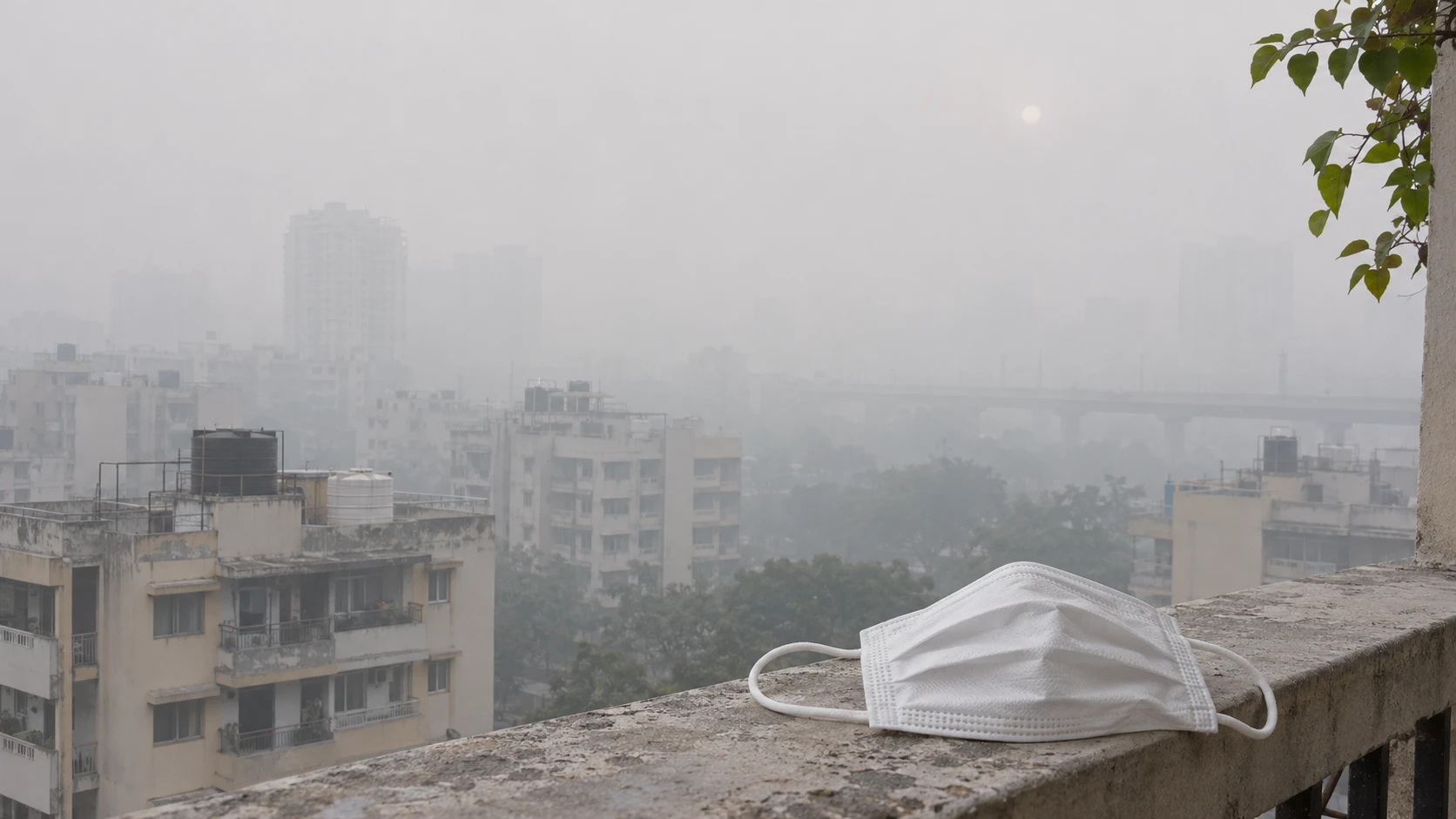
- Wearing a cloth or paper mask and treating it as protection on a Very Poor day; the NCDC says these are not effective in poor to severe air.
- Going out for the usual morning or late-evening walk on a Very Poor day.
- Burning crackers, candles, coils or wood in a closed room.
- Leaving windows open at the worst hours on a Poor or worse day.
Actions that reduce risk
- Residents: look up your nearest station on CPCB's air quality portal each morning and follow the band it falls in; our guide to bad AQI days sets out the NCDC advice for each band.
- Keep a fitted N95 or N99 mask at home for each adult, plan indoor exercise for Poor and worse days, keep medicines for asthma and heart conditions within reach.
- Do not burst crackers outside the hours the court allowed, and do not use banned types; they add to the smoke and raise the risk of burns and eye injuries.
- Schools and employers: follow CAQM's Stage III list, including hybrid classes for children where it applies, and tell parents and staff the AQI band for the day.
- Authorities: publish the DPCC hourly record and the cracker enforcement figures, and say when stations are not reporting.

Leave a comment