
Quick answers
When is Diwali in 2026?
Sunday 8 November 2026, according to the Government of India central holiday list, which also places Naraka Chaturdasi on 8 November. Tamil Nadu's 2026 holiday notification also gives Deepavali as 8 November. Local bursting hours are tied to specific dates, so check your state or district order.
What time can we burst crackers on Diwali 2026?
It depends on where you live. The Supreme Court's 2018 judgment set 8 pm to 10 pm on Diwali across India, and state, district and police orders apply it locally, some with different two-hour slots (Tamil Nadu allowed 6 am to 7 am and 7 pm to 8 pm in 2025). In Delhi-NCR, the 2026 position was before the Supreme Court on 15 October 2026, so do not assume crackers are allowed there until an order is issued. Follow your current local order.
Are joined crackers (laris) allowed in 2026?
Conventional laris remain barred. On 30 September 2026 the Supreme Court accepted a limited, conditional relaxation only for specified next-generation joined green crackers recommended by CSIR-NEERI, made by licensed manufacturers, tested, certified and marked. Buy only from a licensed shop and follow your local order.
How do I know a cracker is a legal green cracker?
Buy only from a licensed shop, never online, and look for the CSIR-NEERI green logo and a QR code you can scan. Fake QR codes have been reported, so the logo is a check, not a guarantee.
Should I put ice or toothpaste on a firecracker burn?
No. Cool the burn under cool, clean running water for 20 minutes. Even 10 minutes helps if that's all you can manage. No ice, toothpaste, oil or butter. Put nothing else on it, and cover it loosely with cling film or a clean, lint-free cloth.
What should I do if a spark or cracker piece hits an eye?
Do not rub it. Flush chemicals or dust with clean water for at least 15 to 20 minutes, but if the eye was hit by a cracker, something is stuck in it or it is cut, do not wash, wipe or press it; shield it and go straight to an eye hospital.
What if a cracker does not go off?
Do not go near it or relight it. Wait at least 20 minutes, then soak it in a bucket of water before throwing it away.
Diwali falls on Sunday 8 November 2026 in the central government holiday list. The same list places Naraka Chaturdasi on 8 November, and Tamil Nadu’s 2026 holiday notification also gives Deepavali as 8 November. Check your state list and local order for exact dates and bursting windows. Crackers are part of many families’ celebrations, but they also cause burns, eye injuries and fires. The National Crime Records Bureau (NCRB) recorded 110 accidental fires caused by fireworks across India in 2024, with 112 people injured and 134 deaths over the whole year.
Before you buy: legal crackers and your local order
Supreme Court orders since 2018 allow only green or improved crackers, sold only by licensed traders, and bar online sales through e-commerce websites. Conventional joined crackers (series crackers or laris) remain barred. On 30 September 2026, however, the Court accepted the Centre’s proposal for a limited, conditional relaxation for specified next-generation joined green crackers recommended by CSIR-NEERI. They must match approved specifications, come from licensed manufacturers, meet the noise limits, be tested and certified, carry traceable marking and contain no banned chemicals. Crackers with barium salts remain banned: when this guide was checked on 15 October 2026, the Court had listed the question of barium-based green crackers, after open-ground testing, for hearing that day. The Court has also said there is no total ban on firecrackers.
The Ministry of Health and Family Welfare (MoHFW) firecracker guidelines say green crackers carry the green CSIR-NEERI logo and a QR code you can scan. That is a check, not a guarantee: a Supreme Court order of October 2025 records NEERI reports of QR codes being sold to unregistered manufacturers. Buy recent, branded stock from a licensed shop, because MoHFW warns that old or unbranded crackers behave unpredictably. Green crackers pollute less, but they are not pollution-free.
Bursting hours are local, and they change every year. The Supreme Court’s 2018 judgment set 8 pm to 10 pm on Diwali and said this window applies throughout India. State, district and police orders apply it locally, and some use different two-hour slots: for Diwali 2025, Punjab and West Bengal allowed 8 pm to 10 pm, while Tamil Nadu allowed 6 am to 7 am and 7 pm to 8 pm. Rules can also depend on air quality. National Green Tribunal orders of 2020 tied green-cracker use to a city’s air quality, and Punjab’s 2025 order asked district magistrates in nine cities that do not meet national air-quality standards to take special precautions. Check the current order of your state, district administration, pollution control board or police before you buy.
Delhi-NCR has its own position. After an NCR-wide ban, the Supreme Court allowed green crackers there in 2025 only as a one-time test case: sale from 18 to 20 October 2025, and use only from 6 am to 7 am and 8 pm to 10 pm on the day before Diwali and on Diwali. The Delhi-NCR position for Diwali 2026 was before the Court on 15 October 2026. At a hearing on 12 October, the Chief Justice’s bench said it was not inclined to order a ban and urged people to choose less-polluting ways to celebrate. Until an order for 2026 is issued, do not assume crackers are allowed in Delhi-NCR.
MoHFW notes that crackers louder than 125 decibels at 4 metres from the point of bursting are banned by law; that limit is for a single cracker, and joined crackers have lower limits. Some cities ban sky lanterns. In 2024, Mumbai Police banned their use, sale and storage from 23 October to 21 November, saying sky lanterns could pose a grave danger to lives and damage public property. Do not release them, and check whether your city has banned them. Carbide guns, pipe devices that mix calcium carbide with water, are illegal and dangerous; MoHFW asks people to report their sale or use.
Set up a safe spot before dark
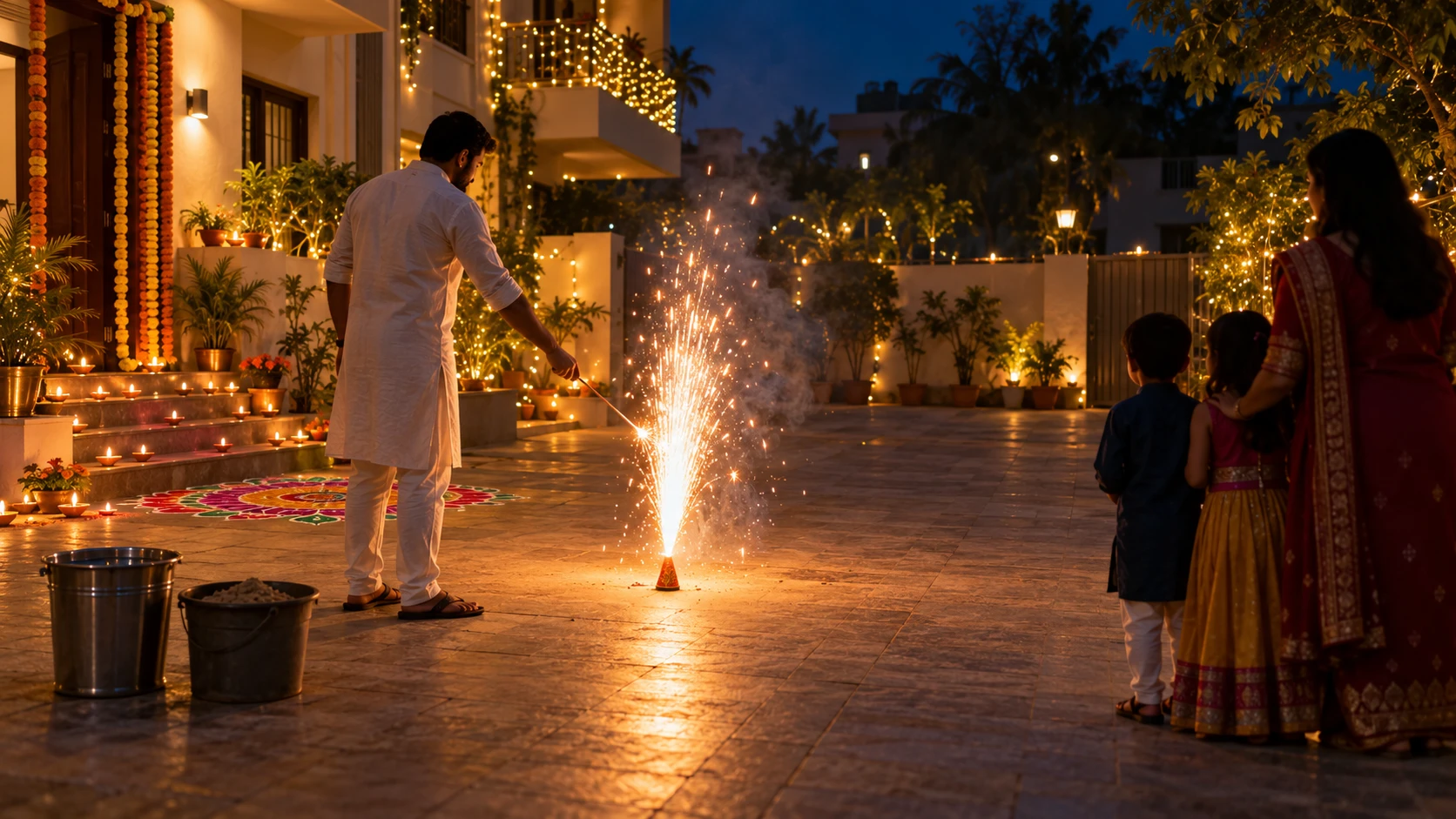
Choose open ground or a park, away from buildings, people, parked vehicles, dry leaves, trees and overhead wires. Never use a narrow lane, a public road or an indoor space. PESO’s do’s and don’ts recommend a community display rather than every household lighting its own crackers. Tamil Nadu’s 2025 advisory also asked people to keep away from hospitals, schools, courts, places of worship and thatched houses.
Keep two buckets of water and a bucket of sand ready. Keep unused crackers away from the lighting spot and from diyas and candles, never in your pockets. Inside the house, keep diyas off the floor and the stairs.
Lighting crackers safely
- One person lights one cracker at a time; everyone else watches from a safe distance.
- Use a long candle or an incense stick (agarbatti), keep your elbow straight, stand at arm’s length and never bend over a cracker. Step back as soon as it is lit.
- Never hold an anar, bomb or other cracker in your hand while lighting it (sparklers are the exception, used with care). Never cover a cracker with, or light it inside, a tin, bottle or pot to make it louder.
- Launch rockets only from a stable launch tube pointing straight up, away from buildings, trees, overhead wires and people, and never in strong wind.
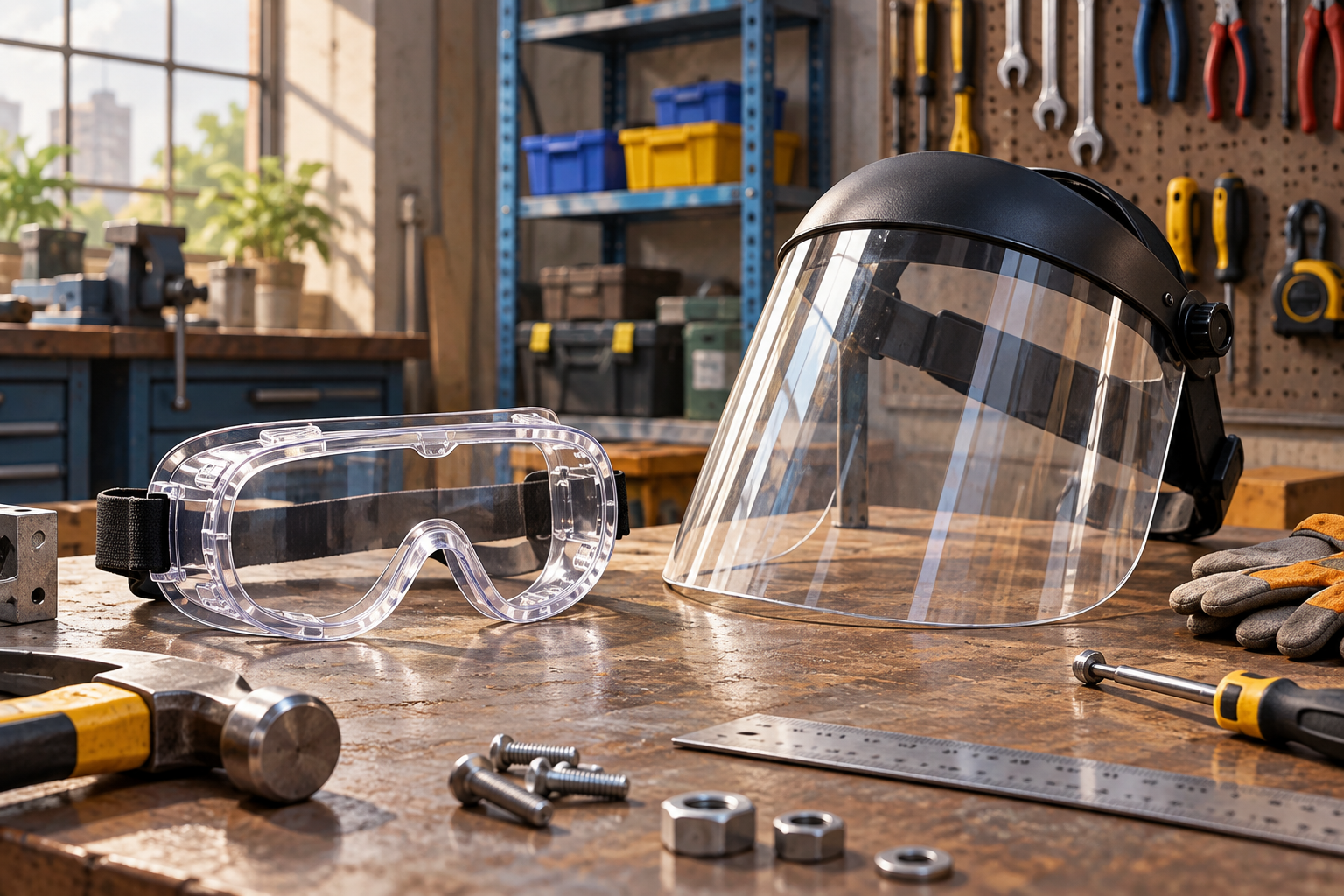
- Wear close-fitting, thick cotton clothes, closed footwear and protective glasses. Avoid synthetic or flowing clothes such as a ghagra, and tie a dupatta or chunni snugly behind your back.
- Never throw a cracker at a person or animal, and never light crackers after alcohol or drugs.
If someone’s clothes catch fire, they must not run. The National Disaster Management Authority (NDMA) advises dropping to the ground and rolling to put out the flames; you can also smother them with a blanket or douse them with water.
Children, older people and pets
An adult should light the fireworks or closely supervise any child who does. Do not let children under 5 handle fireworks, including sparklers. Drop used sparklers into a bucket of water, because the metal wire stays hot, and teach children never to pick up a cracker that did not go off. The Delhi health department advises people with chronic lung or heart conditions, pregnant women, young children and older people to take extra care and avoid exposure to polluted air, and MoHFW advises people with asthma or other breathing illnesses to stay indoors. Let them watch from indoors with windows closed. MoHFW also advises keeping pets indoors with doors and windows closed.
Flats, balconies and high-rises
MoHFW warns that rockets can go off course, enter homes or land on rooftops and start fires, and advises pointing them away from buildings. So never light crackers on a balcony, on a staircase or inside a flat. Because stray rockets can reach homes, it also makes sense to keep balcony doors and windows closed during peak bursting hours and to move anything that burns easily, such as drying clothes or cardboard, off the balcony. If a fire grows beyond what a bucket of water can put out, get everyone out and call 101 or 112.
If a burn happens
- Make it safe. Move the person away from flames and unexploded crackers.
- Cool the burn at once. Cool the burn under cool, clean running water for 20 minutes. Even 10 minutes helps if that’s all you can manage. No ice, toothpaste, oil or butter. This follows MoHFW’s 2026 burn first-aid guidance. Do not use very cold water either. For babies, young children and anyone with large burns, cool only the burned area and do not immerse the body, because prolonged cooling can cause hypothermia.
- Remove rings, watches, bangles and tight clothing before swelling starts, but leave fabric that is stuck to the burn.
- Put nothing on the burn: no toothpaste, oil, ghee, butter, turmeric, creams, ointments or other home remedies.
- Cover it loosely with cling film or a clean, lint-free cloth. Do not use cotton wool, and do not burst blisters.
Call 112 or go to hospital at once for deep burns, burns larger than the injured person’s palm, burns on the face, eyes, ears, hands, feet, joints or groin, chemical burns, breathing trouble or hoarseness, possible blast injuries, signs of shock, or any burned child or older person. Press firmly on heavy bleeding while you get emergency care.
If something hits an eye
Do not rub the eye.
- Chemicals, powder or a small speck, with no visible wound: flush the eye with plenty of clean, cool water for at least 15 to 20 minutes, holding the eyelids open, then see an eye specialist immediately, as MoHFW advises.
- Hit by a cracker, something stuck in the eye, or a cut or punctured eye: do not wash it, wipe it, press on it or try to remove anything. Cover it gently with something stiff, such as a clean paper cup, so that nothing presses on the eye, and go to an eye hospital at once.
According to IANS, doctors at the AIIMS Delhi eye centre (the Dr Rajendra Prasad Centre) recorded 190 eye injuries from firecrackers and carbide guns over the 10-day Diwali 2025 period, up from 160 in 2024.
Smoke, asthma and air quality
MoHFW warns that cracker smoke worsens air quality and can cause breathing problems such as asthma attacks, and advises people with asthma or other breathing illnesses to stay indoors. Check your city’s Air Quality Index (AQI): the Central Pollution Control Board (CPCB) says “Poor” air (201 to 300) causes breathing discomfort to most people on prolonged exposure, and “Very Poor” air (301 to 400) can cause respiratory illness on prolonged exposure. Delhi’s AQI was 351 (Very Poor) on the day after Diwali 2025. Delhi’s health department advises seeing a doctor for breathlessness, chest discomfort or pain, cough, giddiness or red, watery eyes.
After the celebration: duds and leftovers
Never go back to a cracker that did not go off, and never relight it. Wait at least 20 minutes, then soak it in a bucket of water. Put used crackers into water or sand; Tamil Nadu Fire and Rescue Services advises soaking spent and misfired fireworks in water for a few hours before throwing them away. Wash your hands after handling crackers, store any unused ones in a cool, dry place away from flames, and do not use old stock.
When to call for help
- 112 is India’s single emergency number. A state-run centre passes calls to police, fire, health and other services.
- 101 is the fire service number.
- 108 is the emergency ambulance number in many states (where available); 102 is mainly a patient-transport service for pregnant women and children. If unsure, call 112.
Save these numbers before Diwali night, and when you call, give the exact address, a landmark and how many people are hurt.
What this guide does not cover
This is general safety and first-aid information, not legal or medical advice. Firecracker rules differ by state, district and year, and the legal position described here is as checked on 15 October 2026, so follow the current official order where you live, and get medical care quickly for any serious burn or eye injury.
What needs attention
- Holding a cracker while lighting it, bending over it or going back to a dud puts the face, eyes and hands closest to the blast.
- Synthetic or loose, flowing clothing such as a dupatta or ghagra can catch fire easily from sparks.
- Rockets can go off course, enter homes or land on rooftops and start fires.
- A green logo or QR code is a check, not a guarantee: NEERI has reported QR codes being sold to unregistered manufacturers.
- Firecracker smoke worsens air quality and can cause breathing problems, especially for people with asthma or heart or lung disease.
Controls that reduce risk
- Buy green crackers only from a licensed shop, and check your state or district order for permitted crackers and hours.
- Choose an open ground away from buildings, vehicles and dry material, or join a community display.
- Keep two buckets of water and a bucket of sand ready before the first cracker is lit.
- Light one cracker at a time with a long candle or incense stick at arm's length, wearing close-fitting cotton clothes, closed footwear and protective glasses.
- Make sure an adult lights or closely supervises every firework, and do not let children under 5 handle fireworks, including sparklers.
Common unsafe practices
- Holding an anar, bomb or other cracker in the hand while lighting it.
- Going back to a cracker that did not go off, or trying to relight it.
- Lighting crackers in narrow lanes, near parked vehicles, under trees or wires, or from a balcony.
- Covering a cracker with a tin, glass bottle or other container for a louder bang.
- Putting ice, toothpaste, oil, butter or turmeric on a burn.
- Rubbing an injured eye or trying to pull out something stuck in it.
Leave a comment