Home / Safety Blogs / Common Types of Special Hazards Fire Suppression
Safety Blog · Ready For Review
Common Types of Special Hazards Fire Suppression
Special-hazard suppression is used when a conventional sprinkler alone cannot meet the fire scenario or business objective. The engineer begins with the burning material and geometry, then evaluates how quickly the fire develops, whether people occupy the enclosure, how the agent reaches hidden fuel, the risk of re-ignition, ventilation and pressure effects, water and drainage, residue, corrosion, environmental releases and recovery. Water-based, gaseous and chemical technologies work through different mechanisms and are not interchangeable. A fast discharge that extinguishes flame may still leave hot batteries, deep-seated material or leaking fuel capable of re-ignition.
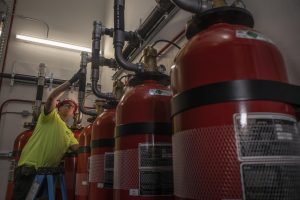
Blog photographs & illustrationsExisting HowToSurvive.in special-hazard suppression imageFull article
Special hazard fire suppression systems go beyond traditional fire sprinkler systems to provide fire protection in commercial and industrial facilities.
Why Special Hazards Systems? In places where water-based sprinkler systems aren’t enough to protect against fires, special hazards fire protection systems are put in place.
In high-risk places, special systems are often needed to quickly find and put out fires to save lives and property. These systems are made to protect high-value assets and processes and keep downtime to a minimum.
Common Special Hazard Fire Suppression Systems There are many different types of special hazard fire suppression systems used to protect buildings, such as:
FM-200:- is a type of fire protection that puts out fires quickly. It is good for the environment, safe for people to be in, has no color, doesn’t need to be cleaned up, and cuts down on downtime after a fire.
Noves 1230:- This system is very good at keeping important documents and electronics safe from fire. It is a clean agent fire suppressant that puts out a fire in seconds, doesn’t leave any residue, and doesn’t conduct electricity.
Intergern:- This highly effective gaseous fire suppression system puts out fires by mixing nitrogen, argon, and carbon dioxide.
Early Suppression, Fast Response (ESFR):- systems are replacing in-rack sprinkler systems in warehouses to protect storage that is high up.
Foam Fire Suppression:- Foam fire suppression systems are often used to protect areas with a high risk of fire, like aircraft hangars.
Deluge Systems:- A deluge system is a great way to keep dangerous areas safe. In a deluge system, all of the sprinkler heads are open and water or another agent is released through all of them at the same time. This creates a total flood that puts out the fire.
CO2 Fire Suppression:- This system uses CO2 to lower the amount of oxygen in the air to a point where fire can’t start. CO2 systems put out fires quickly and don’t need to be cleaned up.
Key risks
What needs attention
FM-200 is a trade name for HFC-227ea; zero ozone-depletion potential does not mean zero climate impact
The US EPA lists a 100-year global-warming potential of 3,220 for HFC-227ea and is phasing down HFC production and consumption under US law; Indian legal status and supply must be checked separately
3M states it completed its exit from PFAS manufacturing at the end of 2025, so legacy Novec 1230 systems require a documented agent, parts, recharge and transition strategy
Inert-gas blends such as IG-541 reduce oxygen concentration and require room volume, venting, cylinder storage, pipework and exposure assessment
CO2 is not simply a clean agent for occupied electronics rooms: extinguishing concentrations can cause asphyxiation, and accidental discharge during maintenance is a known fatal hazard
Water mist performance depends on the tested nozzle, pressure, spacing, enclosure and fire; extrapolating from one approval to another hazard is unsafe
Deluge systems normally use open nozzles or sprinklers and discharge across the designed zone after the releasing system opens the valve; they are not intended for every room fire
Foam type and concentration must match the liquid and hardware; PFAS-containing AFFF releases should be minimised and contained, while fluorine-free alternatives also need performance and environmental evaluation
ESFR may permit ceiling-only protection in specific storage arrangements, but it does not automatically eliminate in-rack sprinklers
Prevention checklist
Controls that reduce risk
Write the protected hazard and design objective on the system record—not only the agent brand
Verify the installed agent, concentration, quantity, cylinder pressure or mass and approved design calculations
Check room doors, dampers, penetrations, raised floors and ceiling voids against the latest enclosure-integrity test
Confirm pre-discharge alarms are perceptible and allow the approved escape sequence
Test detection voting, manual release, abort function where provided, shutdowns, dampers and remote notification
Physically isolate hazardous gaseous systems during work when the approved procedure requires it
Review CO2 warning signs, rescue policy and re-entry atmospheric-testing procedure
Inventory legacy HFC and fluoroketone agent, recharge availability, recovery arrangements and transition options
Identify foam chemistry, compatible fuel, test concentrate, containment route and waste-disposal method
Require competent redesign after any hazard, enclosure, ventilation, equipment or environmental-policy change
Mistakes to avoid
Common unsafe practices
Selecting an agent because it leaves no residue without checking whether it extinguishes the actual fuel
Calling every gaseous system safe for occupied rooms
Using CO2 total flooding where people can enter without robust safeguards and isolation procedures
Replacing Novec 1230 or HFC-227ea with a new agent without recalculating concentration, flow, cylinders, nozzles and room pressure
Skipping enclosure-integrity and pressure-relief assessment for gaseous systems
Assuming water mist works for any electrical, battery, oil or machinery fire
Discharging or training with PFAS-containing foam without containment and disposal planning
Treating a deluge discharge as proof that detection logic, distribution and water supply meet the design
Changing room walls, cable penetrations, ventilation or raised floors without retesting gaseous-system integrity
Expecting flame knockdown to end thermal runaway, hot-metal reaction or leaking-fuel hazards
02
Watch & learn
Related Videos
Verified suppression learning
Fire Water Spray System in Hindi HVWS MVWS Working Principle System Requirements Advantage
Fire Safety Academy · Language as published
Directly relevant supporting material for this blog's suppression subject; playback was available in the checked catalogue.
03
Facts & action
Evidence, Cases & Next Steps
Broad technology families8Sprinkler or preaction, mist, spray or deluge, foam, clean chemical, inert gas, CO2 and dry or wet chemical
HFC-227ea 100-year global-warming potential3,220US EPA value; not a discharge concentration
End of 3M PFAS manufacturing2025Completed company-wide exit reported by 3M
Evidence chart
Broad proven protection; water and hazard compatibility must be addressedWater sprinkler or preaction
Lower water volume potential; strongly application and listing dependentWater mist
Rapid zoned exposure or equipment protection; high water and drainage demandWater spray or deluge
Compatible flammable-liquid control; concentrate and environmental constraintsFoam or foam-water
Low residue; climate, decomposition, enclosure and lifecycle constraintsClean chemical agent
No HFC agent; cylinders, venting, pressure and oxygen exposure constraintsInert gas
Strong extinguishment and no residue; severe life-safety hazardCarbon dioxide
Targeted hazards such as cooking or local industrial equipment; residue and compatibilityWet or dry chemical
Verified facts
What the evidence supports
Design starting point | Fuel, fire scenario and performance objective
Occupied enclosure | Exposure, alarm, egress, discharge delay and agent decomposition must be assessed
Gaseous system | Requires concentration, distribution and enclosure-hold-time proof
Water mist | Application-specific tested system, not merely a finer sprinkler
Deluge or water spray | Open discharge devices protect a defined area or equipment when the release valve opens
Foam | Selected for compatible flammable-liquid or other tested hazards with containment and environmental planning
CO2 | Effective and residue-free but potentially lethal at extinguishing concentrations
ESFR | A storage-sprinkler design concept, not a replacement for every in-rack or special-hazard system
Do This Today
Immediate prevention actions
Read the agent label, system nameplate and latest service report
Confirm the protected fuel and enclosure still match the approved design basis
Look for new cable holes, raised-floor openings, doors or HVAC changes in gaseous rooms
Test warning signs and confirm staff recognise pre-discharge and evacuation alarms
Check cylinders, tanks, pumps and concentrate are in date, accessible and correctly supervised
Ask how an accidental CO2 or inert-gas discharge is isolated and how re-entry atmosphere is verified
Find where discharged foam or contaminated firewater will flow
Document recharge agent and parts availability for legacy HFC or fluoroketone systems
Open one impairment record and verify the system was restored and functionally tested
If danger develops
Emergency survival steps
On any suppression alarm, stop work and follow the posted evacuation sequence immediately
Leave before gaseous-agent discharge and never delay to collect equipment
Do not enter a room after CO2, inert-gas, clean-agent, aerosol or chemical discharge
Call 112 and identify the agent, protected hazard, room and whether anyone is missing
Keep doors closed unless the approved emergency procedure or responders direct otherwise; premature ventilation can cause re-ignition or spread contamination
Avoid foam, chemical runoff and decomposition products and stay upwind where possible
Do not operate an abort, manual release or isolation device unless trained, authorised and following the emergency plan
Give responders the safety data sheet, agent quantity, detection logic, shutdown status and hazard inventory
Re-entry requires authorised clearance, atmospheric testing where applicable and confirmation that the fire and re-ignition hazard are controlled
Restore or provide approved temporary protection before the hazard returns to service
What the data does not show
Limitations
No single dataset compares success rates of all special-hazard technologies across Indian occupancies
Agent trade names, formulations and availability change, so the approved product documents and safety data sheet must be checked at procurement and service
EPA HFC rules and values describe US regulatory context; India follows its own Kigali implementation and domestic requirements
3M's PFAS exit does not automatically make every installed fluoroketone system illegal or unusable, but it creates lifecycle and supply questions
Environmental impact cannot be reduced to one metric; toxicity, persistence, breakdown products, discharge frequency and waste handling also matter
CO2 alarm thresholds cited are US workplace provisions, not a design recipe
Embedded Hindi videos predate some 2025–2026 environmental and supply developments
Sources and further reading
Community discussion
Questions, experience and constructive safety discussion
Comments publish immediately unless security controls identify spam. Please do not post private information, unsupported allegations or unsafe instructions.


Leave a comment