
What happened here
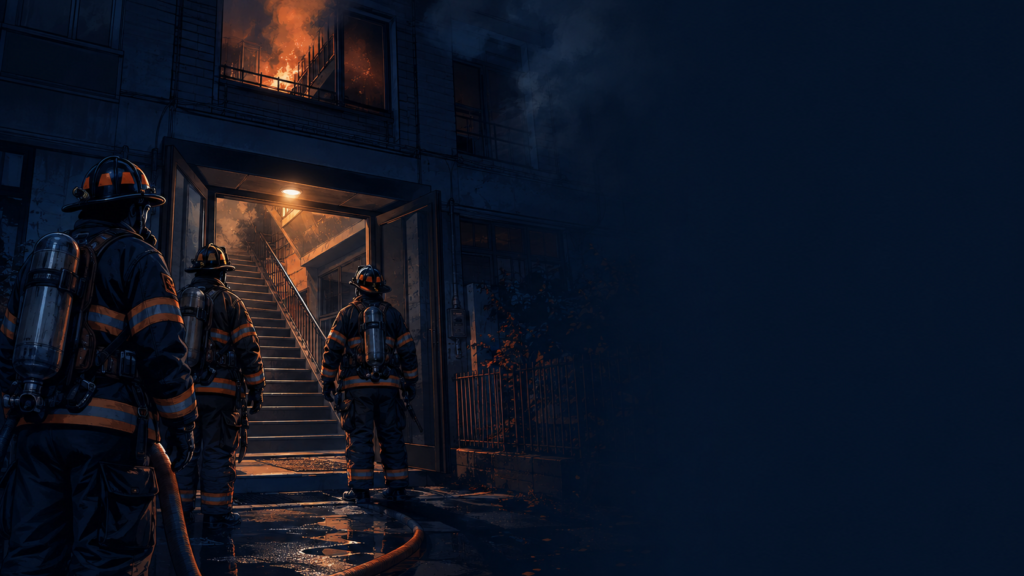
A response review focused on rescue information, damage scope and facts that remain unreported.
Quick answers
What happened in the Westminster flat fire on Medway Street?
On 6 September 2026, London Fire Brigade reported a fire on Medway Street, Westminster, that damaged half of a second-floor flat and part of a third-floor flat. Firefighters brought one man to safety, and the cause is under investigation.
Does a firefighter rescue by staircase mean stairs are always safe in a fire?
No. The rescue route describes a professional operation in that building at that time. It cannot establish that every staircase is safe during every fire, and professional rescue decisions are not a universal evacuation rule.
What information should be given to firefighters on arrival?
Give the location, the time of your observation and any uncertainty. Saying you last saw someone near a doorway is different from claiming they are definitely inside. Never enter a dangerous building to check a detail.
What to do if someone may still be inside a burning building?
Call 112 from a safe place and tell responders that someone may be missing. Do not re-enter the building yourself.
The confirmed incident
London Fire Brigade reports a fire on Medway Street, Westminster, on 6 September 2026. Half of a second-floor flat and part of a third-floor flat were damaged. Firefighters searched the building and brought one man to safety through an internal staircase; ambulance crews assessed him at the scene. The cause is under investigation. Official LFB incident bulletin.
What the rescue account does not establish
The recorded rescue route describes a professional operation in this building at that time. It cannot establish that every staircase is safe during every fire. The report also does not provide a complete occupant register or a final injury assessment. These gaps should remain visible when the case is shared.
Learning exercise: make a reliable handover
For a preparedness discussion, practise separating what you saw from what someone else told you. A useful handover states the location, observation time and uncertainty. For example, “I last saw someone near that doorway” is different from claiming that a person is definitely still inside. Do not enter a dangerous building to check a detail for the sake of completing a report.
Building managers can prepare an address and contact sheet in advance. Keep personal details restricted to those who need them and give urgent information directly to responders. The purpose is a clear handover, not a crowd-sourced rescue operation.
Media context
The cover is an AI-generated illustration, not the incident scene. Videos are related Indian learning material. Searches did not identify verified footage of this specific Westminster incident; footage from other places named Medway has been excluded.
- First call
- Fire under control
- Bulletin update
Why consequences escalated
- Editorial learning: distinguish observed information from second-hand accounts.
- Professional rescue decisions cannot be turned into a universal evacuation rule.
Failures and risk multipliers
- No verified pre-incident violation or individual fault is identified in the source.
Actions that reduce risk
- Prepare a clear building address and contact record.
- Share last-known observations with responders and label uncertainty.
- Avoid repeating unverified rescue or casualty claims.

Leave a comment