
Quick answers
How to make a home fire escape plan that the whole family understands?
Hold a calm discussion and ask each household member to describe the designated route in their own words. Note where answers differ, and take uncertainty about doors, stairs or an alternative route to the building manager or a fire-safety professional.
What questions should a household fire escape plan answer?
It should record which designated route each person has been shown, who needs assistance and what arrangements are agreed, where everyone should report after leaving, and who will resolve any unclear part of the plan.
Can a window, ledge or rooftop be used as a backup fire escape route?
A window, ledge or rooftop jump should not be treated as a planned alternative. Follow the arrangements appropriate to the building, report any obstructed route for correction and obtain help with unresolved access needs.
What to do during a house fire emergency in India?
Use a safe designated exit and follow emergency-service instructions. Once outside, stay outside and do not re-enter a burning building. For emergency assistance in India, call 112.
Start before there is smoke
A plan is useful only if the people who rely on it understand it. Uttar Pradesh Fire Services asks households to know their escape options, agree where to meet and avoid returning inside a burning building. Official household escape-plan guidance.
Have each person explain the route
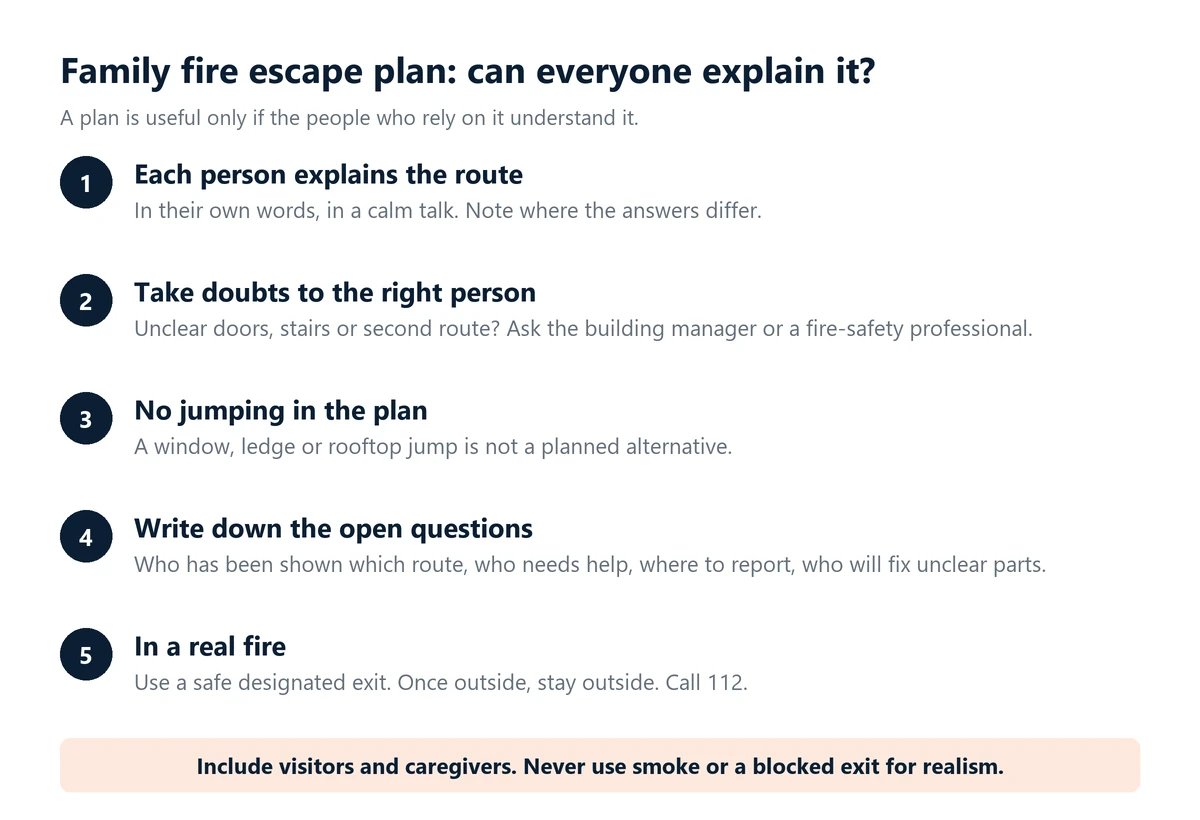
In a calm discussion, ask household members to describe the designated route in their own words. Note where their answers differ. Take uncertainty about doors, stairs or an alternative route to the building manager or fire-safety professional; a sketch alone cannot establish that a route is safe.
Do not treat a window, ledge or rooftop jump as a planned alternative. Follow the arrangements appropriate to your building and obtain help with unresolved access needs.
Record questions, not assumptions
- Which designated route has each person been shown?
- Who needs assistance, and what arrangements have been agreed?
- Where should everyone report after leaving?
- Who will resolve any unclear part of the plan?
Use a short note that everyone can find. If a route is obstructed, report it for correction. Do not quietly draw another arrow and assume the problem has disappeared.
Make the discussion practical
Include visitors and caregivers when explaining the plan. Ask someone unfamiliar with the building to describe what they understood. A misunderstanding found during an ordinary conversation is something you can resolve before an alarm.
Do not stage a dangerous exercise, introduce smoke or block an exit for realism. Arrange any formal drill through the responsible building team.
How often should a family practise its escape plan, and what should the walk-through test?
Practise it twice a year, and test more than the route on paper. Ready.gov, the United States government’s public preparedness site, advises practising a home fire escape plan twice each year and finding two ways out of each room in case the usual way is blocked by fire or smoke. It also warns that a fire can become life-threatening in just two minutes. This is American guidance, and an Indian flat may have one door and one stair, so use it to decide what to ask, not as a rule for your building. See the Ready.gov guidance on home fires.
What to check in a calm walk-through
- Doors. Ready.gov says to sleep with the bedroom door closed. Before opening a door, feel the door and the knob. If either is hot, or smoke is coming around the door, leave it closed. If you do open a door, open it slowly.
- Windows and grilles. Ready.gov asks people to check that windows are not stuck and that screens come out quickly. In many Indian homes the equivalent is a grille or lock. Ask where the key is kept and whether every adult can use it.
- In the dark. Ready.gov suggests practising the way out in the dark or with eyes closed. Do this only on level floor in a calm moment, and never on a staircase.
- Anyone who uses a walker or wheelchair. Ready.gov says to check all exits to be sure the doorways are wide enough to get through.
- Children. Ready.gov says to teach children not to hide from firefighters.
What our NBC 2026 chapter adds for homes
Our chapter on homes, apartments and hotels points to a few things a family can look at. For lodging houses it says locks that cannot be released quickly, such as chain bolts, are not allowed, and bathroom locks must open from outside in an emergency. It says the only way out should not pass through a non-residential use in the same building, which matters if you live above a shop. It says a floor of 500 square metres or more needs two separate exits, and that no stove or heater should stand at the foot of a stair.
NBC 2026 is voluntary until a state adopts it, and the building may have been approved under earlier rules. A walk-through at home is not an inspection. If something looks wrong, such as a blocked stair or a locked exit door, take it to the building manager and the fire officer, who decide what applies to a real building.
During an emergency
Use a safe designated exit and follow emergency-service instructions. Once outside, stay outside. For emergency assistance in India, call 112. Official ERSS information.
What this guide provides
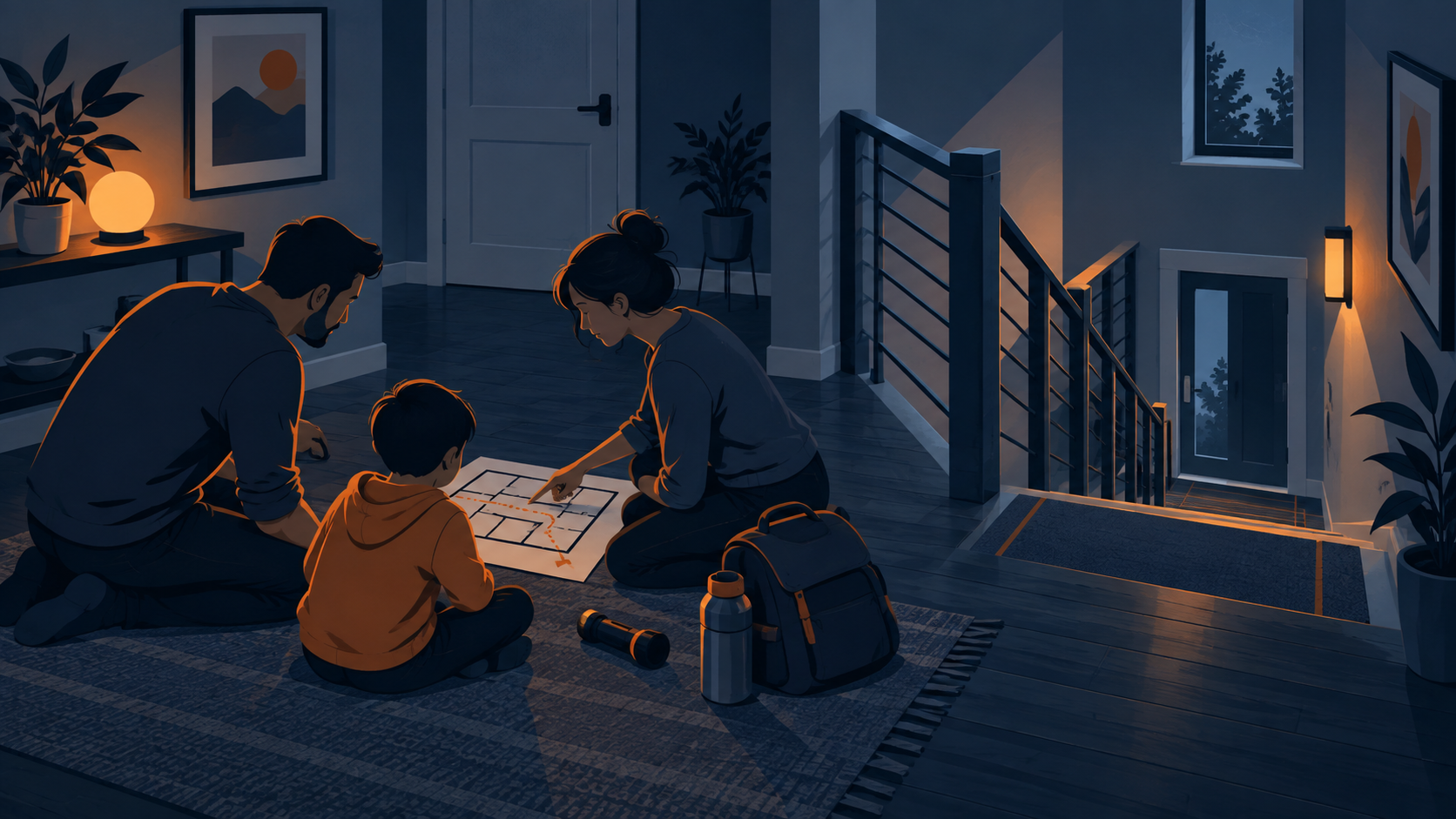
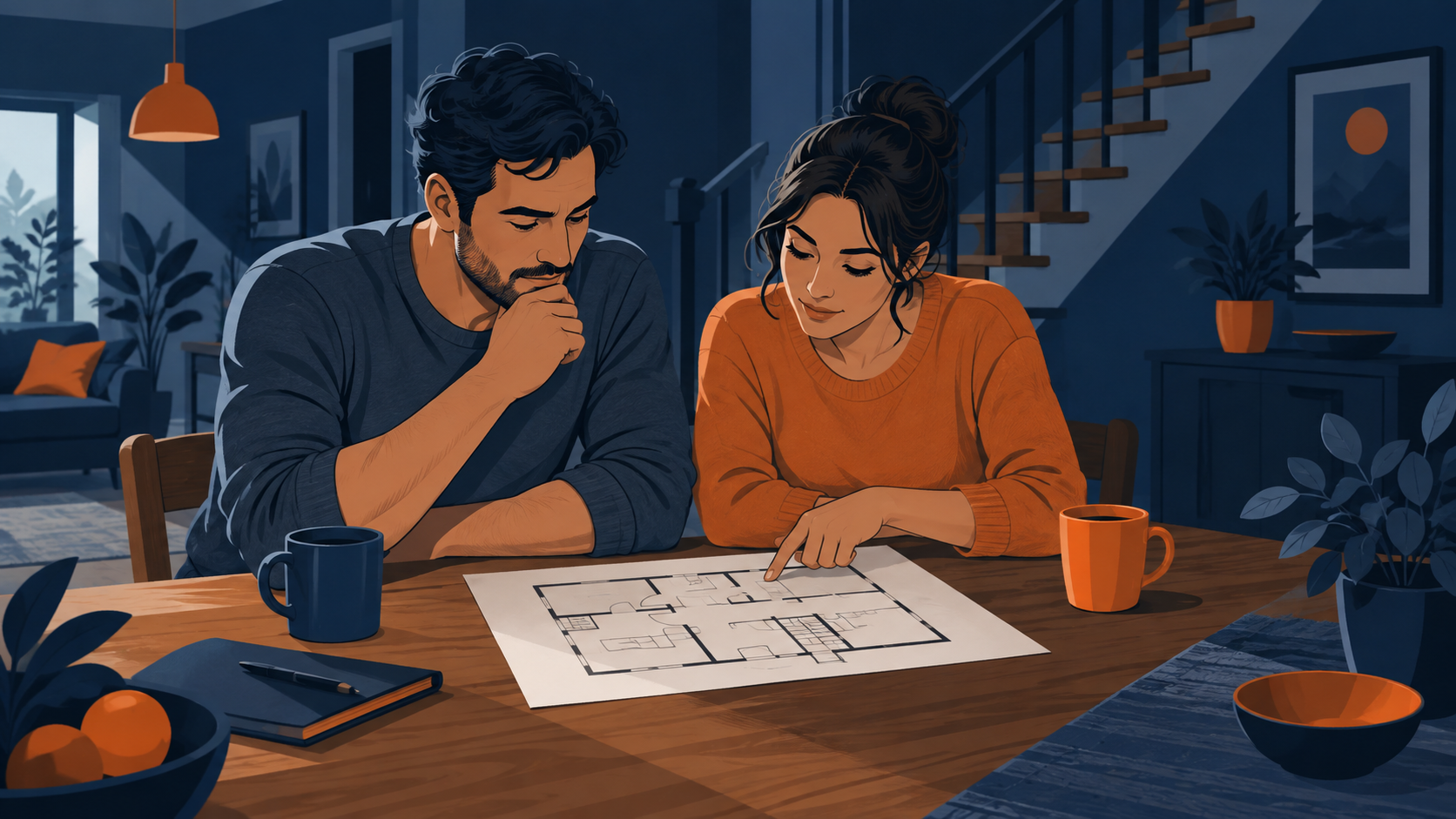
This is an editorial planning aid based on Indian official guidance, not a building inspection or certification. No national statistic is needed for the activity, so the data panel contains practical checks rather than invented percentages. Both supplied images are AI illustrations of a fictional household planning session.
What needs attention
- A route description can reveal questions that a familiar-looking plan hides.
Controls that reduce risk
- Ask each person to explain the plan.
- Record questions and the person responsible for resolving them.
Common unsafe practices
- Do not assume everyone understood the same instruction.

Leave a comment