
What happened here
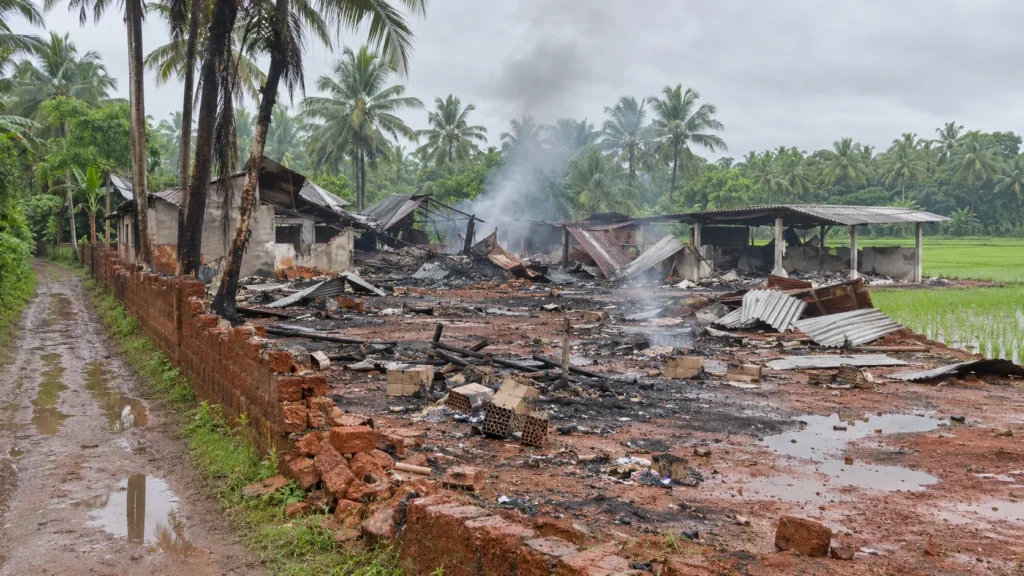
At about 3.30 pm on Tuesday, 21 April 2026, explosions ripped through a fireworks manufacturing unit at Mundathikode, near Thrissur, Kerala, where fireworks were being prepared for the Thiruvambady side of the Thrissur Pooram. The unit had eight sheds on nearly five acres; five caught fire, three of them holding large stocks of explosives. Reports put the toll at 16 to 17 and the injured at about 40 (over 24 in later court coverage); about 50 houses were damaged. The District Collector said 43 people were present and 27 survived. On 3 November 2026, 196 days later, a judicial commission reported to the Home Minister that about 7,000 kg of explosives had been stored against a permitted 15 kg, that banned potassium chlorate was widely used, and that friction between chemicals in the heat started a fire that led to the explosion. A chargesheet has been filed and the Kerala High Court is monitoring the case. The commission's recommendations and the final toll are not settled in the coverage reviewed.
Quick answers
What happened at Mundathikode on 21 April 2026?
Explosions destroyed sheds at a fireworks unit near Thrissur, Kerala, at around 3.30 pm, while fireworks were being prepared for the Thrissur Pooram. Reports put the toll at 16 to 17 and the injured at about 40.
How many people died?
Sources differ. The coverage of the commission's 3 November 2026 report says 16 were killed; The News Minute reported 17 on 27 April and The Hindu's court coverage also says 17. We say 16 to 17.
What did the judicial commission find?
That about 7,000 kg of explosives were stored at the unit against a permitted 15 kg, that banned potassium chlorate was widely used, and that friction between chemicals in the high temperature started a fire that led to the explosion.
Who stored the explosives?
The commission, as reported, says those who had taken the fireworks contract stored about 7,000 kg. The unit's licensee died of burns on 24 April and could not give evidence. We do not name anyone.
Has anyone been charged?
Police have filed a chargesheet under the Bharatiya Nyaya Sanhita, the Explosives Act, 1884 and the Explosive Substances Act, 1908. The coverage reviewed does not say who is named or whether anyone was arrested.
Was compensation paid?
The state announced Rs 14 lakh each for the families of the dead and told the Kerala High Court in July that compensation had been paid. The Prime Minister announced Rs 2 lakh for each family and Rs 50,000 for each injured person.
Why is potassium chlorate banned in fireworks?
The commission calls it a banned explosive substance, and The New Indian Express says it is highly sensitive to friction, which raises the risk of a fire or blast during mixing and handling.
What should people living near such a unit do after a blast?
Move well away, do not touch debris because more explosions can follow, and call 112. Ask the local authorities for soil and water testing and for counselling if needed.
What happened on 21 April 2026
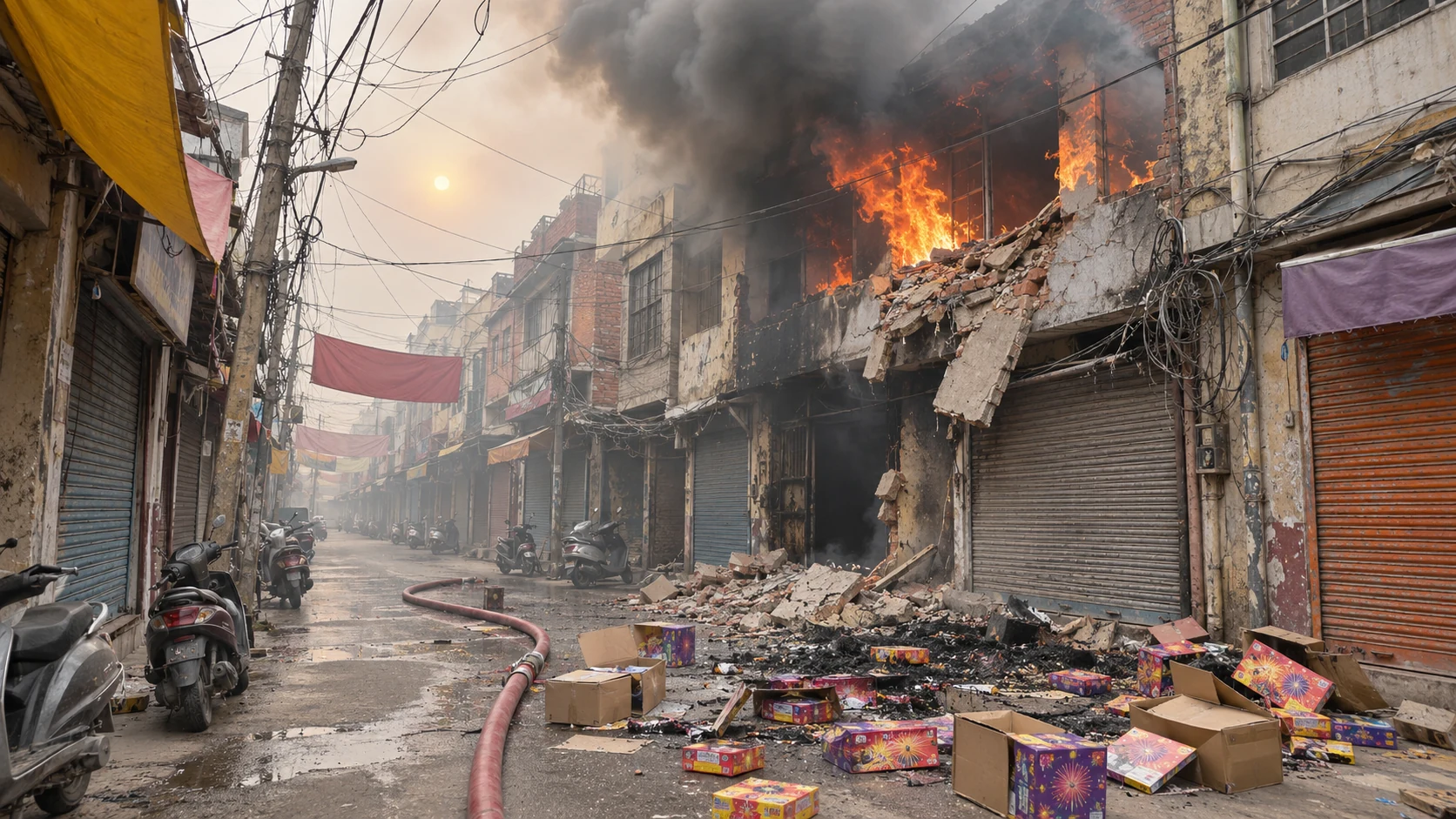
On the afternoon of Tuesday, 21 April 2026, a series of explosions tore through a fireworks manufacturing unit at Mundathikode, near Thrissur in Kerala. Workers there were preparing fireworks for the Thiruvambady side of the Thrissur Pooram, the temple festival that was only days away. The Hindu says the blast came at around 3.30 pm and that locals compared the roar to an earthquake. South First’s day-one report speaks of two powerful blasts within seconds of each other, heard several kilometres away.
The Hindu describes a unit in the Kuttamkulam fields spread over nearly five acres, with eight sheds. Five of them caught fire, three of them holding large quantities of explosive material. Rescue was slow. The unit stood in a large plot next to paddy fields with limited access, repeated blasts kept rescuers back, and earthmovers were brought in to clear a way for fire engines. South First adds that firefighters had to break through a nearby wall to get in. Explosions continued on and off for hours. Windows of nearby houses were shattered, and later court coverage speaks of about 50 houses damaged.
Early counts rose through the week as injured workers died in hospital. The first reports spoke of nine dead; The Hindu’s evening report put it at 13, with around 40 injured, five of them with severe burns and 23 admitted to Government Medical College Hospital, Thrissur. The unit’s licensee suffered severe burns and died in hospital on 24 April, which means he could not give evidence to the later inquiry. We have not named any of the victims.
On 29 April the District Collector told the inquiry commission that 43 people had been present at the site and 27 of them survived (The Hindu). The commission’s chair said that day that 43 people had reportedly been working and storing explosives in three small sheds placed close together, with no firefighting system and no access for emergency vehicles. Officials said the dead were identified from bodies and many recovered body parts, and DNA samples were taken for testing (South First, The Hindu).
Follow-up: the commission’s report, 3 November 2026
On Tuesday, 3 November 2026, 196 days after the blast, the one-member judicial commission headed by retired Justice Ramachandran Nair handed its report to Kerala’s Home Minister. Coverage by The Hindu, The New Indian Express and Deccan Herald (PTI) reports its main findings as follows:
- Storage: the unit was permitted to store 15 kg of explosive material, but those who had taken the fireworks contract had stocked about 7,000 kg there. The New Indian Express puts this at nearly 467 times the limit and says the contractors “allegedly” did so.
- Banned chemical: potassium chlorate, a banned explosive substance, was widely used in making the fireworks. The New Indian Express adds that it is highly sensitive to friction.
- Cause, as the commission found it: friction between chemicals in the high temperature set off a fire, and the fire led to the massive explosion.
The coverage reviewed does not give the report’s recommendations, and the full text was not available. In April the commission’s chair had said the panel would also look at whether fireworks displays can be held safely, and would make recommendations. Nothing in the coverage says yet whether the report will be made public.
Where the reports differ
- Final toll: 16 killed in the coverage of the 3 November report (The Hindu, The New Indian Express, Deccan Herald) and in the commission chair’s April statement of “officially declared” deaths (The Hindu, 29 April). 17 killed in The News Minute’s report of 27 April, which says one more worker died in hospital that day, and in The Hindu’s court coverage from July to September. We say 16 to 17, and use 16 on our map.
- Injured: about 40 on the first day and in the 3 November coverage; over 24 in The Hindu’s later court coverage.
- Early toll: day-one and early reports gave 9, 12, 13 and later higher figures as more people died. The old figures should not be used.
- What set it off: the commission found friction between chemicals in the heat. A survivor told the police he had seen a spark before the explosion (The Hindu, 29 April), and early reports spoke of chemical mixing in summer heat (South First). These are earlier witness and preliminary accounts, and the commission’s finding is the one we put forward.
What happened in court and afterwards
- The Kerala High Court took up the matter on its own, on the basis of news reports. By 28 August the police had filed a chargesheet under the Bharatiya Nyaya Sanhita, the Explosives Act, 1884 and the Explosive Substances Act, 1908. An inquiry by the Additional District Magistrate was also on (The Hindu).
- The Centre and the Deputy Chief Controller of Explosives told the High Court that the unit had more workers than permitted, that fireworks were carried in the open and that the mandatory safety zones between work areas were not kept (The Hindu, 28 August).
- On 23 July the Advocate General told the court that some manufacturers supplied far larger quantities of fireworks for public displays than they were authorised to, without proper storage. The Thrissur police commissioner proposed joint pre-licence inspections, regular safety audits, two wide access roads to every unit, grounding of static charge at shed entrances, training and certification of workers, and heavier penalties (The Hindu).
- The state announced Rs 14 lakh each for the families of the dead in June (The New Indian Express, Deccan Herald). The Prime Minister had announced Rs 2 lakh for the next of kin of each person killed and Rs 50,000 for each injured in the first days after the blast (South First). The state told the High Court in July that compensation had been paid.
- A month after the blast, six survivors living near the site were treated for symptoms like those of post-traumatic stress. Others told The Hindu in September that they had received no help.
- On 30 September The Hindu reported that tests by the State Pollution Control Board found chromium, copper, vanadium and cyanide above permissible limits in the topsoil at the site, with removal of about 1,470 tonnes from about 7,000 square metres recommended. The local Member of Parliament has written that the recommended action has not been taken.
- The two devaswoms decided not to hold their fireworks at this year’s Pooram (The News Minute). A PTI report says rituals went ahead and only one symbolic round of crackers was to be burst.
What is not known
- The commission’s recommendations, and whether the report will be published in full.
- Whether anyone has been arrested, and who exactly is named in the chargesheet. The coverage reviewed does not say.
- What the licence allowed apart from the 15 kg storage figure, and what action the licensing authority has taken since.
- The exact final toll, which sources give as 16 or 17.
- Whether the contaminated soil has since been removed, and whether any additional compensation has been decided.
What this case teaches
The headline figure is the gap: 15 kg permitted, about 7,000 kg stored, according to the commission. When the quantity on site is hundreds of times the licence limit, every distance, shed size and escape plan worked out on paper stops meaning anything. Add friction-sensitive chemicals that are banned for this work, crowded sheds and no road in for the fire engines, and a spark in the afternoon heat can decide the rest. The commission’s chair said the harm was made worse by poor safety measures and that proper precautions might have avoided the accident.
For similar hazards on our site, see the Vellore Arjunapuram explosives godown blast, the Anaikattu cracker godown blast in Vellore, the Siwan firecracker house blast, the Narketpally detonator factory blast and the Ludhiana Field Ganj firecracker fire. Our guide Firecracker factory blasts in India explains what usually goes wrong, illegal home firecracker units and cracker storage covers storage, and explosives and fuel at road, mining and construction sites sets out the rules.
What units, workers, neighbours and festival committees can do
- Licence holders and contractors: keep what is stored on site within the licensed quantity, and never let it build up because a festival order is large. Keep sheds apart as the licence requires, with two wide roads in for fire engines. Do not use banned chemicals such as potassium chlorate. Keep the number of people in a shed to what the licence and the work need.
- Workers: ask what you are working with and how much is stored near you. Know your nearest way out and where to gather away from the sheds. You may refuse a task that has not been made safe, and you can report unsafe storage to the police or the licensing authority, the Petroleum and Explosives Safety Organisation (PESO).
- Festival committees: do not ask a maker for more than the licence lets them supply or store. The Thrissur police commissioner’s proposal is that committees who do so should face the penalty for abetment.
- Neighbours: if there is a blast, move well away and keep others away. More explosions can follow. Do not touch debris or burnt material, and call 112. Ask your panchayat or the District Collector for soil and water testing if a site has burnt, and for counselling if you are struggling afterwards.
- Everyone: save the emergency numbers on your phone. Emergency numbers in India tells you which to call, and our guide to festival crowds covers staying safe at melas and pandals.
Live or work in Thrissur or near Mundathikode? Our Thrissur safety guide lists the emergency numbers, the fire stations in the district and the main local risks.
- Explosions destroy sheds at the Mundathikode fireworks unit; blasts continue for hours and slow the rescue
- The Chief Minister orders an inquiry; the Prime Minister announces Rs 2 lakh for the next of kin of each person killed and Rs 50,000 for each injured
- A high-level meeting decides there will be no fireworks at the Thrissur Pooram, scheduled for 26 April; rituals to go ahead
- The unit's licensee dies of burns in hospital
- The News Minute reports the toll at 17 after another worker dies in hospital
- The commission visits the site; the Collector says 43 were present and 27 survived; the chair describes the safety lapses
- The state announces Rs 14 lakh each for the families of those killed
- The state tells the Kerala High Court that compensation has been paid; the Advocate General and the police commissioner place safety proposals before the court
- The High Court is told a chargesheet has been filed and that the Centre found more workers than permitted and safety zones not kept
- Soil at the site is reported contaminated above permissible limits; removal recommended
- The judicial commission submits its report to the Home Minister: about 7,000 kg stored against 15 kg permitted, banned potassium chlorate, friction in the heat
Why consequences escalated
- Explosions destroyed sheds at a fireworks unit at Mundathikode, near Thrissur, on 21 April 2026, killing 16 to 17 people and injuring about 40.
- The commission reported on 3 November 2026 that about 7,000 kg of explosives had been stored against a permitted 15 kg.
- The commission found banned potassium chlorate widely used, and friction between chemicals in the heat started a fire that led to the explosion.
- The commission's chair said in April that 43 people were working and storing explosives in three small sheds close together, with no firefighting system and no access for emergency vehicles.
- The Centre told the High Court that more workers than permitted were deployed and safety zones were not kept.
- The final toll is 16 or 17 depending on the source, and the commission's recommendations are not public in the coverage reviewed.
Failures and risk multipliers
- Storage far above the licence: about 7,000 kg against a permitted 15 kg, according to the commission.
- A banned, friction-sensitive chemical, potassium chlorate, was widely used (commission).
- Many workers in a few small sheds close together, with no firefighting system and no access for emergency vehicles (commission chair, April).
- More workers than permitted, fireworks carried in the open and safety zones not maintained (the Centre and the Deputy Chief Controller of Explosives, to the High Court).
- These are findings and statements as reported. They are not rulings by a court, and the chargesheet's contents are not in the coverage reviewed.
Actions that reduce risk
- Keep what is stored within the licensed quantity, and do not let festival orders push stock past it.
- Keep banned, friction-sensitive chemicals such as potassium chlorate out of the work altogether.
- Limit the number of people in each shed, keep sheds apart as licensed, and keep two wide access roads and firefighting means for emergency vehicles.
- Train and certify workers; carry out joint inspections and regular safety audits, as proposed to the High Court.
- After a blast, keep away from the site, call 112, and ask for soil and water testing and counselling for people nearby.




Leave a comment