
Quick answers
What happened at Pinakota on 24 October 2026?
A fire and explosion at a road-construction site in Ananthagiri mandal, ASR district, killed seven people. Police said it began during diesel refuelling and was an accidental fire. Police later said no traces of gelatin explosives were found, while another Telugu report says only that no visible explosive traces were seen; the reports do not fully agree. Early reports had blamed gelatin sticks. The inquiry has no published finding.
Do you need a licence to store diesel at a work site?
PESO lists diesel among petroleum that needs a licence under the Petroleum Rules, 2002, but its FAQ says storage below 2,500 litres of Class B or 45,000 litres of Class C is exempt, with a one-time PESO approval for Class C. PESO does not state diesel's class; check the supplier's data sheet.
Can explosives be delivered straight to the blasting site?
PESO's FAQ says no: the consignor must deliver cartridged explosives to the consignee's licensed magazine, not directly to a blasting site (Rule 90(1)).
Who is allowed to blast?
A person holding a shot firer's certificate and permit to blast (Form LE-10, valid up to five years) must do or supervise the loading and firing, per PESO's FAQ.
How far must people stay from an opencast blast?
The Metalliferous Mines Regulations, 1961 (regulation 164) require warning and shelter for everyone within 300 metres of the firing point in an opencast working. It is a mines rule and not a rule for every roadside blast.
What do the construction rules say about explosives?
The BOCW Central Rules, 1998 require explosives to be used under a responsible person, with warning and danger signals for workers and the public, and no smoking, naked lights or other ignition sources near them (rules 212 and 213).
What should I do if I see explosives kept in a vehicle or shed?
Do not touch them. Call 112 and the District Magistrate's office. We have not checked who takes a complaint about unlicensed storage.
What should I do if there is a fuel fire?
Leave and keep going, warn others, call 112, 101 or 108, and do not try to fight a fire that has reached drums, a tank or explosives. Cool a burn under cool running water for about 20 minutes and get emergency help for a large or deep burn.
On the morning of Saturday 24 October 2026, a fire and explosion at a road-construction site near Pinakota, in Ananthagiri mandal of Alluri Sitarama Raju (ASR) district, Andhra Pradesh, killed seven people. Early reports blamed gelatin sticks kept for blasting the hillside. The police account differs: an accidental fire during diesel refuelling, with no traces of gelatin explosives found, though the reports do not fully agree on that point. The full account, with the reports and what is still unknown, is in our case study of the Pinakota fire; we do not repeat it here. This page asks a wider question that every contractor, quarry owner, mine manager and village near a work site should be able to answer: what do the rules actually say about keeping and moving explosives and fuel, and what should a careful site do beyond the rules? We opened the PESO guidance on the Explosives Rules, 2008 and the Petroleum Rules, 2002, the Metalliferous Mines Regulations, 1961 and the Building and Other Construction Workers Central Rules, 1998, and we say plainly where a figure comes from a foreign rule or is our own suggestion. Updated 26 October 2026.
In short
- Two different hazards. Blasting explosives and diesel are covered by different laws, different licences and different safe distances. Mixing them up helped the early reports go wrong at Pinakota.
- Explosives need a licence at every step (storage for use, the road van, the shot firer), and PESO says explosives must go to a licensed magazine and not straight to a blasting site.
- Diesel is on PESO’s list of petroleum that needs a licence to store, but small quantities are exempt. At the roughly 250 litres reported in the ASR drums, the law asks little; the safety depends on what people do at the nozzle.
- Remote sites run on drums. Police told PTI that workers there carry diesel in drums to refuel vehicles because the site is around 100 km away. Drum refuelling is not unusual at remote sites, and that is where handling discipline matters most.
- Our suggestions for contractors, workers and villagers are in their own sections and are marked as ours.
What happened at Pinakota, in brief
About 8.30 am on 24 October, diesel was being transferred from a Bolero Camper to the fuel tank of a tipper at the site, according to police quoted by The New Indian Express (its page is dated 24 October in the web address and shows an update time of 25 October). A fire broke out, the tipper’s tank exploded, and the fire spread to two drums holding about 250 litres of diesel kept in the Camper. Seven people died, among them a primary-school teacher on her way to work. District Superintendent of Police Amit Bardar told PTI, as carried by NDTV, that it was not a blast but an accidental fire, that the workers may not have taken adequate precautions while filling the tank, and that a spark could have triggered it. The Hans India’s first report had said gelatin sticks for blasting the hill were kept in the vehicle; later, the SP told The New Indian Express that no gelatin sticks or traces of gelatin explosives were found when the site was examined (the case study also cites an unnamed official in a TeluguPeople report saying the same), while another Telugu report says only that no visible explosive traces were seen and still suspects gelatin. The reports do not fully agree. The Hindu reported that about 10 homes in the tribal village of Peechumamidi were damaged, with broken asbestos roofs and cracked walls. The inquiry is not finished and we found no published finding on the exact ignition source.
Whatever the final finding, the case sets the scene for this guide: a remote work site, fuel in drums, vehicles parked close together, workers and a passer-by near the fuel point, and homes a short distance away.
Explosives: what the Rules say
The Explosives Rules, 2008 are administered by the Petroleum and Explosives Safety Organisation (PESO) under the Explosives Act, 1884. The points below are taken from PESO’s own FAQ on the Rules, which gives the rule numbers. We could not open the full text of the Rules, so we quote the FAQ, and the Rules and their amendments should be checked for any specific job.
- Licence for each step. A licence is needed to manufacture, possess for use or sale, and transport commercial explosives. The forms are listed in Rule 113: for example Form LE-3 to possess explosives for use or sale in a magazine, Form LE-7 for a road van, and Form LE-10 for a shot firer’s certificate and permit to blast (valid up to five years).
- Licensed magazine, not the blasting site. PESO says the consignor must deliver cartridged explosives to the consignee’s magazine and not directly to a blasting site (Rule 90(1)). A loaded explosives van should not be parked near the mine or blasting site.
- Not with detonators. Class 2 and class 3 explosives must not be transported along with detonators (Rule 10(3)(c)).
- Cartridges stay as packed. Class 2 explosives must be used in their original cartridge packing and not cut open to make different sizes (Rule 89(2)).
- The road van. No passengers may be carried on hire (Rule 29). The driver and cleaner must have their antecedents verified by the local police. The van must carry its licence, the indent (Form RE-11), the transport pass (Form RE-12), the bill and the record of explosives (Form RE-6).
- Who may blast. Loading and firing must be done or supervised only by a person holding a shot firer’s certificate and permit to blast. A shot firer is tied to the licensed magazine named in the permit, and must keep a daily record of explosives received and fired for five years.
- Safety distances. Explosives are put in four categories by risk (X, Y, Z and ZZ), and magazines must keep the inside, middle and outer safety distances set in Schedule VIII and shown on the distance forms attached to the licence. A magazine cannot be built before a No Objection Certificate (Rule 104).
- Who can inspect. The Controller, District Magistrates, Executive Magistrates, Commissioners of Police and police officers of Sub-Inspector rank and above, and officers of the Director General of Mines Safety (DGMS) can enter, inspect, search and seize at licensed premises.
We did not find, in the pages we opened, a clause that fixes a distance between a diesel point and an explosives magazine. That is a gap in what we could open, not proof that none exists. The distance forms in the licence are where a magazine’s limits are written down, and a site owner can ask the licensing authority.
Mines: what the Metalliferous Mines Regulations say
The Metalliferous Mines Regulations, 1961 are made under section 57 of the Mines Act, 1952 and apply to every mine other than a coal or oil mine. We read a copy hosted on the Telangana High Court website; amendments after that copy may exist, and coal mines have their own regulations, which we did not open.
- Storage (regulation 154). Explosives within a mine’s premises must be stored only as the rules under the Explosives Act allow; no explosives may be kept in any building except a magazine approved by the licensing authority, with a limited exception the Regional Inspector can allow in writing for temporary storage near the mine entrance. The storage licence, or a true copy, must be kept at the mine office.
- Taking shelter (regulation 164). The blaster must make sure everyone nearby has taken shelter, and must keep people from approaching the shot. In an opencast working there must be sufficient warning, by efficient signals, over the whole area within 300 metres of the firing point (the “danger zone”), and everyone there must have taken shelter. If a public road or railway lies in the danger zone, two persons must be posted at its two extreme points in the zone and must clear traffic and warn passers-by. Where a permanent building not owned by the mine lies in the danger zone, the total charge fired at one time is capped at two kilograms unless the Chief Inspector or Regional Inspector permits more in writing.
- Handling (regulation 170). Nobody handling explosives or charging holes may smoke or carry a light other than an enclosed light or electric torch. Nobody may keep explosives in a dwelling house. Any explosives found in or about a mine must be deposited in the magazine and reported to the manager in writing.
- Fire (regulation 119). Inflammable materials must not be stored within 15 metres of any mine entrance that is not effectively sealed from the underground workings, and no fire may be lit within 15 metres without the manager’s written order.
- PESO’s FAQ adds that a shot-firer permit holder under the Explosives Rules cannot blast in an area covered by the Mines Act, 1952, and that for a site under that Act the No Objection Certificate comes from the Director General of Mines Safety.
The 300 metre figure is for opencast mines under these regulations. It is not a rule for every roadside rock cut or quarry, and we have not tried to decide which regime applies to a particular site. Where a job falls under the Mines Act, the Explosives Rules alone or the construction rules below depends on what kind of work it is; the contractor’s licence and the district authorities can say.
Construction sites: what the BOCW Central Rules say
The Building and Other Construction Workers (Regulation of Employment and Conditions of Service) Central Rules, 1998 have a short chapter on explosives. The employer must make sure that (rule 212) explosives are handled, used and stored as per the manufacturer’s instructions and material data sheet; that use is under the direct supervision of a responsible person; and that, before use, warning and danger signals are put up at conspicuous places to warn the workers and the general public. Rule 213 adds a ban on smoking, naked lights and other ignition sources where explosives are handled, stored and used; a safe distance and non-sparking tools when opening packages; stopping use and handling when the weather is unsuitable; and compliance with the rules under the Explosives Act. Rule 35 asks for fire-extinguishing equipment sufficient for any probable fire, adequate water supply, and trained persons to operate the equipment.
Rule 146 deals with oil and fuel stored in tunnelling work: in sealed containers, in fire-resistant areas, at safe distances from explosives and flammable chemicals. That is for underground work, not an open hillside. We found nothing in these Rules that sets a refuelling procedure for open-air vehicles. We have not checked whether these Rules apply to every road job, since some work falls under other laws.
Diesel: what the Petroleum Rules say
PESO’s list of products that need a licence under the Petroleum Rules, 2002 includes diesel (HSD), petrol, kerosene and furnace oil. The Rules sort petroleum by flash point: Class A below 23°C, Class B from 23°C up to but below 65°C, Class C from 65°C up to but below 93°C. PESO’s page does not say which class diesel falls in; the flash point printed on the supplier’s safety data sheet decides, and we do not guess.
PESO’s FAQ gives the exempt quantities: storage of Class A below 30 litres, Class B below 2,500 litres and Class C below 45,000 litres does not need a PESO licence, although a one-time approval from the PESO office is mandatory for Class C below 45 kilolitres. PESO recommends that even the exempt quantity be kept in a safe and secluded place in proved containers. District authorities can licence limited storage above those figures. Transporting Class A and B needs a licence in Form XI; transporting Class C does not.
Our reading: the 250 litres reported in the ASR drums is far below the exempt limits for any of the three classes, so the Rules would not have asked the contractor for a storage licence at that scale. That does not mean the handling was lawful or unlawful; it means the law at this scale leaves the real work to site discipline. We could not open the Petroleum Rules themselves and rely on PESO’s FAQ and list for these figures.
Refuelling practice: what a foreign rule says
We found no Indian clause that spells out how to refuel construction equipment in the open. The United States federal construction standard does, and its points are a useful checklist even though they are not Indian law. In 29 CFR 1926.152: only approved containers and portable tanks for flammable liquids, with approved safety cans for quantities of 5 gallons (about 19 litres) or less; no smoking or open flames in fuelling areas, with conspicuous no-smoking signs; the motors of equipment being fuelled shut off during fuelling; dispensing nozzles of the automatic-closing type; transfers of more than 5 gallons kept 25 feet from other operations, with drainage to control spills and good ventilation; spills disposed of promptly; a fire extinguisher rated at least 20-B:C where fuelling is done and on tank vehicles. For the more flammable liquids (its categories 1 to 3) it also requires the containers to be bonded before transfer and no ignition source within 50 feet of use. Rule 1926.151 prohibits smoking near fire-hazard operations. Which of these apply to a given diesel depends on its flash point, which is why the data sheet matters.
An earlier case: Hunasodu, Shivamogga, January 2021
On the night of 21 January 2021 a lorry loaded with gelatin sticks exploded at a stone-crushing unit at Hunasodu village on the outskirts of Shivamogga, Karnataka. Early reports differ on the number killed: The New Indian Express said six, then five bodies recovered with the toll unclear; The Week’s headline said five while its text said eight. We did not find a final count in the pages we opened. The Deputy Commissioner said the explosives had been stored in a stationary lorry at the unit and that illegal storage was clear; The Week reported that the gelatin had been brought from Tamil Nadu to blast rocks and that no permission for blasting had been given. The state ordered a high-level inquiry; three people were taken into custody. Pieces of the lorry were found on a roof about a kilometre away, and the sound was reported to carry 70 to 80 km. We read only two news reports on this case, so treat the details as reported, not established.
The pattern, as far as these reports go: explosives kept in an ordinary vehicle at a work site, close to workers, without the licensed storage and permission the Rules call for. That is the opposite of the licensed magazine and safety distances described above. See also our Myla warehouse detonation case, on why explosive storage should never share a boundary with civilian life.
Our suggestions for contractors and site supervisors
These are our own precautions, built on the rules above and the foreign checklist. They are not quoted legal requirements.
- Keep explosives and diesel on separate sides of the site, each with its own marked, fenced area. Ask the licensing authority what distance your magazine licence allows, and never keep detonators, gelatin or any blasting material in a vehicle that also carries fuel.
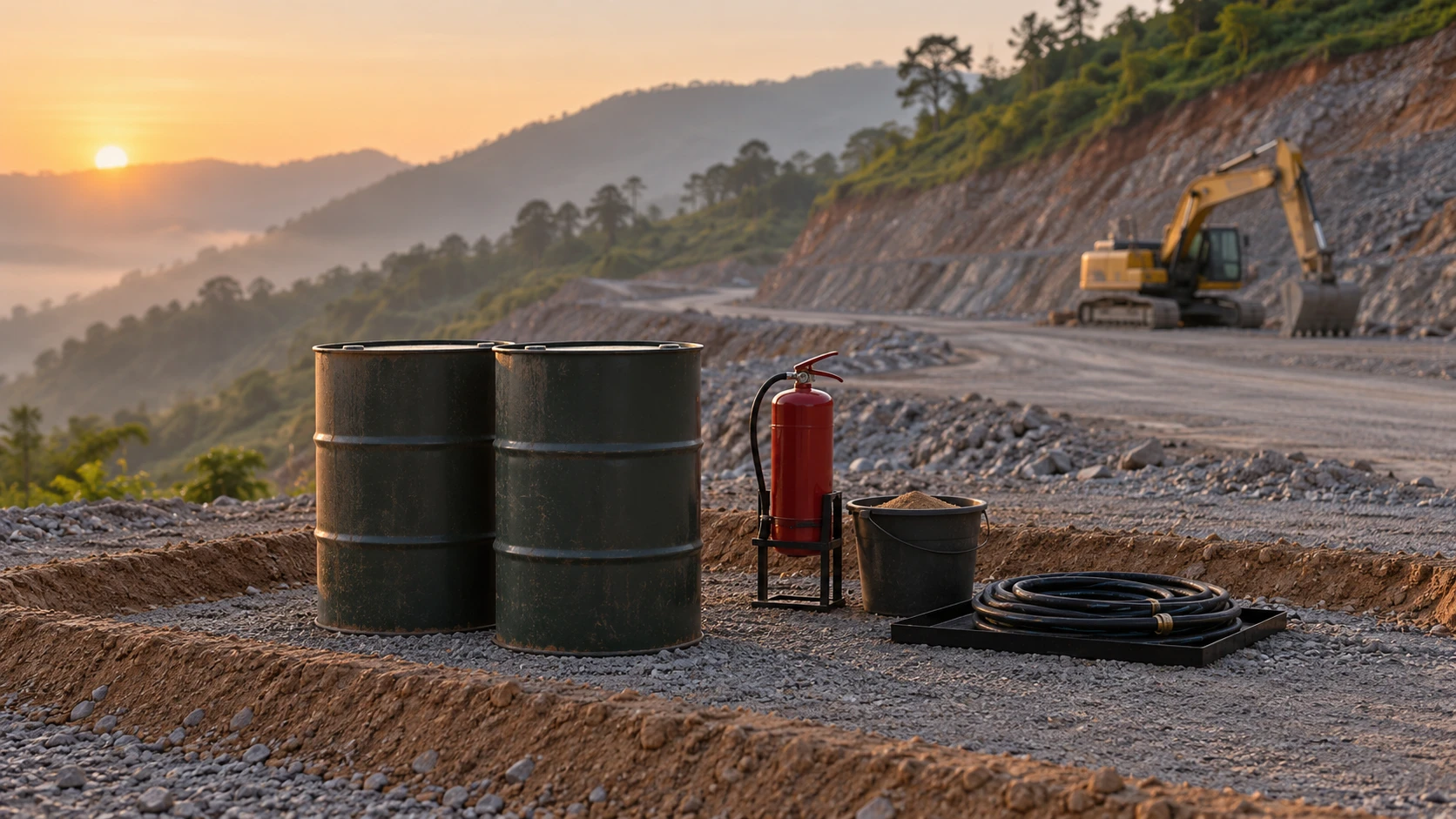
- Set up one fuel point and use it. Choose level, open ground, away from vehicles and from where crews rest, with a low earth bund to hold a spill. Do not refuel next to other parked vehicles.
- Stop the engine, let a hot engine cool, and remove smokers and anyone not needed from the fuel point before the cap comes off. Put up a no-smoking sign.
- Use a hand pump or closed transfer from the drum, with an auto-closing nozzle or a funnel and a drip tray, and avoid pouring from open drums. Wipe up spills before the engine is started.
- Keep drums upright, labelled, capped and in the shade, on the ground and not inside a vehicle where people sit or work. Bring only what the day needs.
- Keep at least one charged extinguisher suitable for oil fires, a bucket of dry sand and a water source at the fuel point, and have at least one person trained to use them. The BOCW Rules ask for trained persons for site fire equipment.
- Make one named person responsible for fuel and one licensed shot firer responsible for blasting. Write the daily quantities in a register.
- Tell the nearest panchayat and homes in advance when blasting is planned, put up warning signals as BOCW rule 212 requires, and post lookouts on any public road within the danger area.
Our suggestions for workers
- Never smoke, use a phone or switch on anything with a flame near fuel or explosives.
- If you see engines running at a fuel point, a spill, smoking or explosives kept with fuel, say so to the supervisor. If nothing changes, tell someone outside the site, such as the panchayat or the police.
- Do not touch, move or carry any explosive, detonator or fuse unless you are the licensed person whose job it is.
Our suggestions for villagers and people living near work sites
- Ask the contractor or the panchayat what is kept on the site: fuel, explosives or both, and how much. Homes close to a work site, like the houses about 20 metres from the ASR fire, take damage from a blast or fire even if nobody inside is hurt.
- If blasting is planned, move away from the warned area, keep children and cattle out of it, and stay clear until the all-clear. The mines danger zone of 300 metres is a useful guide to how far fragments can fly, but it is a rule for opencast mines only.
- If you see explosives or gelatin kept in a vehicle, a shed or a house, do not touch them. Call the police on 112 and the District Magistrate’s office. Under the Explosives Rules, District Magistrates and police officers of Sub-Inspector rank and above can inspect and seize at licensed premises. We have not checked who takes a complaint about unlicensed storage, so ask the police or the DM’s office.
If a fuel or explosives fire starts
We found no Indian rule on this, so these are our suggestions, based on general emergency practice.
- Leave at once and keep going. Fuel drums and vehicle tanks can burst and throw burning fuel, and a fire with explosives can detonate without warning. Do not go back for tools, vehicles or belongings.
- Warn others, stay upwind and uphill if you can, and stay out of sight of the fire if that is possible. We have not found an official safe distance for a fuel-drum fire in India, so this is our suggestion: move as far as you can.
- Call 112, or 101 for the fire brigade and 108 for an ambulance, and give the exact location. On a remote site, send someone to the road to guide them in.
- Do not try to put out a fire that has reached drums, a fuel tank or any explosives. Only a small, new fire, tackled by trained people with the right extinguisher, is worth fighting.
- People with burns: cool the burn under cool running water for about 20 minutes (NHS), take off clothing and jewellery near it but not anything stuck to the skin, and cover it loosely with cling film or a clean cloth. No creams, oil, butter, toothpaste or ice, and do not burst blisters (NHS, WHO). Get emergency help for a large or deep burn or one on the face, hands, feet or genitals, or if smoke was inhaled. See our basic first aid guide.
- The NHS and WHO pages are British and global; in India use 112 or 108.
What is still not known
- Pinakota: the ignition source, whether any explosives were present (police later said no traces of gelatin explosives were found; another Telugu report says only no visible traces; early reports said gelatin; the reports do not fully agree), any legal action against the contractor, and whether the site held the licences the work needed. We found no published finding.
- Shivamogga: the final death toll and the outcome of the inquiry. We read only two reports.
- Whether the BOCW Rules, the Mines regulations or the Explosives Rules alone govern a particular roadside rock cut or quarry.
- How many such incidents happen at Indian road, quarry and mining sites each year. We found no official count and make no claim.
We will update this page when the picture changes. Updated 26 October 2026. Related: the Bengaluru Pulakeshinagar building blast, the Rohtas fuel-shop fire, firecracker factory blasts in India, the fire triangle and workplace fire safety.
What needs attention
- The ASR reports first blamed gelatin sticks; police called it an accidental diesel fire and later said no traces of gelatin explosives were found (The New Indian Express, SP; TeluguPeople, unnamed official, per the case study), while another Telugu report says only that no visible explosive traces were seen. The reports do not fully agree.
- Police said workers at the ASR site carry diesel in drums to refuel vehicles because the site is around 100 km away.
- PESO's FAQ says explosives must be delivered to a licensed magazine and not to a blasting site, and must not be transported with detonators (Rule 10(3)(c) and Rule 90(1)).
- The Metalliferous Mines Regulations set a 300 metre danger zone for opencast blasting, with warning signals and traffic lookouts.
- The BOCW Central Rules require warning and danger signals for workers and the public before explosives are used, and a ban on smoking and naked lights near them.
- About 250 litres of diesel is below PESO's licence-exempt storage limits for every petroleum class, so site discipline matters more than licensing at that scale (our reading).
- We found no Indian clause on how to refuel construction equipment in the open, and no distance between a diesel point and a magazine in the pages we opened.
Controls that reduce risk
- Contractors: one marked fuel point on open ground with a low bund, a spill kit, sand and a charged extinguisher; engines off; no smoking.
- Keep explosives in a licensed magazine, separate from fuel, and let only a permitted shot firer blast.
- Warn the panchayat and homes before blasting, put up signals and post lookouts on public roads.
- Workers: report spills, smoking or explosives kept with fuel; do not touch explosives.
- Villagers: ask what is kept on site; if you see explosives in a vehicle or shed, do not touch them, call 112.
- If a fuel fire starts: leave and keep going, call 112, 101 or 108; do not fight a fire that has reached drums or tanks.
Common unsafe practices
- Refuelling vehicles parked close together, with people standing nearby.
- Refuelling with the engine running or hot, or with anyone smoking.
- Pouring from open drums and leaving spills.
- Keeping explosives or detonators in an ordinary vehicle at the work site.
- Keeping fuel and explosives together.
- Blasting without clearing and warning everyone in the danger area, including public roads.
- Putting butter, oil or ice on a burn, or bursting blisters.




Leave a comment