
Quick answers
Why do fire accidents keep happening in India?
Investigations keep finding the same faults: inflammable goods stored in the wrong places, blocked exit passages and badly maintained wiring. Fire safety audits also have no clear legal scope, method or frequency, so many stop at paperwork.
What is a fire safety audit?
It is a check of whether a building meets the National Building Code of India, the relevant Indian standards and state and local fire rules. A good audit finds blocked exits and overloaded wiring before a fire does.
Who runs fire services in India?
Fire services are a state subject. They are often run by municipal corporations and local bodies, so equipment and enforcement vary from city to city.
What can a shop owner or society do right now?
Open every exit and make sure none is locked or blocked, move inflammable stock away from the stairs, get the wiring checked by a licensed electrician and make sure the points from the last fire audit were fixed. Save 101 and 112.
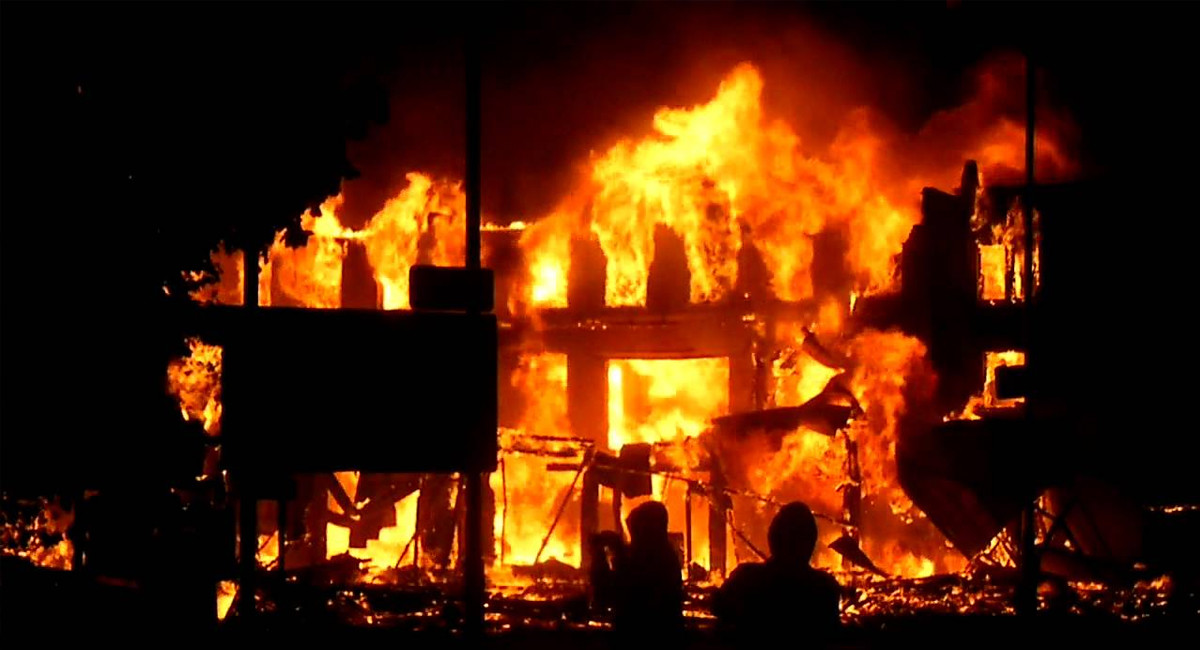
A factory in Delhi. The rooftop restaurants at Kamala Mills in Mumbai. The Meenakshi Temple in Madurai. Each of these fires made headlines, and each time the early findings sounded the same: inflammable material stored where it should not be, exit passages blocked, and electrical wiring that nobody had looked after.
When the same faults turn up fire after fire, the problem is not bad luck. It is the system around fire safety.
Why fire accidents keep happening
India does have a framework for fire safety audits. What it does not have is a law that clearly says what an audit must cover, how it should be done, what it is meant to achieve and how often it must happen. So an audit can be a serious inspection in one building and a signature on a form in the next.
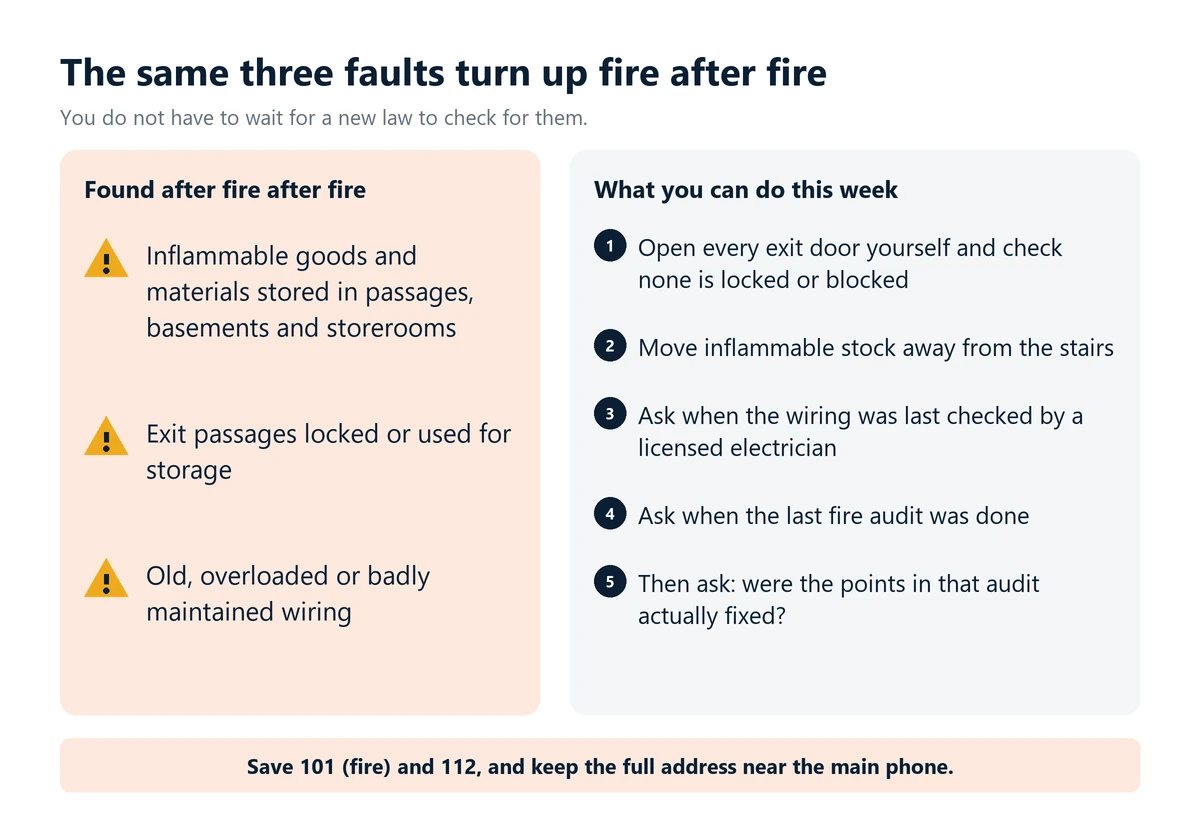
Meanwhile the same three faults keep showing up after fires:
- inflammable goods and materials stored in passages, basements and storerooms
- exit passages locked or used for storage
- old, overloaded or badly maintained wiring
High-rise buildings and storage areas
Metro cities are building upwards fast. Many high-rise buildings do not have adequate fire protection, and a fire on an upper floor is much harder for the fire brigade to reach and fight.
In shops, malls and commercial buildings, fires often start in the storage area. Goods are packed tight, cartons go up to the ceiling, and nobody is there when it starts. Badly stored stock helps the fire spread and gets in the way of the firefighters.
What a fire safety audit should do
A fire safety audit checks whether a building actually meets the National Building Code of India, the relevant Indian standards and the state and local fire rules. Done properly, it finds the blocked exit and the overloaded panel before a fire does.
Because the law does not fix the scope, method or frequency of these audits, they often stop at paperwork. Making them mandatory, giving them to independent agencies rather than the owner’s own people, and reviewing every building every year would make a real difference.
Fire services are a state subject
Fire services in India are a state subject. They are often run by municipal corporations and local bodies, so equipment, staffing and enforcement vary a great deal from one city to another. A rule is only as strong as the local fire service that has to check it.
Awareness in the community
People need to know how fires start and what to do in the first few minutes. Regular sessions in housing societies, schools and places of worship help build that habit. Fire extinguishers and hoses must be kept in working order, and the people around them must know how to use them. Periodic inspections by the fire service keep owners honest and catch hazards early.
What needs to change
- A clear law on audits. A uniform national fire safety code with mandatory audits and real penalties for not fixing what the audit finds.
- Better-equipped fire services. Modern firefighting equipment and infrastructure, especially in fast-growing cities.
- Fire safety in schools. Awareness campaigns, and fire safety as part of the school syllabus.
- Regular inspections and drills. Periodic checks and evacuation drills, so that exits stay open and people know the way out.
What you can do this week
You do not have to wait for a new law. If you run a shop, office or factory, or sit on a society committee, open every exit door yourself and check that none is locked or blocked. Move inflammable stock away from the stairs. Ask when the wiring was last checked by a licensed electrician, and when the last fire audit was done. Then ask the harder question: were the points in that audit actually fixed?
Save 101 (fire) and 112 in your phone, and keep the full address written near the main phone.
What needs attention
- Investigations into fires such as the Delhi factory, Kamala Mills and Madurai Meenakshi Temple keep finding the same three faults: stored inflammables, blocked exits and poor wiring
- India has no law that clearly sets the scope, method or frequency of a fire safety audit
- Fires in commercial buildings often start in badly kept storage areas
- High-rise buildings in metro cities often lack adequate fire protection, which makes firefighting harder
- Fire services are run by states and often by municipal bodies, so capacity varies widely
Controls that reduce risk
- Get a fire safety audit by an independent, qualified auditor every year and act on its findings
- Clear inflammable stock out of stairs, corridors and basements
- Have the electrical wiring inspected and replace overloaded or damaged circuits
- Train staff to use extinguishers and run regular drills
- Invite the local fire service for a periodic inspection or awareness session
Common unsafe practices
- Stacking inflammable goods in storerooms, basements and stairwells
- Locking or blocking exit passages to stop theft or to use them as storage
- Leaving old, overloaded wiring in place until it fails
- Getting a fire audit done only for the NOC and never fixing what it found
- Keeping extinguishers on the wall without anyone knowing how to use them
Leave a comment