
Quick answers
Is the National Building Code mandatory for fire safety?
The NBC began as a recommendation. The Union Home Ministry has asked states to include its fire safety provisions in their building bye-laws, and it is the adopted local rules and approvals that are binding.
What fire safety features does the NBC call for in public buildings?
Fire-resistant materials and fire check doors, enclosed fire exits, grouping of buildings by use, automatic fire detection and alarms, sprinklers and water sprays, fireman's lifts and fire barriers.
Why do fires still kill people in Indian public buildings?
States often lack the staff to enforce the NBC, and common causes of fires include electrical faults, ignoring safety laws and a lack of modern fire safety equipment.
How can fire safety in public buildings be improved?
Through compulsory fire liability insurance, regular independent audits and inspections, fire safety workshops and drills, and investment in modern firefighting equipment that is kept in working order.
What can a visitor do to stay safe in a hospital or mall?
Find two exits when you arrive and check they are unlocked. Report blocked staircases or locked fire exits to the management, and in a fire use the stairs, not the lift, and call 112 or 101 from outside.
In just over a week in 2021, three hospital fires in western India killed about 37 people, most of them patients who could not get out of bed. India has detailed fire safety rules for buildings like these. The trouble is that too often they are not followed, and nobody checks.
Hospital fires that should not have happened
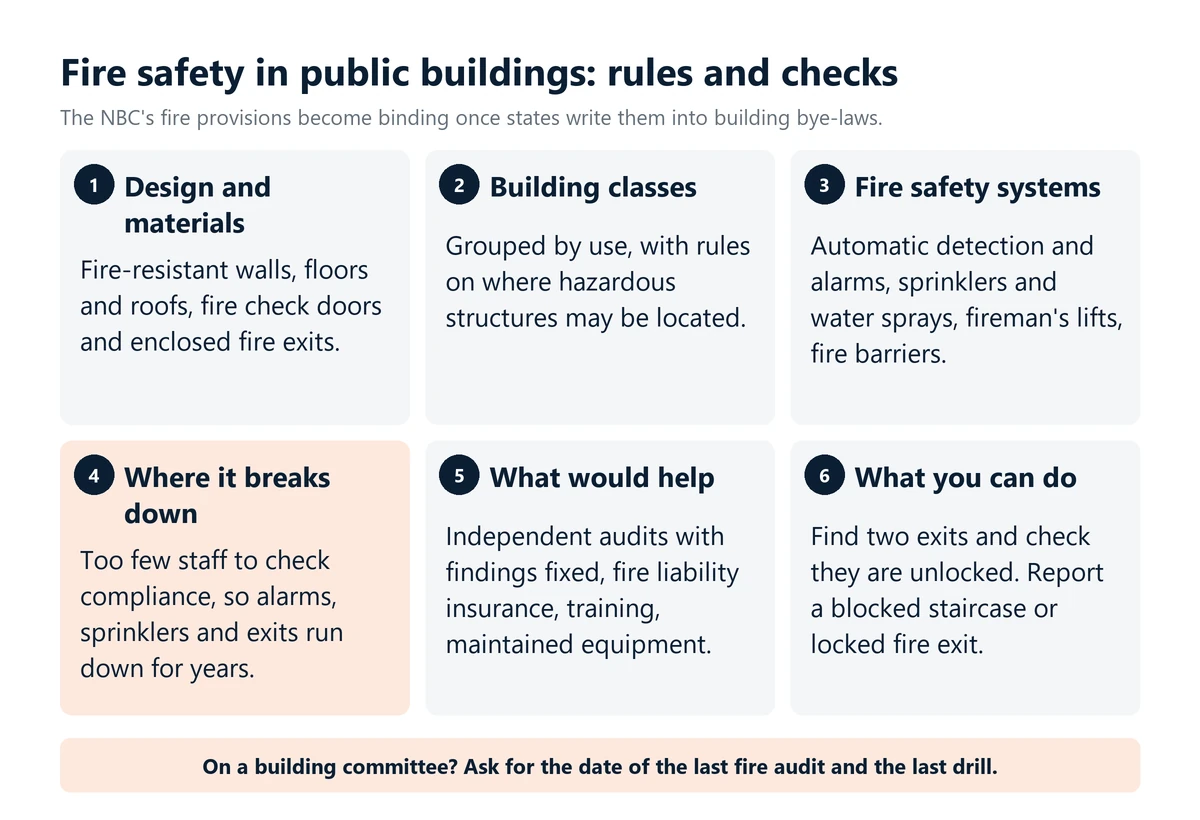
On 23 April 2021, a fire at a hospital in Virar near Mumbai killed at least 15 people. On 28 April, four patients died in a hospital fire at Mumbra near Thane. On 1 May, 18 people died in a hospital fire at Bharuch in Gujarat. These tolls are as reported at the time; some later reports put the Virar toll at 13.
Fire is not a rare event in India. The National Crime Records Bureau (NCRB) counted 11,037 fire accidents across the country in 2019. They killed 10,915 people and injured 441, and 6,329 of those deaths (58%) were in residential buildings and dwellings. Common causes include electrical faults, ignoring safety laws, and a lack of modern fire safety equipment in public buildings.
What the National Building Code says
The National Building Code of India (NBC), published by the Bureau of Indian Standards, lays down detailed rules for fire and life safety. Updated 28 October 2026: a Bureau of Indian Standards notification in the Gazette of India dated 30 April 2026 establishes SP 7:2026 (National Building Construction Standards 2026) and withdraws SP 7:2016, the National Building Code of India 2016. Our guide to fire safety laws in India covers the change; read the rest of this page with it in mind. It began as a recommendation. The Union Home Ministry has asked states to write its fire safety provisions into their local building bye-laws, which is what makes them binding.
Its main fire safety provisions cover:
- Design and materials. Fire-resistant materials for outer walls, load-bearing inner walls, floors and roofs, along with fire check doors and enclosed fire exits.
- Building classes. Buildings are grouped by use, such as residential, educational, institutional, assembly and industrial. The code also says where buildings may be located, so that hazardous structures do not sit next to homes, hospitals, offices and shops.
- Fire safety systems. Automatic fire detection and alarms, automatic sprinklers and water sprays, fireman’s lifts and fire barriers.
- Exemptions. Local fire services may relax some rules where there is real practical difficulty, but this should be done rarely and with care.
Other rules for hospitals and public buildings
- Fire safety committees. These are meant to carry out periodic audits of fire installations, heating, ventilation and air-conditioning, and other electrical equipment in Union government hospitals.
- Third-party accreditation. The Union Health Ministry requires third-party accreditation for fire safety and a fire response plan in every hospital.
- NDMA requirements. The National Disaster Management Authority sets fire safety requirements for public buildings, including minimum open space around the building, protected exits, dedicated staircases and regular evacuation drills.
- Supreme Court directions. The Supreme Court directed states to carry out fire safety audits of dedicated COVID-19 hospitals.
Where it breaks down
Having the rules is not the problem. The evidence suggests that states often do not have enough staff to check whether public buildings actually comply with the NBC and other safety codes. A building can get its approvals and then let alarms, sprinklers and exits run down for years without anyone noticing.
What would make public buildings safer
- Compulsory fire liability insurance. Making it compulsory for all public buildings would protect occupants and visitors, and insurers would push for outside inspections and regular safety checks.
- Regular independent audits. Audits and inspections by someone other than the building’s own staff, with the findings actually fixed.
- Awareness and training. Fire safety workshops and drills in neighbourhoods, schools and public buildings, so people know how to prevent fires and what to do when one starts.
- Better equipment, kept working. Investment in modern firefighting equipment, and the maintenance to keep it ready.
If states enforce these rules and building managers take them seriously, many fires can be prevented and many more can be survived.
What you can do
You do not have to manage a hospital to help. Next time you visit a hospital, office or mall, find two exits and check that they are unlocked. If you see a blocked staircase or a locked fire exit, tell the management. If you sit on a hospital board or a building committee, ask for the date of the last fire audit and the last drill.
What needs attention
- Hospital fires at Bharuch, Virar and Mumbra showed how quickly public buildings full of vulnerable people can turn deadly
- The National Building Code sets fire-resistant materials, building classes, detection, sprinklers, fireman's lifts and fire barriers
- The NBC is a model code; it binds only once a state writes it into its building bye-laws
- States often lack the staff to check that public buildings actually comply
- Exemptions for 'practical difficulty' are allowed but should be rare
Controls that reduce risk
- Get an independent fire audit of every public building you manage and close its findings
- Check that alarms, sprinklers, fire doors and the fireman's lift work and are serviced
- Hospitals: keep a written fire response plan and assign roles on every shift
- Keep dedicated staircases and protected exits clear, with open space around the building for fire tenders
- Run evacuation drills, including for patients or visitors who cannot walk out on their own
Common unsafe practices
- Treating the NBC as advice rather than as the standard your building will be judged by
- Leaving government offices and hospitals with no extinguishers or basic firefighting installations
- Running hospital wards without a written fire response plan
- Skipping fire audits of HVAC and electrical equipment in hospitals
- Asking for exemptions to avoid the cost of a second staircase or sprinklers
Leave a comment