
Quick answers
What to do first if a fire starts at home?
Raise the alarm and warn others without delaying your own escape. Leave by a safe route, avoid routes affected by smoke or heat, stay out and call 101 or 112 from safety.
Can I use the lift during a building fire?
In an ordinary building fire, use the appropriate stairs rather than a lift, unless a specifically designed evacuation system and the responsible authority direct otherwise.
What to do if the fire escape route is blocked?
Move away from smoke, close a door between you and the fire if safe, signal your location and call 112. Do not jump or enter smoke to retrieve property.
What information should I give when calling 112 for a fire?
Give the full address, floor, entrance, number of people who may be inside and any known hazards. Stay available to direct responders without re-entering the building.
What should I do if my flat is on fire?
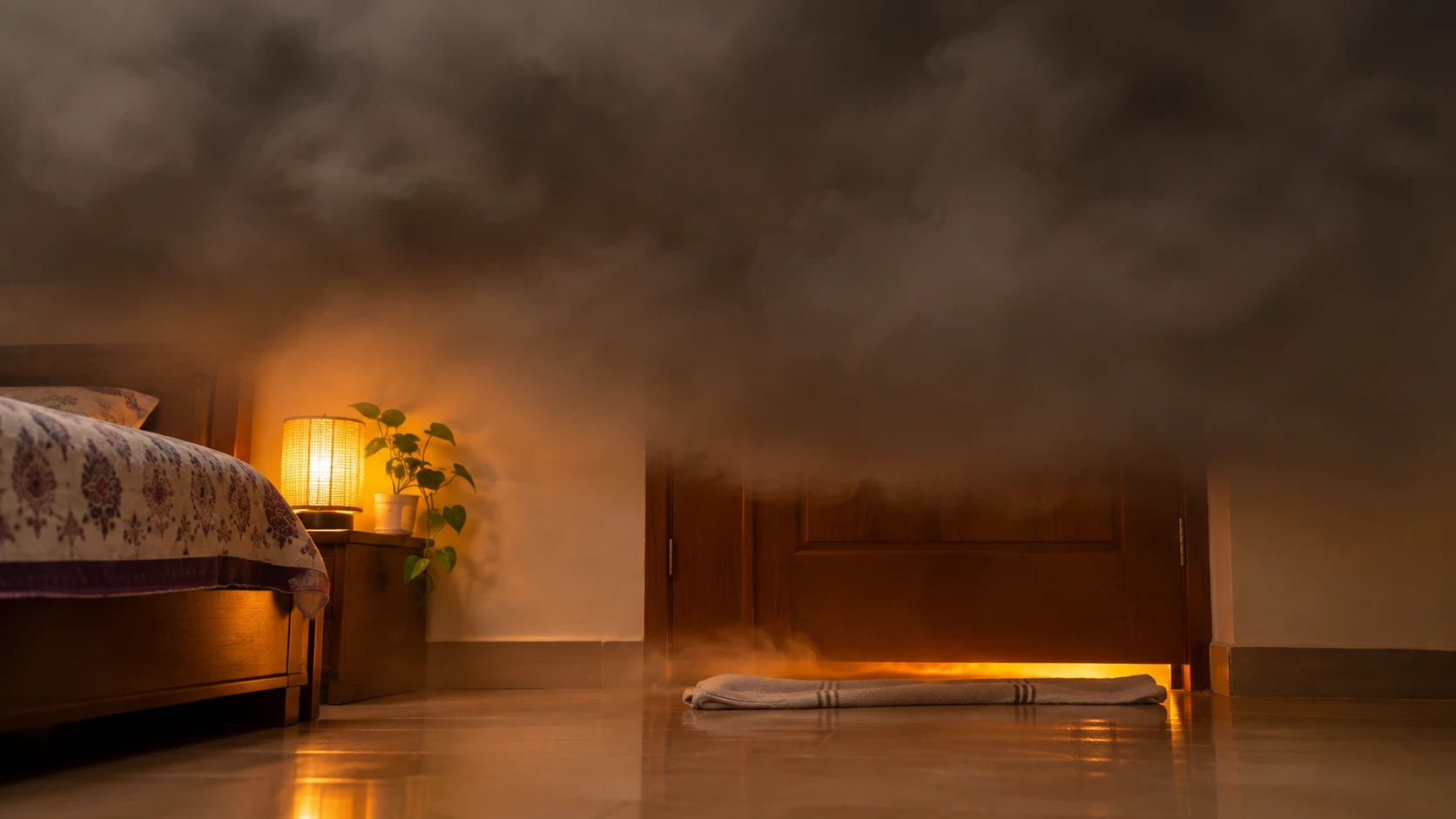
Get everyone out by the nearest clear exit, staying low under any smoke, close the doors behind you, use the stairs and not the lift, and call 101 or 112 from outside. Do not go back in. If you cannot get out, go to a room with a window, close the door, cover the gaps with cloth, call and signal from the window.
Should I put a wet towel at the door gap?
The US Fire Administration says to cover cracks around the door with cloth, and the Goa fire service plan says wet clothing or towels. We found no test that settles wet against dry, so use the thickest cloth within reach and wet it only if water is at hand.
Should I go to the balcony or the terrace in a fire?
The Goa fire service plan says never to evacuate to the roof, but to go down and out by the stairs. If you cannot get out, we suggest a room with a window, and a balcony only if it is clear of smoke and flames, as a place to signal from. We found no official Indian instruction on balconies.
When should I leave my flat and when should I stay inside?
If the fire is in your flat, leave. If it is elsewhere in the building, we found no official Indian rule to stay inside. Our suggestion: feel your door; if it is cool and the stairs are clear of smoke, leave by the stairs. If there is smoke in the corridor, stay in the flat, close the door, cover the gaps and call 101 or 112.
Which number should I call for a fire, 101 or 112?
101 is the fire brigade and 112 is the all-emergency number. The Delhi Fire Service says to dial 101 irrespective of the size of the fire. Call from outside and give the building, floor and flat number.
What should I do if my clothes catch fire?
Stop, drop and roll. If someone else is burning and the fire is out of control, wrap them in a blanket until it goes out. The National Institute of Disaster Management says not to pull off burnt clothing unless it comes away easily and not to put an adhesive dressing on the burn. Call 108 or 112 for medical help. Long, loose clothes catch fire fast, so tuck back a saree or dupatta before cooking or lighting a lamp (that last point is our suggestion).
A fire escape plan for a flat has four parts: two ways out of every room where you can, a meeting place outside, one named helper for each child and elder, and a practice run. In many Indian flats the second way out is a grilled window or balcony, so make sure one opening can be released from inside, and call 101 or 112 only once you are outside.
If the fire is in your own flat, what you do in the first minute counts more than anything else. Get everyone out, close the door behind you, stay out, and call 101 or 112 once you are safe. This page puts the steps in the order you will need them and says what to do if you cannot get out. Checked 4 November 2026.
In short
- Get out first. Take the nearest clear exit. Phones, documents and valuables can wait.
- Stay low and feel the door. Smoke rises. Touch a closed door with the back of your hand. If it is hot, keep it shut and use another way out.
- Close doors behind you and take the stairs. Never the lift.
- Call 101 or 112 from outside. Give the full address, floor and flat number.
- Cannot get out? Go to a room with a window, shut the door, push cloth into the gaps, call, and signal from the window.
- Never go back in.
Escape comes before belongings
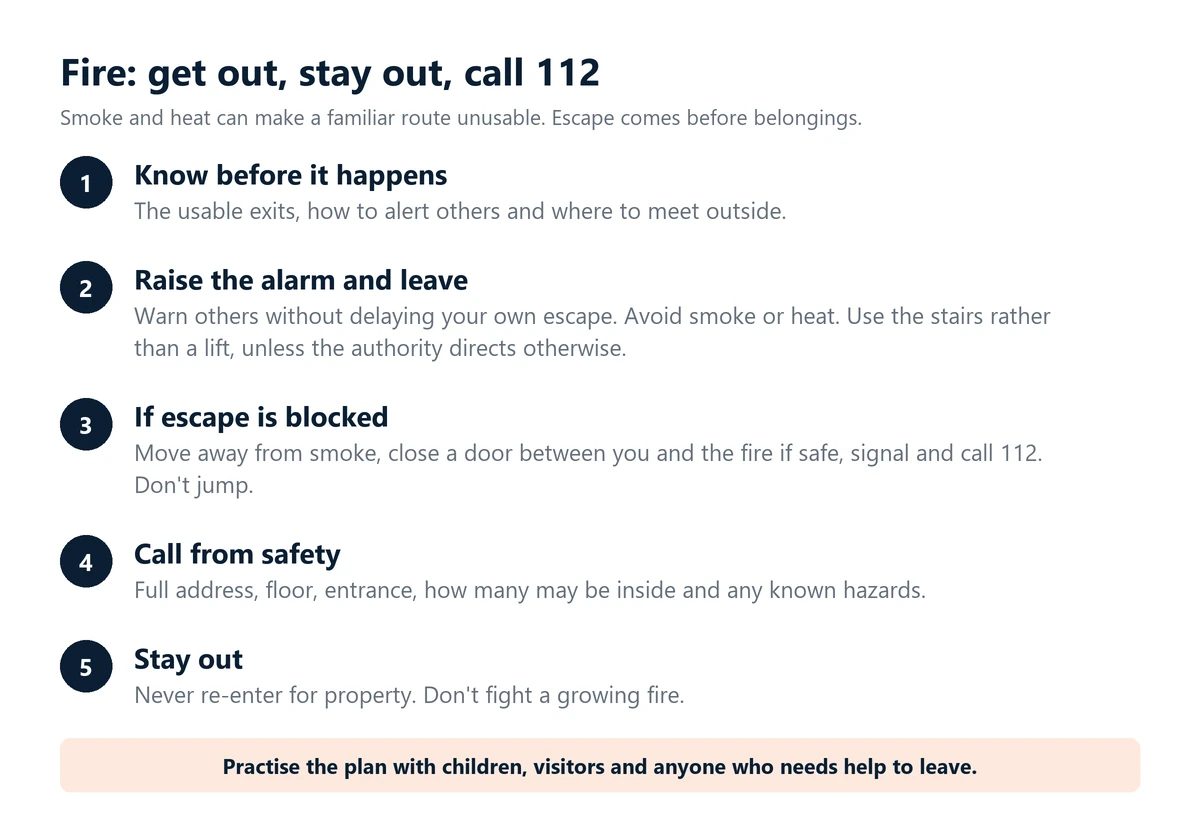
Early warning gives people time to act, but smoke and heat can make a familiar route unusable. Know the usable exits from your home or workplace, how to alert others and where to meet outside. A building’s actual layout and local fire plan determine the route; never assume that every door or stair remains safe during a fire.
When you notice fire or smoke
Raise the alarm and warn others without delaying your own escape. Leave by a safe route and stay out. Avoid a route affected by smoke or heat. In an ordinary building fire, use the appropriate stairs rather than a lift unless a specifically designed evacuation system and the responsible authority direct otherwise. If escape is blocked, move away from smoke, close a door between you and the fire if safe, signal your location and call 112. Do not jump or enter smoke to retrieve property.
Call from safety
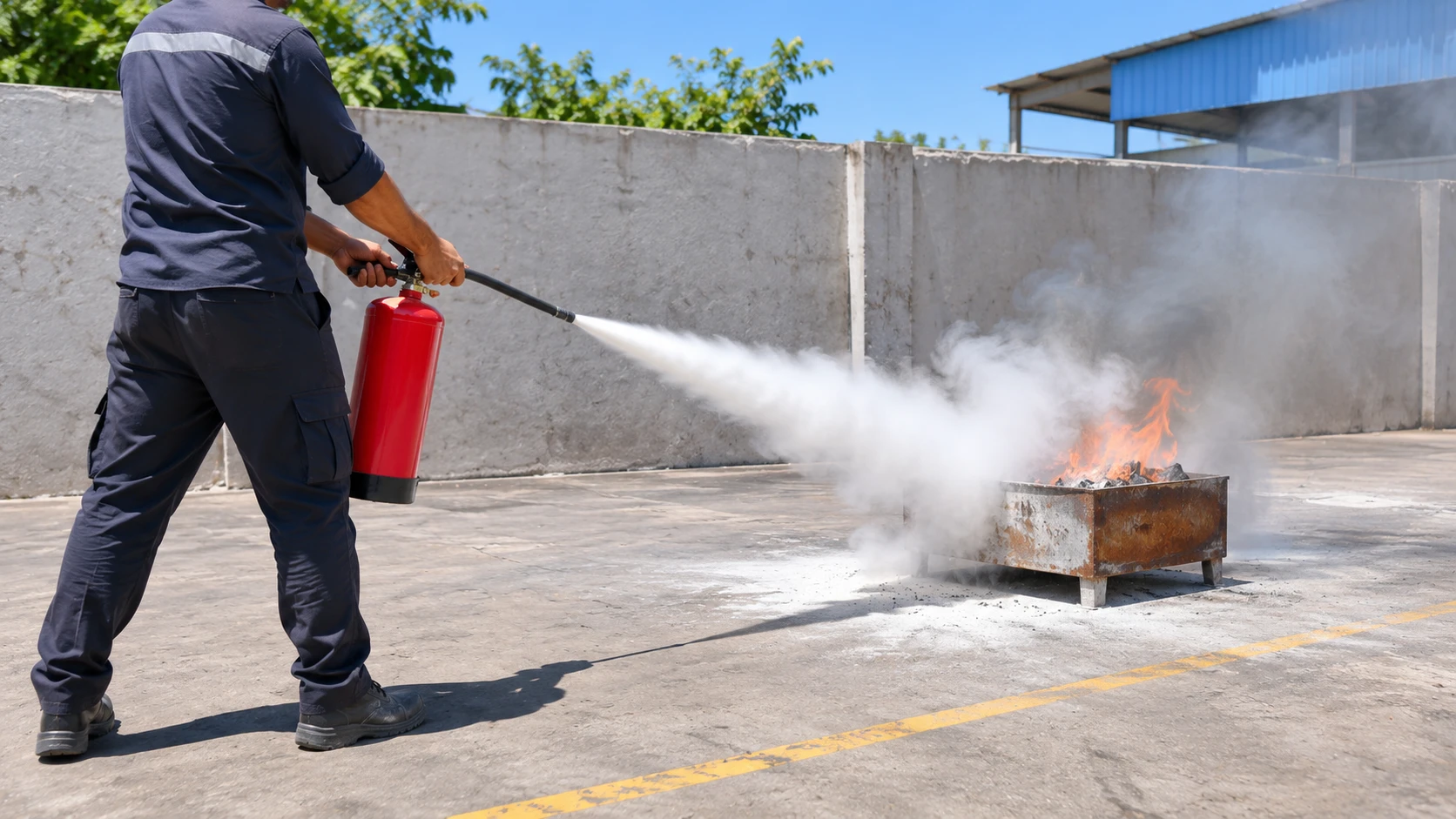
India’s 112 system can dispatch fire and other emergency services. Give the full address, floor, entrance, number of people who may be inside and any known hazards. Stay available to direct responders without re-entering. Do not attempt to fight a growing fire. A portable extinguisher is for an appropriate small, early-stage fire only when the user is trained, has the right equipment and has a clear escape route.
In your flat: the first minute, step by step
- Raise the alarm calmly. Tell everyone at home to leave now, children and elders first. The Delhi Fire Service asks people not to shout or run, because that causes panic, so say it firmly and keep moving.
- Do not stop to fight it unless it is tiny. The Delhi Fire Service says a fire may be attacked only if you can do so without undue risk, and the Goa plan says to put out a small fire but, if it is spreading, to get out and close the door behind you. In a flat, with smoke filling the room fast, our advice is simpler: unless it is a very small fire right next to you and you know how to use the extinguisher, leave. Our guide to using a fire extinguisher covers that side.
- Stay low if there is smoke. Smoke rises to the ceiling. The Goa fire service plan says to stay low and crawl to the nearest exit when there is light smoke, and a University of Illinois Chicago safety page says the same. Our guides to being stuck in a smoke-filled room and to breathing and the wet cloth go through it in more detail.
- Feel the door before you open it. The US Fire Administration says to feel the door with the back of your hand, and if it is hot, to leave it closed and use your second way out. If your flat has only one door to the stairs and that door is hot, go to the steps below for when you cannot get out.
- Close the doors behind you. The Delhi Fire Service asks people to close all doors and windows behind them as they leave. It costs a second.
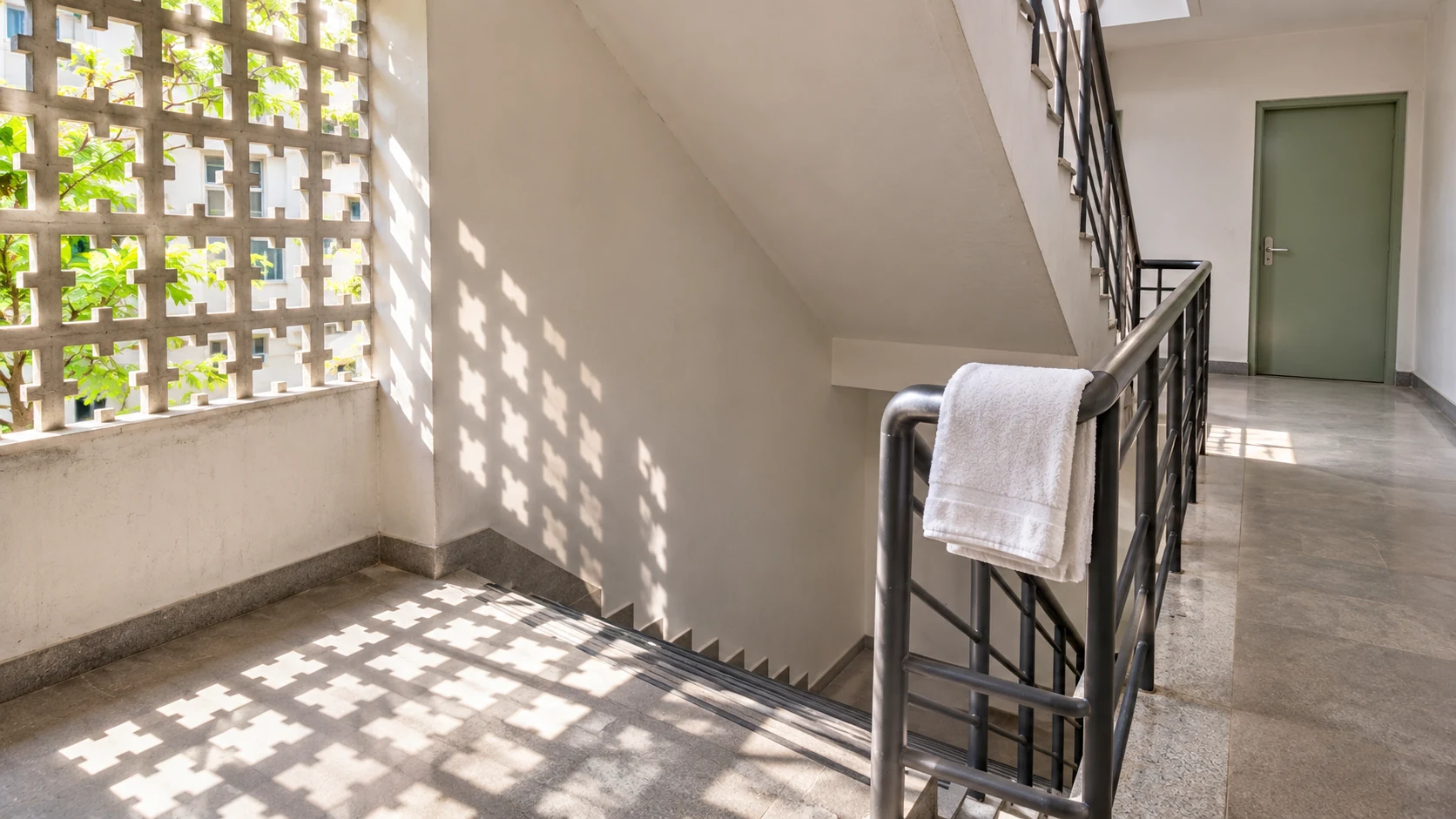
- Take the stairs, never the lift. The Delhi Fire Service says not to use the lift as a means of escape, and the Goa plan says a lift can stop at the fire floor or fail.
- Go down and out, not up. The Goa plan says never to evacuate to the roof. Our suggestion: if the stairs below you are full of smoke, do not climb up on your own. Go back into a room of your flat and follow the steps below.
- Meet at the agreed spot and count heads. The Delhi Fire Service asks people to report to the person in charge at the assembly point. In a society, that is the place you agreed on with your neighbours. If someone is missing, tell the fire officers when they arrive. Do not go back in yourself.
- Call 101 or 112. 101 is the fire brigade and 112 is the all-emergency number. The Delhi Fire Service says to dial 101 irrespective of the size of the fire. Give the building name, full address, floor and flat number, and say if anyone may still be inside. Our page on the fire brigade number and what to say has the details.
If you cannot get out of the flat
This is for when the door to the stairs is hot, the corridor is full of smoke or the flames are between you and the exit. The steps below come from the Goa Directorate of Fire and Emergency Services evacuation plan, the Manipur State Disaster Management Authority fire sheet and the US Fire Administration. Where we add something of our own, we say so.
- Go to a room with a window, as far from the fire as you can reach, and shut the door behind you. The Manipur sheet says to lie down or sit near the floor, cut down the smoke entering the room and look for an exit.
- Block the gaps. The US Fire Administration says to close the door and cover the vents and cracks around it with cloth. The Goa plan says to use wet clothing or towels around the cracks of doors and to seal vents. The sources differ on wet or dry, and we found no test that settles it, so use the thickest cloth within reach. Wet it only if there is water at hand and it costs you no time.
- Call 101 or 112 and say exactly where you are: building, floor, flat number and which room. If you have no phone, the Goa plan says to signal at the window for help.
- Signal from the window with a light-coloured cloth or a torch, as the US Fire Administration advises. Our suggestion: a whistle, if you have one, carries further than your voice.
- Stay low and cover your nose and mouth with a cloth. The Manipur sheet says to breathe through a wet cloth, so wet it if water is at hand. This is a last resort, not protection from carbon monoxide.
- Do not break the window, and do not jump. The Goa plan warns that flames and smoke can travel back in from outside, and says to wait to be rescued if you are above the second floor. The sources we read do not settle whether to open a window for air: the Goa plan allows a small crack that you can shut at once, while our guide to a smoke-filled room says to keep it shut. Our suggestion: keep it shut unless you need to call out or signal.
- A balcony can be a place to signal from. This is our suggestion, not an official instruction: if the room opens onto a balcony that is clear of smoke and flames, step out, pull the door shut behind you so that smoke stays in, and make yourself seen. If smoke or flames are coming from below or from a neighbouring balcony, stay in the room at the window instead. We did not find an official Indian page on balconies.
When to leave and when to stay inside
If the fire is in your flat, you leave. If it is in another flat or on another floor, the pages we could open do not settle it. The Delhi Fire Service says to leave by the nearest available exit, and the Goa plan is written around getting out by the stairs, but neither gives a separate rule for people whose own flat is untouched, and we did not find an official Indian instruction to stay inside in that case. What follows is our suggestion:
- Feel your own door with the back of your hand. If it is cool and the corridor and stairs are clear of smoke, leave by the stairs and close the door behind you.
- If there is smoke in the corridor or on the stairs, do not push through it. Go back in, close the door and follow the steps above for when you cannot get out.
- When you call, follow what the control room and the fire officers on the spot tell you.
- For a tall building, our guide to high-rise fire safety goes further.
If your clothes catch fire
The steps above leave out what to do when the fire reaches a person. The hazard sheet of the National Institute of Disaster Management (NIDM) that we read says: if clothes catch fire, stop, drop and roll. If a fire is out of control, wrap the person in a blanket until it goes out. It also says to avoid long, loose clothes, because they catch fire fast, and, for the burn afterwards, not to pull off burnt clothing unless it comes away easily and not to put an adhesive dressing on the burnt area. Then call 108 or 112 for medical help. We give no further burn treatment here. The sheet is undated and says its text was customised from an American home-emergency guide, so read it as general guidance.
Our suggestion: the loose end of a saree or dupatta near a stove or a diya is one of the commonest ways this starts at home. Tuck it back before you cook or light a lamp, and keep a thick cotton blanket or bedsheet where you can reach it from the kitchen door.
The same NIDM sheet gives the flat-fire basics we have used on this page: dial 101, know at least two ways out and keep them clear, and if you are trapped, sit or lie near the floor, cut down the smoke coming into the room, look for a way out and breathe through a wet cloth. Our guide to an LPG leak or a burning gas pipe covers the kitchen cylinder, and the one on lifts in a fire or a power failure covers the lift.
Make the plan work for everyone
Test warning arrangements as the rules require, maintain exits and equipment, and practise how children, visitors and people needing assistance will leave. Correct blocked routes or failed devices promptly and seek competent local advice on the applicable rules. This is general escape guidance, not certification that any particular building is safe.
A worked fire escape plan for a two-bedroom flat in a society
This is an example, not an official template. Copy it onto a card and change the details. Take a flat on the fourth floor with one main door, a kitchen, a living room with a grilled balcony, and two bedrooms, one with a grilled window. The plan could read like this.
- Way out 1: main door, then the common stairs, then the ground floor gate.
- Way out 2: there is no second door, so the second way out is a window or balcony that you can open and signal from. Write down which one, and who holds the key to its grille.
- Meeting place: a fixed spot outside the building, such as the society gate or a named tree, away from the fire engine lane.
- Helpers: one adult for each child, one adult for each elder, named in writing. If you live alone, write the name of the neighbour you have agreed with.
- Card by the phone: building name, address, floor, flat number and landmark, ready to read out to 101 or 112.
The United States Fire Administration advises homes to draw a map with all doors and windows and to find two ways out of every room (USFA home fire escape plans, page read 16 November 2026). In a flat with one door, that advice is hard to meet fully, which is why the window and balcony entries above matter. For the full fill-in version, use our home fire escape plan template.
Grilled windows and balconies: make one opening work from inside
Box grilles keep out thieves and monkeys, but they can also keep you in. In April 2022 the Mumbai fire chief appealed to residents to keep grilled windows only if they are openable and have a lock that can be broken during a fire evacuation, as reported by the Free Press Journal. He said box grills make rescue harder and that people in corner rooms may have only the front door as an exit. A 2020 report in Citizen Matters says a fully grilled opening should be fitted with an openable window that can serve as an escape route and for fire fighter access.
What this means for your plan:
- Pick one window or balcony door per flat as the escape opening and fit it with a grille that opens from inside.
- Check that every adult and any child old enough can open it alone, without a hunt for keys.
- If a key is needed, hang it at a fixed place near that window and tell everyone where it is.
- Never padlock a balcony grille or the terrace door from outside. The Citizen Matters article also cites the Maharashtra Fire Prevention and Life Safety Measures Act, 2006, as saying the terrace door must not be kept locked. We have not read the Act itself, so check your own state rules.
- Do not jump from the grille. It is a place to signal from while help comes. Our page on why people jump in fire incidents explains the risk.
Children and older family members: one named helper each
The USFA page on children says to talk about who will help each child get out safely, and that babies and very young children must be woken and helped (USFA children). Its page for older adults says to discuss your plan with family and neighbours, to check that a walker or wheelchair can pass through every exit doorway, and to contact the building manager or fire department if you need extra help (USFA older adults). In a society, tell your secretary or watchman which flat has someone who cannot use the stairs alone. Our guide to fire escape for wheelchair users and older people shows what the building rules plan for.
Practise once, then fix what failed
The USFA says residents could have less than 2 minutes to escape a home fire once the smoke alarm sounds. So practise at a calm hour and, once, at night. Ask each person to walk the route in their own words and see if the grille opens, the main door unlocks fast and the meeting place is reachable in the dark. Our page on reviewing your family fire escape plan gives the questions to ask, and the one on the assembly point says what to do when you reach it.
If you are in a tall block, also read what the building itself must provide in our NBC 2026 guide to apartment fire rules and the one on exits, stairs and corridors. Whatever the plan says, the first call is the same: get out, stay out, then dial 101 or 112.
Do this today
- Walk through your flat and count the ways out: the main door, any second door and the balcony. Our suggestion: if your doors or windows have grilles, keep the keys where everyone at home can find them, and check that someone can open them from inside.
- If you have a smoke alarm, test it. Our guide to fitting, testing and caring for smoke detectors shows how.
- Write the building name, address, floor and flat number on a card near the phone. Our page on a 112 call information card has a template idea.
- Agree on a meeting point outside, and read our home fire escape plan with the family.
- Keep a torch, a whistle and a light-coloured cloth where you sleep.
- The kitchen is where many home fires begin. Our seven kitchen fire rules take five minutes to read.
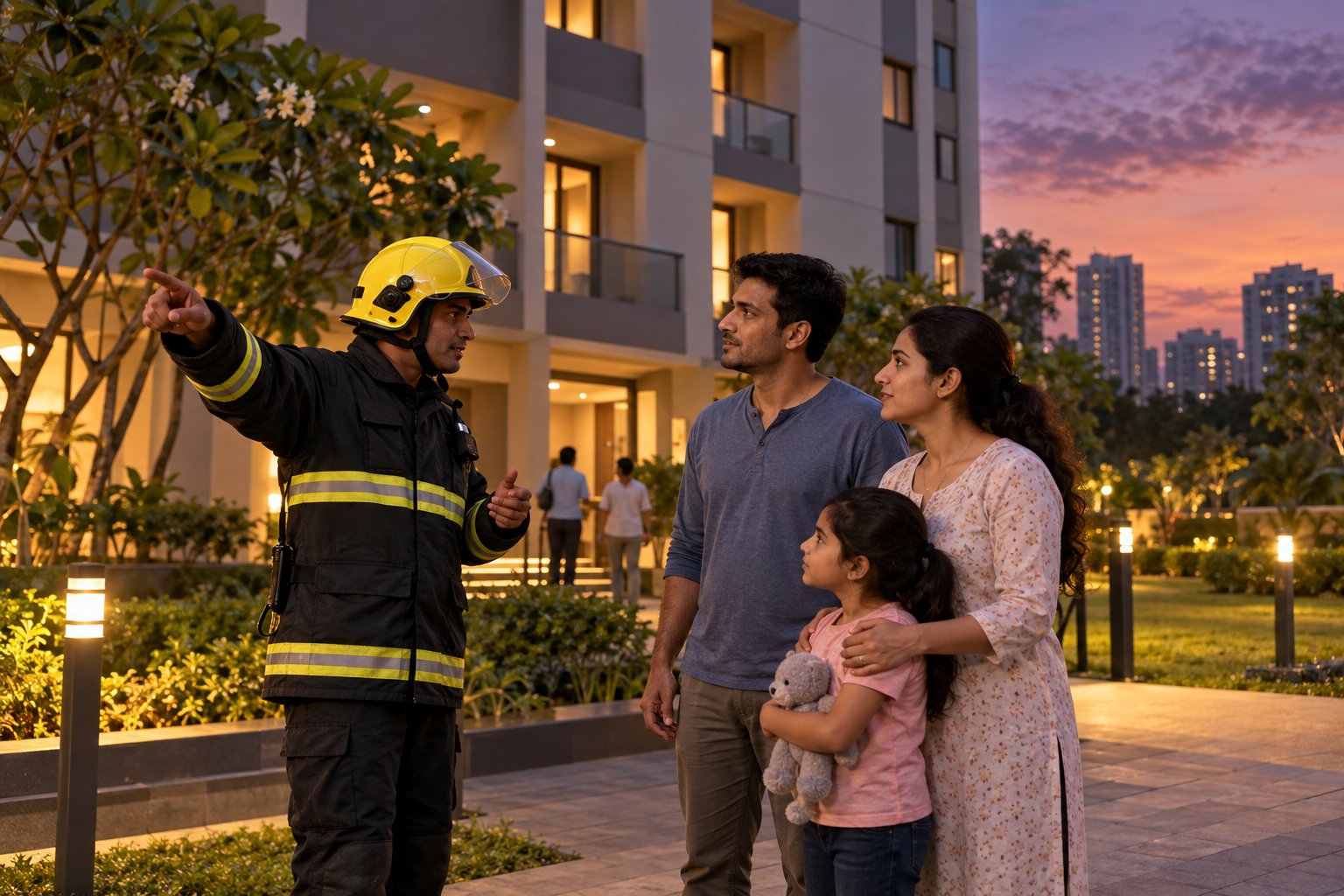
Cover note: AI-generated editorial illustration of a fictional family safely outside with a firefighter, not a real fire photograph.
101 (fire brigade) and 112 (all emergencies) both work in India. Older leaflets may list other numbers.
What needs attention
- Smoke and heat can make familiar routes unusable. Equipment only helps when suitable, maintained and used within training.
- The Delhi Fire Service says a fire may be attacked only without undue risk; the Goa plan says to extinguish a small fire but, if it is spreading, to get out and close the door behind you.
- The US Fire Administration says to feel a door with the back of the hand and keep it shut if hot; if you cannot get out, close the door, cover cracks with cloth, call and signal at the window.
- The Goa plan says to seal door cracks with wet clothing or towels, while the US page says cloth; no source we read settles wet against dry.
- We did not find an official Indian instruction on whether flat residents should stay inside when the fire is on another floor, or on balconies.
- The NIDM hazard sheet says: if clothes catch fire, stop, drop and roll; wrap the person in a blanket if the fire is uncontrolled; do not pull off burnt clothing unless it comes away easily; do not put an adhesive dressing on a burn. Its trapped-in-a-room steps match the ones on this page.
Controls that reduce risk
- Check detection, exits, electrical/cooking hazards and an accessible household plan; practise how everyone will leave and meet.
- Count your ways out, keep grille keys reachable, test the smoke alarm, write your address and flat number near the phone and keep a torch and whistle where you sleep.
Common unsafe practices
- Re-entering for belongings.
- using smoke-affected exits.
- fighting a growing fire.
- Stopping to fight a fire that is spreading.
- Opening a hot door.
- Climbing to the roof instead of going down and out.
- Breaking a window or jumping instead of waiting at it for rescue.
- Using the lift.


Leave a comment