
What happened here
 1 / 2
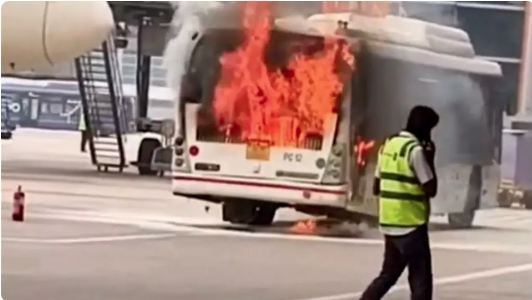
1 / 2 On 28 October 2025, an empty AISATS passenger coach parked at stand C32 at Delhi Airport Terminal 3 caught fire while waiting to collect the crew of AI-315. Airport responders extinguished it without reported injury.
Quick answers
What happened in the Delhi Airport bus fire?
On 28 October 2025, an empty AISATS passenger coach caught fire while parked at stand C32 at Terminal 3 of IGI Airport, New Delhi, waiting to collect the crew of AI-315. Airport fire personnel put it out, and no injury was reported.
Is the cause of the Delhi Airport coach fire known?
No final technical ignition finding or complete maintenance history has been published. A cause or missing safety system should not be assumed without an investigation record.
Why does a fire in an empty airport bus matter?
An airside vehicle fire can threaten nearby people, aircraft, equipment and operations even when the vehicle is empty. Ground vehicles need maintenance, accessible extinguishers and trained staff.
What should you do if smoke appears on a passenger coach?
Alert the driver and other passengers, stop in a safe place if possible and leave by the nearest usable exit without belongings. Move well away from the vehicle and do not return to it.
What happened
On 28 October 2025, an AISATS passenger coach caught fire while parked at stand C32 at Terminal 3 of Indira Gandhi International Airport, New Delhi. A later Lok Sabha answer recorded that the coach was waiting to collect the crew of Air India flight AI-315. No passenger or staff member was inside the coach, and no injury was reported.
Response and outcome
Airport fire personnel attended and extinguished the fire. The event remained confined to the ground vehicle; the reviewed official record does not report injury to crew, passengers or responders.
What the evidence does not establish
The reviewed public sources do not publish a final technical ignition finding, complete maintenance history or vehicle-component examination. They also do not establish that a particular detection or suppression system was missing. Those questions should not be converted into conclusions without an investigation record.
Why an empty coach still matters
An airside vehicle fire can threaten nearby people, equipment and operations even when the vehicle is empty. Operators should maintain ground vehicles, keep extinguishers and emergency controls accessible, train staff to raise the alarm and preserve evidence for a competent technical review.
If smoke or fire appears on a passenger coach
Alert the driver and other occupants immediately, stop in a safe place when possible, use the nearest usable exit and leave belongings behind. Move well away from the vehicle and follow airport or emergency-service instructions. Do not return to a burning vehicle.
Evidence boundary
This account uses the parliamentary answer and contemporaneous reporting for the date, stand, intended crew pickup and zero-occupant outcome. It does not infer a cause or fleet-wide compliance failure.
More on Delhi: see our Delhi fire and emergency safety guide for fire brigade numbers, every fire station and the local risks to know.
- AISATS coach waits at stand C32
- Smoke begins from the parked vehicle
- Airport response is activated
- Fire is controlled and fully extinguished
- Civil Aviation Ministry answers Parliament on the incident
Why consequences escalated
- Airside vehicle fire can threaten aircraft and fuel operations
- No occupants made this a near miss rather than evacuation event
- Vehicle inspection must cover electrical and engine compartments
- Parking separation and rapid airport response limit escalation
- Ground handlers need accountable maintenance records
Failures and risk multipliers
- Assuming an empty parked coach cannot cause a serious airside fire
- Naming a cause before the technical investigation is published
- Leaving ground-vehicle maintenance records incomplete or unchecked
- Keeping no working extinguisher within the driver's reach
- Passengers staying on board to collect bags when smoke appears
Actions that reduce risk
- Keep a maintenance record for every airside coach, covering engine and electrical checks
- Keep a working extinguisher and emergency controls within the driver's reach
- Train drivers to stop, raise the alarm and move people away at the first sign of smoke
- Preserve the burnt coach and its records for a proper technical review
- Publish the cause once the investigation is complete


Leave a comment