
Quick answers
What are the common fire risks in Indian homes and apartments?
Electrical overload and old wiring, unattended gas stoves and leaking LPG cylinders, locked exits and non-functional hydrants in high-rises, and flammable materials like foam mattresses and wooden interiors.
What fire safety equipment should a home have?
Fit smoke alarms in the passage outside the bedrooms and in hallways, a heat alarm in the kitchen (cooking smoke sets off smoke alarms), and keep at least one fire extinguisher at home, such as an ABC or carbon dioxide type.
How often should a family practise a fire evacuation drill?
Conduct a family evacuation drill regularly, at least twice a year, and make sure everyone knows two exits from the flat or building.
What should a family keep ready for a home fire emergency?
Keep important documents and medicines in a grab-and-go bag, save 112 and display the full address, and keep escape routes clear of obstructions.
We all feel safest at home. That is exactly why so many of us are careless there. The official numbers are clear: most people who die in fire accidents in India die in a house or a flat, not in a mall, factory or office.
What the numbers say
The National Crime Records Bureau (NCRB) report Accidental Deaths & Suicides in India 2024 records 5,888 deaths in fire accidents that year. Of these, 3,555 (60.4%) happened in residential or dwelling buildings. That is nearly ten people a day dying in their own homes.
The biggest named causes of fire deaths in 2024 were cooking gas cylinder or stove bursts (1,389 deaths) and electrical short circuits (1,012 deaths). Both are everyday risks in an Indian home.
Where people sleep, fire kills
Fires are deadliest when people are asleep or cannot get out. Two fires in Delhi show how it happens:
- Anaj Mandi, December 2019: 43 people died in a building used as an illegal factory. Most were labourers sleeping inside, and most were killed by smoke.
- Mundka, May 2022: 27 people died in a four-storey commercial building that had no fire department clearance and no extinguishers.
Mundka was an office building, not a home, but the lesson carries over to any flat or chawl: one blocked staircase, no alarm and a lot of plastic can turn a small fire into a death trap within minutes.
Common fire risks in homes and flats
- Electrical overload. Too many plugs in one socket, old wiring, cheap extension boards and illegal connections. Heaters, ACs, irons and geysers draw heavy current.
- The kitchen. A kadhai left on the flame, a cracked LPG hose, a regulator left on overnight.
- High-rise problems. Locked fire exits, hydrants that do not work, sprinklers never serviced, and shafts that carry smoke up to the floors above.
- Things that burn fast. Foam mattresses and sofas, wooden false ceilings and panelling, synthetic curtains.
- Careless societies. No fire audit, two-wheelers and junk in the stairwell, cars parked over hydrant points.
Do smoke alarms really help?
Yes. India has no national data on this yet, but the National Fire Protection Association in the United States found that the risk of dying in a reported home fire is 54% lower in homes with working smoke alarms than in homes with none, or none that worked (NFPA report, 2019; US data). Smoke kills people in their sleep. An alarm wakes them up in time to get out.
What your family can do
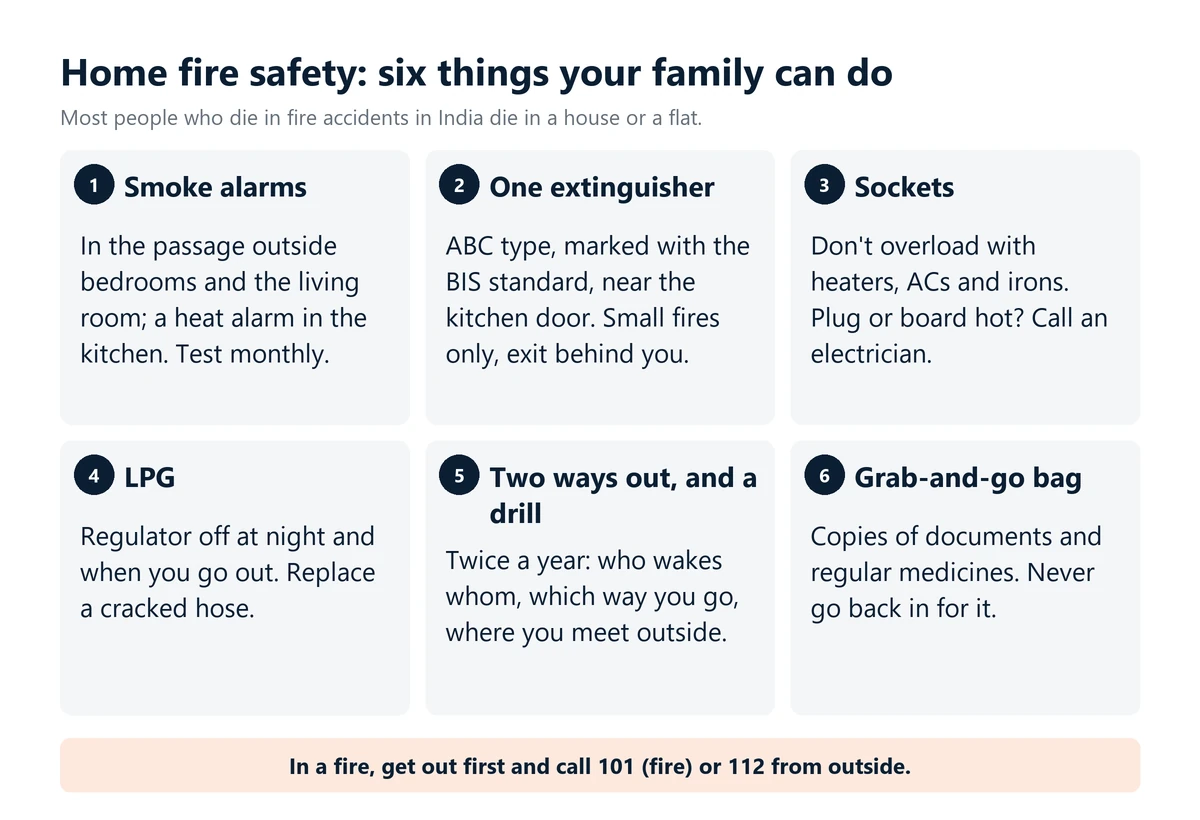
- Fit smoke alarms in the passage outside the bedrooms and in the living room. In the kitchen, a heat alarm works better, because cooking smoke sets off a smoke alarm. Test them every month.
- Keep one extinguisher at home, an ABC type marked with the BIS standard, near the kitchen door, and learn how to use it. Use it only on a small fire with your exit behind you.
- Do not overload sockets, especially with heaters, ACs and irons. If a plug or switchboard gets hot, call an electrician.
- Switch off the LPG regulator at night and when you go out, and replace a cracked hose.
- Know two ways out of your flat and your building.
- Do a family drill at least twice a year: who wakes whom, which way you go and where you meet outside.
- Keep a grab-and-go bag with copies of important documents and regular medicines, but never go back in for it.
What needs to change
- Housing societies and RWAs should get a fire safety audit every year and fix what it finds.
- Builders should not hand over flats until fire systems actually work.
- Fire NOC status for residential towers should be online for residents to check.
- Residents need a simple way to report blocked exits and dead hydrants.
Look around tonight
Is there a smoke alarm in your home? Is the extinguisher in date? Can you reach the staircase without climbing over shoes, cycles and cartons? Does your society ever hold a fire drill? If the answer to any of these is no, raise it at the next society meeting.
In a fire, get out first and call 101 (fire) or 112 from outside.
A home is only as safe as the habits of the people living in it. That is why HowToSurvive.in exists: to help families stay safe where it matters most.
What needs attention
- Six out of every ten fire-accident deaths in 2024 were in homes
- Gas cylinder or stove bursts and short circuits are the two biggest named causes
- Fires at night are deadliest because smoke overcomes people in their sleep
- Blocked staircases and locked exits turn small fires into mass-casualty fires
- Foam furniture, wooden panelling and synthetic curtains let fire spread fast
- Working smoke alarms sharply cut the risk of dying in a home fire
Controls that reduce risk
- Fit smoke alarms outside the bedrooms and in the living room, and a heat alarm in the kitchen
- Keep a BIS-marked ABC extinguisher near the kitchen door and learn to use it
- Have an electrician check old wiring and overloaded points
- Replace cracked LPG hoses and switch off the regulator at night
- Ask your society for a yearly fire audit and clear stairwells
- Hold a family fire drill at least twice a year
Common unsafe practices
- Thinking fire only happens in factories or markets
- Running a heater, AC and iron from one socket or extension board
- Leaving the LPG regulator on overnight or using a cracked hose
- Having no smoke alarm, or one with a dead battery
- Parking two-wheelers and dumping junk in the stairwell
- Going back inside for valuables


Leave a comment