
Quick answers
Can throw-down crackers set off a whole bag of crackers?
No authority we opened says so. CPSC dropped cartons of 600 snappers from up to 8 feet and found they did not mass-explode; at most, individual ones went off. A loose box of adult snappers did burst open when one or more went off. A loose or mixed bag in a closed room is a different thing, and we have only an unverified first-hand account of that.
What are throw-down crackers?
CPSC describes snappers as small novelty fireworks with a paper wrap around sand or gravel coated with trace silver fulminate, which snap when thrown to the ground. Canada says party snaps may not be sold or used there. We found no Indian rule or official text that names this type or says what the local ones contain.
How should I store leftover crackers at home?
Keep as few as you can, in their original packets inside a closed tin or wooden box, in a cool, dry place away from fire, heat, LPG, diyas, switchboards and children. Never keep crackers loose in a bag, and keep throw-down or pop-type crackers apart from the rest. This is general safety guidance; follow local rules and licences.
How many crackers can I legally keep at home in India?
Rule 9(5) of the Explosives Rules, 2008 says no licence is needed to possess fireworks not exceeding 100 kg for own use and not for sale. That is a legal limit, not a safe amount. Keep far less, and check your district order.
What should I do with a cracker that did not go off?
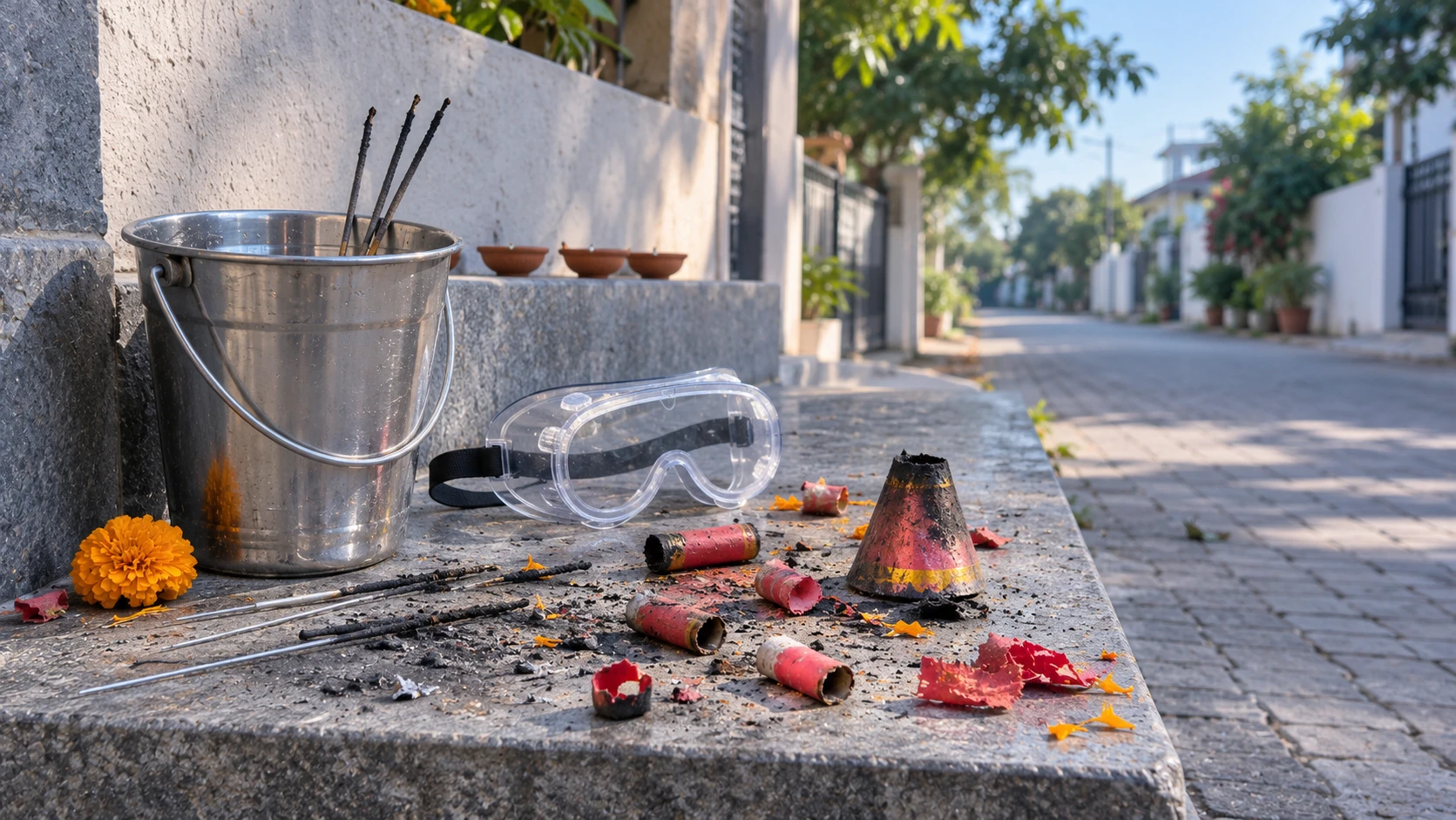
Never relight it or pick it up bare-handed. The Ministry of Health says wait and douse it with water; for a bomb, wait at least 20 minutes first. Then soak it in a bucket of water, ideally for 24 hours, and dispose of it as your municipality advises.
Can I use last year's crackers?
The Ministry of Health says old or unbranded crackers behave unpredictably and should not be used. If you have old stock, soak it in water and ask your fire station or municipality how to dispose of it.
What do I do if stored crackers catch fire?
Get everyone out, call 101 or 112 from outside and stay well back. Do not try to fight a fire that has reached a box, bag or room. Repeated bangs can go on for a long time. A single cracker burning alone on open ground can be doused from a distance. This is our general advice, not an official instruction.
Is it safe to carry crackers in a bag or on a scooter?
The Ministry of Health and CPSC say never to carry crackers in your pockets. Two reported cases, at Eluru in 2024 and near Puducherry in 2021, involved crackers carried in sacks on two-wheelers, and the cause in both is not confirmed. Carry them in a firm box and avoid jolts.
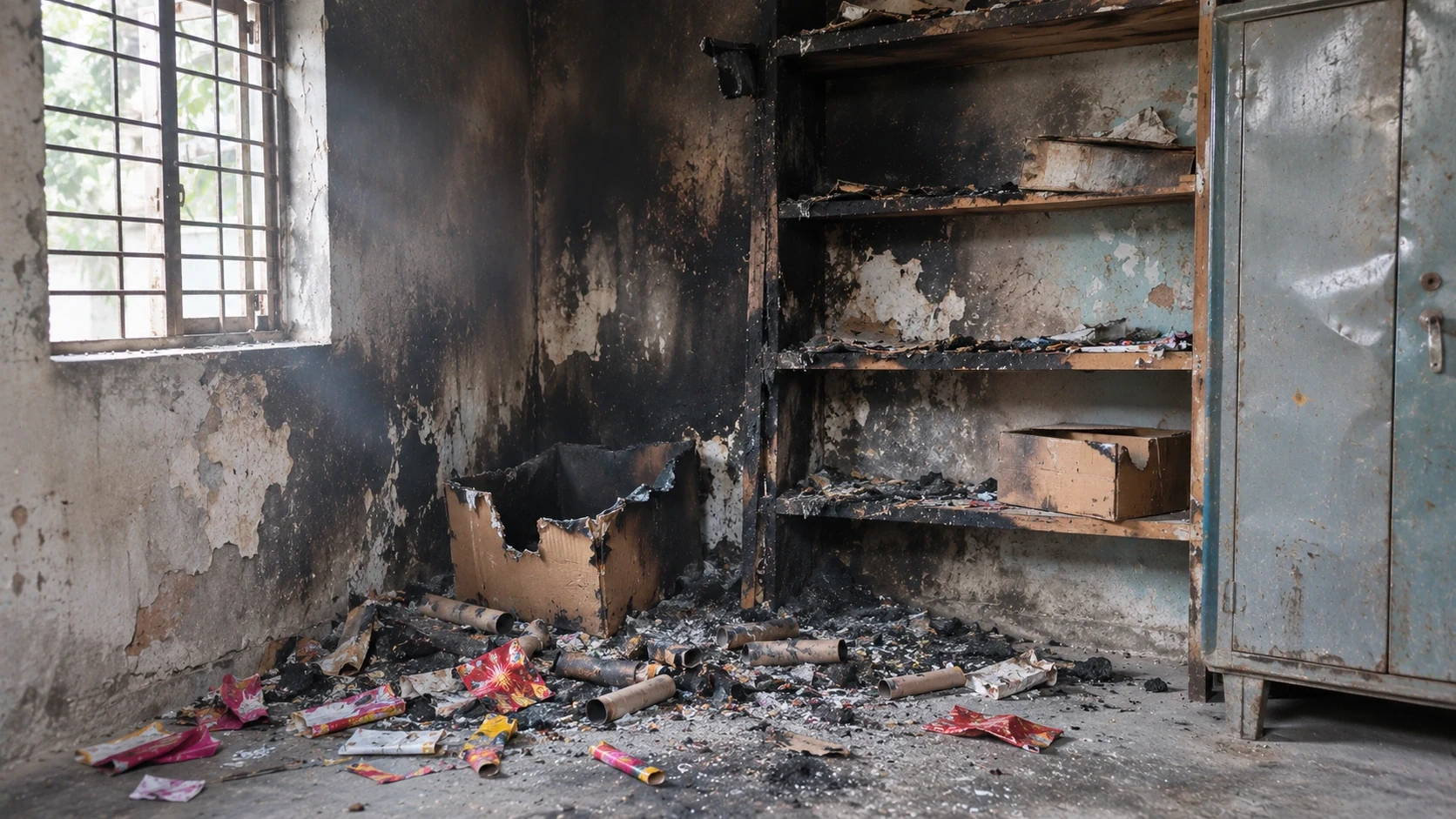
Diwali this year is on 8 November, and by tomorrow most homes will have a few crackers left over: a packet of sparklers, some bombs, a bag of the little ones that children throw on the ground. Where they go next is the question this page is about. We checked what the health ministry, fire services and safety regulators say, and what real fires in stored crackers look like. We also found something that surprised us: no authority we could open says that throw-down crackers can set off a whole bag on their own. What the sources do show is how easily a mixed bag in a closed room turns into a fire. Checked 8 November 2026.
In short
- Keep as little as you can, for as short a time as you can. Burst the legal ones on the day. The Ministry of Health says to store crackers in a cool, dry place, away from sources of fire or ignition.
- Never keep throw-down or pop-type crackers loose in a bag with other crackers. Give them their own closed box, away from bombs, rockets and anything that burns, and never drop, throw or press down on the box.
- Old and unbranded crackers are unpredictable. The Ministry of Health says not to use them. Do not light them to “finish the stock”.
- Duds and leftovers go into water, not into the dustbin dry. Never relight a dud. Soak it overnight at least, then hand it over with household waste as your municipality advises.
- If stored crackers catch fire, leave. Get everyone out, call 101 or 112 and stay back. The bangs can go on for a long time.
A first-hand account shared with us
This account was told to us first-hand. It has not been verified by the fire service, the police or any other authority, and we have no name, place or date to give. We were told that a neighbour’s store room caught fire within about a minute after someone put a bag of firecrackers inside it. On the narrator’s own inquiry, the bag held throw-down type crackers, the kind that go off when thrown or dropped without being lit, and the weight or the soft throw of the bag was enough to set some of them off. Those then set off the other crackers in the bag, and everything in the room burnt.
We cannot confirm any part of this, and we say so plainly. What we can do is set it beside the published evidence, which supports some of it and not all.
What throw-down crackers are, and what the tests say
The US Consumer Product Safety Commission (CPSC) describes snappers as small novelty fireworks: a loose paper wrap around a charge of sand or gravel coated with trace quantities of silver fulminate, which gives a small snap when thrown to the ground. In a January 2013 report it also describes a louder “adult snapper”, a paper tube like a firecracker with a pressure-sensitive charge. In 2011 CPSC said it treats adult snappers, although they have no fuse, as equivalent to more powerful firecrackers. Canada’s natural resources department says party snaps may not be sold or used there, because they contain a small amount of explosive material that goes off when thrown or stepped on, and because of many serious injuries, mainly to children.
Here is the part that matters for the bag. In its own drop tests, CPSC dropped boxes and whole cartons of 600 adult snappers from 4, 6 and 8 feet. It concluded that simply dropping a carton or a box “will not cause a mass explosion”; at most, a number of individual snappers go off separately. But a single loose box of adult snappers did burst open when one or more devices went off, spilling the rest on the floor. And the pressure from one snapper, about 0.85 psi at two inches, was far smaller than the roughly 6.5 psi from a typical firecracker. These were laboratory drops of snappers packed in their own boxes. They say nothing about a loose bag, a bag with other crackers, or a closed store room.
So here is our reading, and it is our reading, not a finding. A thrown or dropped throw-down cracker can certainly go off, and a few going off in a loose bag is believable. A single one is small. The danger is what is sitting next to it: bombs, flash-powder crackers, paper wrappers and cardboard, all packed together in a closed room with no way out for the sparks. That is the mix in the account above, and it is the mix to avoid.
We could not find any Indian rule, Ministry of Health text or Supreme Court order that names pop-pop, snap or throw-down crackers, and no Indian source that says what the locally sold ones contain. The Ministry of Health’s 2026 firecracker guidelines list chakri, bombs, snake tablets and others, and say never to throw crackers at people, but they do not describe this type. If you buy them, you are buying something whose contents and safety standard you may not be able to check.
Real fires in stored and carried crackers
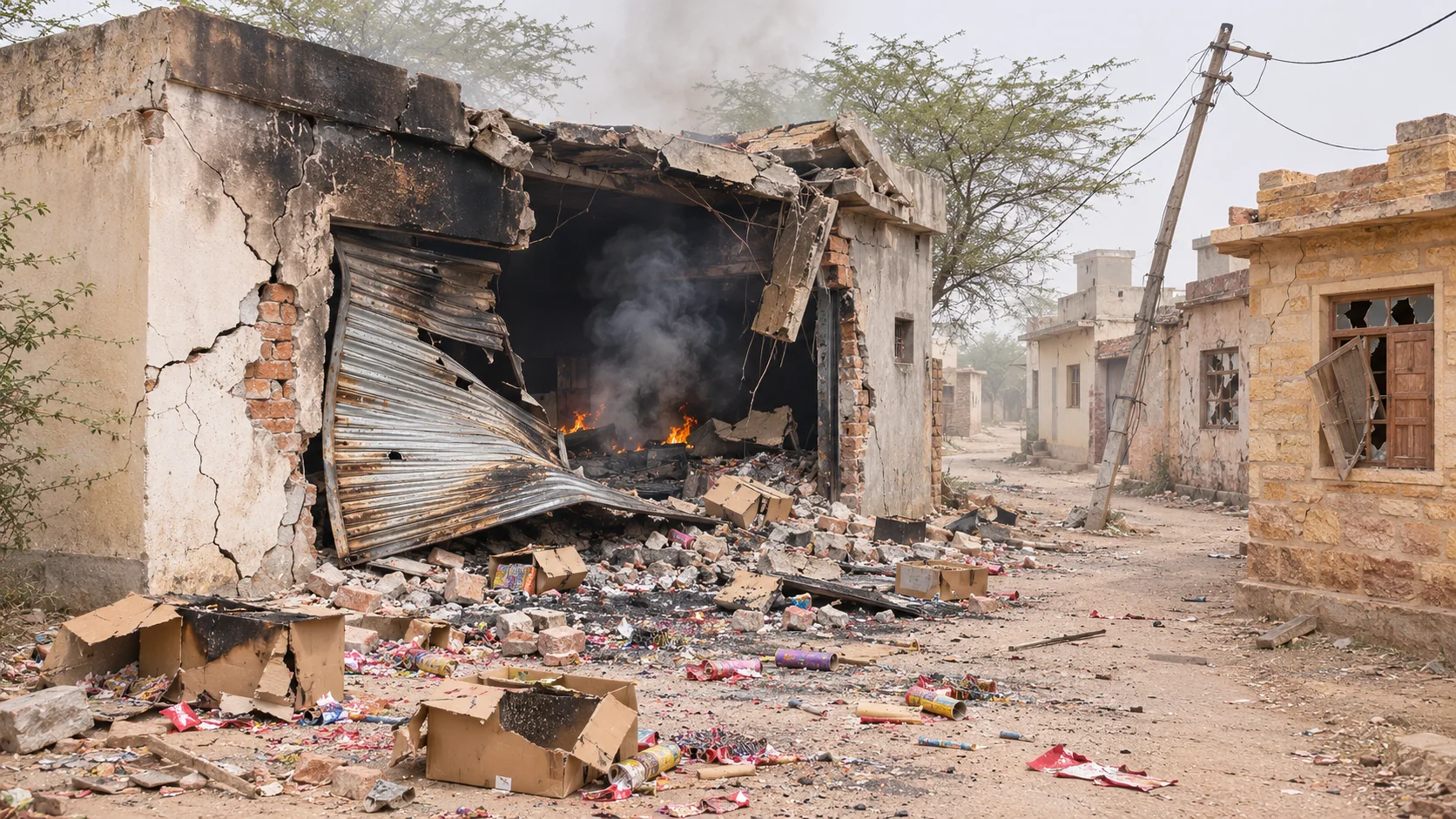
These are incidents reported by news outlets, which we opened. In most of them the cause is still not established or is only what police first said. None of them is a throw-down case proven by the reports, and we do not claim that. They are here for the pattern.
Eluru, Andhra Pradesh, 31 October 2024. A sack of “onion bomb” crackers being carried on a two-wheeler went off on a lane near a temple. The Week and India TV report one dead and six injured, with two parked vehicles damaged. Police were investigating; both outlets say the vehicle went over a pothole, and The Week says the jolt may have made the bombs in the sack shift and collide. Reports differ on who died and on what exactly fell into the pothole.
Near the Puducherry-Villupuram border, 4 November 2021. Scroll and The News Minute report that two bags of country crackers carried on a scooter caught fire or exploded and two people died; two or three others were hurt. The Villupuram Superintendent of Police opened an inquiry and suggested the crackers may have gone off from heat caused by friction. That is a police remark, not a finding.
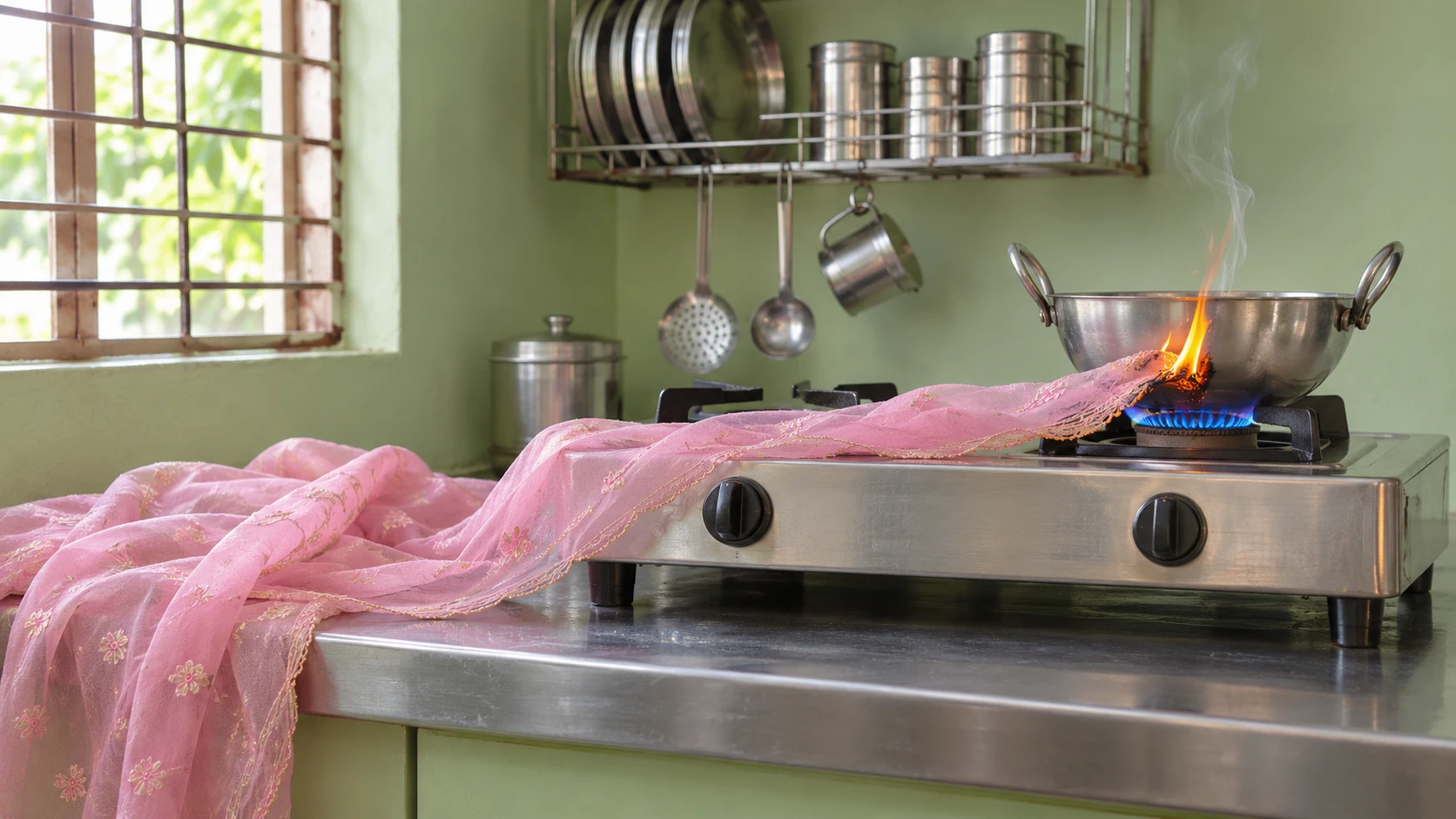
Rein Bazar, Hyderabad, 28 October 2024. Crackers kept in a two-room house burst while the family cooked. NewsDrum (PTI) and NewsMeter report the police’s preliminary account that sparks from the gas stove fell on a box of crackers, and an elderly couple died of suffocation; a girl was hospitalised. NewsMeter notes that another post blames overheated cooking oil, so the exact spark is not settled.
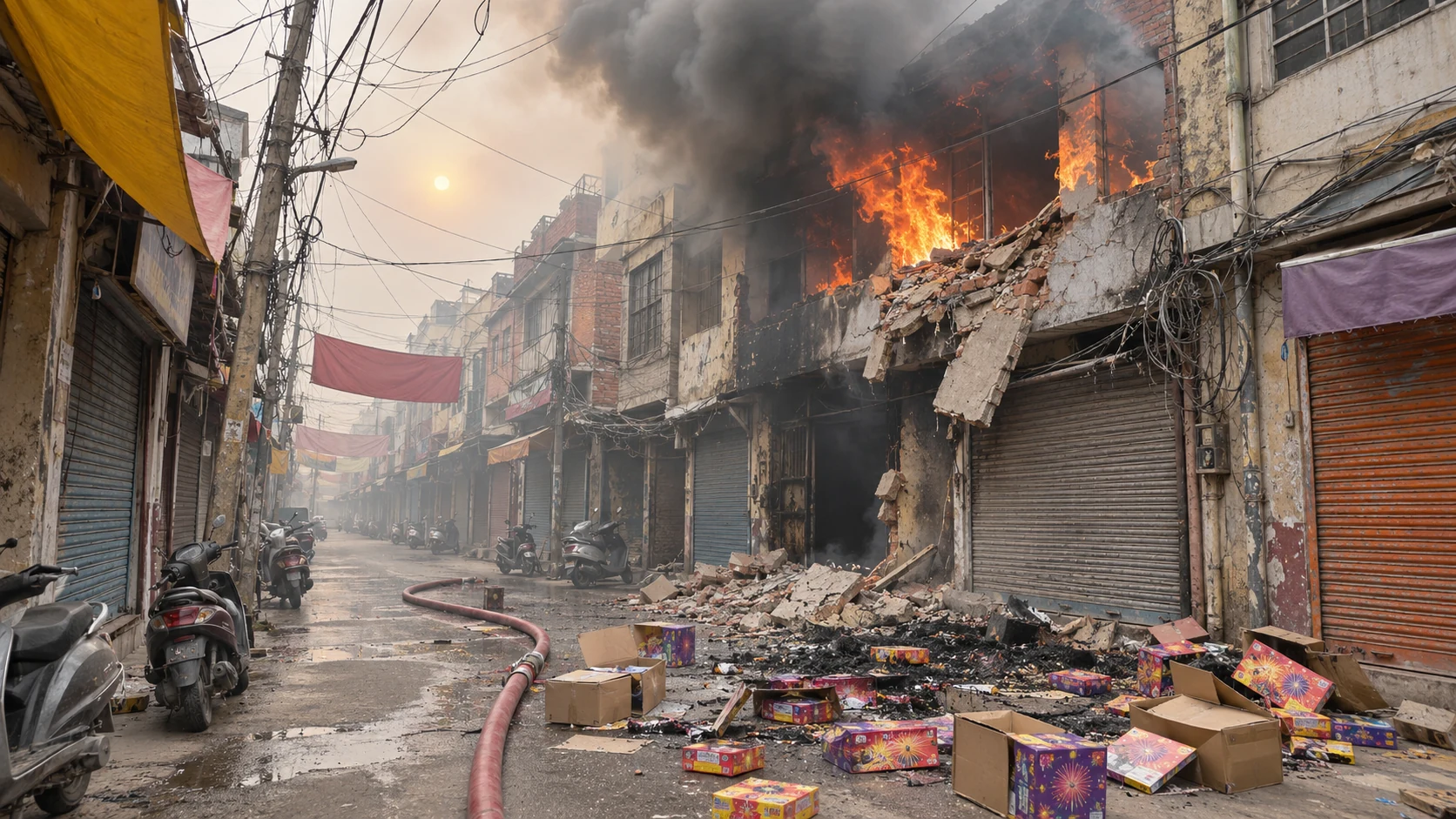
Karungalakudi, near Melur, Madurai, 4 to 5 November 2026. Crackers bought for Deepavali and kept in a house, on the terrace or the upper floor according to different outlets, exploded and badly damaged that floor. DT Next and Deccan Chronicle report one young man dead and two others seriously burnt. DT Next says that while students were bursting a few crackers, a spark reportedly set off the stored ones; Deccan Chronicle says police said the crackers accidentally went off. Police were investigating.
Greenbank, Whidbey Island, Washington, 24 June 2026. A house fire led to a huge explosion of fireworks stored inside, which flattened the home and damaged two others. KOMO reports the stock was kept for a private event and that the fire chief said ash from smoking fell into the box. The South Whidbey Record reports about 700 pounds of fireworks and says the cause was officially undetermined as of 26 June. Three firefighters were hurt; one needed surgery on a hand. The blast came shortly after crews arrived.
Zamboanga City, Philippines, 29 June 2024. A depot holding firecrackers and pyrotechnics blew up, killing five and injuring many (Philstar says 21, The Star says 38, eight of them seriously). Philstar reports the city suspended the dealer’s permit; both outlets say the cause was under investigation. This was a commercial warehouse, not a house, and we include it for scale.
Kota Bharu, Malaysia, 21 May 2021. A car believed to be carrying fireworks exploded near a junction. The New Straits Times and Malay Mail report the driver was killed and others hurt (Malay Mail says four), and other vehicles were damaged. Some people claimed lightning; the New Straits Times says police had not confirmed it, and Malay Mail says the fire service’s first finding was that the car carried fireworks.
What these fires have in common
- A small trigger and a large store. A jolt, a stove spark, a burst cracker nearby, smoking ash. Almost none of these needed a flame held to the stock.
- Everything kept together. A sack, a box in a two-room home, a car boot, a stock room. When one thing goes, the next is a few centimetres away.
- Closed or crowded spaces. Houses, terraces, vehicles, depots. Nowhere for blasts to spread out, and a floor that cannot take it.
- Repeated bangs. The Whidbey blast came after firefighters arrived. In the Avadi blast described in our cracker storage guide, small explosions went on for about 20 minutes. Do not wait to see how bad it gets.
- Unfinished answers. In nearly every case the cause is “under investigation”. That is why we stick to the pattern and make no claim about one fault.
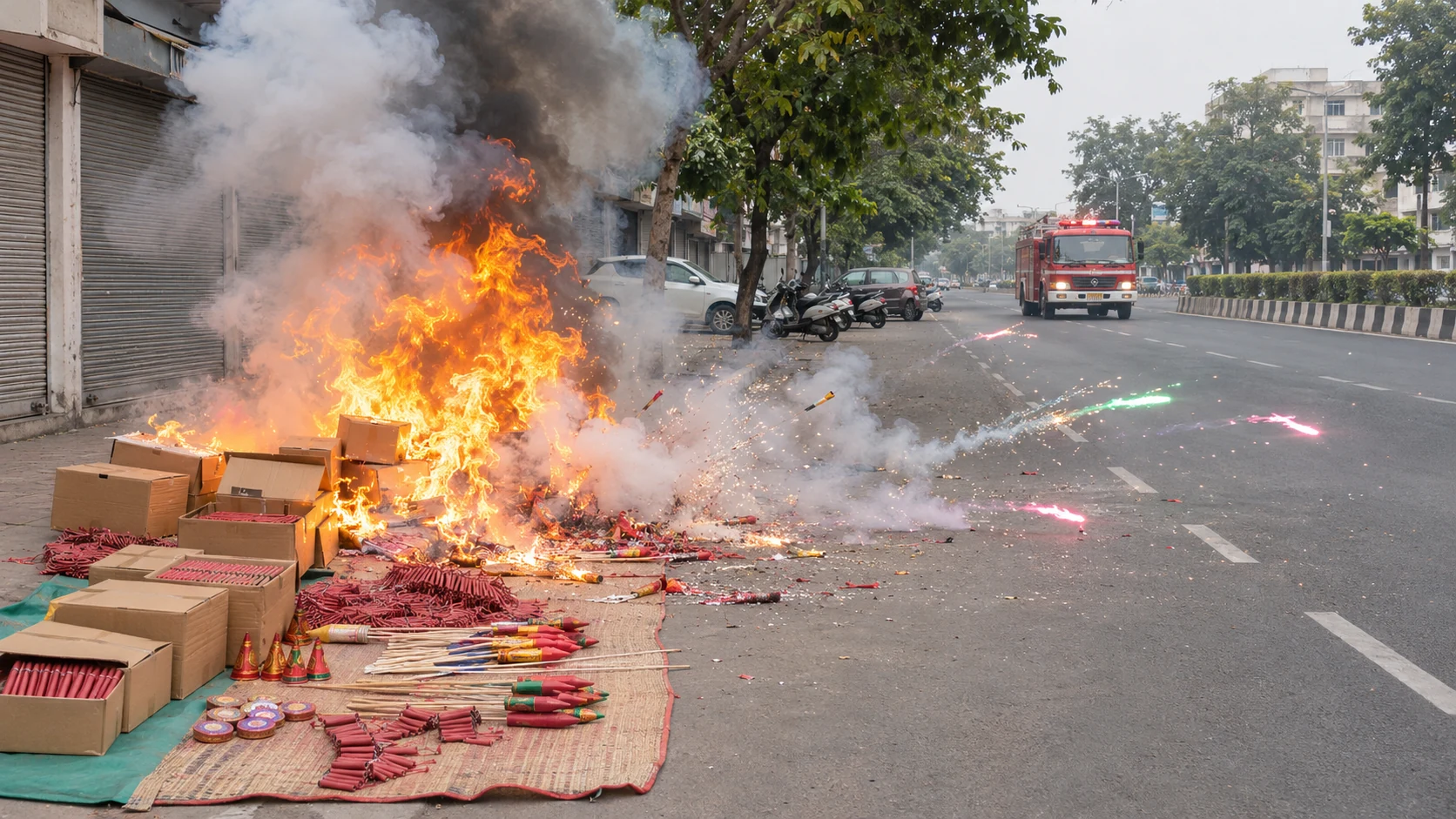
Our site already carries cases of crackers kept in shops and godowns, such as the Ludhiana store fire, the Hingoli storage fire and the Nagaur godown blast. For home blasts, see Fatehpur and Dholpur, and for a roadside stall, Surat.
What the law says about keeping crackers at home
India. The Explosives Rules, 2008, Rule 9(5), say no licence is needed to possess fireworks not exceeding 100 kg for own use and not for sale. That is a legal ceiling for a family. It is not advice on how much is safe to keep at home, and the less in the house, the better. Anything for sale needs a licence, and our guide to illegal home firecracker units and cracker storage sets out the rules for shops, stalls and storehouses as we read them. Rules can change and district orders add to them, so check with your district office or fire station.
Other countries, for comparison only. The UK Health and Safety Executive says private individuals can keep up to 50 kg (net) of the less powerful, hazard type 4 fireworks for up to 21 days without a licence, if not for sale or use at work. Canada’s natural resources department says up to 10 kg of consumer fireworks can be kept in a home without a licence, away from flammable material and ignition sources, and out of reach of anyone not authorised. The US CPSC pages we opened do not set a home storage limit. Indian readers should follow Indian rules and the local order for the year, not these figures.
How to store leftover crackers safely
The Ministry of Health’s 2026 guidelines give three storage lines: store crackers away from sources of fire or ignition, in a cool and dry place, and not near a flame or heat source. They also say old or unbranded crackers behave unpredictably and should not be used. A UK fire service says to keep fireworks in a closed box and use them one at a time. The rest of this list is our own practical guidance, built on those lines and on the incidents above. It is general safety guidance; follow local rules and licences.
- Keep the smallest amount possible. Do not buy “extra” for next year. Old stock is the stock the Ministry says not to use.
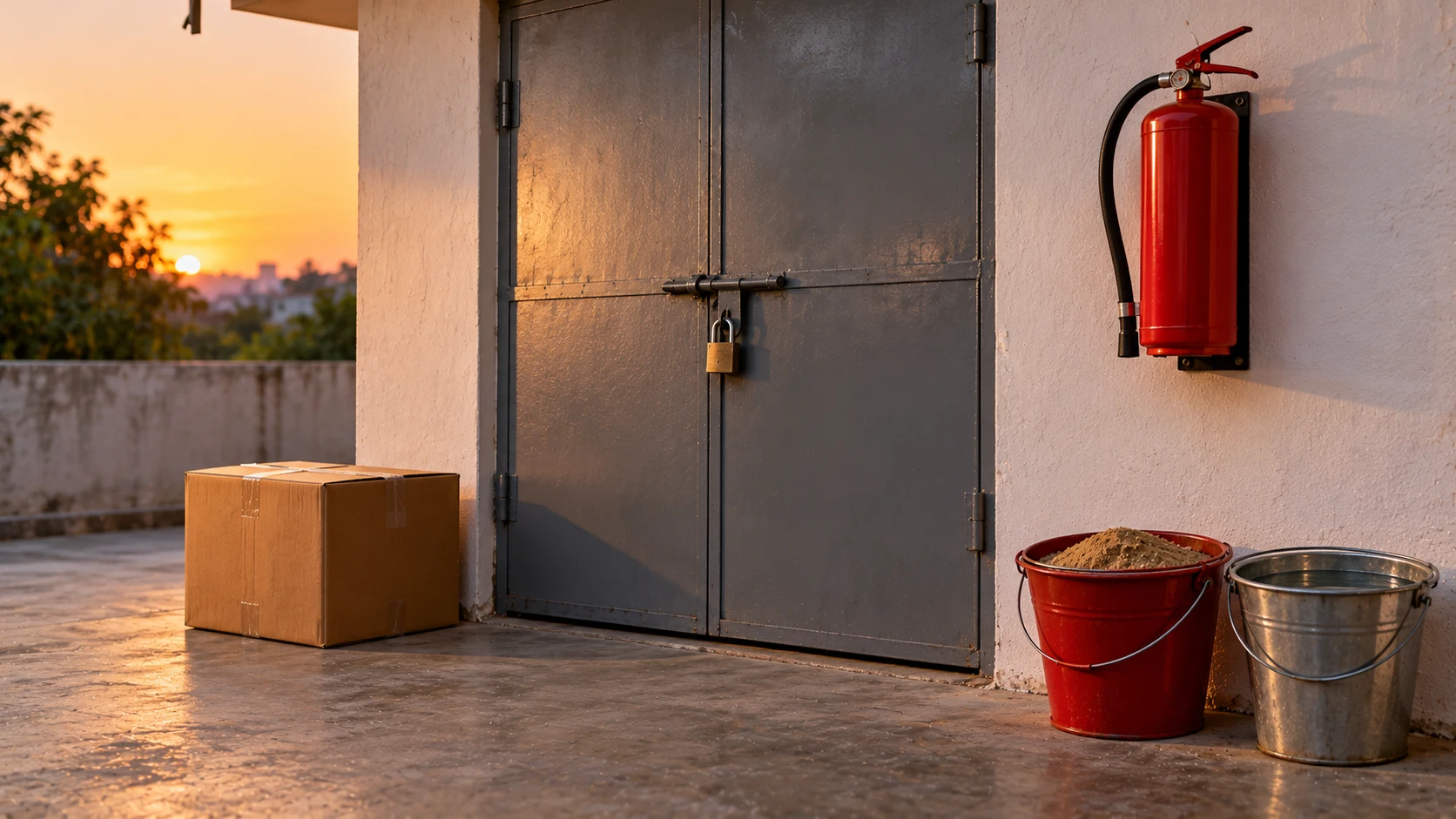
- Original packets, inside a closed box. A tin or a wooden box with a lid is better than a plastic bag or a cloth bag. Do not decant crackers loose into one container.
- Keep throw-down, pop-type and snap crackers apart. Their own labelled box, away from bombs, rockets and anything that goes bang or burns. Do not use a bag at all.
- Never drop, throw, swing or stack things on the box. Put it down gently and leave it. Teach children that a box of crackers is never a ball or a seat.
- Away from where people live and sleep. Not in the bedroom, the kitchen, the puja room or under the staircase. Choose a ground-level, ventilated, lockable spot outside the living area if you have one.
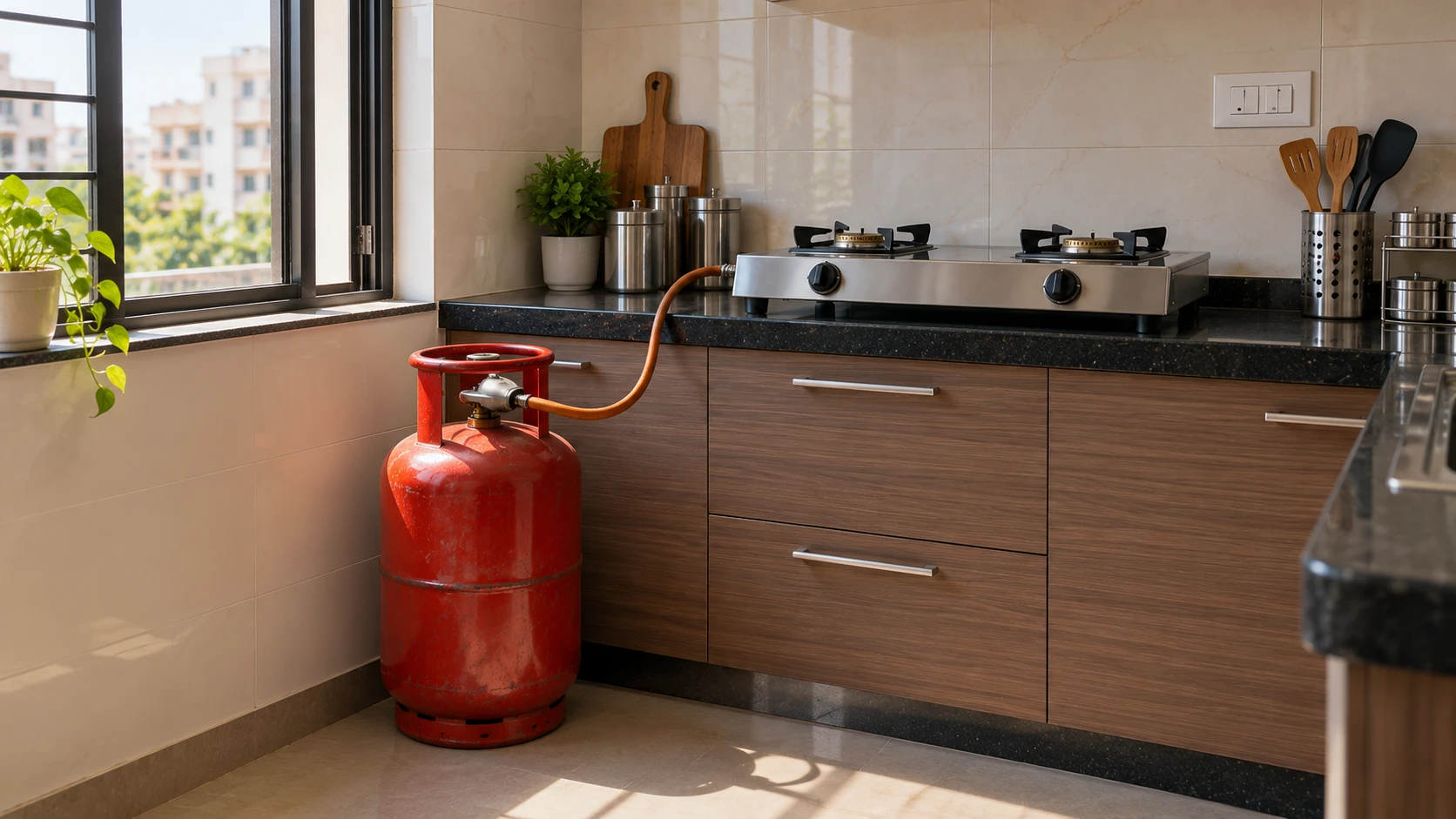
- Keep away from heat and sparks. LPG cylinder, stove, diya, candle, incense, switchboard, charger, inverter, geyser and tools that throw sparks. Not on a terrace that bakes in the sun.
- Not in the same room as fuel and paint. Petrol, thinner, kerosene, spirit and aerosols turn a small flash into a big fire. See our guide on explosives and fuel at sites for why fuel and explosives must not share a room.
- Locked, and out of children’s reach. Children pick up and throw whatever is within reach. A lock on the box is cheap.
- No smoking and no flame anywhere near it. The Whidbey and Hyderabad fires began with a small spark near the stock.
- Do not carry crackers in your pocket, and do not carry a sack on a scooter. The Ministry of Health and CPSC both say never to carry crackers in a pocket. Carry a packet in hand or in a firm box on the floor of a car, not a loose sack on a bike (see Eluru and the Puducherry border above).
If someone is storing a large quantity next door and it worries you, do not go in and do not argue. Note the address and tell the police or the fire service. Our cracker storage guide explains how.
Duds and leftovers: how to dispose of them
The Ministry of Health says never to relight a dud, to discourage children from picking up crackers that failed to explode, and that failed crackers must be doused with sand or water. For a bomb that fails, it says to wait at least 20 minutes and then douse it with water before disposal. It also says to dispose of all used or unburst crackers by dousing them in water first. CPSC says never to try to relight or pick up fireworks that have not fully gone off, and to soak them in plenty of water before throwing them away.
How long to soak? The Ministry of Health gives no time. North Yorkshire Fire and Rescue Service says to soak each firework in a bucket of water for at least 24 hours, put them in a bag that holds the water, and ask the local council where to take them. It adds that you should first check whether the shop will take unused fireworks back. Canada says to wait at least 30 minutes before going near a dud. We suggest overnight at least, and ideally 24 hours, in a bucket kept outdoors.
- Wear closed shoes, and pick up duds with a stick or tongs, not bare hands.
- Put them in a bucket of water outside, away from the house, and leave them there.
- Drain, then bag the wet crackers in a sealed bag and keep them wet until disposal.
- Hand over as your municipality advises. Ask your nearest fire station or police if you have old, whole crackers you no longer want.
- Do not burn them, bury them, flush them or dump them in a drain or a field.
If stored crackers catch fire
We found no Indian fire-service page that says what a householder should do when a stock of crackers catches fire, so this is our general advice, drawn from how the fires above went. It is not a legal or medical instruction.
- Get everyone out first. Walk out; do not run back for belongings. Shut the door behind you if you can do so in a second.
- Call 101 or 112 from outside and give the lane and a landmark. Tell the crew that crackers are inside, and where.
- Do not fight it. A single cracker or a small heap burning on open ground, with nothing near it, can be doused with a bucket of water from a distance. Once flames reach a box, bag or room, stay away. The bangs can come in bursts for a long time.
- Stay well back and keep others back. Windows, balconies and stairs facing the fire are not safe places to watch from. Warn neighbours; rockets and fragments can fly sideways.
- Look after burns and clothes on fire. If someone’s clothes catch fire, they must not run. See our guide on what to do when clothes catch fire and our first-aid guide on firecracker eye injury and burns.
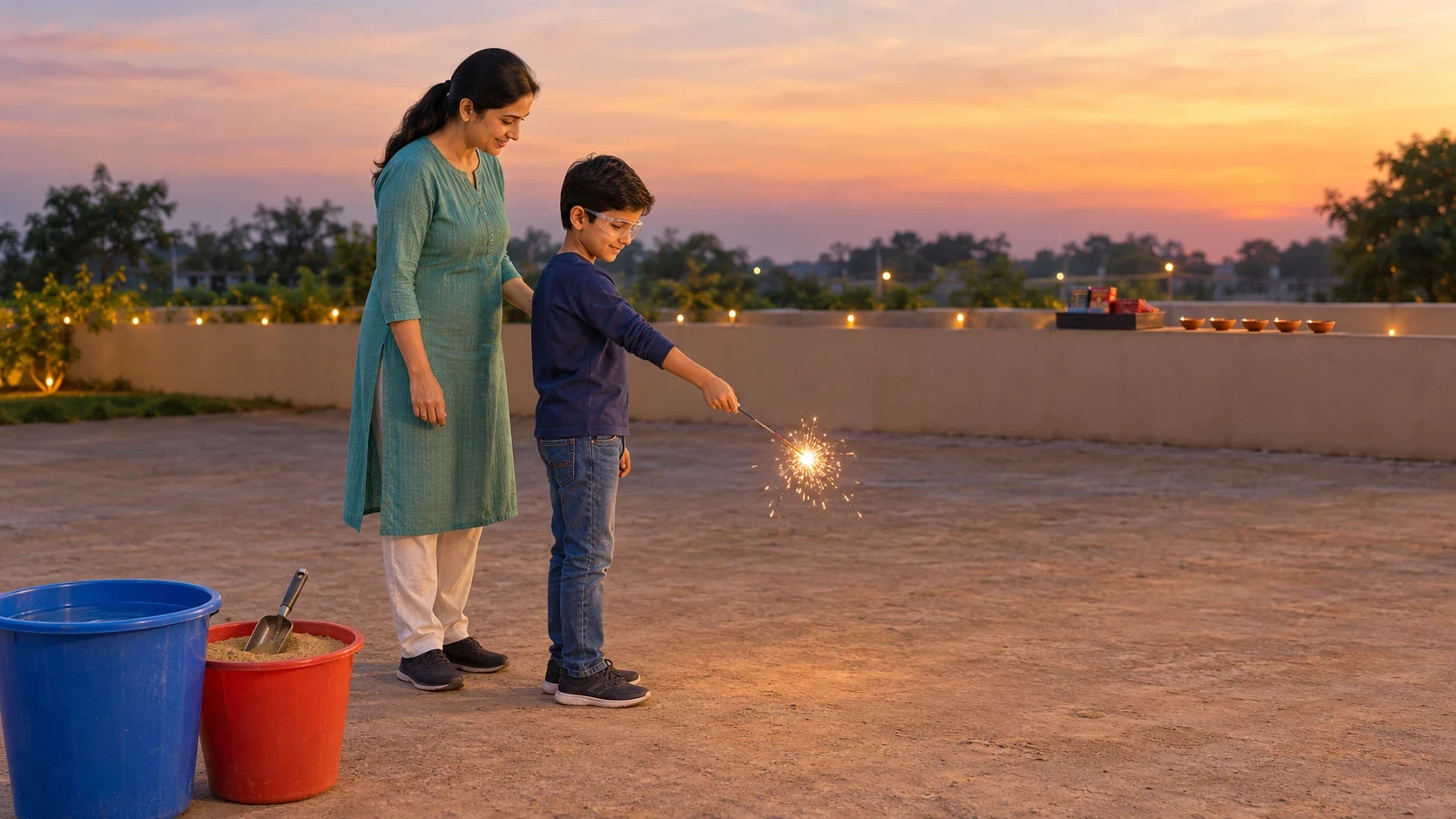
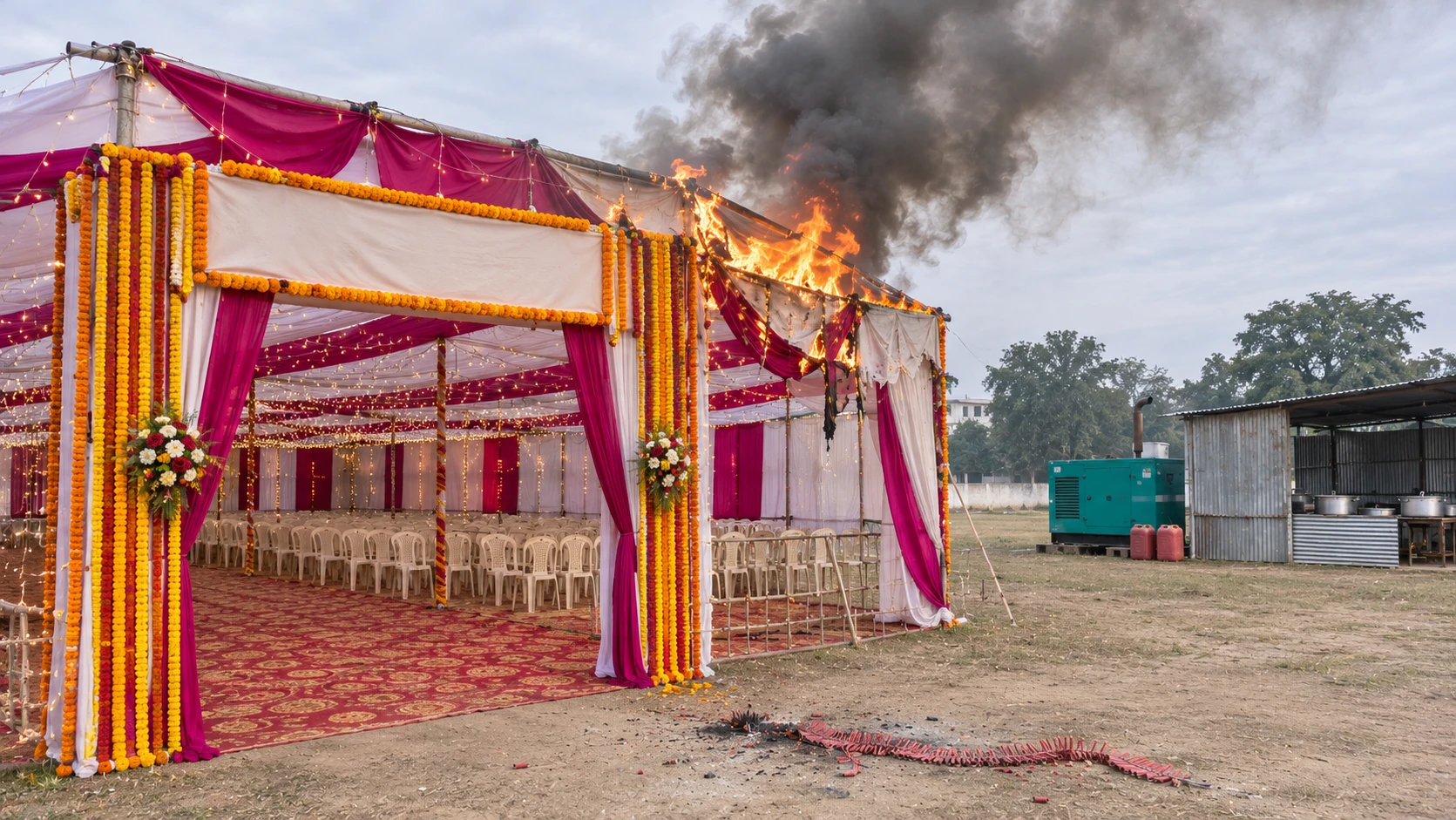
For lighting, buckets of water and sand, and the rules for green crackers this year, read our Diwali firecracker safety guide. For diyas, LPG and sweets-making in the same week, read festival-season home fire safety and our LPG leak guide. If you are planning a baraat or wedding, wedding pandal and venue safety covers crackers and generators. Our guide to the fire brigade number explains what to say when you call.
What we could not confirm
- The first-hand account at the top. We have no report, no place and no date, and no authority has confirmed it or its cause.
- Any official statement that throw-down crackers set off a whole bag. CPSC’s drop tests found a carton of snappers did not mass-explode; they did not test a loose bag, a mixed bag or a closed room.
- What Indian throw-down, pop-pop or snap crackers contain, and whether any Indian rule names them. We found none.
- The cause in the real incidents above. Most are still under investigation or rest on a first police remark.
- Soaking time. The Ministry of Health gives none; the 24 hours comes from a UK fire service.
- Whether the Indian rules have changed since the text we read. Check with PESO or your district office.
Do this today
Look at what you have left. Do not bin anything dry. Put any dud in a bucket of water outdoors tonight, and soak it overnight. Move the rest into a closed box, away from the kitchen, the lamps and the children, and keep the throw-down type in a box of its own. Then ask yourself whether you really need to keep any of it. If not, burst the legal ones carefully in the open tomorrow, in your area’s allowed hours, or ask your fire station or the shop what to do. Share this page with your building’s WhatsApp group; someone in it is storing a bag somewhere.
What needs attention
- No authority we opened says throw-down crackers can set off a whole bag; CPSC drop tests found a sealed carton of 600 adult snappers did not mass-explode.
- A single loose box of adult snappers did burst open and spill when one or more devices went off, so a few going off in a loose bag is believable.
- The risk is the mix: other crackers, paper and cardboard in a closed room.
- In seven reported stored or carried cracker fires, the triggers were small: a jolt, friction, a stove spark, a burst cracker, smoking ash. Causes are mostly still under investigation.
- The Ministry of Health 2026 guidelines say to store crackers in a cool, dry place away from ignition, to avoid old or unbranded stock, and to douse duds with water.
- India allows up to 100 kg for own use without a licence; this is a legal ceiling, not a safe amount.
- We found no Indian rule or official text that names throw-down, pop-pop or snap crackers.
Controls that reduce risk
- Keep the smallest amount possible, in original packets in a closed tin or wooden box.
- Keep throw-down and pop-type crackers in a box of their own, apart from other crackers.
- Store away from living areas, heat, LPG, lamps and electricals, and out of children's reach.
- Soak all duds overnight, ideally 24 hours, then dispose as your municipality advises.
- Never drop, throw or stack on the box; carry it gently.
- If a fire starts, leave, call 101 or 112 and stay back.
Common unsafe practices
- Putting loose crackers of different kinds in one bag.
- Throwing or dropping a bag or box of crackers into a store room.
- Storing crackers in the kitchen, bedroom, puja room or next to LPG or lamps.
- Keeping crackers on a sun-baked terrace.
- Carrying a sack of crackers on a two-wheeler.
- Relighting a dud or "finishing" last year's stock.
- Throwing wet duds in the dustbin without soaking, or burning them.
- Going back in, or standing close, to watch a stored stock burn.





Leave a comment