
Quick answers
What do the IMD colour codes mean?
IMD's 2021 procedure gives green as no warning (no action), yellow as watch (be updated), orange as alert (be prepared) and red as warning (take action). The colour is decided from the probability of the event and its expected impact.
Was the Nilgiris under a red alert when the bus was buried?
Reports differ. PTI and DT Next say red, from the Regional Meteorological Centre in Chennai, for Saturday 24 October; ETV Bharat calls it orange. We could not open an archived IMD warning for that day.
What is IMD showing for the Nilgiris now?
On IMD's district page on the morning of 26 October, a thunderstorm and lightning warning for 26 and 27 October and none for 28 to 30 October, with no heavy-rain warning. It can change during the day, so check again before you leave.
Will the Bay of Bengal cyclone affect the Nilgiris?
IMD's bulletin of 26 October expects the system to cross the Andhra Pradesh and Yanam coast as a very severe cyclonic storm by 28 October. For Tamil Nadu it mentions only squally wind along the north Tamil Nadu coast on 27 and 28 October. It lists possible landslides in hilly areas for the affected states, not the Nilgiris.
What does NDMA say to do if a landslide starts?
Move away from the landslide path or downstream valleys quickly, stay alert, awake and active, locate and go to shelters, stay with your companions, do not panic, and do not touch loose material or electrical wiring or poles.
When should I not travel on a hill road?
Our suggestion: when your route is orange or red, after heavy rain the night before, after dark in a downpour, and whenever a ban or closure is in force. IMD calls orange be prepared and red take action; the rest is our judgement and not an official rule.
Is the alternative road safe?
Not necessarily. On 24 October the Kotagiri road, suggested as the diversion, had three slides of its own (Onmanorama). Check the road you plan to take.
Who do I call?
112 for any emergency and 108 for an ambulance. Reports gave 1077 as the Nilgiris district number; other districts have their own control rooms, listed in our state-wise helpline guide.
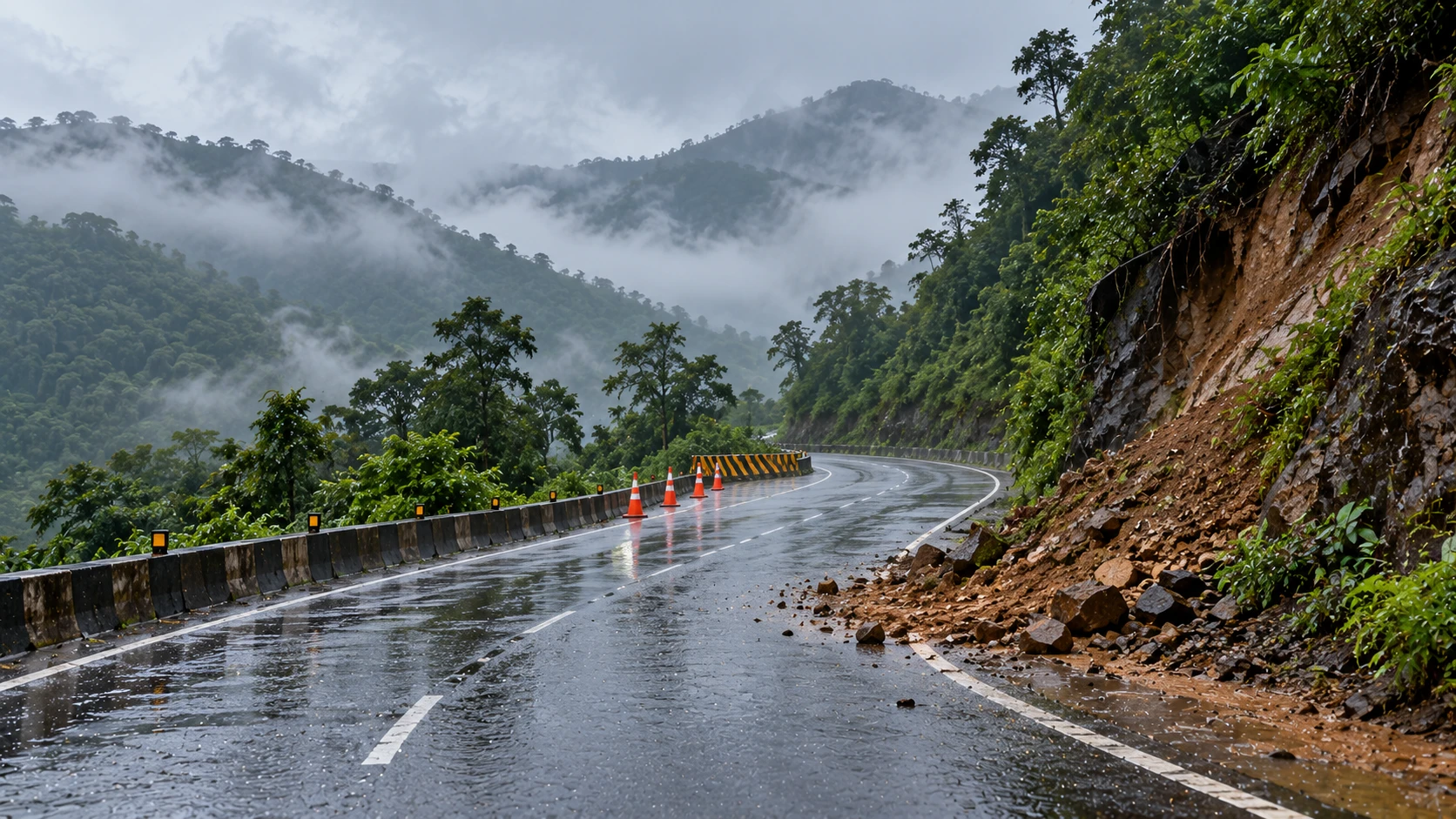
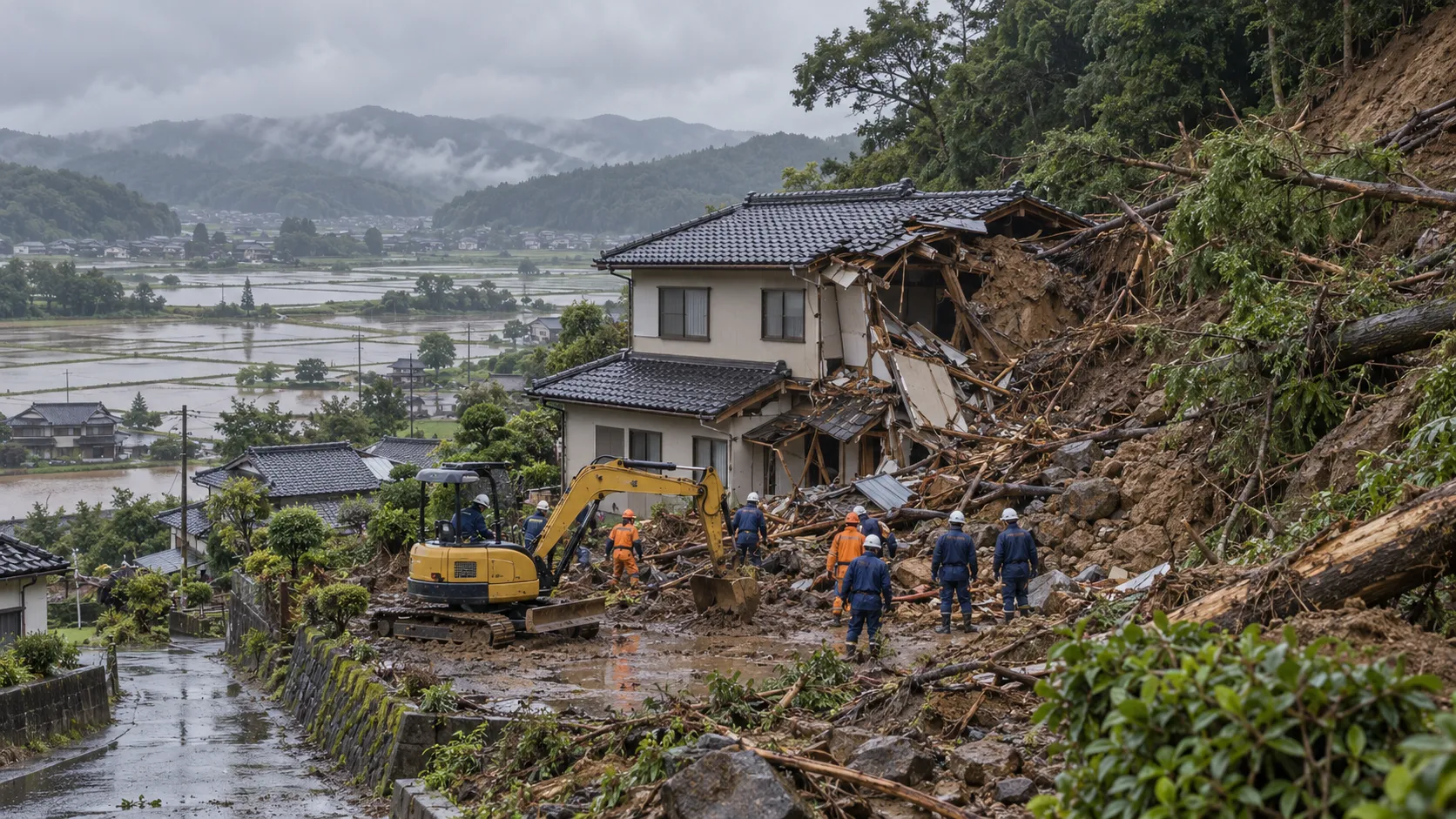
Late on the night of Friday 23 October 2026, a mudslide with uprooted trees and rocks buried a Tamil Nadu State Transport Corporation (TNSTC) bus at Burliar, at the foot of the Coonoor ghat road in the Nilgiris. The driver died and the conductor was seriously injured. More than 200 vehicles were stranded, and over a hundred Kerala students were in two buses that had stopped about 300 metres behind the slide (PTI, via The Tribune). Our case study sets out that incident and where the reports disagree. This page is a different thing: a working guide for anyone who drives or rides on a hill road in India in heavy rain. It explains what the India Meteorological Department (IMD) colour codes officially mean, what IMD is showing today for the Nilgiris and for the Bay of Bengal system, what the National Disaster Management Authority (NDMA) says to do before, during and after a landslide, and when, in our view, you should not start the trip at all. Anything we add ourselves is marked Our suggestion. Updated 26 October 2026.
In short
- The four IMD colours are green (no warning, no action), yellow (watch, be updated), orange (alert, be prepared) and red (warning, take action), as set out in IMD’s 2021 forecasting procedure. The colour is a signal for authorities and the public; it is not a road-closure order.
- Colour changes and sources differ. For the Nilgiris on 24 October, PTI and DT Next report a red alert from the Regional Meteorological Centre, Chennai; ETV Bharat calls it orange. On IMD’s district page on the morning of 26 October, the Nilgiris showed a thunderstorm and lightning warning for 26 and 27 October and no warning for 28 to 30 October.
- The Bay of Bengal system was a deep depression at 11.30 pm IST on 25 October, with a Cyclone Alert (Orange Message) for the Andhra Pradesh and south Odisha coasts. IMD’s bulletin lists possible landslides in hilly areas among the secondary hazards there. It carried no heavy-rain warning for Tamil Nadu’s hill districts.
- NDMA’s core advice: plan hill trips by the weather department’s information; if a landslide begins, move away from the slide path and downstream valleys quickly; stay alert; do not touch loose material or electrical wiring.
- Our suggestion: do not start a ghat-road trip in orange or red rain, after heavy rain the previous night, or after dark in a downpour. A collector’s ban or a closed road settles the matter, whatever the colour.
What happened at Burliar, and on the same stretch 17 days earlier
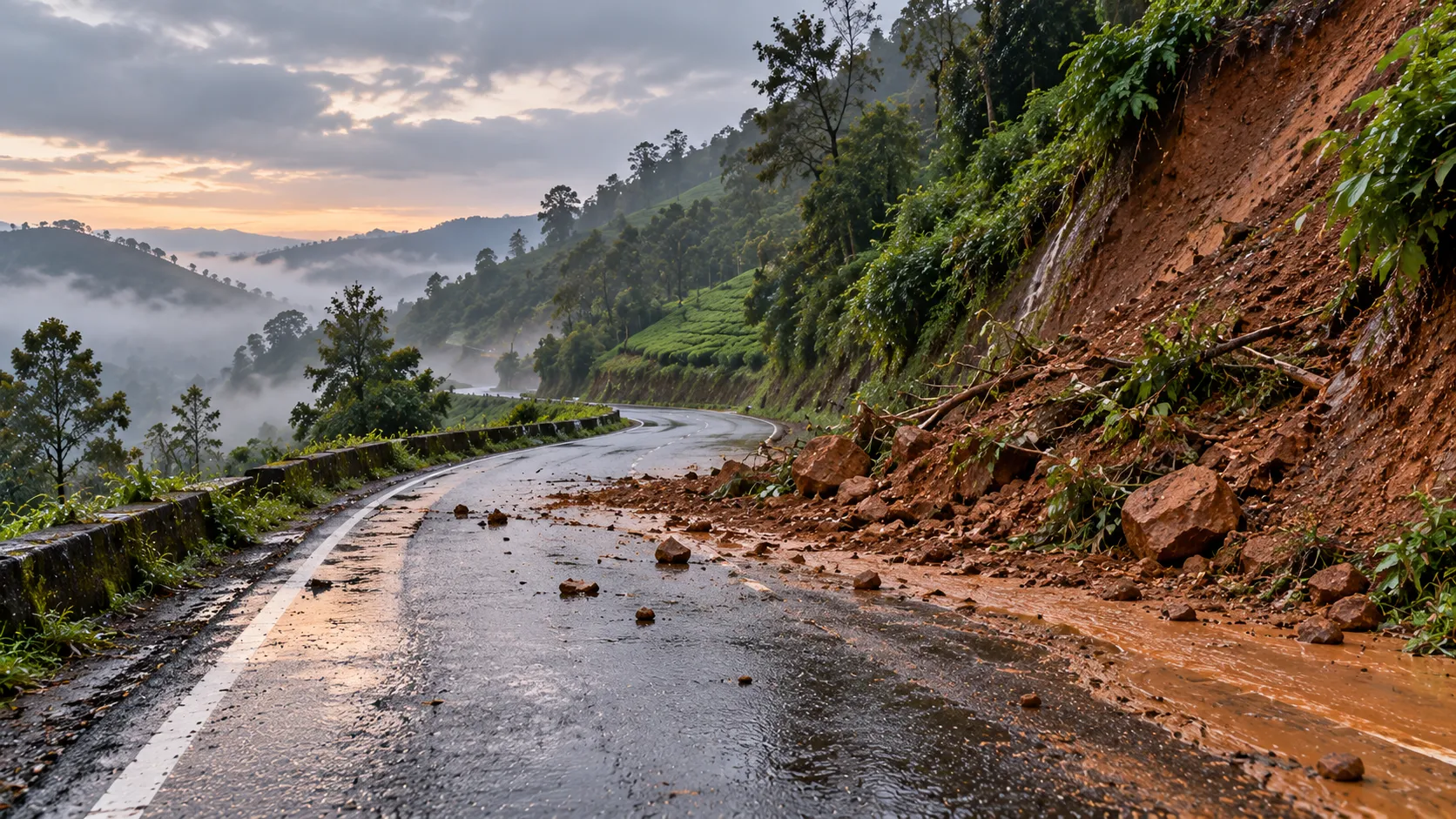
PTI’s report in The Tribune says the bus had come from Coonoor towards Mettupalayam and that the mud, trees and rocks crushed its roof and pushed through its windows. Rescuers spent hours pulling the two crew members out of neck-deep slush. A fire officer said the driver was trapped in his seat under the debris. Police said three passengers had got off shortly before Burliar. Other reports give different passenger counts and routes, which the case study lists; we do not name the crew. Burliar recorded 25 cm of rain, The Tribune reports, and The Hindu’s video puts the figure at 250 mm in 24 hours, which is the same amount.
Onmanorama describes one Kottayam school group of 78 students and 8 teachers stuck on the Mettupalayam-Ooty road from about 11 pm on Friday, after a vegetable truck ahead of them lost control and went nearly 100 feet into a gorge; ropes were used to get them across the blocked road. The same report counts landslides at 14 places on the Coonoor road and three on the Kotagiri road, which matters because the Kotagiri road was the suggested alternative. ETV Bharat reported that motorists were advised to use the Kotagiri-Mettupalayam road instead. A diversion can carry its own slides.
It was not the first serious slip there that month. On the morning of Wednesday 7 October, boulders came down on a moving car near Burliar after overnight rain. PTI’s first report, in Deccan Chronicle, said three people were severely injured and none had died. DT Next later reported that a 64-year-old man in the car died on the way to hospital. That is a small example of why an early injury count should be read as provisional.
What the IMD colours mean
IMD’s Standard Operating Procedure for Weather Forecasting and Warning (March 2021) gives the colour code for weather warnings:
- Green: no warning (no action).
- Yellow: watch (be updated).
- Orange: alert (be prepared).
- Red: warning (take action).
The same document says the colour for a warning is decided from the probability of the event and its expected impact, and that the forecaster takes the local situation into account. For heavy rain at district level, its general criteria are: isolated extremely heavy rain, red; scattered heavy to very heavy rain, red; isolated heavy to very heavy rain for three days running, orange on days one and two and red on day three; scattered or isolated heavy rain, yellow; heavy rain expected where a flood situation already exists, orange or red; no heavy rain, green. It calls these criteria general and lets regional centres decide the colour for their districts, and it notes that a district’s colour can differ from that of the larger subdivision around it. So a district map and a state map can both be right and still show different colours.
IMD’s words for 24-hour rainfall are: heavy, 64.5 to 115.5 mm; very heavy, 115.6 to 204.4 mm; extremely heavy, 204.5 mm and above. Read against that scale, 250 mm in 24 hours at Burliar is in the extremely heavy class. That comparison is ours, using the station figure quoted in The Hindu’s video.
For heavy rain, IMD’s own impact-and-action text lists localised landslides in hill and vulnerable areas among the impacts, and suggests: check for traffic congestion on your route before leaving, follow any traffic advisories, avoid areas that often waterlog, and avoid staying in vulnerable structures. It says nothing specific about driving a ghat road, so the practical advice below is partly our own.
What IMD showed on 26 October 2026
The Nilgiris. IMD’s district-wise warning page, opened on the morning of 26 October, carries a five-day layer. For the Nilgiris district it lists thunderstorm and lightning, squall and similar weather on 26 and 27 October and no warning on 28, 29 and 30 October. The layer stores a colour index for each day; we read it as yellow for the first two days and green after that, by matching it with the legend and with other districts, which is our reading and not IMD’s caption. There is no heavy-rain warning for the Nilgiris in that layer. This is a snapshot: IMD revises district warnings through the day, and the ban on tourist movement ordered by the District Collector is separate from IMD’s colour. Onmanorama and ETV Bharat say it ran until 26 October, and PTI says three days from 24 October. We could not find a report on whether it was lifted or extended.
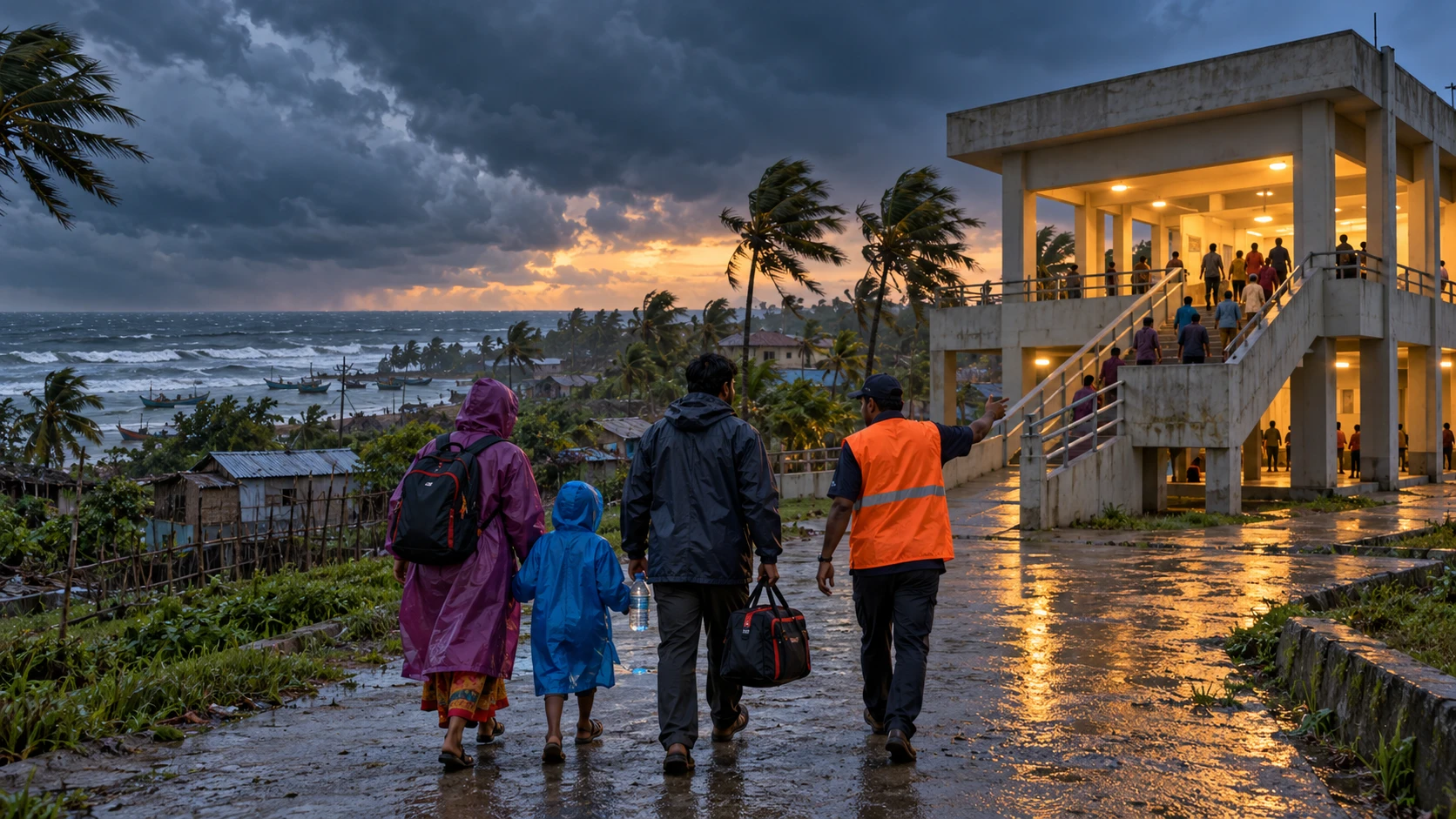
The Bay of Bengal system. IMD’s National Bulletin No. 7, issued at 0230 hours IST on 26 October, says a deep depression lay at 11.30 pm IST on 25 October near 15.3 degrees north, 89.7 degrees east, about 730 km east-southeast of Visakhapatnam. IMD expects it to become a cyclonic storm on the early morning of 26 October, a severe cyclonic storm by 27 October and a very severe cyclonic storm, crossing the Andhra Pradesh and Yanam coast between Bapatla and Visakhapatnam with winds of 115 to 125 km/h gusting to 140 km/h by the forenoon of 28 October. The bulletin is headed Cyclone Alert for Andhra Pradesh and adjoining south Odisha coasts, Orange Message, and gives a storm surge of 1.0 to 1.5 m near Kakinada and Yanam. Its list of expected impacts for coastal Andhra Pradesh, and for south Odisha, south Chhattisgarh and north-east Telangana on 28 October, includes possible landslides in hilly areas. For Tamil Nadu it mentions only squally weather of 40 to 50 km/h, gusting to 60 km/h, along and off the north Tamil Nadu coast from the evening of 27 to the evening of 28 October. The IMD advisory we opened lists the system as unnamed, so we use no name. IMD’s next message was due at 0930 hours IST and we have not read it; check the IMD site for anything newer.
What this means for a driver. The system is not forecast to hit the Nilgiris. The cyclone bulletin is relevant to anyone travelling in the hills of coastal Andhra Pradesh, south Odisha, south Chhattisgarh and north-east Telangana on 27 to 29 October, and to anyone driving through those states.
What NDMA says about landslides
These points are from the Landslide pages of NDMA’s awareness resources, read on 26 October. NDMA’s National Disaster Management Guidelines on landslides (June 2009) say landslides affect at least 15 per cent of India’s land area, more than 0.49 million square kilometres, in 22 states and parts of two Union Territories, and name the Nilgiris among the vulnerable hill regions. The same document lists a slide at Marapplam in the Nilgiris in October 1993, in which 40 people were killed.
Before:
- Plan your trip to the hills according to the information given by the weather department or news channels.
- Identify areas of rockfall and subsidence, and cracks that indicate landslides, and move to safer areas.
- Listen for unusual sounds such as trees cracking or boulders knocking together.
- If you live close to a river, keep monitoring its flow.
- Keep drains clean and weep holes open; avoid construction in vulnerable areas.
During:
- Move away from the landslide path or downstream valleys quickly, without wasting time.
- Stay alert, awake and active, NDMA’s “3 A’s”; locate and go to shelters.
- Try to stay with your family and companions.
- Do not panic.
- Do not touch or walk over loose material, or touch electrical wiring or poles.
After:
- Check for injured and trapped persons. Do not move an injured person without giving first aid unless the casualty is in immediate danger.
- Report damage to roads, power and telephone lines to the authorities.
- Do not drink water straight from rivers, springs or wells; it may be contaminated.
- If you may need a helicopter rescue, know how to give signs to the crew.
NDMA’s pages do not carry a separate list for drivers. The US government’s Ready.gov landslide page, which is foreign guidance, adds lines that fit a road: never cross a road with water or mud flowing; listen and watch for rushing water, mud or unusual sounds; a faint rumbling that grows louder may mean a slide is near; a stream that suddenly turns from clear to muddy is a warning; if you are caught in the path of a slide, move uphill as quickly as possible; and after a slide, stay away from the area because more slides can follow.
When not to travel: our suggestions
None of the following is an official rule; it is our reading of the IMD and NDMA material above and of what happened at Burliar. A closure order, a night ban or a collector’s advisory always overrides it.
- Our suggestion: postpone any trip that is not urgent when the districts on your route are orange or red for your travel days. IMD calls orange “be prepared” and red “take action”; for a ghat road, “action” can simply mean staying home.
- Our suggestion: look at the last 24 hours, not only today’s colour. On the Nilgiris, rain fell from Friday night, and the slide came in that same night’s rain; slopes that have been soaked can fail even when the next day’s forecast is milder.
- Our suggestion: do not start a hill climb after dark in heavy rain. You cannot see cracks, mud on the carriageway or a leaning tree. Reports say the Nilgiris district barred vehicles from 6 pm to 7 am (PTI, via The Tribune).
- Our suggestion: check the whole route and the way back, and the alternative road too. At Burliar the Kotagiri road, suggested as the diversion, had slides of its own.
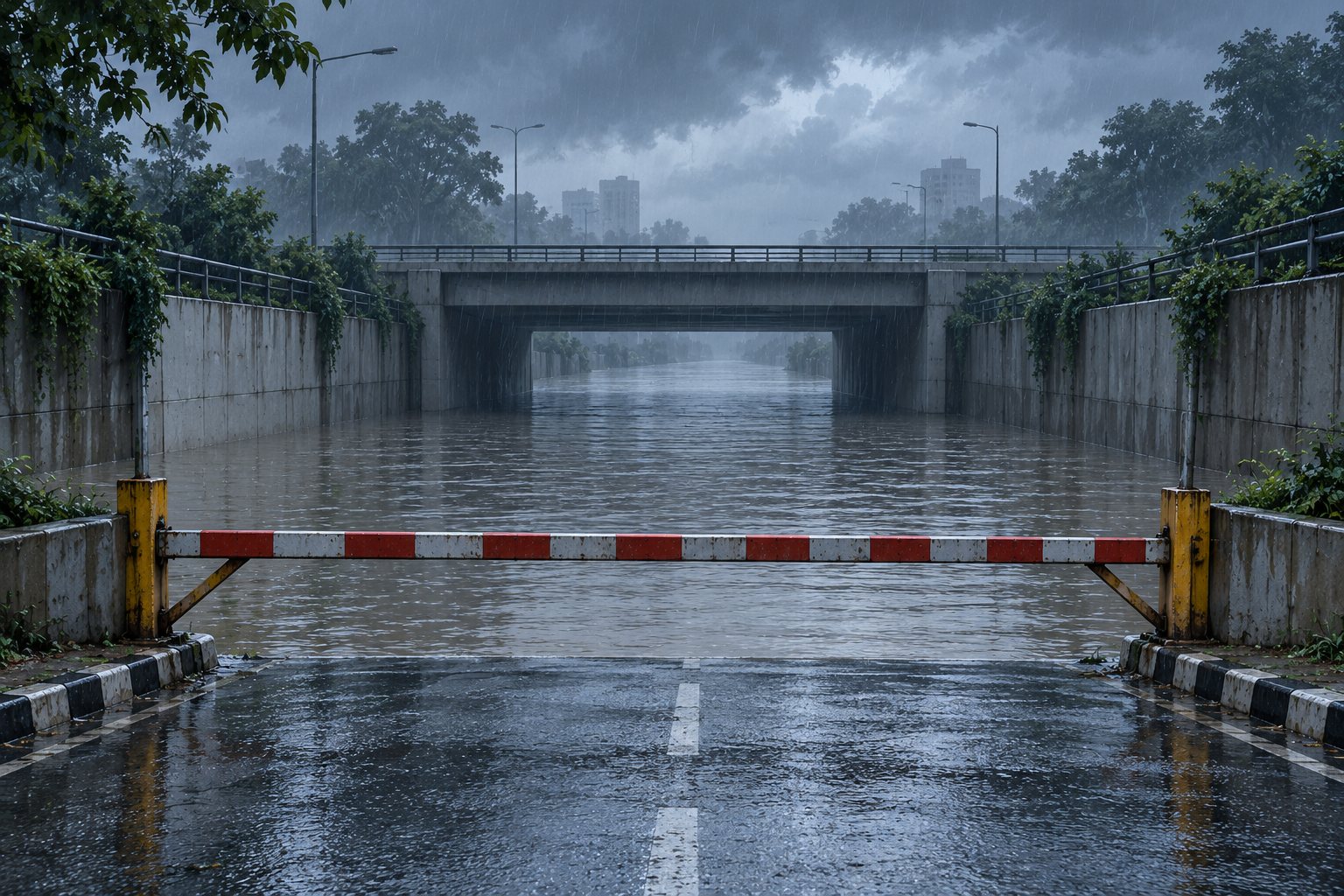
- Our suggestion: if a ban, closure or tourist advisory is in force at your destination, cancel or rebook. Do not argue your way past a barricade; the people stopping you can see the road ahead.
- Our suggestion: if you are a passenger in a bus on a red-alert day, you can ask the operator whether the service is running to schedule and, if the driver continues in a downpour, ask for a halt at a safe place. Our passenger’s guide shows how to speak up.
On the road in heavy rain: our suggestions
- Our suggestion: drive slowly with headlights on, keep a long gap, and do not stop or park directly under a steep cut slope, a rock face or leaning trees. Pull in where the slope above is gentle and the road edge is firm.
- Our suggestion: treat these as stop-and-think signs: small stones or mud already on the road, fresh cracks across the tarmac, water running out of the cut face, a stream turning muddy, trees or poles tilting, and any rumbling or cracking sound (NDMA lists the sounds).
- Never cross a road with water or mud flowing across it (Ready.gov).
- Our suggestion: if a slide has already covered the road ahead, stop well short of it, switch on the hazard lights and warn vehicles behind. NDMA says not to walk over loose material, so do not walk across it to “have a look”. Turn back only if the road behind is clear and the slope above you is quiet; otherwise move on foot away from the slope and call for help.
- Our suggestion: keep the fuel tank well filled, the phone charged, a power bank, a torch, drinking water and some food in the car. On 24 October more than 200 vehicles were stranded (PTI), and Onmanorama says some travellers walked several kilometres to safety.
- Tell someone your route and your expected arrival time.
If a slide starts while you are on the road
- NDMA: move away from the landslide path or downstream valleys quickly, without wasting time. Ready.gov: if you are caught in the path, move uphill as quickly as possible.
- Our suggestion, combining the two: leave the vehicle if you can do so safely and get out of the slide’s path to the side or to higher stable ground. Do not run down the road along a valley floor, because slides and flowing mud follow it.
- Stay alert and awake, stay with your companions, do not panic, and stay clear of loose material and of any electrical wiring or pole (NDMA).
- Call 112. In the Nilgiris, reports gave the toll-free emergency number 1077. Say exactly where you are: the nearest village, the road name and kilometre stone.
- Our suggestion: if you are trapped inside a vehicle, call 112 or the local number, give your location, keep still to save phone battery and air, and make a noise at intervals. We found no NDMA instruction for this situation.
- After the first slide, stay away from the area; more slides can follow (Ready.gov). Check on injured or trapped people near the slide, without entering the direct slide area, and do not move an injured person without first aid unless they are in immediate danger (NDMA).
How to check the alert before you leave
- IMD’s district-wise warning page shows a five-day colour map, with a popup for each district. IMD’s cyclone centre in New Delhi publishes national bulletins when a system is active.
- NDMA’s SACHET portal carries alerts from authorised agencies; see our floodwater note for how to use it.
- Read the District Collector’s orders and the state police or highways advisories for your route, and the district control room number. Our state-wise helpline list and emergency numbers guide help.
- Check again before the return leg. The colour on a district map can change by evening.
What is still not known
- Whether the Coonoor-Mettupalayam road had reopened, and whether the tourist ban had been lifted or extended, as of 26 October. We found no report.
- The conductor’s present condition. The last reports we read said intensive care.
- Why this stretch failed twice in 17 days. We found no official finding on whether road cutting, drainage or slope condition played a part, so we make no claim.
- The IMD colour for the Nilgiris on 24 October: red (PTI, DT Next) or orange (ETV Bharat). We could not open an archived IMD warning for that day.
- The next IMD district update for the Nilgiris, and the path of the Bay of Bengal system after landfall.
We will update this page when the picture changes. Updated 26 October 2026. Related: landslide-prone regions and warning signs, night driving safety, cyclone safety, flood safety myths about cars and shallow water, the Ananthagiri Ghat bus overturn and our Nilgiris case study.
What needs attention
- IMD defines the four warning colours as no action, be updated, be prepared and take action, and decides the colour from probability and expected impact.
- The colour for a district can differ from that of its subdivision, and the Nilgiris alert colour for 24 October is reported as both red and orange.
- 250 mm in 24 hours at Burliar is in IMD's extremely heavy class (204.5 mm and above); this comparison is ours.
- The Kotagiri-Mettupalayam road, suggested as an alternative, had three slides of its own on 24 October (Onmanorama).
- There was a boulder fall on the same stretch 17 days earlier, on 7 October; its first report said no deaths and a later report said one man died.
- IMD's bulletin for the Bay of Bengal system lists possible landslides in hilly areas among secondary hazards for Andhra Pradesh, south Odisha, south Chhattisgarh and north-east Telangana.
Controls that reduce risk
- Before leaving: check the IMD district warning for every district on your route and the return day, and the collector's orders.
- Postpone non-essential trips when your route is orange or red, or after heavy rain the night before (our suggestion).
- Do not start a hill climb after dark in a downpour (our suggestion).
- If a slide starts: move away from the slide path and downstream valleys; do not touch loose material or wiring; call 112.
- Keep fuel, phone charge, power bank, torch, water and food; tell someone your route (our suggestion).
- After a slide: stay away from the area, check for injured without entering the slide area, report damaged roads and lines.
Common unsafe practices
- Treating a lower colour on today's map as proof that the hill road is safe after a night of heavy rain.
- Starting a ghat climb after dark in heavy rain.
- Taking an alternative hill road without checking it, because it may have slides too.
- Walking out onto loose slide debris to look or to photograph it.
- Parking under a steep cut slope or leaning trees while waiting.
- Ignoring a collector's ban or a closed barricade.
- Running down the road along a valley floor when a slide starts.





Leave a comment