
What happened here
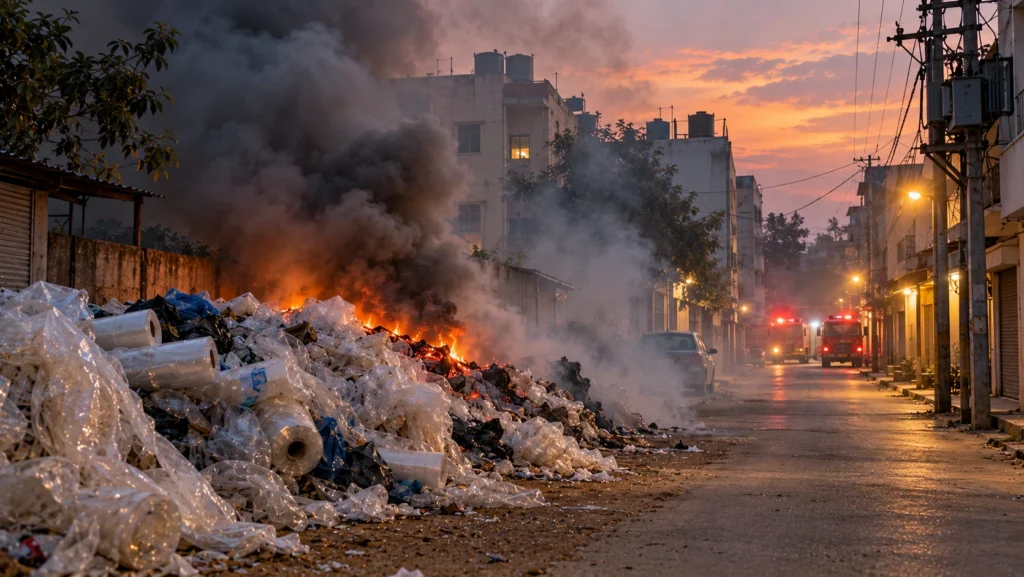
Surat has seen repeated fires in piles of hotfix plastic waste, the film and sheets left over from heat-transfer work on cloth. In the last 30 days we found a large fire at the municipal waste plant near Mithikhadi, Limbayat, on 27 September and a smaller open-heap fire at Punagam around 30 September, with no casualties reported. Residents report smoke, breathing trouble and night dumping. This page sets out the incidents, the law, what burning plastic is known to release in general, and what residents and units can do.
Quick answers
What is hotfix waste in Surat?
It is the thin heat-transfer film and sheets, with adhesive, that small units use to fix designs and stones on cloth, and the cut-offs and rejects left over. Reports give a thickness of about 22 to 30 microns; the polymer has not been named publicly.
How many hotfix waste fires were there in the last 30 days?
We found two: a large fire at the SMC waste plant near Mithikhadi, Limbayat, on 27 September, and a smaller open-heap fire at Punagam around 29 to 30 September. The Punagam fire rests on one report. We found none dated after 30 September.
Was anyone hurt?
No deaths or injuries were reported. Loktej said Limbayat residents had eye irritation and difficulty breathing, and no hospital figures were reported.
Is burning plastic waste in the open illegal?
Yes. The Solid Waste Management Rules, 2026 bar open burning, the National Green Tribunal ordered a ban on open burning of waste in 2016 with compensation, and CPCB guidelines say open burning of plastic waste must be strictly prohibited.
Who do I call about a burning heap or illegal dumping?
Call 101 or 112 for a fire. For dumping, call the SMC helpline on 1800-123-8000 or use SMC’s online complaint system.
What happened
Surat has been seeing a run of fires in piles of hotfix plastic waste. In the 30 days to 21 October 2026 we found two such fires in local reports: a large one at a Surat Municipal Corporation (SMC) waste processing plant near Mithikhadi in Limbayat on Sunday, 27 September, and a smaller one in an open heap at Punagam, reported on 30 September. No deaths or injuries were reported in either. We found no hotfix fire report dated after 30 September, but Gujarati local coverage is patchy online, so this is a minimum count and not a full tally.
Here, hotfix means the thin heat-transfer film and sheets used to fix designs and stones on cloth in small embellishment units. The waste is rejected film, cut-offs, carrier sheet and adhesive residue. Gujarat Samachar reported that the sheets are about 22 microns thick, or about 33 microns with the adhesive gum on, and that the gum is flammable. The Blunt Times described a similar film as 30 microns thick. Neither report names the polymer, and we have not found a published SMC or laboratory result on what the sheets are made of.
The incidents of the last 30 days
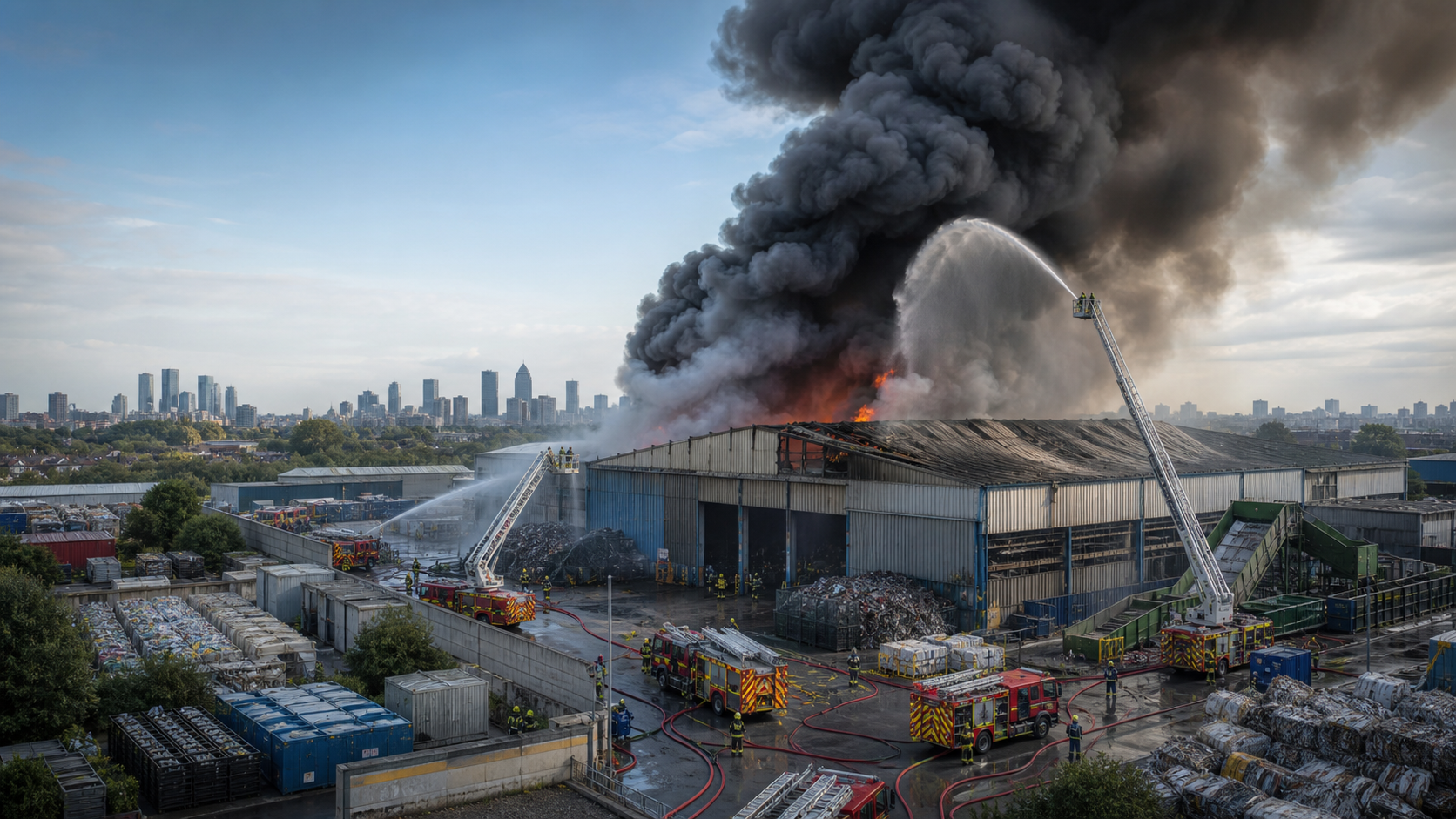
- 27 September, about 6 pm, Mithikhadi, Limbayat zone. Sandesh, Loktej and two GSTV reports (and television clips from TV9 Gujarati and News18 Gujarati) described a fierce fire at the municipal dry-waste processing plant near Mithikhadi. Hotfix plastic waste and other flammable material fed it. More than five fire vehicles from three fire stations went. Sandesh said black smoke was visible up to 3 km away and Loktej said about 5 km. Loktej reported that residents had eye irritation and difficulty breathing and said the authorities had not confirmed any specific toxic gas. No casualties were reported. The cause is not known; Sandesh and Loktej said a short circuit was among the possible causes and that it would be examined once the fire was out. We found no report of when it was fully extinguished.
- Night of about 29 to 30 September, near Bordha Farm, Punagam. Loktej (published 30 September, single source) reported a late-night fire in an open heap of hotfix plastic waste. Black smoke spread, a parked car beside the heap had its plastic parts melted, and the Surat Fire Brigade controlled the fire with water spray before it spread further. Residents told the paper that waste is dumped there secretly at night and that they had complained to SMC several times. They asked for the dumpers to be identified and for the possibility of arson to be examined. No official was quoted.
- 29 September, Udhna (a risk, not a fire). Loktej reported a large pile of hotfix waste on the road under a DGVCL transformer near Hari Ichha Puja Industry, with parked vehicles on the other side of the road. Residents feared a spark and a blocked approach for fire tenders. We found no response from DGVCL or SMC.
- 7 October, Khajod dumping site (not linked to hotfix). Gujarat Samachar (single source) reported a fire in a waste heap at SMC’s Khajod site at 3.56 pm, put out with about 5,000 litres from one tender of Bhimrad fire station. The report does not mention hotfix. We list it because it shows how often dump fires are being reported in the city.
The month before was busier. Between 25 August and 10 September, reports described fires in hotfix heaps at Puna, under a bridge at Hirabaug (a scooter and wiring burnt, controlled after about an hour), at Punagam near the Anjani Khadi bridge (residents said such fires came about every two days), at Bharatnagar in Varachha (a rickshaw burnt) and near Radhaswami Society in Punagam. Loksatta reported eight fire calls in one day and four the next, with two cars and two two-wheelers burnt. These are earlier than our 30-day window and each rests on one or two outlets.
What people living near the dumps face
The complaints in the reports are consistent. Residents describe thick black smoke, a choking feeling and fear when a heap or plant burns (GSTV, Sandesh), eye irritation and difficulty breathing at Limbayat (Loktej), and night dumping that goes on despite repeated complaints (Loktej, Gujarat Samachar). Motorists were alarmed by smoke at Hirabaug, and at Udhna residents worry that parked vehicles and garbage would slow a fire tender. In Punagam a neighbour’s car was damaged. We found no report of anyone treated at a hospital after these fires, and none about schoolchildren.
For a sense of what a long-burning Surat dump does to the nearby homes, see DeshGujarat’s April 2026 report on the Khajod site. Residents there said a fire that had burned for about 10 days made opening windows impossible and that respiratory problems were rising among children and older people. That was municipal waste, not hotfix, and the report quotes no official, so we use it only as an example of resident experience.
What burning plastic puts in the air
We found no published air-quality reading for Mithikhadi or Punagam on these days. SMC has an Air Quality Management Cell and monitoring stations, but we could not find station data for these dates, so this page gives no AQI figure.
What official and published sources say in general: the Central Pollution Control Board (CPCB) says burning plastics in uncontrolled conditions produces hazardous air pollutants, depending on the polymer and the additives, and that dumping plastic can leach metals and phthalates into soil and groundwater. The World Health Organization says uncontrolled waste burning is often among the worst sources of dioxins, which it calls highly toxic, and that over 90 per cent of human exposure is through food. The US CDC notes that hydrogen chloride can form when many plastics burn, and that breathing it irritates the throat and, at higher levels, can harm the lungs. A 2025 review in RSC Advances says burning PVC releases hydrogen chloride, and that chlorine-containing plastics play a significant part in forming dioxins and furans, along with fine particles, carbon monoxide and volatile organic compounds from open burning. Because the hotfix polymer has not been identified, none of this tells us what was in the Surat smoke. It is the reason to stay away from it. Our guides on air quality after large industrial fires and on what to do about smoke from a nearby fire cover the household steps.
Surat starts from a high plastic load. In a CPCB study of 60 cities (data of 2010 to 2012, cited in its September 2017 guidelines), plastic made up 12.47 per cent of Surat’s municipal solid waste, the highest of the 60, against an average of 6.92 per cent. That study is old and covers household and market waste, not hotfix scrap, so it is context only.
The law and the city’s response
- Open burning is banned. The Solid Waste Management Rules, 2026 came into force on 1 April 2026 and replace the 2016 rules. A PIB release quotes Rule 5(1)(f) as barring dumping on roadsides and open burning, and the Ministry says the new rules allow environmental compensation under the polluter-pays principle. The National Green Tribunal, in December 2016, ordered a complete ban on open burning of waste with compensation of Rs 5,000 for simple burning and Rs 25,000 for bulk burning, as reported by the press and quoted in later NGT filings. CPCB’s plastic-waste guidelines say open burning of plastic waste must be strictly prohibited and that local bodies must ensure it does not happen. We have not checked the Air Act, 1981 provisions for this page.
- SMC’s action on hotfix. Reports of 30 August to 2 September said SMC gave notices to more than 1,500 units (Gujarat Samachar) or about 1,000 (Loksatta), with about 11,000 small hotfix units said to operate in the city. SMC’s public notice banned production, storage, sale, distribution and use of the plastic, citing a 2021 standing committee resolution and Section 376 of the Gujarat Provincial Municipal Corporations Act, 1949, and warned of criminal action. SMC said discarded hotfix waste can choke drains and storm-water channels. The same week the mayor asked officials not to seal units and to arrange disposal, and Varachha MLA Kumar Kanani asked for collection, not sealing. SMC then allotted a plot at Saniya Hemad for disposal and began preparing a baling machine, and its standing committee chairman asked for a ‘Plan-B’ for collection, transport and scientific disposal (Loktej, 1 and 3 September). On about 9 October a News18 Gujarati clip showed Mr Kanani saying that, despite repeated requests, no permanent solution had been found.
- Who to call. For a fire, call 112 or 101; since 24 September 2026 Surat fire calls also run through 112. The SMC Fire Control Room is 0261-2414195. For dumping and civic complaints, the SMC helpline is 1800-123-8000 (6 am to 10 pm), and SMC’s online complaint system is on its website. We have not found a GPCB complaint number for open burning in Surat, so we do not list one.
What residents can do safely
- Do not walk up to a burning heap, and do not try to put out burning plastic with a bucket or a hose. Keep children, older people and anyone with asthma or a heart condition away from the smoke.
- Call 101 or 112 and give the area, a landmark and what is burning. Tell the operator if a transformer, a gas cylinder, a petrol pump or parked vehicles are close.
- If smoke is drifting towards your home, move indoors, shut doors and windows and switch off fans and air conditioners that pull outside air in, until the smoke clears or the authorities say otherwise. Follow any local instruction.
- A cloth or dust mask does not filter gases. Our smoke guide explains NIOSH’s point that particle respirators do not protect against harmful gases or vapours. We found no Surat-specific official mask advice, so do not rely on a mask to stay near the fire.
- If someone is breathless, wheezing or has burning eyes, move them to clean air and call 108. People with lung or heart disease should follow their doctor’s advice.
- Report the dumping spot to SMC on 1800-123-8000 with a photo and the location. Do not set the heap alight and do not confront the people dumping.
What units and the city can do
- Keep scrap off the road. Store hotfix waste covered, inside the unit or in a closed yard away from live wiring, and hand it only to a collector or site approved by SMC. Ask SMC in writing which route it accepts, since Gujarat Samachar noted this is industrial waste outside the door-to-door system.
- Treat the adhesive-coated film as fire load. The reports describe the gum as flammable. Keep stacks small, away from heat presses, panels and transformers, and keep a lane clear for a fire tender. The same rules help in textile markets, as the Adinath market fire and the Shyam Sangini market fire showed.
- Clear piles before they ignite. Reports say the city started lifting accumulated waste in early September. Regular pick-ups from known dumping spots, lighting and cameras at the worst ones, and a published list of approved disposal sites would cut the number of heaps. Waste-site fires are hard to put out; the Neasden waste-site fire in London shows how long one can take.
- Publish the facts. SMC and GPCB could release the laboratory result on what the sheets are made of, the cause of the Limbayat fire, and air readings for the days after it.
What is still not known
The polymer in the hotfix sheets, the cause of the 27 September fire, when it was fully put out, how much material burned, any SMC or GPCB action against the plant or the dumpers, any FIR, air-quality readings for these days, and any hospital figures are not confirmed. The Punagam fire rests on one report, and its exact date is not stated. We will update this page when an official source publishes more.
More on Surat: see our Surat fire and emergency safety guide for fire brigade numbers, every fire station and the local risks to know.
- Fire in a roadside plastic waste heap at Puna; paper says over 40 tonnes a day of hotfix waste is generated in the Puna-Varachha area (Gujarat Samachar, no source given)
- Fires in hotfix heaps at Hirabaug and Punagam; Loksatta reports 12 fire calls in 24 hours and two cars and two two-wheelers burnt; SMC notices to 1,000 or more units
- SMC offers a plot at Saniya Hemad and a baling machine; public notice bans hotfix; mayor asks officials not to seal units; Plan-B meeting begins lifting of waste
- Hotfix heap fires at Bharatnagar, Varachha (rickshaw burnt) and near Radhaswami Society, Punagam (GSTV)
- Fire at the SMC waste plant near Mithikhadi, Limbayat; hotfix waste involved; more than 5 vehicles from 3 stations (Sandesh, Loktej, GSTV)
- Fire not yet out when Loktej reports at 9 pm; no casualties reported; cause not known
- Pile of hotfix waste under a DGVCL transformer at Udhna reported as a fire risk; no response found (Loktej)
- Late-night fire in an open hotfix heap near Bordha Farm, Punagam; car damaged (Loktej, 30 September)
- Fire in a waste heap at Khajod dumping site, 3.56 pm, one tender and about 5,000 litres of water; hotfix not mentioned (Gujarat Samachar, 9 October)
- News18 Gujarati clip: MLA Kumar Kanani says no permanent solution found despite repeated requests
- No hotfix fire report dated after 30 September found; no cause, FIR, laboratory result or air data found
Why consequences escalated
- Two hotfix plastic waste fires were reported in the last 30 days; one is well confirmed and one rests on a single outlet.
- The Limbayat fire was at a municipal waste plant, not an open roadside dump, so storage inside SMC sites is part of the problem.
- Residents report smoke, breathing difficulty and eye irritation, and say night-time dumping goes on despite complaints.
- Fires were far more frequent in late August and early September, around the time SMC began notices and lifting waste.
- The plastic has not been publicly identified, so claims about what the smoke contained cannot be made for these fires.
Failures and risk multipliers
- Hotfix scrap is heaped on roads, open plots and creek banks, often at night, where one spark or lit match can set it alight.
- Piles sit under transformers and near parked vehicles, which slows fire tenders and adds to the damage.
- No public air-quality or laboratory information has followed the fires, so residents are left guessing about the smoke.
- Reports show mixed messages between sealing units and arranging disposal, and no permanent disposal route is yet in place.
Actions that reduce risk
- Units: store hotfix scrap covered and away from wiring, and give it only to an SMC-approved collector or site.
- Units: keep adhesive-coated film in small stacks away from heat presses and keep a lane clear for fire tenders.
- SMC: lift waste from known dumping spots on a fixed schedule and publish the approved disposal route.
- SMC and GPCB: publish the polymer test, the cause of the Limbayat fire and air readings for the days after it.
- Residents: keep clear of the smoke, call 101 or 112 with a landmark, and report dumping spots to SMC.

Leave a comment