
What happened here
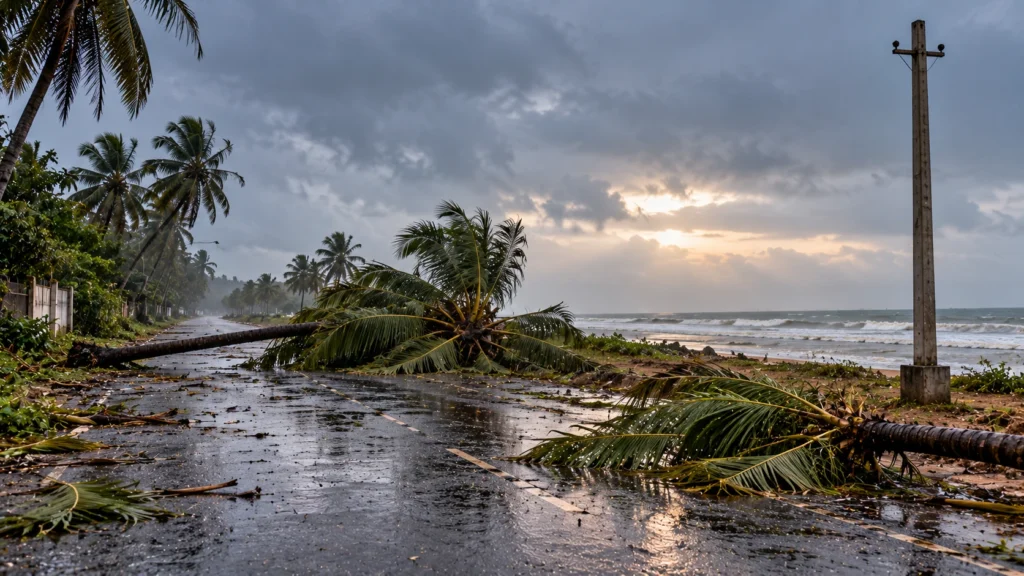
Cyclone Arnab began crossing the Andhra Pradesh and Yanam coasts at about 1.30 am on 28 October 2026 and stayed almost still for hours. By about 10.39 am IMD said landfall was complete, with the centre south-west of Yanam, about 20 km east-north-east of Narsapur, and the storm weakened to a severe cyclonic storm over land. Over 200 mm of rain fell in Anakapalli, Vizianagaram and Visakhapatnam, trees and poles came down, and 84,396 people were in shelters beforehand. PTI reports two electrocution deaths in Andhra Pradesh and the Times of India one tree-fall death in Puri, Odisha; the early no loss of life statements came before these reports. Updated 28 October 2026, 12.30 pm IST.
Quick answers
When and where did Cyclone Arnab make landfall?
Landfall began at about 1.30 am on Wednesday, 28 October 2026 (IMD's own update puts the start at about 1.20 am). The centre crossed the Andhra Pradesh and Yanam coasts between Bapatla and Visakhapatnam, south-west of Yanam and about 20 km east-north-east of Narsapur, according to IMD as reported by ETV Bharat. Outlets differ on when it ended, so the end time below is IMD's.
Has landfall finished, and is it still a cyclone?
At about 10.39 am IMD said the landfall process was complete and the system was entirely over land, weakened from a very severe to a severe cyclonic storm. The Regional Meteorological Centre in Bhubaneswar expects a deep depression over Odisha's Malkangiri district by Wednesday night. We have not found a report that it has already become a depression. Kalinga TV quotes the same centre as saying landfall ended about 8.30 am, which does not match IMD's later updates.
Were there deaths?
The reports differ. PTI, quoting officials, reports two electrocution deaths in Andhra Pradesh, one on Tuesday night and one on Wednesday morning at Yellamanchili. The Hindu reported a 65-year-old man killed by a live wire in water at Mangalapalem on Tuesday, who may be one of the two. The Times of India reports a woman died in Puri, Odisha, when a tree fell on her house. The Chief Minister's 8.45 am no loss of life statement came before these reports. No injury count has been published.
Which districts are affected?
In Andhra Pradesh, Kakinada, Konaseema, West Godavari, Yanam, Visakhapatnam, Anakapalli, Vizianagaram and Srikakulam had the heaviest rain, wind or flooding, and a railway track was damaged in Alluri Sitharama Raju district. In Odisha, IMD has a red warning for Ganjam, Gajapati, Rayagada, Koraput, Malkangiri and Nabarangpur. Schools are shut in several Jharkhand districts until 29 October.
How many people were moved to safety?
In Andhra Pradesh, 84,396 people were moved to 290 shelters by Tuesday evening, according to the Chief Minister. In Odisha, the state minister said about one lakh people had been moved by 7.28 am on Wednesday, against a plan for about 48,000.
What should I do now?
Stay indoors until your district says it is safe, as the wind can pick up again. Treat every fallen wire as live and keep well away from it and from any water around it, and call the electricity helpline or 112. Do not walk or drive through floodwater. Fishermen in Odisha should stay out of the sea until 29 October, and everyone should check train and flight status before travelling.
What happened
Landfall began at about 1.30 am on Wednesday, 28 October 2026. IMD’s own update puts the start at about 1.20 am. The centre crossed the Andhra Pradesh and Yanam coasts between Bapatla and Visakhapatnam, south-west of Yanam and about 20 km east-north-east of Narsapur. At about 10.39 am IMD said the landfall process was complete and the system was moving entirely over land, weakened from a very severe to a severe cyclonic storm (ETV Bharat). It has not been called a depression in any report we opened, but the Bhubaneswar centre expects a deep depression over Odisha by Wednesday night.
Cyclone Arnab, rated a very severe cyclonic storm by the India Meteorological Department (IMD), came ashore on the Andhra Pradesh coast in the early hours of Wednesday, 28 October 2026. The landfall began at around 1.30 am near Narsapur in West Godavari district, according to The Hindu. The storm then sat almost still for hours, so the “landfall” went on well into the morning. At 9.38 am IMD placed the centre about 45 km south-south-west of Yanam, with another two hours of landfall still to come. IMD’s reading of the crossing point is between Bapatla and Visakhapatnam, just south of Yanam. Kakinada, Konaseema, West Godavari and Yanam took the strongest wind.
This page is a running record. The numbers will move, and the deaths in particular are not settled. Updated 28 October 2026, 12.30 pm IST. The first version was written on the morning of 28 October 2026.
Wind, rain and the sea
- Wind: IMD gave sustained winds of 125 to 135 km/h with gusts to 150 km/h at the height of it, easing to 115 to 125 km/h with gusts to 140 km/h by the 6.30 am bulletin.
- Rain: the north of the state got the water. Between 8.30 am on 27 October and 4 am on 28 October, IMD recorded over 200 mm at several stations in Anakapalli, Vizianagaram and Visakhapatnam districts. The highest was 261.5 mm at Kannuripalem in Anakapalli.
- Storm surge: IMD first warned of 1.5 to 2.5 m above the normal tide near Kakinada and Yanam. By the morning bulletin it spoke of 1 to 1.5 m. No report we opened gives the height actually seen.
- Other stations: between 8.30 am on 27 October and 5.30 am on 28 October, Visakhapatnam recorded 216.9 mm, Kalingapatnam 147.5 mm, Tuni 123.3 mm, Kakinada 118.4 mm and Machilipatnam 115.2 mm (live blog report of IMD readings). In Odisha, Mahendragiri in Gajapati district recorded 249.9 mm in 24 hours, the highest there, according to the Bhubaneswar centre.
What was done before it arrived
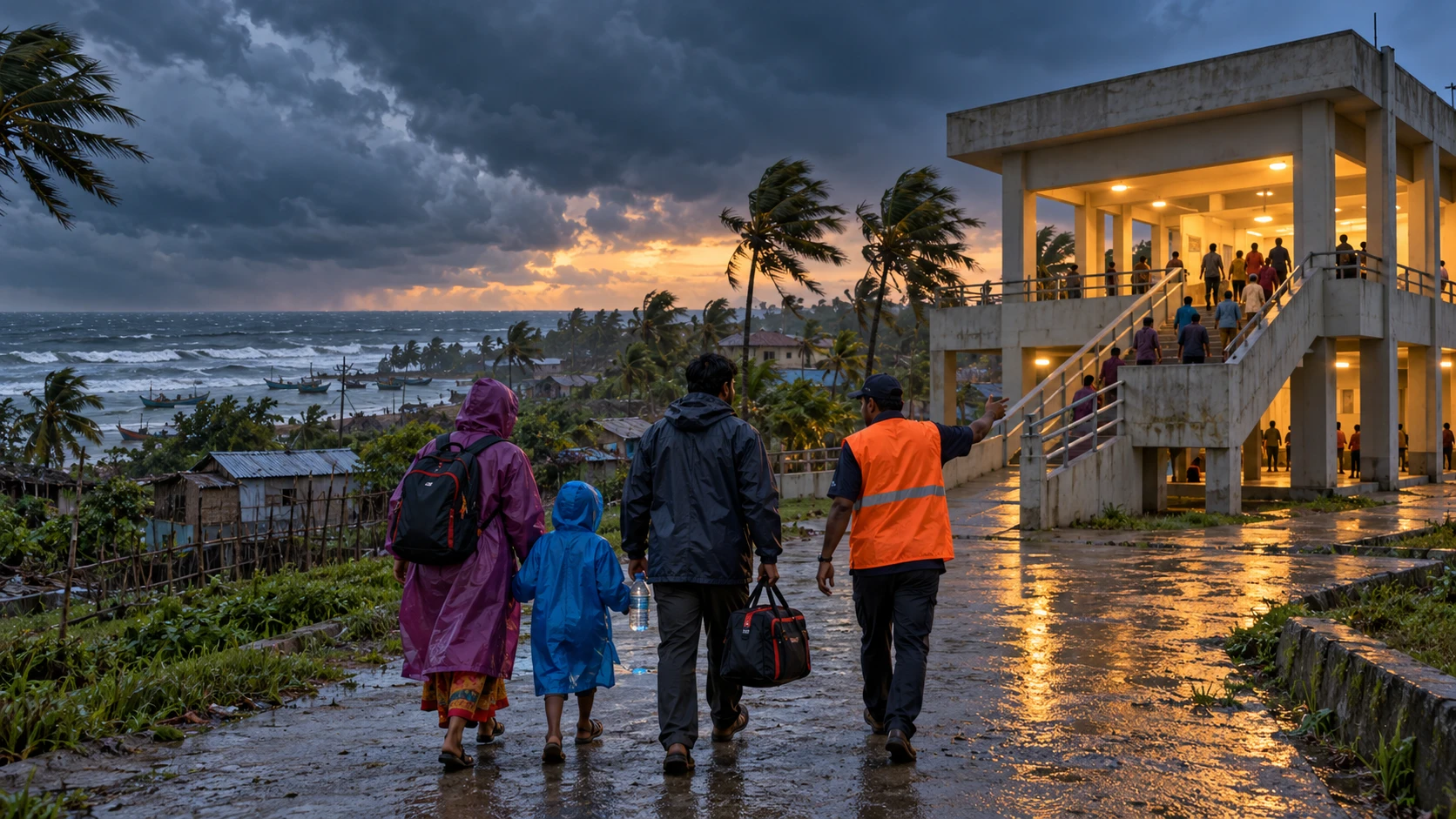
Andhra Pradesh moved people early. By Tuesday evening the Chief Minister said 290 cyclone shelters were open and 84,396 people had been shifted. More than 30,000 fishing boats were brought back from the sea, and 93 Andhra boats were reported safe at Gopalpur in Odisha. 8,400 power staff were kept ready, and the state had planned for as many as 15,000 electric poles to fall. In Uppada, a few thatched houses facing the sea collapsed, and The Hindu reports that the families were safe in the camps.
On the Odisha side, the state said it would move about 48,000 people from low-lying and landslide-prone places, and its minister spoke of about one lakh moved by Wednesday morning. Those two figures differ and we have not been able to reconcile them.
What the storm did
- Trees and poles: at least 200 trees came down inside Visakhapatnam city on Tuesday. The Kakinada police chief said a few hundred trees and fewer than 100 electric poles were uprooted in his district. The Konaseema collector put the number of poles uprooted in that district at about 6,000. These are different districts and different officials, so they are not a contradiction, but they show how uneven the damage was.
- Coast: the Uppada beach road was damaged by waves, and one report says it was washed away. Boats tied to trees at Kakinada were carried into the creek. Five fishing boats capsized at Visakhapatnam.
- Homes and fields: rainwater entered houses in Gajuwaka in Visakhapatnam. Low-lying parts of Visakhapatnam, Konaseema and Yanam were flooded, and houses were damaged in Mummidivaram and Yanam. A banyan tree fell on a house in Yanam. Paddy was flattened at Ramachandrapuram.
- Rescues: police in Kakinada brought out four people trapped by floodwater near Bombay Katta, and a rescue team reached three night-shift staff cut off at the port godowns.
- Travel and power: India Today reports at least 91 trains and 21 flights cancelled across Tuesday and Wednesday. In parts of Visakhapatnam, power was out for nearly 24 hours. After landfall, about 50 trains from Vijayawada were halted with delays of up to five hours, and the Delhi to Bhogapuram flight was cancelled (Deccan Chronicle).
Deaths reported so far
The early statements and the later reports pull in different directions, and all of them are on the record.
- The Hindu, in a report published at 11.31 pm on Tuesday 27 October, says one man, 65, died at Mangalapalem in Visakhapatnam after he allegedly came in contact with live wires that had snapped and fallen into water.
- On Wednesday morning, at about 8.45 am, the Chief Minister said no loss of life had been reported so far, and credited the advance precautions. The National Disaster Response Force (NDRF) also reported no casualties at 10.19 am. The Hindu’s own early-morning report found no human loss in Kakinada, Konaseema and West Godavari districts.
- Later on Wednesday, PTI, quoting officials, reported two deaths by electrocution in separate incidents in Andhra Pradesh. A 53-year-old man died on Tuesday night after touching a live wire that had snapped over an agricultural field channel. A woman died on Wednesday morning after stepping on an exposed live wire outside her home in Yellamanchili, Anakapalli district; PTI’s headline gives her age as 55 (ETV Bharat live blog, 11.46 am).
The Chief Minister’s 8.45 am statement came before these reports, so it no longer describes the position. The Hindu’s man is 65 and PTI’s is 53, so we cannot tell whether they are the same person, and we do not add the reports together. At least two people have died of live-wire contact in Andhra Pradesh, and possibly three. No names have been published in the reports we read, and we have not used any. In Odisha, the Times of India reports that a 40-year-old woman died in Puri district on Tuesday around 9 am when a tree fell on her house and a brick wall collapsed on her while she was cooking, in rain and wind linked to the approaching cyclone.
Why a live wire in water is the danger people forget
A cyclone is over when the wind drops, but the next few hours are when many people step outside. Wires snap, poles lean, and the water on the road can carry current. The death reported from Visakhapatnam is exactly that case. If a line is down, stay far from it and from any water around it, and ring the electricity helpline or 112. Do not try to move a wire with a stick or a bamboo. Our step-by-step guide on live wires and floodwater after a cyclone covers what to do when you see one down, and our guide on electric wires near your house, balcony or terrace has the basics, and the cyclone safety guide covers warnings, evacuation and what to do after. Never wade or drive through floodwater, as set out in our guide on floodwater.
A warning about videos
A fact-check published on 29 September 2026 found that an Instagram reel posted on 24 September, which claimed to show “Cyclone Arnab” damage in Odisha, was footage from Bhadradri Kothagudem in Telangana. The name Arnab was in the news for weeks before this landfall, so old and borrowed clips will be going around. Before you forward a cyclone video, check the date and the place.
Living on the Kakinada coast? Our Kakinada fire and emergency safety guide lists the district fire stations and emergency numbers, and the cyclone and sea-water risks worth planning for.
After landfall
An IMD scientist said the system would move north and north-east, bringing rain to Chhattisgarh, Jharkhand, eastern Madhya Pradesh, Bihar and Uttar Pradesh before it weakens over land. The Regional Meteorological Centre in Bhubaneswar expects it to become a deep depression and cross Odisha’s Malkangiri district by Wednesday night.
- Odisha: a red warning for heavy to very heavy rain, with isolated extremely heavy falls, covers Ganjam, Gajapati, Rayagada, Koraput, Malkangiri and Nabarangpur. Winds of 60 to 70 km/h, gusting to 80 or 85 km/h, are expected in some districts, and fishermen are told to stay out of the sea until 29 October. The state minister said about one lakh people had been moved by 7.28 am, and 2,037 shelters were ready.
- Jharkhand: schools are closed in several districts until 29 October, and IMD has issued heavy rain warnings for nine districts, including Ranchi.
- Andhra Pradesh: streams overflowed in Srikakulam, the bus stand was flooded and road links to hundreds of villages were cut (Deccan Chronicle); flood alerts went out for 167 villages and paddy fields went under water (PTI). A railway track was damaged and the ghat road closed in Alluri Sitharama Raju district, and the Araku tourist spots are shut for three days. Crop damage runs to thousands of acres, with the full extent awaiting an official assessment. At about 12.05 pm the Chief Minister reviewed the districts, asked for fallen trees on highways and other roads to be cleared, and wrote to the Union Home Minister with a preliminary damage assessment.
What is not known
The final number of dead and injured, which of the live-wire reports overlap, the exact landfall point and the time it ended, the damage to houses, crops and power lines, the surge height actually reached, and the date the storm is downgraded to a depression. We have not seen final figures from Odisha, Chhattisgarh or Jharkhand. Last checked on 28 October 2026 at 12.30 pm IST.
- Storm intensifies into a very severe cyclonic storm overnight; Andhra Pradesh shelters, boats and power crews readied
- A woman in Puri district, Odisha, is fatally hurt when a tree falls on her house in rain and wind from the approaching cyclone
- Very heavy rain in Visakhapatnam, Anakapalli and Vizianagaram; at least 200 trees fall in Visakhapatnam city; The Hindu reports a man, 65, died at Mangalapalem after touching a live wire in water
- Chief Minister says 290 shelters are open and 84,396 people moved; flights and trains cancelled
- Landfall process begins near Narsapur, West Godavari; wind picks up at Kakinada
- Storm practically stationary; centre about 30 km east of Narsapur; Kakinada police rescue 4 people trapped in floodwater
- Chief Minister says no loss of life reported so far
- IMD says centre is about 45 km south-south-west of Yanam and landfall will continue about two more hours
- NDRF reports no casualties; teams clearing fallen trees in Yanam and Konaseema
- IMD says the landfall process is complete and the system is entirely over land; centre near 16.45 N, 81.90 E, about 20 km east-north-east of Narsapur and 60 km south-west of Kakinada; weakened from a very severe to a severe cyclonic storm (ETV Bharat live blog)
- PTI, quoting officials, reports two electrocution deaths in separate incidents in Andhra Pradesh, one on Tuesday night and one on Wednesday morning at Yellamanchili, Anakapalli district
- Streams overflow and a bus stand is flooded in Srikakulam; a railway track is damaged and the ghat road closed in Alluri Sitharama Raju district; the Chief Minister reviews the districts and writes to the Union Home Minister with a preliminary damage assessment (Deccan Chronicle)
Why consequences escalated
- A very severe cyclonic storm stayed almost still over the Andhra coast for hours, so wind and rain lasted far longer than a normal landfall.
- The rain fell mainly in the north of the state (over 200 mm at several stations) while the wind was strongest around Kakinada, Konaseema and Yanam.
- Early evacuation, with 84,396 people in shelters and fishing boats ashore, is credited by the Chief Minister with preventing casualties.
- The death count is not settled: the early no loss of life statements of 28 October morning were overtaken by PTI reports of two electrocutions in Andhra Pradesh, and a woman died in Puri on 27 October. The Hindu's 65-year-old man at Mangalapalem may be one of the two or a third.
- The damage was uneven, from hundreds of trees in one district to about 6,000 poles in another.
Failures and risk multipliers
- A live wire fell into floodwater at Mangalapalem and a man allegedly touched it (The Hindu); the wire's owner and the cause are not reported.
- A tree fell on a house and brought a wall down on a woman cooking in Puri, in rain that had already weakened the wall (Times of India).
- Some people were still outside or cut off when floodwater rose: 4 at Bombay Katta and 3 night-shift staff at the port godowns in Kakinada.
- Early and borrowed videos are already circulating with the cyclone's name; a September reel was found to be from Telangana.
- Official counts of dead, evacuated and damaged poles come from different officials and times and do not yet line up.
- A man touched a snapped wire over a field channel on Tuesday night and a woman stepped on an exposed live wire outside her home in Yellamanchili on Wednesday morning (PTI, quoting officials); the wires' owners and the circumstances are not reported.
Actions that reduce risk
- If a power line is down, stay well away from it and from any water around it, and call the electricity helpline or 112.
- Do not step out the moment the wind drops; the storm can stall or circle back, and wires and trees are down.
- Move to a shelter when the district asks you to, and take medicines, documents, a torch and water.
- Stay out of floodwater and do not drive through it.
- Before forwarding a cyclone video, check the date and the place.
- Resident associations in coastal towns: know where the nearest shelter is, and keep a list of elderly neighbours who need help to reach it.






Leave a comment