
Quick answers
Do 20 to 22 people die every day in road accidents in Gujarat?
As an annual average, about 21, according to MoRTH's totals: 7,717 deaths in 2024 is 21.1 a day, and 2021 to 2023 gives 20.4 to 21.5. The Sandesh News caption that says 20 to 22 names no source, so we call it a claim, and we found no official figure for 2025 or 2026.
How many people died in road accidents in Gujarat in 2024?
7,717, from 15,588 accidents, according to MoRTH's Road Accidents in India 2024. The NCRB's 2024 report gives the same 7,717.
Is Gujarat's road death toll rising or falling?
It rose from 6,170 in 2020 to 7,854 in 2023 and fell 1.7 per cent to 7,717 in 2024. We have no official total for 2025.
Is Gujarat worse than other states?
By deaths, tenth in India, with 4.4 per cent of the national total. By severity, 49.5 deaths per 100 accidents against 36.3 for India, it is worse than the national average.
Who dies most on Gujarat's roads?
A journal study of the Gujarat Road Safety Authority's 2023 report found that pedestrians and two-wheeler riders together were 68.6 per cent of deaths. Nationally in 2024, two-wheeler riders were 46.2 per cent and pedestrians 20.6 per cent.
What is the main recorded cause?
Over-speeding: 70.28 per cent of India's 2024 deaths, and an even higher share in secondary readings of Gujarat's data. Not wearing helmets and seat belts is the other big factor.
What is Gujarat doing about it?
A five-year plan to halve deaths by 2030, a month-long helmet drive in May 2026, e-challans across all 38 police districts, the cashless treatment scheme and the Guj-MARG app for reporting damaged roads. We found no published result showing deaths fell because of them.
Am I protected if I help a crash victim?
Yes, in good faith. Section 134A of the Motor Vehicles Act says a Good Samaritan is not liable for civil or criminal action for the victim's injury or death that results from negligence in giving help. You also cannot be forced to give your name.
How do I report a dangerous road in Gujarat?
For a pothole or damaged bridge on a state road, the Guj-MARG app of the Roads and Buildings Department; on an NHAI tolled highway, 1033; in a city, your municipal corporation. For danger in progress, call 112.
Which numbers should I call?
112 for any emergency, 108 for an ambulance and 1033 for NHAI tolled highways.
On 21 October 2026 the Gujarati news channel Sandesh News posted an Instagram reel whose caption says that 20 to 22 people die every day in road accidents in Gujarat. We could read the caption but not play the video, and the caption names no source. So we went to the official numbers. The short answer: the figure is in the right range. Gujarat police recorded 7,717 road deaths in 2024, which is about 21 a day, and the daily average for 2021 to 2023 was also between 20 and 22. But that is an average over a year, and the “20 to 22 a day” line itself is not traced to any report. Last checked: 21 October 2026, around 10 pm IST.
In short
- The claim: Sandesh News reel, Instagram, 21 October 2026, Gujarati caption: 20 to 22 people die daily in road accidents in Gujarat. The caption gives no source. We treat it as a claim.
- The official figure: 7,717 people were killed in road accidents in Gujarat in 2024, from 15,588 accidents (MoRTH, Road Accidents in India 2024). 7,717 divided by 366 days is 21.1 a day. This is our arithmetic.
- Other years: 2021 gives 20.4 a day, 2022 gives 20.9 and 2023 gives 21.5. 2020, a lockdown year, gives 16.9. The 20 to 22 range fits 2021 to 2024.
- Not yet known: we found no official Gujarat total for 2025 or for 2026 so far, so nobody can yet say what the daily figure is today.
- Gujarat in India: 4.4 per cent of India’s 1,77,175 road deaths in 2024 and 3.2 per cent of its accidents. Gujarat ranked tenth in deaths.
- What this page cannot tell you: a clean Gujarat-only split by road user, time of day or road type from the official report. We say below what is national and what is Gujarat.
The claim, and what we could trace
The reel is from the verified Sandesh News account and is dated 21 October 2026. Its hashtags are about Gujarat and road safety, and the audio is marked as original. We could not play it, so we do not know whether it shows a chart, a speaker or a crash, and we have not used it as footage. We searched in English and Gujarati for the same “20 to 22 a day” line and found no report, assembly reply or police statement that says exactly this. What we did find is an older Gujarat Samachar report on the 2022 MoRTH figures that said about 21 people die every day in Gujarat, which is the same range. So the claim is plausible, and it is backed by official totals, but we cannot say where Sandesh got it. If a reader sees a different daily figure elsewhere, check the year and whether it is deaths or accidents. Gujarat averages about 43 accidents a day, which is a different number.
The official numbers, with the arithmetic
The Ministry of Road Transport and Highways (MoRTH) publishes Road Accidents in India every year from police-reported data. We read the 2024 edition (released in June 2026) and checked each number below against its Table 5.1 (accidents) and Table 5.6 (persons killed). Gujarat’s deaths were:
- 2020: 6,170 deaths, which is 16.9 a day (6,170 ÷ 366).
- 2021: 7,452 deaths, 20.4 a day (÷ 365).
- 2022: 7,618 deaths, 20.9 a day.
- 2023: 7,854 deaths, 21.5 a day.
- 2024: 7,717 deaths, 21.1 a day (÷ 366, a leap year). That is down 1.7 per cent from 2023, but 25 per cent above 2020.
Together that is 36,811 deaths in five years. The 2024 accident count was 15,588, down 4.7 per cent from 16,349 in 2023. Our own earlier page on the NCRB’s 2024 accidental deaths report, India’s accident and disaster deaths by state, gives the same 7,717 for Gujarat and 7,854 for 2023, so two official series agree for the state. The two national totals differ slightly (the NCRB’s road-accident line is 1,75,142 and MoRTH’s is 1,77,175), but not for Gujarat.
A few cautions. “Per day” is only the annual total divided by the days in the year. It does not mean that 21 people die on each day. MoRTH itself says its death count comes from police records and may miss people who die in hospital after 30 days, and that police data is not always evidence-based. And accident severity, which is deaths per 100 accidents, was high in Gujarat in 2024: 7,717 deaths for 15,588 accidents is 49.5, against 36.3 for India (our arithmetic from the two totals). Gujarat has fewer accidents than the biggest states, but a larger share of them kill someone.
Gujarat in the national picture
India recorded 4,87,707 road accidents and 1,77,175 deaths in 2024, about 484 deaths a day. Gujarat’s share was 3.2 per cent of accidents and 4.4 per cent of deaths. By deaths Gujarat was tenth in 2024, after ranking ninth in 2022 and 2023. Parliament was told in July 2026 that India recorded 5,13,563 road accidents and 1,83,382 deaths in 2025 (reported by Daily Excelsior and Kashmir Reader, which both say it was a written Lok Sabha reply). The reports we read give no figure for Gujarat for 2025.
Among Gujarat’s big cities, MoRTH’s Table 6.2 for 2024 shows Ahmedabad with 410 deaths (535 in 2023, a fall of 125, or 23.4 per cent, the largest drop among the 50 million-plus cities), Surat with 314, Vadodara with 183 and Rajkot with 160. Together that is 1,067 deaths, about 14 per cent of Gujarat’s total. The other 86 per cent happened outside these four cities.
Who dies, and where: what is Gujarat-specific and what is not
This is where we have to be careful. The MoRTH report breaks deaths down by road user, helmet use, time of day and road type for India as a whole. The state-wise annexures that would give the same split for Gujarat were not in the copy we could read, so we do not claim a Gujarat figure from them. What we can say:
- Gujarat, road users. A peer-reviewed study in Khoj of the Gujarat Road Safety Authority’s 2023 report found that pedestrians and two-wheeler riders together made up 68.6 per cent of deaths in 2023. A Gujarat Samachar report of 21 September 2026 on a Gujarat Road Safety Authority review says pedestrians were 22.9 per cent, car occupants 12.4 per cent and tractor occupants 7.4 per cent. The same article says eight of every ten two-wheeler riders killed were not wearing a helmet, but its own death totals do not add up (it prints 3,717 total deaths against 3,722 two-wheeler deaths), so we treat the “eight in ten” as reported, not confirmed.
- India, road users, 2024. Two-wheeler riders were 81,780 of the dead (46.2 per cent), pedestrians 36,526 (20.6 per cent) and car, taxi and van occupants 21,988 (12.4 per cent).
- India, helmets and seat belts, 2024. 54,122 people killed were not wearing a helmet, 39,470 of them riders and 14,652 pillion riders. Another 14,466 were killed without a seat belt, 7,489 drivers and 6,977 passengers.
- India, time of day, 2024. The evening block from 6 pm to 9 pm had the most accidents, 1,02,897 or 21.1 per cent. Counting 6 pm to 6 am, 2,07,511 accidents (42.5 per cent, our sum) happened at night. These are accidents, not deaths.
- India, road type, 2024. National Highways carried 31.0 per cent of accidents but 36.6 per cent of deaths (64,772). State Highways had another 39,277 deaths. Together the two had about 59 per cent of all deaths (our sum). 54.8 per cent of deaths happened in “open areas” away from built-up activity.
Please do not read the national shares as Gujarat’s. They are the best official picture of how people die on Indian roads, and Gujarat’s riders and pedestrians face the same risks, but the state’s own split may differ.
The main causes in the data
Nationally, over-speeding is the biggest traffic violation recorded: 70.28 per cent of deaths in 2024 (1,24,522 of 1,77,175). Driving on the wrong side or lane indiscipline was 8,327 deaths (4.70 per cent), drunk driving 3,204 (1.81 per cent) and mobile phone use 528 (0.30 per cent). Our own page on over-speeding and drunk-driving deaths has the five-year trend.
Gujarat’s records put over-speeding even higher. Gujarat Samachar’s reading of MoRTH’s 2022 figures lists 7,236 over-speeding deaths out of 7,618, which is 95 per cent by our division, and the Khoj study quotes 92.9 per cent for 2023. Both are secondary readings, the 2022 article has some labels that do not match its own numbers, and we could not check them against the MoRTH annexure. The gap with the national 70 per cent may also reflect how Gujarat police record the cause, so we would not read it as proof that Gujarat drives faster. What is clear from every source is that speed and not wearing a helmet or seat belt dominate the recorded causes.
What is being done in Gujarat
- A five-year plan. The Gujarat Road Safety Authority met in July 2025 and took up a five-year plan to cut road deaths by 50 per cent by 2030, with helmet awareness in schools and colleges, better signs, lighting and barriers at accident-prone spots, and proposed rumble strips on highways (DistilNFO, 22 July 2025). The report gives no baseline count, and we found no published progress figure.
- Helmet enforcement. A statewide helmet drive ran from 1 to 31 May 2026. Police acted against more than 1.88 lakh motorists and recovered over Rs 5.21 crore, including 5,123 government employees (Daily Guardian and WebIndia123, 11 June 2026). The DGP said the aim was to save lives, not collect fines. We found no figure on whether deaths fell. Earlier, in August 2024, the Gujarat High Court said that hardly anyone on a two-wheeler in Ahmedabad wore a helmet and gave the state 15 days to propose steps (Bar and Bench).
- E-challans and cameras. According to the National Informatics Centre, the e-challan system covers all 38 police districts of Gujarat since 2023 and links with CCTV, number-plate recognition, speed guns and red-light detection. Unpaid challans go to a virtual court after 90 days.
- Cashless treatment. The national scheme, notified on 5 May 2025 and launched as PM-RAHAT on 13 February 2026, pays up to Rs 1.5 lakh for up to seven days at designated hospitals. A Lok Sabha reply of 30 July 2026 shows that Gujarat had the most claims of any state: 4,308 raised, 3,669 approved and 3,355 settled, with Rs 4.6 crore paid as of 28 July 2026.
- Reporting damaged roads. The state’s Guj-MARG app lets people send photos of potholes and damaged bridges to the Roads and Buildings Department. In July 2025 officials said 3,632 complaints had come in over six months and 3,620 were resolved. That is a government claim.
- Fines. In September 2019 the state announced lower fines than the central Motor Vehicles Act, and reports then gave Rs 500 for riding without a helmet. We have not verified today’s fine schedule, so check the e-challan site before you quote an amount.
We looked for a current Gujarat order on dumpers and heavy vehicles. The older Ahmedabad city order we found dates from June 2020, so we do not describe it as current. Our companion page on dumpers, heavy vehicles and two-wheelers covers what we could verify there.
For riders
- Wear a certified helmet, ISI-marked, with the strap fastened, every trip, including short ones. Our guide to choosing and fitting a helmet explains what to look for. Ask your pillion rider to wear one too.
- Keep to the speed limit, most of all on highways and at night. Speed is the most-recorded cause of death in the official data.
- Do not ride with a phone in your hand. Keep out of the blind spots of trucks, dumpers and buses, and see our page on dumpers, heavy vehicles and two-wheelers.
- Slow down on flyover ramps, bridge joints and sand patches. See two-wheeler skids on flyovers and bridges.
- A child under four on a motorcycle needs a safety harness and a helmet that fits, and the speed must stay at or below 40 km/h. This is MoRTH’s February 2022 amendment to Rule 138 of the Central Motor Vehicles Rules, which took effect one year after its publication.
For drivers and families
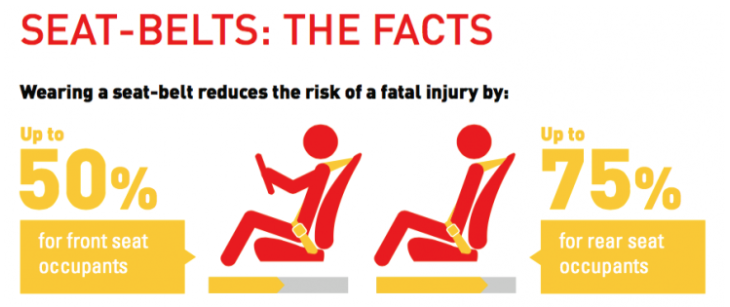
- Buckle up, front and back. In 2024, 14,466 people died without a seat belt across India, and nearly half of them were passengers.
- Put children in the back seat, belted, or in a child seat that suits their size. We did not verify a national legal requirement for child seats in cars, so this is advice, not a legal claim.
- Do not drive tired. Plan night drives with stops, and see our night driving plan.
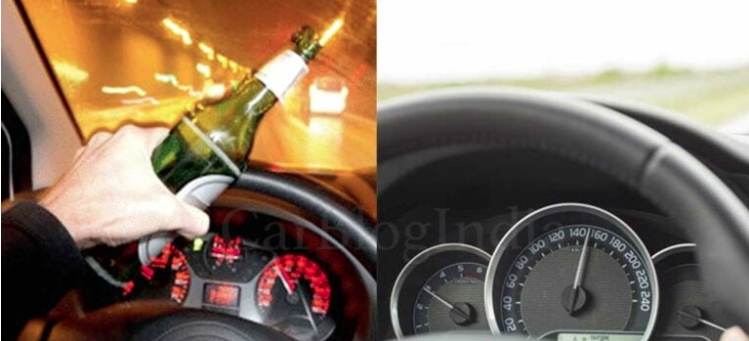
- Do not drink and drive, and do not use a phone. Both are small shares of recorded deaths but entirely avoidable.
- Agree on one rule at home: nobody rides or drives without a helmet or belt, and nobody gets into a vehicle with a driver who has been drinking.
- Save 112, 108 and the number of your nearest hospital on every family phone. Read our road deaths explainer and state-wise road death comparison for the wider picture.
At a crash scene
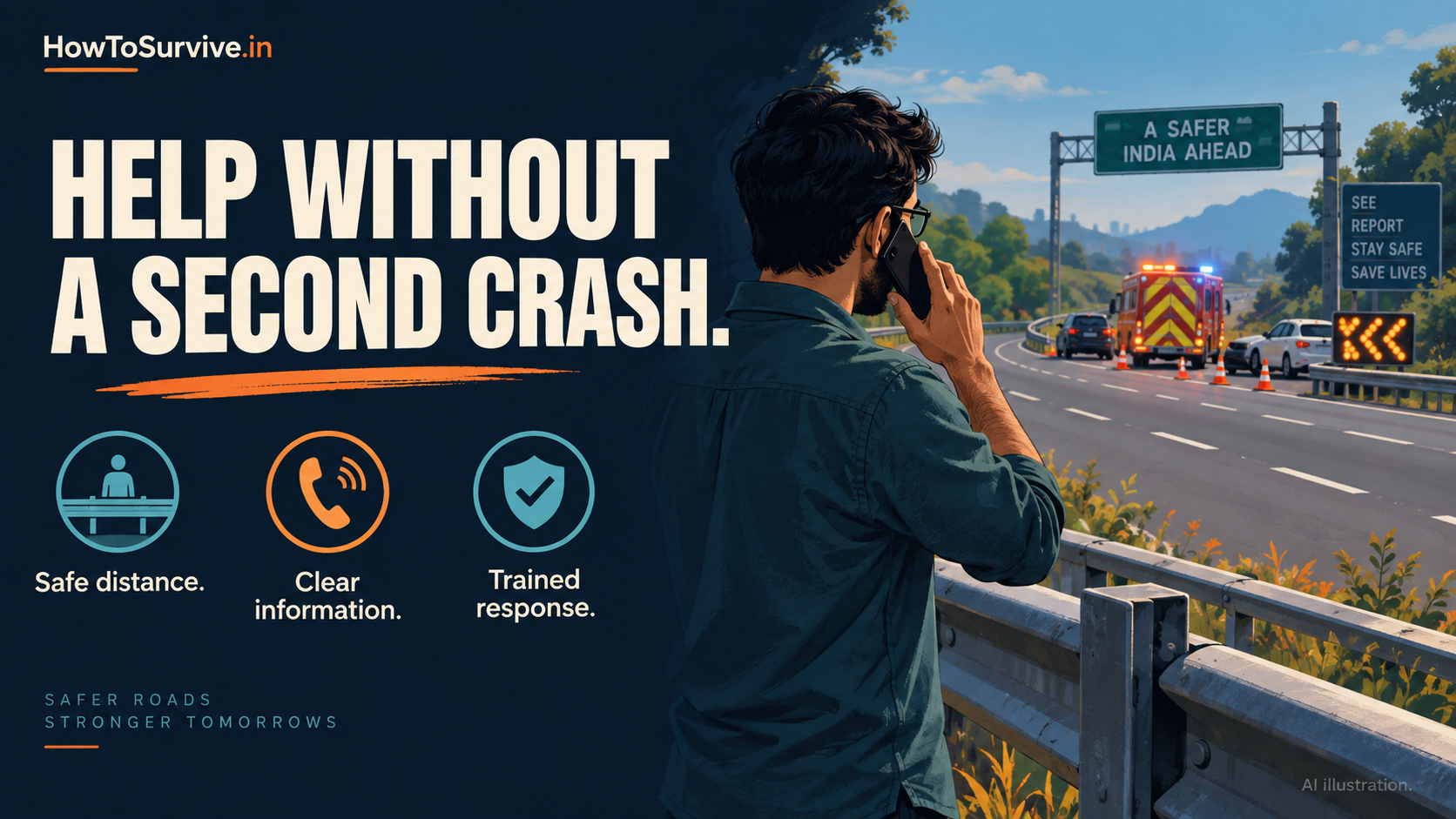
- Stay safe first. Park well off the road, switch on hazard lights, and do not stand where traffic can hit you.
- Call 112, India’s emergency number, and give the place and a landmark. 108 is the ambulance number in Gujarat, run by EMRI Green Health Services, and the integrated 112 service has been rolling out in Gujarat since 2025, so how the numbers are routed can differ by district. If one does not connect, try the other.
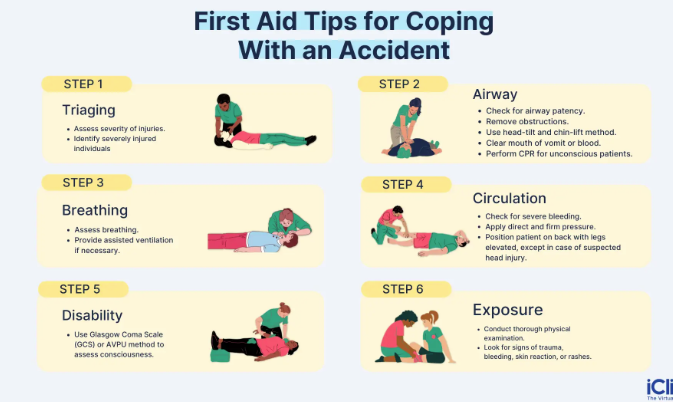
- Give simple help. Do not move a person who may have a neck or back injury unless there is fire or danger, press firmly on bleeding, and stay with them. Our guide on road accident first aid and the witness’s safe-help guide have the steps.
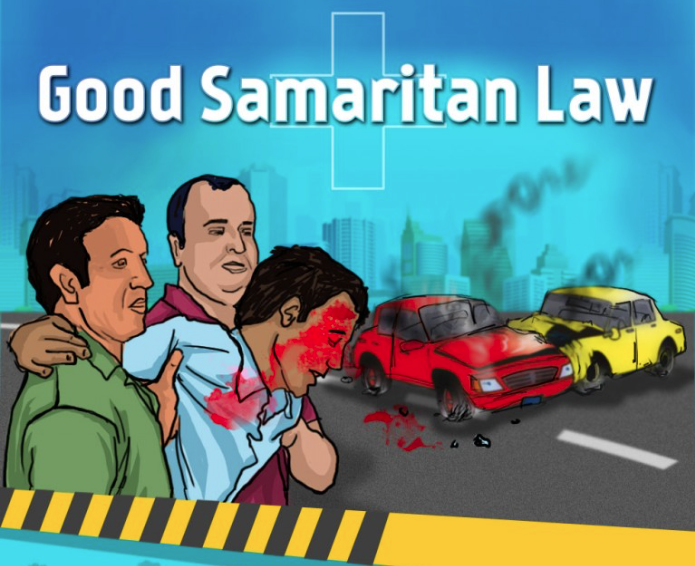
- The law protects you. Section 134A of the Motor Vehicles Act, inserted by the Motor Vehicles (Amendment) Act, 2019 and in force from 1 October 2020, says a Good Samaritan, meaning a person who in good faith and without expecting any reward gives emergency help at the scene or takes the victim to hospital, is not liable to civil or criminal action for the victim’s injury or death that results from negligence in giving that help. The Good Samaritan rules of 29 September 2020 say you cannot be forced to give your name or address, and hospitals must display a charter of your rights. See our explainer on the Good Samaritan law. The law protects the helper. It does not excuse a driver who caused the crash.
- Treatment cost. Under the cashless scheme above, an accident victim can get treatment at a designated hospital up to Rs 1.5 lakh for seven days, and other hospitals must stabilise them. Do not wait for a payment guarantee before you take someone in.
How to report a dangerous road or driver
- A crash or reckless driving in progress: call 112.
- A pothole, damaged bridge or broken barrier on a state road: use the Guj-MARG app of the Roads and Buildings Department. We read about it in July 2025 reports and did not confirm whether it is working today.
- A fault on a National Highway: NHAI’s toll-free 1033 helpline covers NHAI’s tolled stretches, 24 hours, for road conditions, potholes and street lights as well as emergencies.
- A city road: use your municipal corporation’s helpline. For Surat, see our Surat safety guide.
- Give the exact place, the time, a landmark and a photo if you can take one safely, not while driving. We did not verify a single Gujarat helpline for reporting dangerous driving, so 112 is the safe choice.
What we could not confirm
- The source of the Sandesh News “20 to 22 a day” line.
- Any official total for 2025 or 2026 in Gujarat.
- Gujarat’s own split by road user, helmet use, time of day and road type from MoRTH’s state-wise annexures.
- The Gujarat Road Safety Authority’s own report. We read it only through a journal study and a newspaper, and the newspaper’s numbers do not all add up.
- Whether the May 2026 helmet drive reduced deaths.
- Gujarat’s present fine amounts.
If you spot a more recent Gujarat total, or a source for the Sandesh figure, please write to us and we will update this page. Last checked: 21 October 2026.
What needs attention
- The 20 to 22 a day range is consistent with MoRTH's official totals for Gujarat from 2021 to 2024, but it is an annual average and the Sandesh caption names no source.
- Gujarat's deaths rose from 6,170 in 2020 to 7,854 in 2023 and eased to 7,717 in 2024. Accidents fell in 2024 while deaths stayed high, so a larger share of accidents were fatal.
- Gujarat is tenth in India by deaths but its severity, 49.5 deaths per 100 accidents, is well above the national 36.3.
- Ahmedabad cut its deaths from 535 to 410 in 2024, the largest fall among India's 50 million-plus cities. Surat, Vadodara and Rajkot together had 657.
- Over-speeding is the biggest recorded violation nationally (70.28 per cent of deaths) and is recorded even higher in secondary readings of Gujarat's data.
- Gujarat-only splits by road user, helmet use, time of day and road type were not available to us from the official report; national shares are given as national.
- Gujarat's measures (helmet drive, e-challans, cashless treatment, a 2030 target) are real, but we found no published result that shows deaths falling because of them.
Controls that reduce risk
- Rider: wear an ISI-marked helmet, strap fastened, on every trip; keep to the speed limit; keep away from truck blind spots.
- Pillion rider: wear a helmet too. A child under four needs a harness and a fitted helmet, and the speed must stay at or below 40 km/h.
- Driver: buckle up front and back, do not use a phone, do not drink and drive, and rest on long night drives.
- Parent: put children in the back seat, belted or in a suitable child seat, and set one family rule about helmets and belts.
- Bystander: call 112, give simple help, and know that Section 134A protects a good-faith helper.
- Anyone who sees a damaged road: report it through the Guj-MARG app, the 1033 helpline on NHAI tolled highways, or your municipal corporation.
- Reader: check the year and the unit before you share a road-death number.
Common unsafe practices
- Treating an annual average as a figure for every day.
- Quoting a social-media caption as an official number.
- Riding without a helmet, or letting a pillion rider go without one.
- Speeding on highways and at night.
- Sitting in the back of a car without a seat belt.
- Waiting for a payment guarantee before taking a crash victim to hospital.
- Moving a person with a possible neck or back injury without a reason.
- Not reporting a damaged road or an unsafe bridge.
Leave a comment