
What happened here

 1 / 3
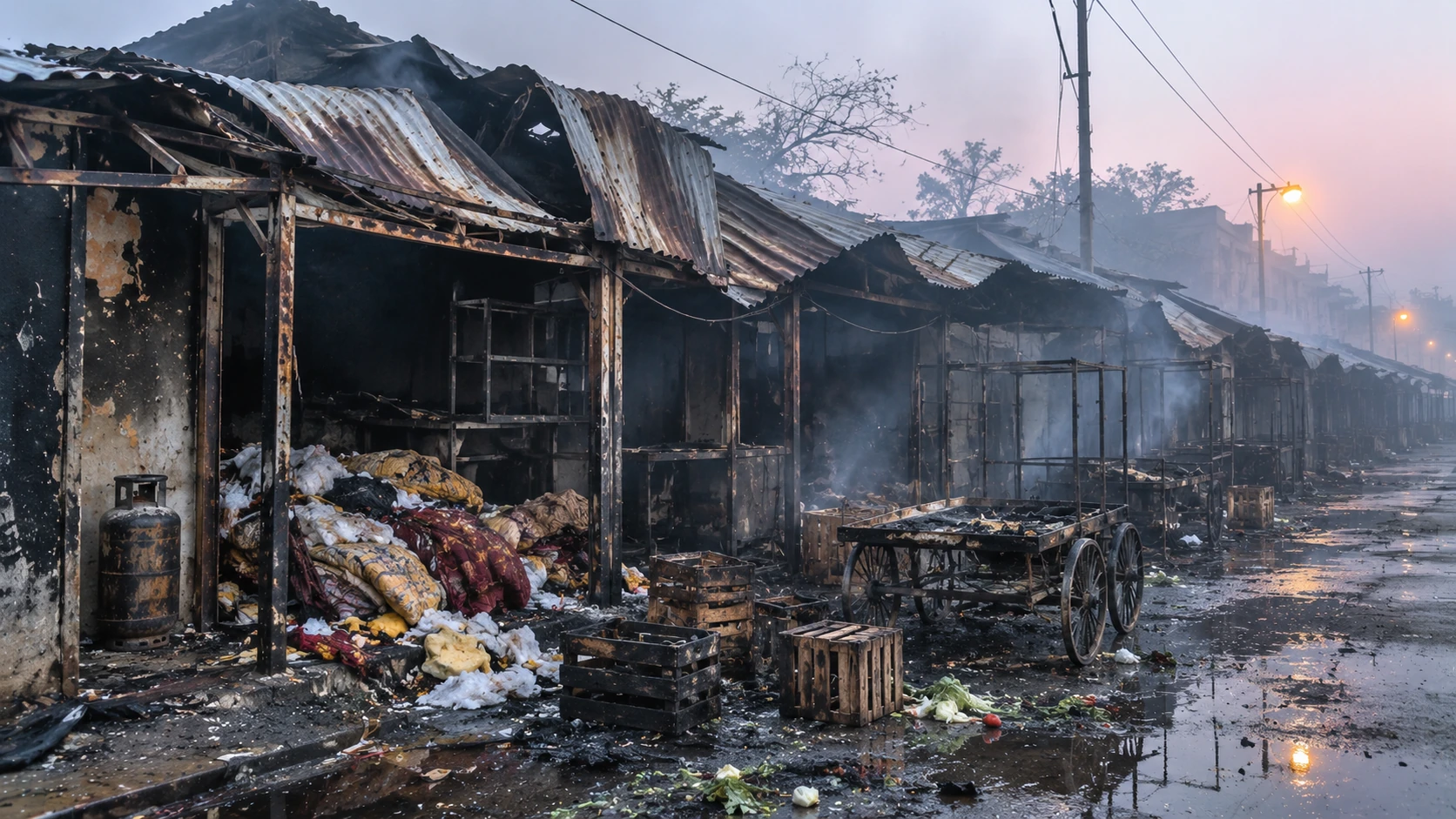
A fire that began around 10.30 pm on 25 October 2026 damaged 30 to 40 shops in Shiv Market, opposite Jammu railway station, and burnt for five to six hours. No casualties were reported. Officials suspect a short circuit; a narrow approach hampered firefighters. The Divisional Commissioner says about 30 shops were damaged and a list for compensation is being prepared; some traders allege the fire service came late, which the department denies, saying its first vehicles reached the spot about eight minutes after the call. The number of shops differs from 12 to 40 across reports. Updated 28 October 2026.
Quick answers
What happened in Shiv Market, Jammu?
A fire that began around 10.30 pm on 25 October 2026 damaged 30 to 40 shops opposite the Jammu railway station and burnt for five to six hours.
Was anyone hurt?
No deaths or injuries were reported in any of the reports we opened.
What caused the fire?
Officials suspect a short circuit in one shop, with wind spreading it. It is a preliminary view, not confirmed.
How many shops were burnt?
Reports range from about 12 to 40. The Divisional Commissioner said on 27 October that about 30 shops were damaged, and the Fire and Emergency Services Department puts it at 29, with about 115 nearby shops saved; PTI had quoted officials at around 40. A formal survey is awaited.
What should market traders do?
Get the wiring checked, fit MCB and earth-leakage breakers, keep the lane clear, keep an extinguisher and switch off the main at night.
Was the fire service late?
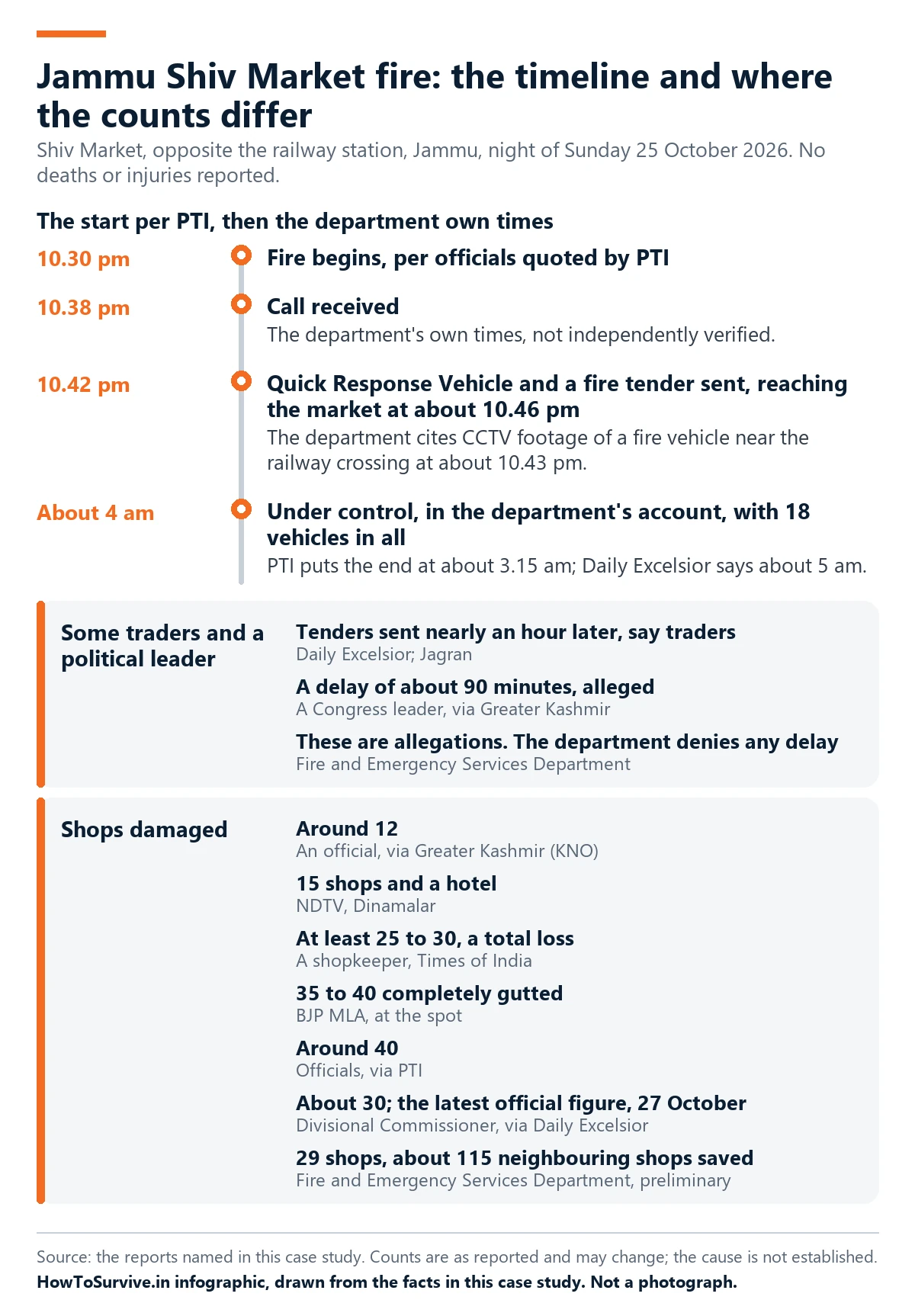
Some shopkeepers say tenders came nearly an hour after the department was told, or an hour and a quarter to an hour and a half late, and a Congress leader alleges a 90-minute delay and a first tender with little water. The Fire and Emergency Services Department denies this. It says the call came at 10.38 pm, the first vehicles left at 10.42 pm and reached the market about 10.46 pm, and it cites CCTV. These are two competing accounts; we have not seen an independent record of either.
Will the traders get compensation?
The Divisional Commissioner said a list of affected shopkeepers is being prepared so that compensation can be considered under the applicable rules, and the Chief Minister asked the administration to help. No amount had been announced as of 9 November, when the BJP asked for immediate compensation and a loss assessment (PTI via The Week). The Deputy Chief Minister had said on 29 October that special assistance would be given as far as possible. Traders told Jagran on 27 October that they were still waiting for a damage assessment and compensation.
What happened
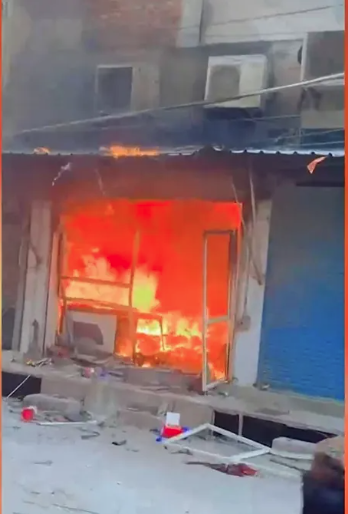
On the night of Sunday, 25 October 2026, a fire tore through Shiv Market, a crowded trading lane opposite the railway station in Jammu. It began around 10.30 pm, according to officials quoted by PTI, and burnt for nearly five hours. PTI puts the end at about 3.15 am on Monday, 26 October; Daily Excelsior says it was fully under control only around 5 am, after nearly six and a half hours. The market has shops selling dry fruits, blankets and food supplies, along with small eateries and dhabas. Nobody has been reported dead or injured. Updated 26 October 2026.
Updated 27 October 2026: The Divisional Commissioner, Jammu, said about 30 shops were damaged and the cause was still being ascertained (Daily Excelsior). The Deputy Commissioner and the tehsildar are preparing a list of affected shopkeepers so that compensation can be considered under the applicable rules, and the Chief Minister has directed the administration to extend all possible help to the traders. Daily Excelsior counts about 11 fire tenders and 30 to 35 shops, including two eateries, garment and blanket outlets and dry fruit shops.
Updated 28 October 2026: The Fire and Emergency Services Department has since issued a clarification, reported by The News Now late on 27 October, in which it denies any delay. It says the call came at 10.38 pm on 25 October, that a Quick Response Vehicle and a fire tender were sent at 10.42 pm and reached the market at about 10.46 pm, and it cites CCTV footage showing a fire vehicle near the railway crossing at about 10.43 pm. As the fire grew, more vehicles came from other stations, 18 in all, and the fire was brought under control at about 4 am on 26 October. The department’s preliminary count is 29 shops affected, with about 115 neighbouring shops saved. It calls reports of a delay misleading. These are the department’s own figures and times. Some traders still say the vehicles came late, and we have not been able to check either account against an independent record.
How many shops were burnt
The count depends on who you ask and when. An official quoted by Greater Kashmir (KNO) said around 12 shops were damaged and that the exact number was being verified. The first television and wire reports (NDTV, Dinamalar) said 15 shops and a hotel. A shopkeeper told the Times of India that at least 25 to 30 shops were a total loss. BJP MLA Vikram Randhawa, speaking at the spot, put it at 35 to 40 shops completely gutted, and PTI, quoting officials, said around 40. Jagran and India TV also report a hotel as burnt or badly damaged. We show the range of 12 to 40. The latest official figure is the Divisional Commissioner’s ‘about 30 shops damaged’ (27 October), Daily Excelsior writes 30 to 35, and the earlier PTI figure was around 40. A formal survey has not been published.
Losses are described as running into crores of rupees (NDTV, Jagran, India TV). No outlet we opened gives a rupee total, and officials said the damage could be assessed only after the fire was fully out.
Why it spread and why it was hard to fight
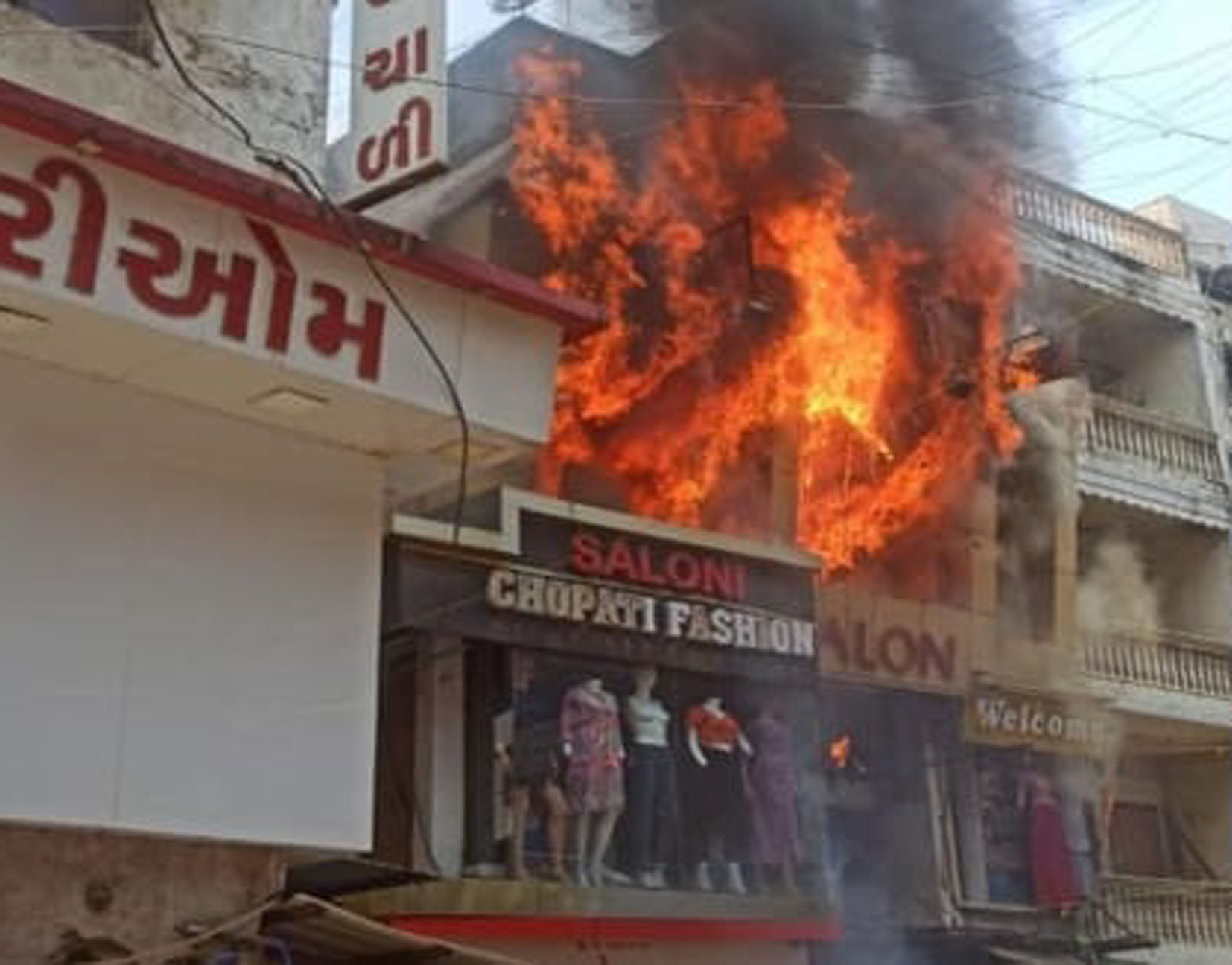
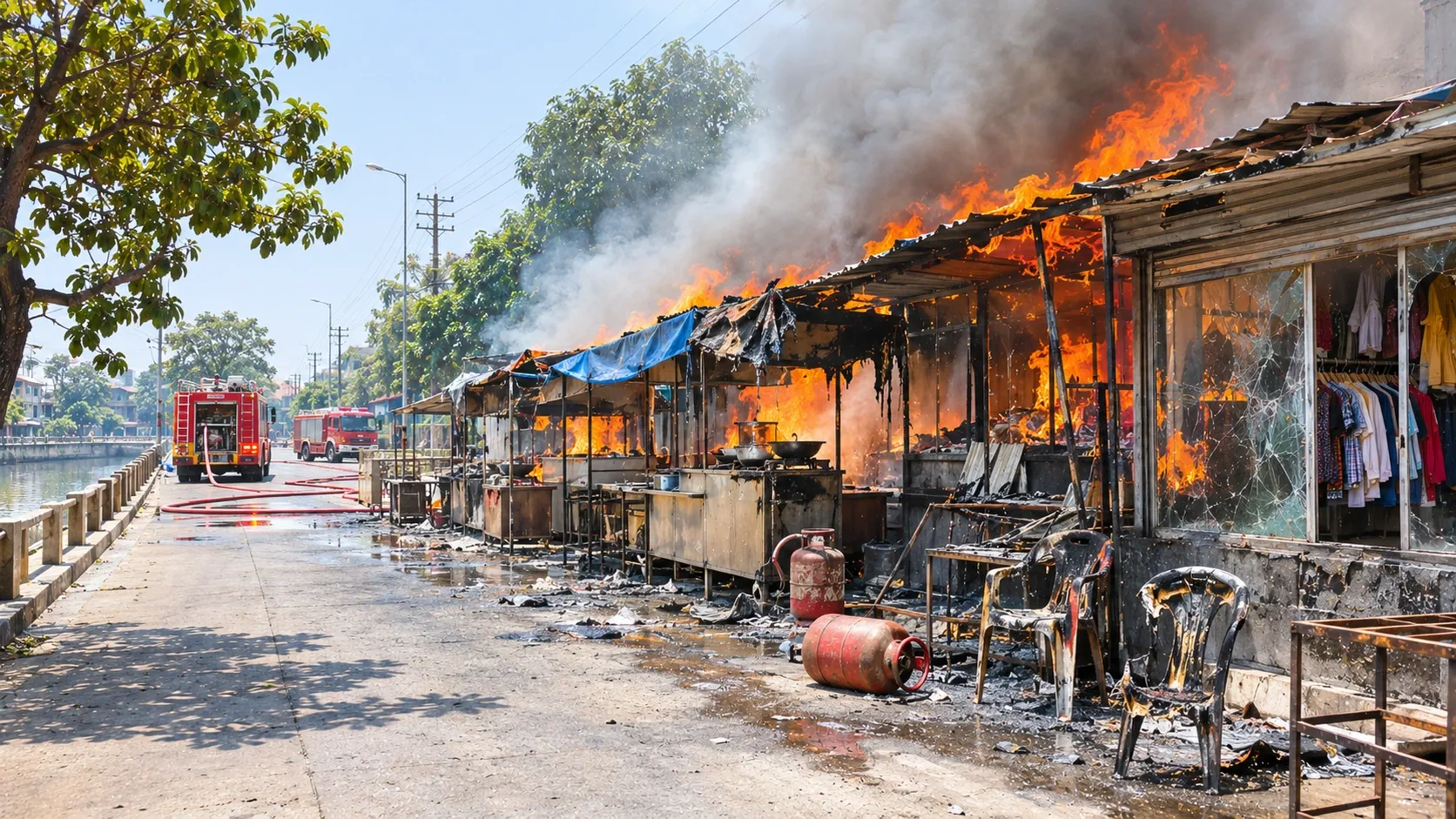
The preliminary view of officials, as reported by PTI, is that a short circuit in one shop started the fire. MLA Randhawa said the same at the spot and added that by the time the fire brigade arrived, the whole market was already burning. Wind helped the flames travel along the lane. The goods made it worse: dry fruits, blankets, packaged food and wooden shop fronts burn easily and give off heavy smoke.
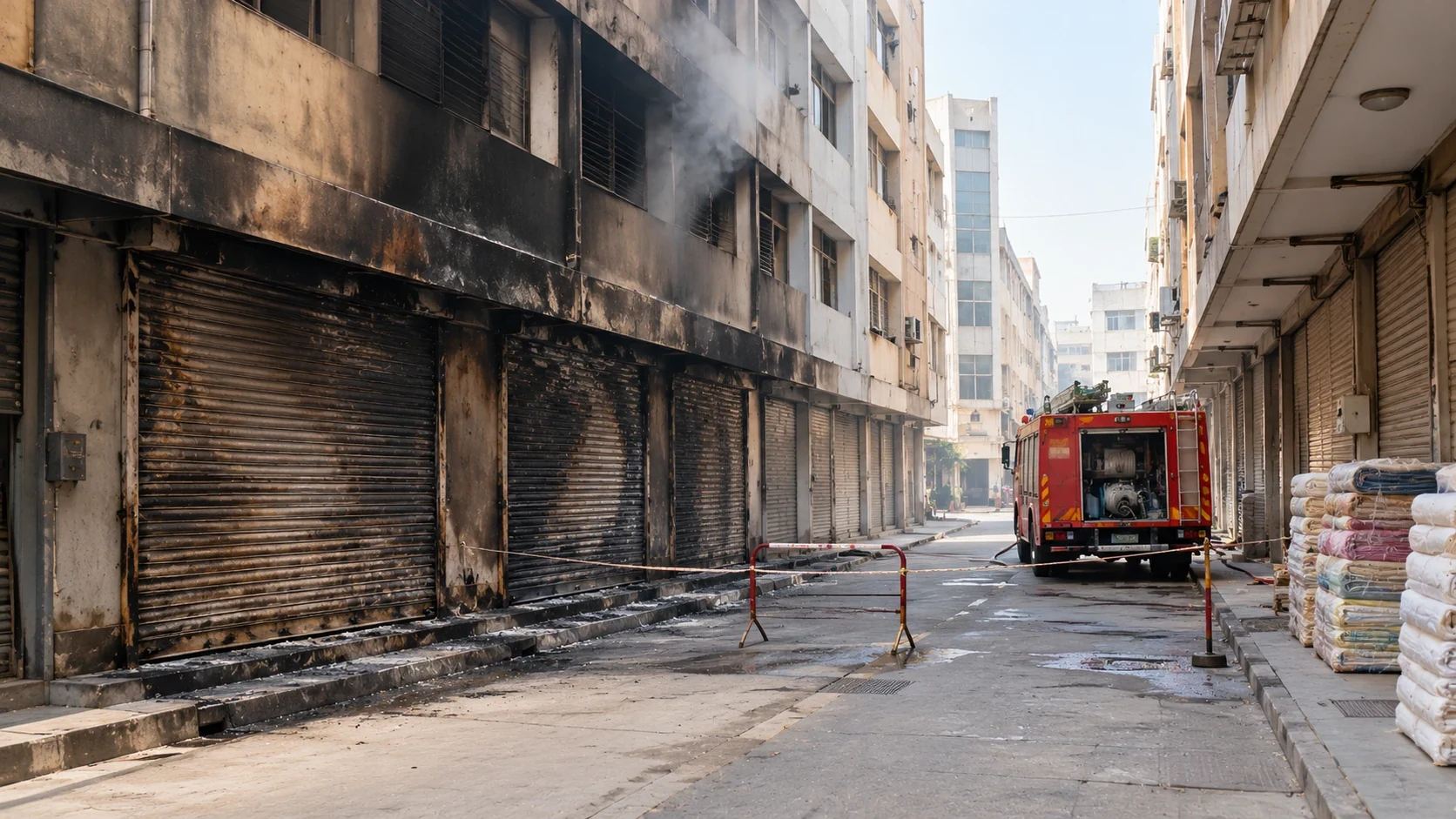
The approach to the market is narrow, and that slowed the firefighters. PTI quotes officials saying that the teams had to go round to the rear of the market to reach the burning shops and stop the fire spreading further. Greater Kashmir reports eight to ten fire tenders at work. The Deputy Commissioner, SP South, a DSP and the SHO were at the site, and local volunteers helped. The MLA said compensation for the traders would be taken up with the administration later. By 27 October the Divisional Commissioner said a list of affected shopkeepers was being prepared for compensation under the rules; we saw no relief amount announced.
No official has named the cause as confirmed. The wiring, the shop load and the layout of the lane have not been examined in any report we found.
Some shopkeepers say the fire service reached the market late. One affected trader told Daily Excelsior that the department was informed within five minutes but tenders were sent nearly an hour later; another said officials kept him busy recording details instead of sending a tender at once. A Congress leader, quoted by Greater Kashmir, alleges a delay of about 90 minutes and that the first tender had little water, and asks for a time-bound inquiry. These are allegations. A shop owner quoted by Jagran on 27 October adds that he phoned the fire service several times without an answer, then went to the fire office himself, and that a small vehicle with weak water pressure came after about an hour and a quarter to an hour and a half. The department has answered with its own timings (above) and denies a delay. It also cites the congested layout, little fire separation between adjoining shops and combustible stock such as dry fruits and blankets as reasons the fire spread so fast. We cannot tell which account of the response time is right.
What NBC 2026 asks for a market like this
For a mercantile building, a floor of 1,001 sq m or more is asked for a wet riser, yard hydrant, sprinklers and fire detection, and a roofed market counts as mercantile. Without sprinklers, one fire compartment in a shop or mall is limited to 750 sq m. The fire department cites a congested layout and little fire separation between adjoining shops, but no report we found describes the wiring, water supply or detection. If such features were present and working, they may have helped, but we cannot say whether it would have changed what happened. NBC 2026 is voluntary until a state adopts it, and a market like this may have been approved under earlier rules. The fire officer decides what applies to a real building. Our chapters on fire rules for shops and malls and on fire compartments explain the rules.
Why this matters
No one was hurt, which is the good news. But a market like this, right opposite a railway station, carries the livelihoods of hundreds of traders and their workers (Jagran), and a total loss of stock can end a small trader’s business. A similar story ran through our Seelampur market fire, the Shyam Sangini textile market fire in Surat and the Adinath textile market fire, where congested lanes and stock made a small fire hard to stop. See also the older Chauta Bazaar fire in Surat.
Lessons for traders and market associations
- Get the wiring checked. Old, overloaded wiring, extension boards and cheap sockets are the usual short-circuit sources. Ask a licensed electrician to test the load, fit an MCB and an earth-leakage breaker, and switch off the main at night. Our note on small electrical faults that cause big fires in homes and shops explains what to look for.
- Keep the lane open. Hand carts, boards and stacked stock narrow the road. A fire tender cannot enter a lane that a scooter can barely pass. Agree with neighbouring traders on a clear width and a rear access.
- Keep an extinguisher in every shop and learn to use it. A small fire in the first two minutes can be put out. After that, leave and call 101.
- Do not store stock right up to the ceiling or across the door. Keep a walking path to the exit, and do not sleep inside a closed shop.
- As a market body, keep a water tank or hydrant point, a list of shop owners with phone numbers, and a night watchman who can ring the fire service at once. Photograph your stock and keep the bills away from the shop; they help with insurance and compensation claims.
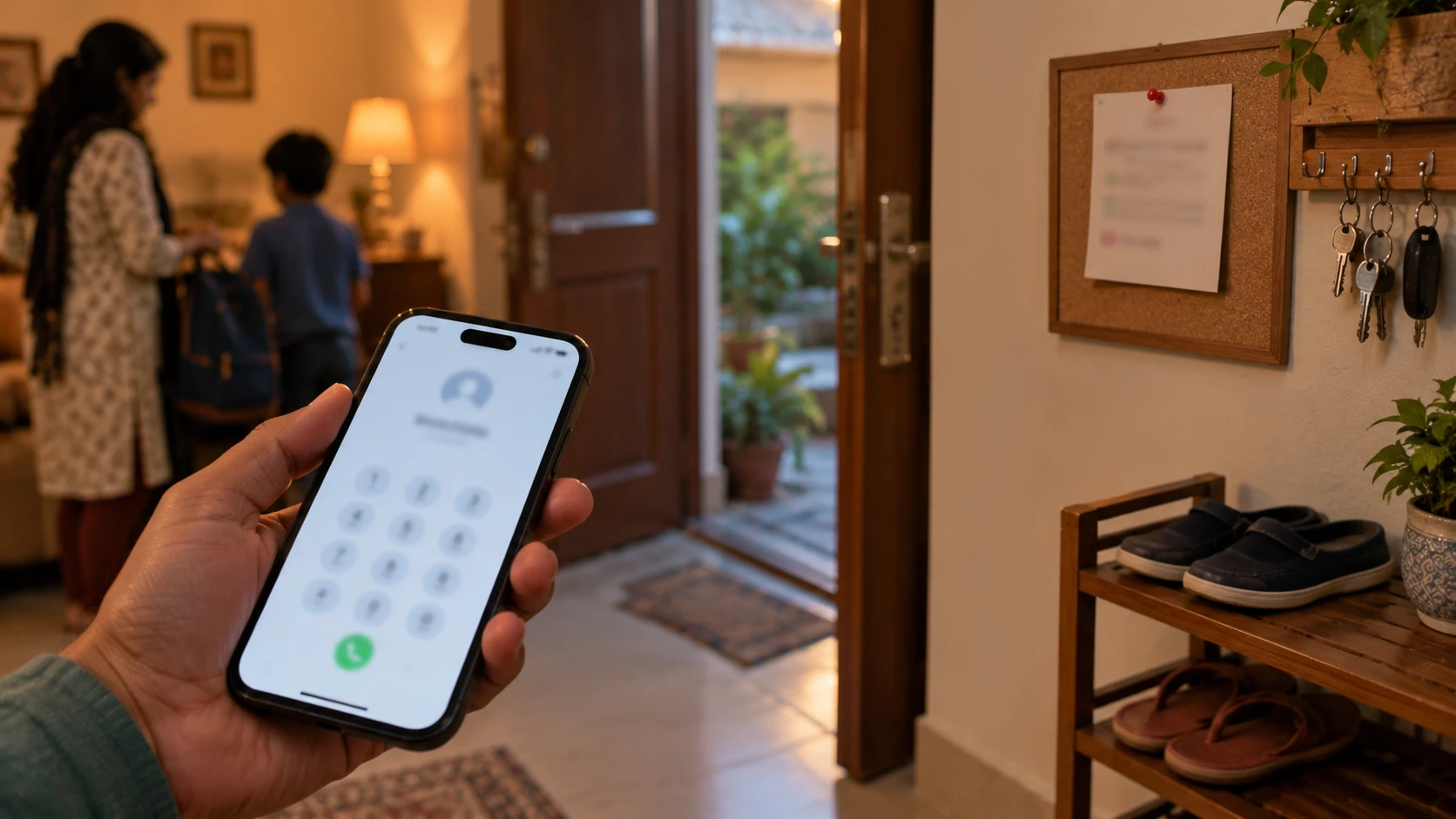
- If you see fire at night, call 112 or 101 and give the exact landmark. Stay out of the lane so the tenders can come in. Our evacuation plan guide and emergency numbers guide are worth saving.
For the larger picture of how thin fire services are stretched in many Indian towns, read our explainer on the shortfall in fire personnel and our note on how fire spreads.
More on Jammu: see our fire and emergency safety guide for emergency numbers, the fire stations and the local risks to know.
What is still not known
The final number of shops and the hotel, the rupee loss, the cause (a short circuit is suspected, not confirmed), how many shops had working extinguishers and wiring checks, and any compensation amount. The department has given its own call, dispatch and arrival times in reply to the allegation of a late response, but they have not been independently verified. Reports also differ on the hour: PTI says about 10.30 pm on Sunday, while some say it started in the early hours of Monday, and on when it ended (about 3.15 am by PTI, about 5 am by Daily Excelsior). We will update this page when the Fire and Emergency Services or the district administration publishes a finding. Updated 13 November 2026: as of 9 November no compensation amount had been announced. The Deputy Chief Minister said on 29 October that the government would give whatever special assistance is possible and warned against promising full compensation, and the Chief Minister visited the market on 2 November. On 9 November the BJP asked for immediate compensation, a loss assessment and stronger fire safety in commercial areas (PTI via The Week). On the same day a Union minister, speaking about a separate fire at a warehouse in Nehru Market, said commercial properties fall outside SDRF rules and that he would ask the state government to consider compensating traders. We found no inquiry report on the cause or on the response time. Last checked on 13 November 2026.
- Fire starts in Shiv Market, opposite Jammu railway station; short circuit in one shop suspected
- Fire spreads along the lane aided by wind; fire tenders arrive and approach from the rear
- MLA says by the time the fire brigade reached, the whole market was in flames
- Fire brought under control after nearly five hours (PTI)
- Officials say around 40 shops gutted, no casualties; losses being assessed
- Divisional Commissioner says about 30 shops were damaged and a compensation list is being prepared; the Chief Minister directs all possible help; traders and a Congress leader allege a late fire-service response (Daily Excelsior, Greater Kashmir)
- Fire and Emergency Services Department clarification (The News Now): call received at 10.38 pm on 25 October; a Quick Response Vehicle and a tender dispatched at 10.42 pm and reached about 10.46 pm; CCTV shows a fire vehicle near the railway crossing at about 10.43 pm; 18 vehicles took part; fire under control at about 4 am on 26 October; 29 shops affected, about 115 nearby shops saved
Why consequences escalated
- A fire in a crowded market opposite Jammu railway station burnt 30 to 40 shops and a hotel over five to six hours.
- No deaths or injuries were reported.
- A short circuit in one shop is suspected; wind and combustible stock helped the spread.
- A narrow approach forced firefighters to attack from the rear.
- The number of shops differs (12 to 40; the Divisional Commissioner says about 30 and the fire department 29) and no rupee loss has been published.
- Some traders and a Congress leader allege the fire service came 60 to 90 minutes late. The department denies it and says its first vehicles reached the spot about eight minutes after the call; neither side's timings are independently checked.
Failures and risk multipliers
- Suspected short circuit in one shop in a congested market (preliminary, not confirmed).
- A narrow access lane that slowed fire tenders (officials via PTI).
- Combustible stock such as dry fruits, blankets and packaged food packed in wooden-front shops (reported goods, our inference about the fuel).
- The MLA's account that the whole market was already in flames when the fire brigade reached the spot (not an official finding). Shopkeepers and a Congress leader allege a late response of 60 to 90 minutes. The department denies it and gives its own times, which we could not check independently.
- The department itself cites a congested layout, little fire separation between adjoining shops and combustible stock such as dry fruits and blankets as reasons the fire spread fast (The News Now, 27 October).
- No report on wiring checks, extinguishers or water points in the market.
Actions that reduce risk
- Get the wiring and load checked by a licensed electrician and fit MCB and earth-leakage breakers.
- Keep the lane clear and agree on a rear access with neighbouring traders.
- Keep an extinguisher in every shop and train staff in using it.
- Switch off the main at night; do not sleep inside a closed shop.
- Photograph your stock and keep bills and records away from the shop.






Leave a comment