

Quick answers
What are the building groups in NBC 2026?
Clause 3.1.1 of Part F sorts buildings by use into ten groups: residential, educational, institutional, assembly, business, mercantile, industrial, storage, hazardous and mixed use. Several groups are split into subdivisions.
Is a clinic business or institutional under NBC 2026?
The business clause names outpatient clinics. The institutional clause names hospitals, sanatoria and nursing homes, which provide sleeping accommodation. The standard does not say where a clinic with a few beds falls, so the fire officer decides.
How is a PG or hostel classified under NBC 2026?
Students and other hostels are named under residential dormitories. A PG house is not named; the nearest wording is lodging and rooming houses or dormitories. The fire officer decides.
Where do coaching classes and banquet halls fall?
The standard does not name either. A coaching class with 20 or more students resembles the educational wording, and a hall for 50 or more people gathering socially resembles assembly, but the fire officer decides.
What if my building has a shop and a home?
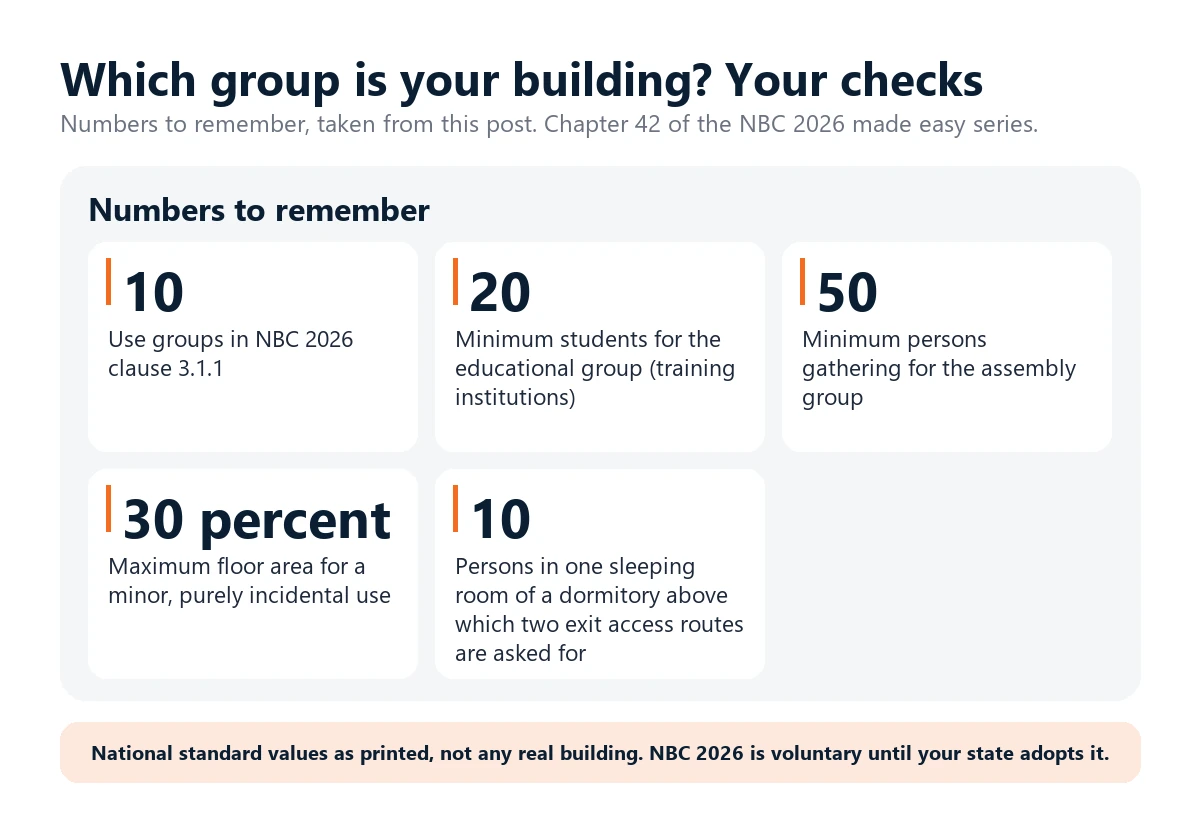
A purely incidental use up to 30 percent of floor area is classed with the main use. Where two or more uses intermingle, the whole building is treated as mixed use. Ask the fire officer which applies to you.
Do I need a certificate to change what my premises are used for?
Clause 3.1.14 says a certificate of occupancy should be necessary before any change in the character of occupancy. NBC 2026 is voluntary until your state adopts it, so ask which rule applies.
NBC 2026 sorts every building into one of ten use groups: residential, educational, institutional, assembly, business, mercantile, industrial, storage, hazardous and mixed use. The group is the first thing to settle, because the later tables in Part F are read by group. A clinic that treats day patients is named under business. A student hostel is named under residential dormitories. A shop is mercantile. A coaching class, a PG house and a banquet hall are not named anywhere in the clauses, so the fire officer decides. This is chapter 42 in our series on the 2026 national building standards. Checked 15 November 2026.
In short
- Ten groups, by use: clause 3.1.1 says every building, existing or new, is classed by its use or the character of its occupancy. Several groups are split into subdivisions.
- The group steers the rest: travel distance, the firefighting installations tables and the use-wise requirements in clause 6 are all read by group.
- More than one use: a purely incidental use up to 30 percent of the floor area rides with the main use. Beyond that, the building is mixed use.
- It is voluntary for now. NBC 2026 binds a building only once your state adopts it. Your state rules and your fire officer decide for your building.
What a use group is, and why it decides so much
Clause 3.1.1 of Part F says all buildings, whether already standing or yet to be built, should be classified according to use or the character of occupancy. The ten groups are residential, educational, institutional, assembly, business, mercantile, industrial, storage, hazardous and mixed use. The details and examples of each group are in clauses 3.1.2 to 3.1.11.
Why bother? Because the group opens every later table. Table 4, which caps travel distance, has a row for each group. For construction Types 1 and 2, the printed limits are 30 m without sprinklers for residential, educational, institutional, assembly, business, mercantile and storage, and 22.5 m for hazardous. With sprinklers they are 60 m for residential and business, 45 m for educational, institutional, assembly and mercantile, 90 m for storage and 30 m for hazardous. The same walk down the same corridor can pass in one group and fail in another. Our chapter on travel distance explains how to read it.
Table 7A sets the firefighting installations for residential buildings, and the tables after it go use by use (see our chapter on finding your building). In Table 7A, lodging and rooming houses up to 500 m2 in area and up to 24 m in height (both conditions to be met) can use self-certification by a certified, State-approved building professional. That concession belongs to one subdivision. Clause 6 adds requirements for each type of occupancy on top of the general rules.
The ten groups in plain words
We name each group by its use. The standard prints a letter against every group, but the list in clause 3.1.1 and the later clauses and tables do not agree on which letter belongs to storage and which to hazardous. We have left letters out so that nothing here depends on which printing is right.
Residential
Clause 3.1.2 covers any building where sleeping accommodation is provided for normal residential purposes, with or without cooking or dining, except buildings of the institutional group. There are five subdivisions.
- Lodging and rooming houses: separate sleeping accommodation for individuals under the same management, transient or permanent, without cooking facilities. The standard lists inns, clubs, motels and guest houses. Sleeping accommodation for more than 20 persons in one building is classified here or as an apartment house, as the case may be. A note says a lodging house counts as a one or two family dwelling if no room in a private dwelling unit is rented to more than three persons.
- Dormitories: group sleeping for persons who are not of the same family, under joint occupancy and single management. The examples are school and college dormitories, students and other hostels, and military barracks.
- Apartment houses: living quarters for three or more families, each living independently with independent cooking facilities. Apartment houses, mansions and chawls are the examples.
- Hotels: sleeping accommodation under single management, with or without dining, for hotels classified up to Four Star category.
- Starred hotels: hotels duly approved by the concerned authorities as Five Star and above.
A school or institution with residential accommodation has that portion classified as dormitories (clause 3.1.3). The pages we read do not list a plain single-family house as its own subdivision.
Educational
Clause 3.1.3: any building used for a school, a college or another training institution, involving assembly for instruction, education or recreation, for not less than 20 students. Temporary buildings used for education fall under clause 3.2.3. The clause does not say how the 20 is counted, for example per class or at one time.
Institutional
Clause 3.1.4: buildings used for medical or other treatment or care of persons with physical or mental illness, disease or infirmity, for the care of infants, convalescents or aged persons, and for penal or correctional detention. They ordinarily provide sleeping accommodation. The subdivisions are hospitals and sanatoria (including infirmaries and nursing homes); custodial institutions (homes for the aged and infirm, convalescent homes, orphanages); and penal and mental institutions.
Assembly
Clause 3.1.5: any building where not less than 50 persons gather for amusement, recreation, social, religious, patriotic, civil, travel and similar purposes. The named examples include shopping malls, theatres and multiplexes, assembly halls, auditoria, exhibition halls, museums, gymnasiums, restaurants and food courts, places of worship, dance halls, club rooms, transport terminals and stadia. A shopping mall is named here, while the shops inside it are mercantile.
Business
Clause 3.1.6: buildings used to transact business and keep accounts and records. The list includes professional establishments, service facilities, courthouses, laboratories, outpatient clinics, research establishments, libraries (so far as their principal function is public business and keeping books and records), IT parks, call centres, broadcasting stations, air traffic control towers and data centres. There are two subdivisions: business buildings occupied by people, and data centres (a machine environment). Libraries and museums are covered in our chapter on libraries, museums and archives.
Mercantile
Clause 3.1.7: buildings used as shops, stores or markets, for display and sale of merchandise, wholesale or retail. The subdivisions are shops, stores, departmental stores and markets; and underground shopping centres.
Industrial
Clause 3.1.8: buildings or structures where products or materials of all kinds are fabricated, assembled, manufactured or processed, such as assembly plants, dry cleaning plants, power plants, laundries, dairies and saw-mills. There are three subdivisions, for low, moderate and high hazard industries. The Authority decides the hazard from the fire loads of the contents and the processes carried on, and where hazards differ in different parts of a building, the most hazardous governs unless those areas are segregated or protected as the standard specifies. This is covered in our chapter on industry hazard classes.
Storage
Clause 3.1.9: buildings primarily for storing or sheltering goods, vehicles or animals, except highly combustible or explosive products. The examples are warehouses, cold storages, freight depots, garages, grain elevators, barns and stables. Storage is marked by few persons in proportion to the area, so a new use that raises the number of occupants to a figure comparable with other groups should change the classification. The clause gives hangars used for assembly, warehouses used as offices and garage buildings used for manufacturing as examples.
Hazardous
Clause 3.1.10: buildings used to store, handle, make or process highly combustible or explosive materials, or materials that give off poisonous fumes or explosions or explosive dust. The examples include gases such as acetylene, hydrogen and ammonia stored under pressure of more than 0.1 N/mm2 in quantities above 70 m3; hazardous and highly flammable liquids and liquefiable gases such as LPG; and the manufacture of artificial flowers, synthetic leather, ammunition, explosives and fireworks. The pages we read do not discuss a single household cylinder in this clause.
How common premises are classified
Here is how the printed wording treats the premises readers ask about most. Where the standard does not place a use, we say so and do not guess. The third column is our reading of the clauses, not a ruling.
| Your premises | What NBC 2026 says | Where it lands |
|---|---|---|
| Clinic with day patients only | Business lists outpatient clinics by name | Business |
| Nursing home with beds | Institutional lists nursing homes by name | Institutional |
| Student hostel | Dormitories list students and other hostels by name | Residential (dormitories) |
| Coaching class | Not named. Educational covers training institutions with 20 or more students | The fire officer decides |
| PG (paying guest) house | Not named. Lodging houses and dormitories are the nearest printed wording | The fire officer decides |
| Banquet hall | Not named. Assembly covers 50 or more people gathering for social purposes, and names assembly halls | The fire officer decides |
| Shop | Mercantile lists shops, stores and markets | Mercantile |
| Shop with the family home attached | Two uses in one building; the minor-use and mixed-use clauses apply | The fire officer decides |
| Cloud kitchen | Not named. Clause 6 points commercial kitchens to good practice for their fire protection | The fire officer decides |
| Office | Business lists professional establishments, service facilities and call centres | Business |
A clinic
The business clause lists outpatient clinics by name, so a clinic where patients are seen and go home sits in business. The institutional clause is about care of persons, usually with beds, and names hospitals and nursing homes. The standard does not say where a small clinic with two or three observation beds falls; that line is for the fire officer. It matters because Table 4 gives institutional 30 m and 45 m for Types 1 and 2 without and with sprinklers, against 30 m and 60 m for business.
A hostel and a PG
A student hostel is named: the dormitory subdivision lists students and other hostels. For dormitories, clause 6.1.1.2 says any sleeping room with more than 10 persons should have two separate and distinct exit access routes in different directions. A PG (paying guest) house is not named. The nearest printed wording is the lodging and rooming house subdivision or the dormitory subdivision. The standard does not name it; the fire officer decides. The answer changes the follow-on rules: for lodging houses, clause 6.1.1.1 says the sole means of egress should not pass through any non-residential occupancy in the same building, and that a house with 500 m2 on any one or more floors should have access to at least two separate means of exit.
A coaching class
The standard does not name coaching centres. The educational clause covers training institutions with not less than 20 students, and a class of 20 or more resembles that wording, in our reading. A smaller batch is not addressed, so the fire officer decides. Our post on coaching centre fire safety lists what parents and owners can check meanwhile.
A banquet hall
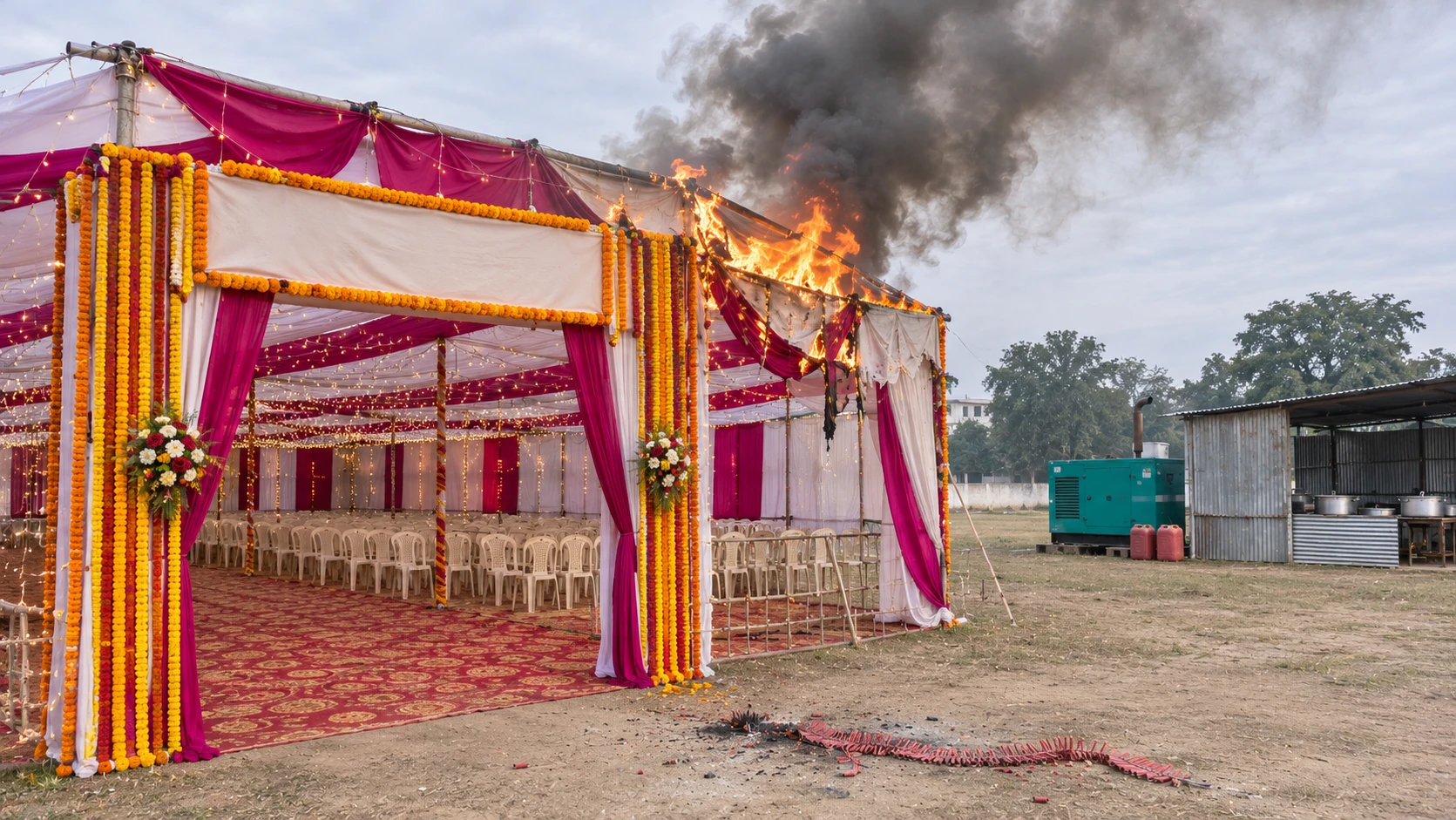
The standard does not name banquet halls. The assembly clause covers any building where not less than 50 persons gather for social and similar purposes, and it names assembly halls and club rooms. A hall that regularly hosts weddings and parties for that many people reads like assembly, in our view. A banquet hall that is part of a hotel may make the whole building mixed use. The fire officer decides. Our post on wedding pandal and venue safety covers the practical checks for hosts and guests.
A small shop with the home attached
A shop is mercantile and a home is residential. Clause 3.1.1.1 says a use that is purely incidental to a main occupancy is treated as part of the main occupancy, provided it does not exceed 30 percent of the floor area. Clause 3.1.1.2 says that where two or more types of occupancy intermingle in the same building, the entire building is treated as mixed use. These two clauses can pull in different directions for a family shop. The standard does not say whether a shop is ever purely incidental to a home, so the fire officer decides. Our post on living above a shop covers the family-side checks.
When a building has more than one use
Indian buildings often have two or three uses under one roof. First, a minor, purely incidental use counts with the main use while it does not exceed 30 percent of the floor area (clause 3.1.1.1). The clause does not say whether that is one floor or the whole building. Second, once uses intermingle beyond that, the entire building is mixed use (clause 3.1.1.2). Third, clause 3.1.11 applies: the most restrictive provisions among the uses govern, exits may be shared only if people can leave without restriction during the working hours of every use sharing them, and the uses are separated by walls and floors of a printed fire resistance.
The separation table prints 120 minutes between residential and mercantile, for example, and marks some pairings not permitted. It is read in full in our chapter on mixed use buildings, renovations and old buildings.
When the use changes
Three short clauses govern a change of occupancy. Clause 3.1.12: where a change puts a building in a different group or a different subdivision of the same group, the building should be made to comply with the requirements for the new group or subdivision. Clause 3.1.13: where the new use is less hazardous, based on life and fire risk, than the existing one, it is not necessary to meet the requirements for the new group. Clause 3.1.14: a certificate of occupancy should be necessary before any change is made in the character of occupancy of a building.
For an existing building, clause 3.3 adds that alterations should not lower the level of fire and life safety, and that changes in the typology of an occupancy, or densification of an existing occupancy for a floor area exceeding 1,000 m2, should be with the approval of the local fire authority. The standard does not say who decides what is less hazardous; that is for the authority.
A worked illustration
This is a made-up example, not the legal answer for any real building. A family flat on the first floor of a four-storey apartment building is let to a coaching class of 30 students. The building is residential. Thirty is above the 20 students the educational clause names, but coaching centres are not named, so the owner asks the fire officer. If the officer places the class in educational, clause 3.1.12 asks that the unit meet the requirements for the new group, and clause 3.1.14 asks for a certificate of occupancy before the use changes. The building is also no longer one use, so clause 3.1.11 comes into play. In Table 4, educational and residential read alike without sprinklers (30 m), but differ with them (45 m and 60 m).
Ask your fire officer
- Which group and subdivision is my building in, and where is that recorded?
- The standard does not name my use. How have you classified it, and on what wording?
- If I change what a unit is used for, do I need a certificate of occupancy first?
- Which version of the standard, or which state rule, applies to my building?
For the process of getting a fire certificate, see our existing guide on the fire NOC application in India.
Where this stands in law
The National Building Construction Standards 2026, Part F, is voluntary. It binds a building only once your state or local authority adopts it, whether through byelaws or its Fire Act, and until then your state’s rules and the fire department decide what applies. A state may also word its own classification differently. This guide is general safety information. It is not legal or engineering advice, and it does not tell you how any particular building is classified.
What we could not confirm
- Where the standard places coaching centres, PG houses, banquet halls, cloud kitchens and clinics with a few beds. The pages we read do not name them.
- How a state that has adopted the standard may have changed its classification. We read the national standard only.
- The listed videos. They were checked for public status and embedding but not watched in full.
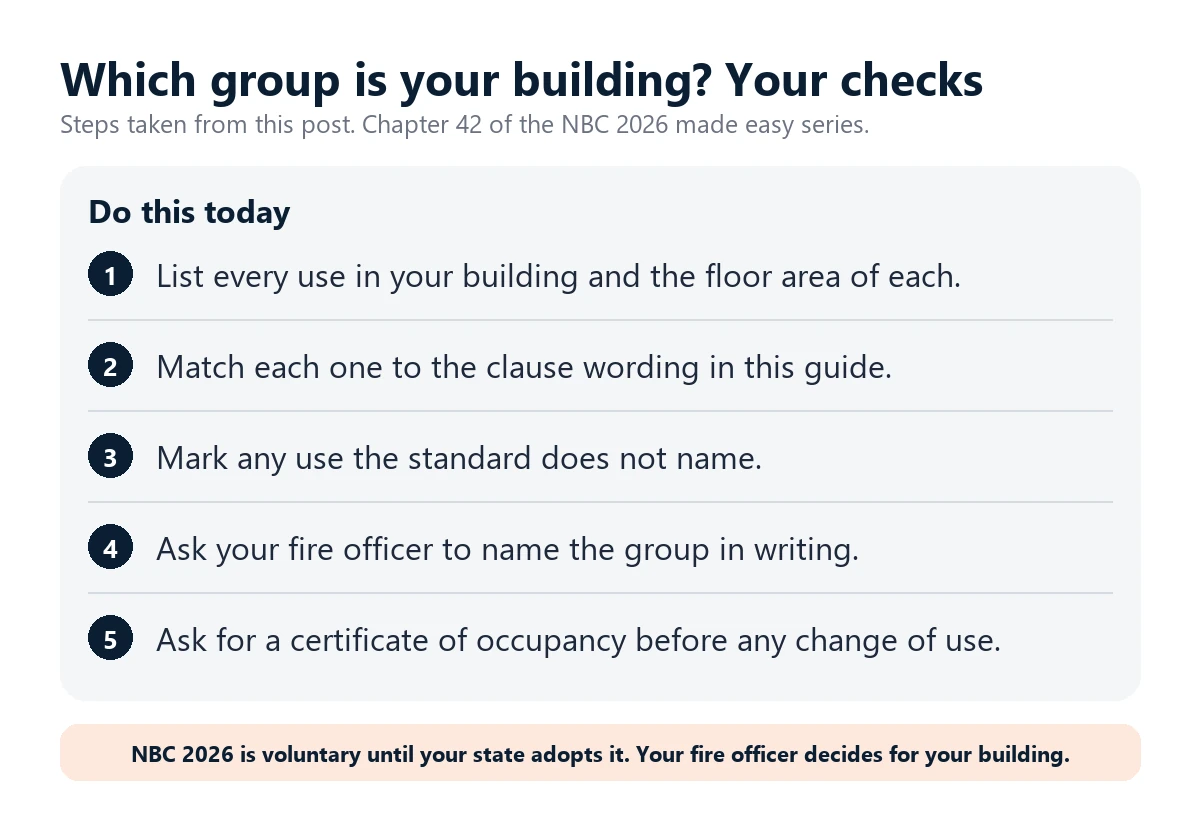
Do this today
Write down every use in your building, with the floor area each takes. Check whether any of them is a use the standard does not name. If one is, ask your fire officer to name its group in writing. The next steps are in our chapters on worked examples and on the fire officer, drills and audits.
What needs attention
- NBC 2026 classifies every building, existing or new, into one of ten use groups, and many of the later tables are read by group.
- Outpatient clinics are named under business; nursing homes and hospitals are named under institutional.
- Students and other hostels are named under residential dormitories; PG houses are not named.
- Coaching centres, banquet halls and cloud kitchens are not named; the fire officer decides.
- A purely incidental use up to 30 percent of floor area is classed with the main use; the clause does not say whether that is per floor or per building.
- A change of occupancy into a different group or subdivision means meeting the requirements for the new group, with a certificate of occupancy first.
- The standard is voluntary until a state adopts it.
Controls that reduce risk
- List every use in your building with its floor area.
- Ask the fire officer to name your group and subdivision, in writing.
- For a use the standard does not name, ask how it was placed and on what wording.
- Ask whether a second use is minor or the building is mixed use.
- Ask about a certificate of occupancy before changing what a unit is used for.
- Ask which version of the standard or which state rule applies.
Common unsafe practices
- Assuming a use is classed the way it is advertised, such as calling a PG a hostel without asking.
- Starting a coaching class, clinic or kitchen in a flat without asking whether the use changes the group.
- Counting a second use as minor when it is more than 30 percent of the floor area.
- Forgetting that a mall is named under assembly while its shops are mercantile.
- Changing the use of a unit without a certificate of occupancy.
- Treating this guide as proof of how a building is classified.



Leave a comment