
Quick answers
What happened in Siwan on 23 October 2026?
A blast at a house in Alampur village, Jamo Bazar police area, where firecrackers were being made, set off stored stock; explosions went on for about two hours. Five deaths were confirmed and a young woman was missing as of 24 October. The cause is not established.
Was the Siwan unit licensed?
Not settled. The Week calls it an illegal unit and police were checking whether a licence existed; residents quoted by one outlet say the family held one.
Can I make firecrackers at home in India?
No. The Explosives Rules, 2008 say explosives may not be made except at a licensed factory, and fireworks are explosives. Even the smallest manufacture needs an LE-1 licence from the District Magistrate.
How many crackers can I keep at home?
The Rules exempt up to 100 kg of manufactured fireworks for own use and not for sale from a licence. That is a legal ceiling, not a safe amount. Keep as little as possible, away from the kitchen and LPG cylinder.
Is it illegal to sell crackers from my house?
Selling needs a licence for the premises, such as an LE-5 shop licence from the District Magistrate, against an approved site and building plan. Selling without one is an offence under the Explosives Act.
How do I report an illegal cracker unit?
Call the police or 112, tell the District Magistrate's office, and you can write to a PESO circle or sub-circle office listed on its Contact Us page. Note the exact address and landmark. Do not go in.
What is the penalty for illegal manufacture?
Section 9-B of the Explosives Act, 1884 provides up to three years' imprisonment, or a fine of up to Rs 5,000, or both, for manufacturing in breach of the Rules or a licence. Other laws can also apply. Check current law.
Has the Supreme Court banned crackers for Diwali 2026?
On 30 September 2026 it said there would be no total ban and no 24-hour bursting, and signalled time slots and conditional green crackers. We found no final order after 15 October. Check your state and district order.
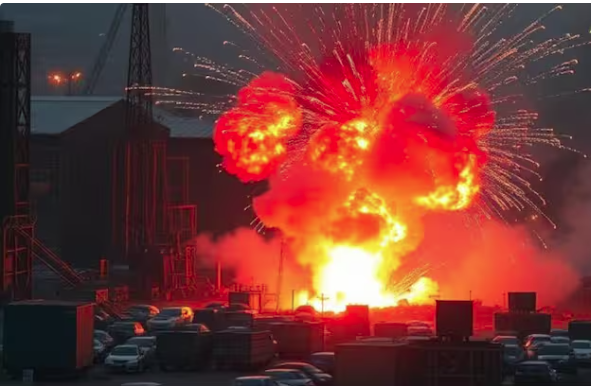
On the evening of Friday 23 October 2026, a blast tore through a house in Alampur village, in the Jamo Bazar police area of Siwan district, Bihar, where firecrackers were being made. Police say five people died and one young woman of the family was still missing at the last report we could open, on 24 October; some outlets put the toll higher. The Week calls the unit illegal and police were checking its licence; residents quoted by one outlet say the family held one. Two days earlier, on 21 October, a godown near Anaikattu in Vellore district, Tamil Nadu, blew up while chemical mixture was being spread on the floor; one woman died and another was in intensive care. Diwali this year falls on 8 November, so the next two weeks are when cracker stock piles up in sheds, shops and houses. This page is about that stock: what the law says about making and keeping crackers, how an unsafe home unit tends to show itself, what households, landlords and neighbours can do, and where to report. Updated 26 October 2026.
In short
- Siwan, 23 October 2026: five confirmed dead, one young woman missing, one report of up to seven; cause not established; licence disputed. See our Siwan case study.
- Vellore, 21 October 2026: one woman dead and a second in intensive care according to the latest report on our Anaikattu case page; the district officer reportedly cancelled the unit’s licence and the godown was sealed.
- The Explosives Rules, 2008 say explosives, which include fireworks, may not be made except at a licensed factory (Rule 10). Keeping fireworks for your own use, up to 100 kg and not for sale, is exempt from a licence under Rule 9(5). Anything for sale needs a licence.
- Even the smallest licensed fireworks manufacture (up to 15 kg at a time) needs an LE-1 licence from the District Magistrate, says PESO’s own guideline document. A house is not a factory.
- If you suspect a home unit, do not go in and do not confront anyone. Note the address and call the police or the fire service, and tell the District Magistrate’s office.
Siwan, 23 October 2026: what the reports say
The Week, Patna Press, ETV Bharat, Tarun Mitra and Dynamite News reported the blast between 23 and 24 October. It happened in the evening while firecrackers were being made in a house. Fire reached the stored stock and set off further blasts; The Week says they went on for about two hours, and Patna Press says the intermittent explosions made the search for victims hard. Part of the house collapsed. Patna Press, ETV Bharat and Tarun Mitra put the number of confirmed dead at five, quoting the Superintendent of Police, Bharat Soni; The Week had first been told four. Dynamite News, writing in the early hours of 24 October, said about seven and noted that official confirmation was awaited. Tarun Mitra reported on 24 October that one young woman of the family had been missing since the blast and had not been found at the site, and that a body first named by villagers had later been identified as someone else. Reports differ on names and ages of the dead, so we use none, and we have not named the family.
On action, The Week, Patna Press and ETV Bharat say the Jamo Bazar station in-charge and the village guard were suspended for alleged negligence, an FIR was registered and a special team was formed; Patna Press and ETV Bharat say it is led by the sub-divisional police officer of Maharajganj. Patna Press says the administration plans raids on illegal manufacture, storage and sale across the district, and ETV Bharat says officials were told to identify suspicious sites. The Superintendent of Police said villagers told police the family had been in the firecracker trade for about 20 years, and that the matter is being investigated from all angles. On licence, the reports are not settled: The Week calls it an illegal unit; Patna Press and ETV Bharat say police were checking whether the required licence existed. We found no finding on licence, cause, arrests or compensation. Our case study carries the full detail and is updated as the picture changes, and our Siwan safety guide lists local emergency numbers.
Vellore, 21 October 2026: a godown that was working like a factory
As set out on our Anaikattu page, eight people were reportedly at work in a godown behind a marriage hall on Appukkal Road, spreading firecracker chemical mixture on the floor, when it caught fire at about 10.30 am. Reports differed for two days on whether the second badly burnt woman had died; the latest report, from Dinakaran on 23 October, says she is in intensive care. That report also says the District Revenue Officer ordered the unit’s licence cancelled and revenue officials sealed the godown. We could not find what the licence covered. The lesson is the one the Rules draw: storing finished crackers is one activity, mixing and drying powder is another, and a store is not built or licensed for the second.
This is a pattern, not a one-off
Siwan, January 2026. Aaj Tak reported on 22 January that a 50-year-old man was killed and three family members seriously hurt in a blast at an illegal firecracker unit run from a house in Baragam village, Hussainganj block. Police said he had been arrested before for making crackers illegally and was allegedly doing it again.
Avadi, near Chennai, 19 October 2025. DT Next reported four dead when a house on Vivasaya Street, Pattabiram, blew up. The Avadi Police Commissioner called it an unlicensed facility; a young man of the household had reportedly been making and storing a large stock of country-made crackers. Small blasts went on for about 20 minutes, a weakened part of the building collapsed and nearby houses were damaged. The two dead who were named in the report had reportedly come to buy crackers.
Attibele, near Bengaluru, 7 October 2023. South First reported 14 dead and six badly burnt in a fire at a cracker godown-cum-shop; a case was registered under the Explosives Act and various sections of the Indian Penal Code, and the owners were arrested. It quotes a former Chief Minister as saying storing that quantity was illegal; it does not say whether the shop held a licence.
Agra, 18 October 2020. ETV Bharat reported three dead and about six hurt at a godown in a lane near a school. Residents said the godown had been stocking crackers illegally for several days and that other godowns in the city were doing the same ahead of Diwali sales.
Hingoli, 5 October 2026. A fire at a large reported stock of crackers in a lane of the old market killed four according to our Hingoli case page; early reports that the stock was illegally stored are attributed to officials and are not a final finding. For blasts at licensed units, see our Sivakasi, Harda and Deesa blog.
What these cases share: stock or work inside or beside homes, a building that could not take a blast, repeated explosions that kept rescuers out, and neighbours who, in Agra at least, knew for days. They also share the limit of what we can say: for most we found no final investigation report, and we make no claim about how many such units India has. There is no public national count.
What the law says, as far as we could verify
We read the Explosives Act, 1884, the Explosives Rules, 2008 (the consolidated 2019 text) and PESO’s guideline document for licences, all on the Petroleum and Explosives Safety Organisation (PESO) website. PESO is the central regulator. The Rules have been amended several times since (PESO lists amendment notifications for 2024, 2025 and 2026 that we did not read), and PESO says its guideline document is for reference only, so check current text with PESO or your district office.
- No licence, no explosives. Rule 7 says no one may manufacture, possess for sale or possess for use an explosive except as authorised or licensed under the Rules. Rule 10(1)(a) says explosives shall not be manufactured anywhere except at a licensed factory whose process is approved by the licensing authority. Fireworks are Class 7 explosives.
- One exemption for households. Rule 9(5) says no licence is needed to possess manufactured fireworks not exceeding 100 kg for own use and not for sale. That is a legal ceiling for a family. It is not advice on how much is safe to keep at home; the less in the house, the better.
- Licences are tied to a place. PESO’s guideline document says a manufacturing licence in Form LE-1 is needed even for fireworks or gunpowder up to 15 kg at one time, and that the District Magistrate is the licensing authority for that smallest band; larger bands go to the Controller of Explosives or the Chief Controller. A shop licence in Form LE-5 covers up to 100 kg of manufactured fireworks of the type it names and up to 500 kg of chorsa crackers or sparklers, and the District Magistrate is the licensing authority for that band; a higher band (above 100 kg up to 300 kg, and above 500 kg up to 1,200 kg of chorsa crackers or sparklers) also exists. A storehouse for more than 5,000 kg of fireworks, only for transfer to the licensee’s own licensed shop, is under Form LE-3. A licence is granted against an approved site layout and building plan, and the premises are inspected.
- A licensee’s death ends it. The guideline document says that if an individual licensee dies, the licence stands cancelled and transfer is not considered. A family cannot simply carry on in the dead man’s name.
- Penalties. Section 9-B of the Act provides up to three years’ imprisonment, or a fine of up to Rs 5,000, or both, for manufacturing in breach of the Rules or a licence, and up to two years or a fine of up to Rs 3,000, or both, for possessing, using, selling or transporting in breach. Section 8 requires notice of an accident, and failure to give it when a life is lost can mean up to three months. Section 16 says the Act does not stop prosecution under other laws. These maximums are old and modest; courts can and do use other laws as well, and the reports on Hingoli and Attibele mention the Explosives Act alongside the criminal code.
What the Supreme Court and the states have said for this Diwali
These orders are mostly about what may be burst and when, not about home factories, but they decide what honest sellers can stock. On 30 September 2026 a bench of Justices M.M. Sundresh and P.B. Varale said it would neither allow a total ban nor bursting for 24 hours, and signalled fixed time slots and conditional use of specified green crackers, including joined crackers (laris), with safeguards. The Additional Solicitor General was given until 15 October to place the CPCB report on barium-based crackers, which earlier orders ban. We looked for a final order after 15 October and found none reported up to 26 October; our Diwali firecracker guide tracks it. The October 2025 order for Delhi-NCR allowed only NEERI-approved green crackers, with a QR code, through licensed traders at set places, with police teams told to seize anything else. WeNotice notes that the Supreme Court has recorded cases of QR codes being sold to unregistered manufacturers, so a QR code alone does not prove a product is legitimate. State, district and police orders on bursting hours and places differ and change every year; read your local order. None of this lets anyone make or stockpile crackers in a house.
How an unsafe home unit tends to show itself
No one outside the family can know for sure whether a unit is licensed. The reports above point to some patterns; the list is ours, drawn from them, and not an official test.
- Large numbers of cartons arriving at a house, shop-cum-home or lane godown for days before a festival, as residents described in Agra.
- People, including children, working with powder or filling shells in a courtyard, terrace or room, and small bangs or sparks heard repeatedly.
- Buyers going in and out of an ordinary house, as in Avadi.
- No visible licence at a shop, or a licence that names a different address from the one in use.
- Someone known to have been caught before, as in the January Siwan case.
- A cramped, weak or half-built building, or one with a gas cylinder, kitchen or workshop sharing the space.
None of these proves anything by itself. They are a reason to tell the authorities, not to confront anyone or to go in and check.
What households should do
- Buy crackers only from a licensed shop, and ask to see the licence. A seller working from a house, a terrace or the back of a shop is not a safe place to buy from.
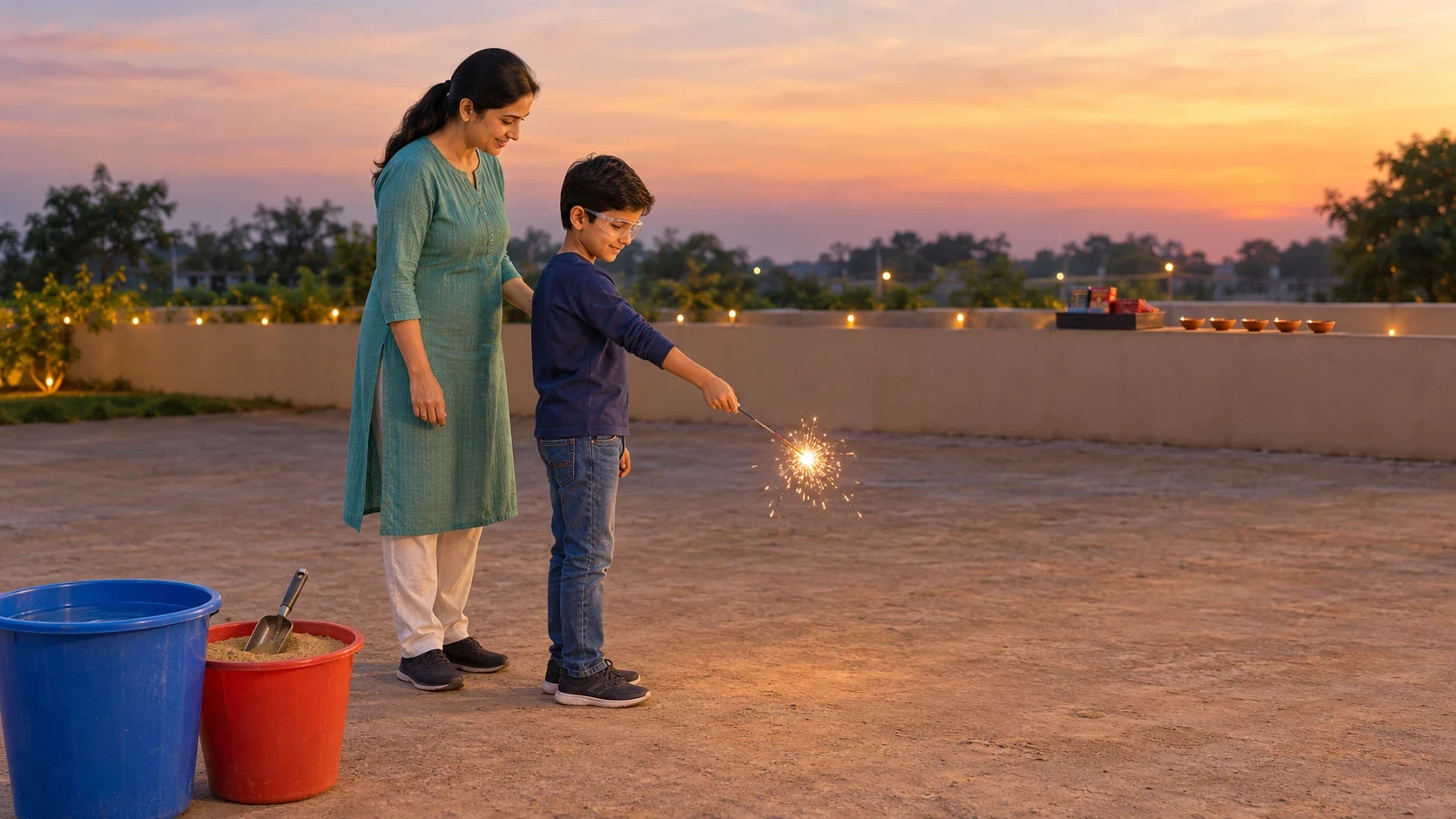
- Buy only what you will burn. Keep it in its original packing, away from the kitchen, the LPG cylinder, lit lamps and anything that charges, and not in the room where you sleep.
- Never make crackers, open one to reuse the powder, or let children do it. Never test or light a cracker near any stock.
- Do not keep crackers in your pocket, and never leave stock in the sun or on a terrace.
- Our Diwali firecracker guide and festival fire safety page cover lighting, buckets of water and sand, and burns.
What landlords and housing societies should do
We did not research landlord liability in law and make no claim about it. What we can say from the cases is that the building matters: in Avadi a weakened structure came down, and in Siwan the front of the house fell into the lane.
- Know what your tenant does in your property. Ask for the licence if the business involves crackers, chemicals or gas, and check that the address on it is the one in use.
- Look at the premises before the festival season, with the tenant present. Heaps of cartons, open powder or work going on in a living space are reasons to say no.
- Put a clause about explosives and bulk stock in the rent agreement, and a society should say the same in its rules.
- Keep the lane and the gate clear so that fire engines can get in. In Fatehpur, Hindustan Times reported that a narrow lane stopped fire tenders from reaching the house, as noted on our Malwan page.
What neighbours should do
- Note the exact address and a landmark, what you saw and for how long. Do not photograph people or approach the premises.
- Report it the same day; a stock that is building up before Diwali will not wait.
- If something goes off: move away at once, keep moving and warn others. In Siwan the blasts went on for about two hours and in Avadi for about 20 minutes, so a second blast is likely. Do not go back for belongings and do not go in to help; firefighters have the equipment.
- Call 112 and give the lane and landmark. Keep the lane clear. Cool a burn under clean running water and cover it loosely with no ointment, then get the person to hospital. See our basic first aid guide.
Where to report
- 112 for any emergency, the national number. 101 is the fire service and 108 an ambulance; how they are answered differs by state, so check the numbers for your district in our state-wise emergency numbers list.
- The local police station or the Superintendent of Police or Commissioner. In Siwan the Superintendent announced raids after the blast, and the police registered the FIR.
- The District Magistrate or Collector’s office. PESO’s guideline document names the District Magistrate as the licensing authority for the smallest manufacturing licence and for shop licences, and the district authority gives the no-objection certificate for others.
- PESO. Its Contact Us page lists circle and sub-circle offices with phone numbers and email addresses, and its Grievance Redressal page lists officers. We did not find a PESO statement on whether a complaint can be made anonymously, so do not assume it can.
- CPGRAMS, the central public grievance portal (pgportal.gov.in), takes complaints about central bodies online, free of charge, and it says grievances sent by email are not entertained. We did not test whether PESO takes illegal-storage reports this way.
- Tell the building’s owner or society as well, but do not wait for them before calling the authorities.
If you hold a licence
Keep only what the licence allows, in the licensed place; whatever it says about quantity is a limit and not a target. Display the licence, renew it before it lapses and, when an individual licensee dies or the shop changes hands, treat the stock as unlicensed until the authority says otherwise. Do not mix, fill, dry, repack or test anything in a store, and never light a sample near stock. Keep buckets of water and sand, an extinguisher and a clear approach road, and make sure workers know to run, not to save stock.
What is still not known
- Siwan: the final toll, whether the missing young woman has been found, the cause, whether the unit held any licence, and any arrest. We found nothing newer than 24 October.
- Vellore: whether the second woman survives, what licence the godown held and what it covered, and whether the owner has been found.
- Whether the Supreme Court has issued a final order for Diwali 2026 after the 15 October date.
- What the 2024 to 2026 amendments to the Explosives Rules change for fireworks. We did not read them.
- How many illegal home units exist. We found no official count and make no claim.
We will update this page when the picture changes. Updated 26 October 2026. Related: the Siwan case study, the Anaikattu godown blast, the Hingoli storage fire, firecracker factory blasts in India, Diwali firecracker safety, festival fire safety and balloon gas cylinders at fairs.
What needs attention
- All seven Indian cases on this page involved stock or work in houses, shops or godowns, not in a large factory complex.
- In Siwan (October) and Avadi further explosions went on for about two hours and about 20 minutes, which kept rescuers away.
- In Agra, residents said stocking had been going on for days before the blast; in the January Siwan case the man had been arrested before for the same activity.
- The Explosives Rules, 2008 allow fireworks to be manufactured only at a licensed factory, and exempt only up to 100 kg of fireworks for own use and not for sale.
- A licence is granted for an approved site and building plan, and PESO's guideline document says an individual licensee's death cancels the licence.
- We found no final investigation report for most of these cases and no official national count of illegal cracker units.
Controls that reduce risk
- Households: buy only from a licensed shop and only what you will burn; no bulk stock at home.
- Landlords and societies: know what the tenant does, check the licence and the premises before Diwali, write a clause on explosives.
- Neighbours: note the address and landmark, do not go in, report the same day.
- If something blasts: move away, call 112, keep the lane clear, cool burns under running water.
- Report to the police, the District Magistrate's office or PESO; use CPGRAMS if you want a tracked complaint.
- Licence-holders: keep to the quantity and place on the licence, display it, renew it, and never test or repack in a store.
Common unsafe practices
- Making or filling crackers inside a house, or letting children help.
- Keeping crackers for sale at home, or in a lane godown that is not licensed for it.
- Mixing, drying or repacking powder in a godown meant only for storage.
- Storing stock beside a kitchen, LPG cylinder, lit lamp or charging point.
- Buying from a house or terrace seller who cannot show a licence.
- Going in to look, or back in for belongings, while blasts are still going on.
- Assuming a family business can carry on after the licensee dies or the licence lapses.

Leave a comment