
Quick answers
What is an assembly point?
It is the agreed safe place outside a building where everyone gathers after an evacuation so that they can be counted. Delhi Fire Service asks people who hear the fire alarm to leave by the nearest exit and report to the person in charge at the assembly point.
Where should an assembly point be?
In the open, away from the building, with room for everyone and clear of the route fire engines and the hydrant. It should be reachable from every exit and lit at night. The distance from the building is our advice, because we found no Indian rule that gives one.
What should I do at the assembly point?
Stay there, be counted by the person in charge, say if you know someone is missing and where they were, keep the lane clear for fire engines and do not go back inside until the fire service says it is safe. Call 101 or 112 if nobody has.
Is an assembly point the same as a refuge area?
No. BIS SP 7:2026 describes a refuge area as an area inside the building, protected from fire and smoke, used temporarily during egress as a staging area. The assembly point is outside the building at the end of the escape route.
Who counts people at an assembly point?
A named warden or person in charge, using a list: the floor warden in an office, the class teacher in a school, a society volunteer in a housing society, or the family member who holds the list at home.
What does the assembly point sign look like?
The ISO 7010 sign E007 is a green square with four white arrows pointing inward from the corners and two white standing figures in the middle. It carries no words.
Do I need an assembly point at home?
There is no rule for a private home that we found, but it takes a minute to choose one: the gate or a wall across the lane. Tell everyone, so that nobody goes back in looking for someone who is already out.
Can I go back inside to get someone or something?
No. Stay at the assembly point and tell the person in charge or the fire crew who is missing and where. That is our advice, and it is the line Delhi Fire Service and our building guides take about leaving and staying out.
Every fire drill ends at the same place, and most people have walked to it without once being told what it is for. The assembly point is the spot you go to after you get out of a building, and it matters more than it looks. It is where someone finds out who is still inside. This page explains what an assembly point is, where it should be, what you do when you get there, and what we could not find in official Indian texts. It is general safety information and not a substitute for the plan of your own building. Checked 10 November 2026.
In short
- An assembly point is the agreed place outside a building where everyone gathers after an evacuation, so that they can be counted. That meaning is our plain-words summary, because we found no formal definition in an Indian government text (see the last section).
- Delhi Fire Service tells people who hear the alarm to leave by the nearest exit, close doors and windows behind them and report to the person in charge at the assembly point. The same page says do not use the lift and do not shout or run.
- It should be in the open, away from the building and out of the way of fire engines. A gate or a doorway is the wrong place.
- Once you are there, stay there. Be counted, tell the person in charge if you know someone is missing, and do not go back in.
- Know yours before the day. In a home it is the gate or the park across the lane. In an office, school or hotel, ask where it is and walk to it once.
What an assembly point means
It is a simple idea. When an alarm goes off, everyone leaves the building and walks to one fixed, safe place outside. A person in charge counts heads or checks a list. That is how the fire crew, when it arrives, can be told that all 40 are out, or that two are missing and were last seen on the third floor. Without it, people drift into the lane, some go home, and nobody knows whether the room upstairs is empty.
You will see other names for the same thing: emergency assembly area, muster point, safe point and evacuation point. The Delhi Fire Service page uses “assembly point”. The NDMA guide on managing crowds at events says “emergency assembly area”. They mean the same thing.
An assembly point is not the same as a refuge area. BIS SP 7:2026 (clause 2.57) describes a refuge area as an area within the building for temporary use during egress, generally a staging area protected from fire and smoke, and a note says such spaces give staging to people who cannot get out of the building themselves. The assembly point is outside, at the end of the escape route. If you want to know how the exits themselves should work, see our guide on factory fire exits and who must do what.
What Indian official pages say
Delhi Fire Service. Its public do and do not page, which showed a last-updated date printed as 07/11/2026 when we opened it, lists what to do if you hear the fire alarm: leave by the nearest available exit, close all doors and windows behind you, and report to the person in charge at the assembly point. It also asks people not to use the lift as a means of escape, not to shout or run because that tends to cause panic, to give way to fire engines, and not to park cars or trucks close to fire hydrants or underground water tanks. It says 101 is the number for the fire brigade. The same page adds that a fire service no objection certificate is not a guarantee against a fire. Our page on the Fire NOC and why a certificate is not enough explains that point.
NDMA guide on crowds. The National Disaster Management Authority’s 2014 guide, Managing Crowd at Events and Venues of Mass Gathering, lists among its emergency planning steps that the emergency assembly area should be clearly identified, and suggests including it in venue maps. Its template for an event plan says the site plan must include maps showing, among other things, emergency exits and emergency assembly points. In its list of fire and electricity causes of crowd disasters it names lack of adequate flood lighting of the assembly area and the pathways the crowd uses. We read the copy hosted by the Goa State Disaster Management Authority. The guide is written for organisers, but a visitor can use the same test: before you settle in, ask where the emergency assembly area is.
BIS building standard. Part F (Fire and Life Safety) of the National Building Construction Standards, SP 7:2026, which replaced the old National Building Code, says in clause 4.11 that fire notices should be prepared for firefighting and evacuation, that occupants should be made thoroughly conversant with their action in an emergency by notices at vantage points and regular training, and that state or local authorities may decide the kind and frequency of fire drills. We read a copy hosted by the Goa Directorate of Fire and Emergency Services.
A foreign comparison. The US Occupational Safety and Health Administration’s appendix on emergency action plans says outdoor safe areas may include parking lots, open fields or streets away from the emergency with enough room for everyone, and that people should move away from the exit doors and avoid crowding close to the building, where they could hamper emergency operations. It also says wardens should be able to account for or verify that all employees are in the safe areas. This is American guidance, so we use it only to explain the idea.
Where an assembly point should be
Putting the Indian pages and common sense together, and marking which part is our own advice:
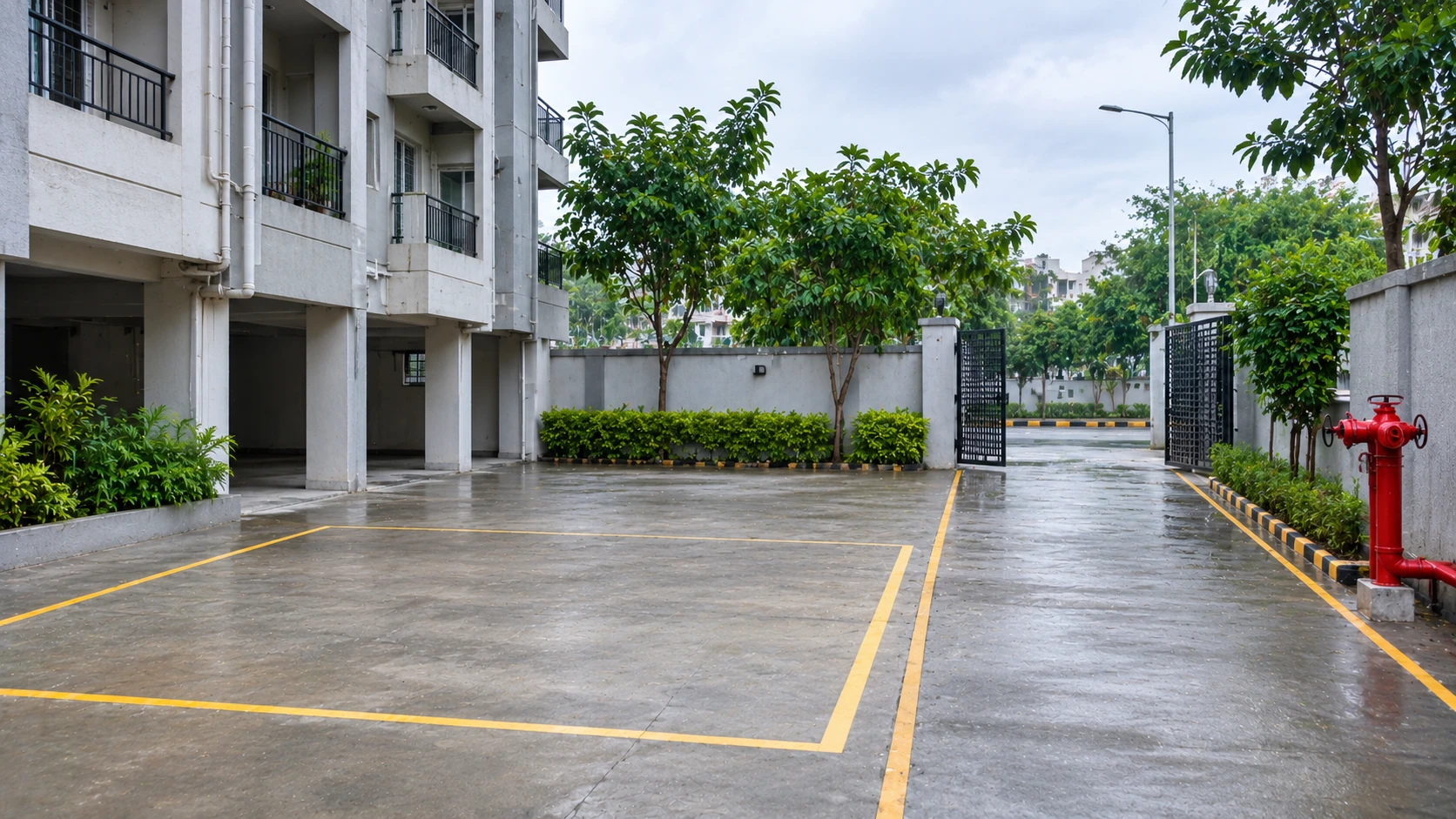
- Outside, in the open, with enough room for everyone who uses the building. A car park, a playground, a garden or a wide stretch of road that traffic is kept off.
- Far enough from the building to be safe from heat, smoke and falling glass. We would say a lane’s width at the very least, and more for a tall building. This distance is our advice, not a figure from the pages above.
- Not on the route fire engines will use, and not near the hydrant. Delhi Fire Service asks people to keep fire hydrants clear, and a crowd at the gate stops engines getting in.
- Reachable by every exit, so that people leaving by the back stair do not have to walk round the burning side.
- Lit at night, since the NDMA guide names poor lighting of the assembly area as a problem.
- Marked. A sign, or a note on the evacuation plan, so nobody has to guess. A second point on the other side of the building is a good idea in case the first is blocked.
What to do when you reach it
- Stop and stay. Do not carry on down the road or go back for a bag. The Delhi Fire Service sheet asks you to report to the person in charge.
- Be counted. In an office or school, the warden for your floor or class takes a head count from a list. In a society or a house, it is whoever has the family list. Tell them who you are.
- Say who is missing. If you know someone was on another floor, in the toilet or helping an older person, tell the person in charge at once, with the floor and room. They pass it to the fire crew when it arrives.
- Keep the lane clear. Move to the side when the fire engine comes. Do not stand in the gate or film from the road.
- Call 101 or 112 if nobody has. 112 is the single emergency number, and our guide on the fire brigade number has a sample of what to say.
- Do not go back inside until the fire service says it is safe. This is our advice, and it is the same line our guides on factory exits and hotel and PG fires take.
People who need help getting there
An assembly point is only useful if everyone can reach it. BIS SP 7:2026 defines “assisted evacuation” as a strategy in which a designated person or persons help another person leave a building and reach a final place of safety. In practice that means naming, in advance, who helps the person who uses a wheelchair, the older neighbour on the fourth floor, the pregnant colleague and the young child. If you run a workplace, school or society, write the names on the plan. If you are the person who needs help, tell the warden before the day.
At home, in a society, office, school and hotel
- Your own home or flat. Choose one meeting place outside, such as the gate or a neighbour’s wall across the lane, and tell everyone. If you live above a shop, see our guide on living above a shop.
- Housing society. Mark the assembly point on the notice board, keep it clear of parked cars, and run a drill once a year. Our emergency evacuation plan guide has the steps, and the free fire drill kit in our fire drill kit tool includes an assembly point sheet and an attendance sheet you can print.
- Office or factory. Keep a live list of everyone inside, including contract and night-shift staff, and check it at the assembly point in every drill. Our factory exits guide has separate checklists for workers, supervisors and owners.
- Hotel, hostel or PG. Ask at check-in where the assembly point is. Our hotel, hostel and PG fire guide shows how to count the doors to both stairs on arrival.
- Event or venue. Look for the emergency assembly area on the venue map or ask the organiser, as the NDMA guide suggests it be shown. Our guides on pandals and melas and New Year’s Eve parties cover exits and crowds.
The sign
The international sign for an assembly point is ISO 7010 E007. Wikimedia Commons hosts a public-domain copy and labels it as an emergency assembly point. We looked at the picture: a green square with four white arrows in the corners pointing inward and two white standing figures in the middle, and no words. If you make a sign for your building, copy that design and do not add sentences to it; any instruction belongs on the evacuation plan next to it, not on the sign. We did not find an Indian standard number for the sign in the pages we read, so we do not quote one.
Common mistakes
- Nobody knows where it is. The family or staff scatter on the road.
- It is the front gate, which blocks the fire engine.
- There is no list, so nobody can say who is out.
- People go back in for a phone, a bag or a pet.
- It was chosen once, never walked, and a parked tempo or a locked compound gate blocks it on the day.
- The drill is a formality. Our page on fire drills and how prepared we are looks at how rarely a proper drill is held.
What we could not confirm
We searched the text of BIS SP 7:2026 Part F and did not find a definition of “assembly point” or a rule that says how far it must be from a building, so every distance on this page is advice and not law. We did not find a central Indian rule that requires an assembly point sign in every building. State fire rules and the National Building Code may carry such duties for certain buildings, and we could not check each state’s rules, so ask your local fire office. The NDMA text we read is the 2014 guide through a state copy, and a later edition may exist. The video listed below is from a private fire training academy, not a government source, and we did not watch it in full. Its spoken language was not reviewed.
What needs attention
- Delhi Fire Service tells people who hear the alarm to report to the person in charge at the assembly point.
- The NDMA crowd guide asks organisers to identify the emergency assembly area and suggests including it in venue maps.
- BIS SP 7:2026 Part F clause 4.11 asks for fire notices, regular training and drills but, as far as our search found, does not define an assembly point.
- We found no Indian rule on how far an assembly point must be from a building, so any distance is advice.
- The ISO 7010 E007 sign has no words; instructions belong on the plan beside it.
Controls that reduce risk
- Choose and mark an assembly point for your home, society, office or school.
- Write a head-count list and name who helps people who need assistance.
- Walk the route once and run a drill each year.
- On the day, stay at the point, be counted and tell the person in charge who is missing.
- Call 101 or 112 if nobody has.
Common unsafe practices
- Not knowing where it is.
- Choosing the front gate, which blocks the fire engine.
- Having no list, so nobody can say who is out.
- Going back in for a bag, a phone or a pet.
- Never walking the route, so a parked vehicle or a locked gate blocks it on the day.
- Putting sentences on the sign instead of on the plan.







Leave a comment