How To SurviveLife-Safety Intelligence for India
Language
Automatic translation
Case Study · Building & Structural

Muradnagar Crematorium Shelter Collapse: 23 Confirmed Dead, Later Reports Higher

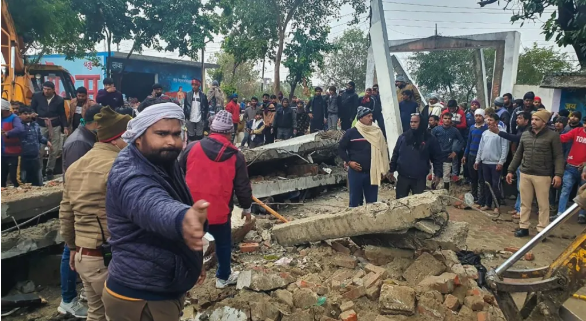
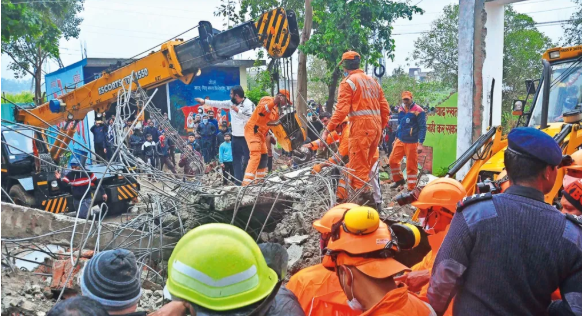
A recently built reinforced-concrete shelter roof collapsed during rain while mourners attended a cremation. NHRC confirmed at least 23 deaths and more than 30 injuries; later local reports cited 24–25, so the record preserves the official minimum and labels later counts.

Date3 January 2021LocationUkhlarsi cremation ground, Muradnagar, Ghaziabad district, Uttar Pradesh, India
01
Case Study

What happened here
NHRC-confirmed deathsAt least 23
Later reports24–25; requires final district record
InjuredMore than 30 in NHRC release
People reportedly attendingAbout 60
Structure ageReported completed roughly two months earlier
WeatherRain at time of collapse
Initial inspectionSubstandard material/design issues reported

A recently built reinforced-concrete shelter roof collapsed during rain while mourners attended a cremation. NHRC confirmed at least 23 deaths and more than 30 injuries; later local reports cited 24–25, so the record preserves the official minimum and labels later counts.

  1. Municipal rain shelter is completed
  2. Mourners gather during rain for a cremation
  3. Roof slab and supporting elements fall onto crowd
  4. Residents, workers, police and NDRF remove survivors
  5. NHRC issues notices seeking statewide review and maintenance
  6. FIR, arrests, technical inspection and compensation action are reported

Why consequences escalated

  • New construction is not safe until materials, design and workmanship are verified
  • Concrete curing and reinforcement placement require recorded quality control
  • Flat shelter roofs must be designed for drainage, ponding and actual support conditions
  • Public authorities need independent completion certification
  • Emergency access and lifting plans matter for heavy-collapse rescue
  • Conflicting casualty totals should remain dated and source-labelled

Failures and risk multipliers

  • Opening or occupying premises without verified approval
  • Allowing one exit or one protective barrier to determine survival
  • Ignoring inspection, maintenance or prior-warning evidence
  • Failing to control hot work, electrical load, occupancy or water entry
  • Presenting allegations or early casualty counts as final facts

People closest to the evidence

““Safety principle””

Public occupancy begins only after the complete life-safety system is verified and remains maintained.

Actions that reduce risk

  1. Verify approvals and occupancy limits
  2. Maintain two independent escape routes
  3. Inspect electrical, structural, drainage and fire systems
  4. Control hot work and combustible/fuel storage
  5. Practise assisted evacuation and accountability
  6. Track every defect to documented closure
02
Watch & learn

Video reports & learning

Captions
Incident news / follow-up

25 Dead As Roof Collapses At Crematorium In UP

NDTV · Language not verified

Newsroom coverage of this case. Early numbers and allegations reflect the original report, not a final finding. Source listing checked 14 September 2026; full playback and site embedding not confirmed.

03
Incident data

The broader evidence

Survival sequence

  1. Raise the alarm and call emergency services
  2. Leave immediately through the nearest safe route
  3. Do not enter smoke, fast water or unstable structures
  4. Assist dependent occupants only within training and without blocking escape
  5. Move to the assembly point and report missing people
  6. Never re-enter until authorised
Minimum confirmed deaths23NHRC
Injured30+NHRC
People reportedly attending60NHRC
Approximate months since construction2Indian Express
Main technical concern families3Material, design, workmanship
Minimum confirmed deaths23NHRC
Injured30+NHRC
People reportedly attending60NHRC
Approximate months since construction2Indian Express
Main technical concern families3Material, design, workmanship

Limitations

  • Commercial news photographs and video stills are copyrighted and are linked, not copied. Only clearly reusable media may be packaged. Court allegations are not convictions. Conflicting casualty/rescue totals remain explicitly labelled until a final official record is obtained.
Location mapMuradnagar area context — approximate area only; exact incident site not markedMap data © OpenStreetMap contributorsOpen map in a new tab ↗

Immediate actions

  • Check approvals and occupancy
  • Find two exits
  • Inspect alarms and emergency lighting
  • Remove combustible and access obstructions
  • Confirm emergency numbers and exact address
  • Practise evacuation
Community discussion

Questions, experience and constructive safety discussion

Comments publish immediately unless security controls identify spam. Please do not post private information, unsupported allegations or unsafe instructions.

Leave a comment

* Name and email are required. Your email address will not be published.


The reCAPTCHA verification period has expired. Please reload the page.