
Quick answers
Should I tie a rope or cloth above a snakebite?
No. India's national guidelines say do not tie a tourniquet or any tight band. It does not stop the venom, can cause gangrene and loss of the limb, and gives false confidence that delays the trip to hospital.
Is a pressure bandage recommended for snakebite in India?
Not for the public. The MoHFW guidelines allow a crepe bandage only when applied by qualified medical personnel, in limited situations, and say that if no trained person is present you should not try it. Use a loose splint instead.
What if the person feels fine after the bite?
Still go to hospital at once. Many bites are dry or by harmless snakes, but some venomous bites, especially krait bites, show few signs at first. The national guidelines say every suspected snakebite should be watched in hospital for 24 hours.
Should we take the snake to hospital?
No. Do not try to kill or catch it, because that wastes time and risks another bite. A photo taken safely from a distance is enough. Doctors treat according to symptoms, not the snake.
Which snakes cause most serious bites in India?
The spectacled cobra, common krait, Russell's viper and saw-scaled viper, often called the big four. NAPSE says they cause around 90% of bites needing treatment, and Indian anti-snake venom is made against them.
Can herbal medicine or a faith healer cure a snakebite?
No. The MoHFW guidelines say traditional remedies have no proven benefit and do more harm than good by delaying treatment. Anti-snake venom given in hospital is the only specific treatment.
How can I prevent snakebite at night?
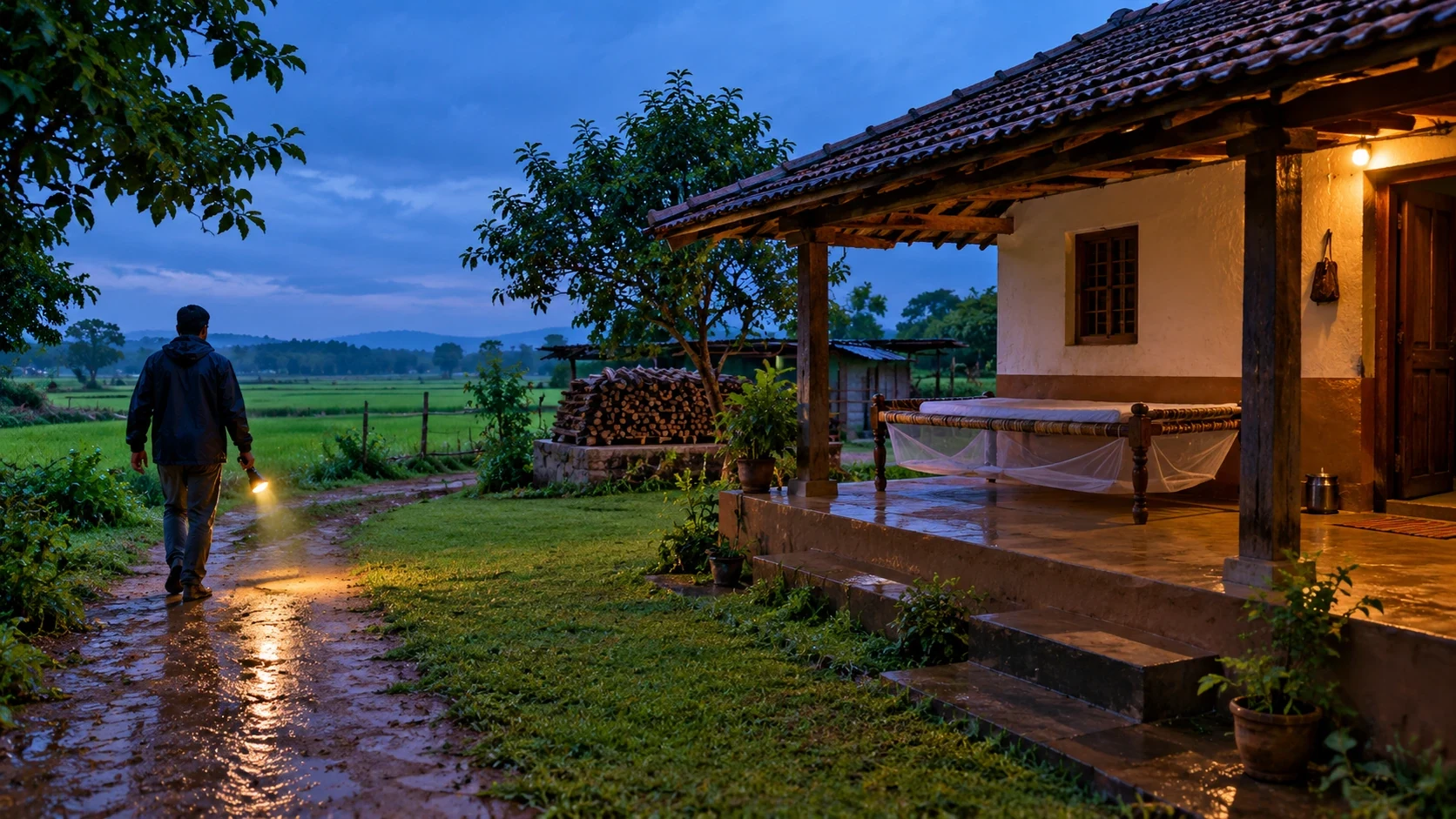
Carry a torch whenever you step out, wear closed footwear, sleep on a cot rather than the floor with a mosquito net tucked well in, and keep the area around the house free of rubbish, firewood heaps and rat holes.
It usually happens on an ordinary day. A farmer steps into the paddy field at dusk, a child runs to the outdoor toilet without a torch, or someone sleeping on the floor during the monsoon feels a sharp prick in the night. In the panic that follows, people do what they have seen in films or heard from elders: tie a rope tight above the bite, cut the wound, suck it, or rush to the local ojha. Each of these wastes the time that matters most. What actually saves lives is simple: keep the person still and get them to a hospital that has anti-snake venom (ASV), fast.
India carries the heaviest snakebite burden in the world, though nobody knows the exact count. Police records compiled by the National Crime Records Bureau (NCRB) show 9,803 snakebite deaths in 2024 and 10,118 in 2023. Research estimates are far higher. The national Million Death Study, which the World Health Organization (WHO) and the Health Ministry’s national action plan both cite, put the toll at about 58,000 deaths a year on average between 2000 and 2019, close to half of all snakebite deaths worldwide. A large ICMR-funded survey published in November 2025 found a much lower death rate in the 25 districts it covered, but it also found that nearly half of the deaths it recorded happened outside hospital, at home or on the way. Whichever figure is closer to the truth, most of these deaths can be prevented.
First aid: what to do in the first few minutes
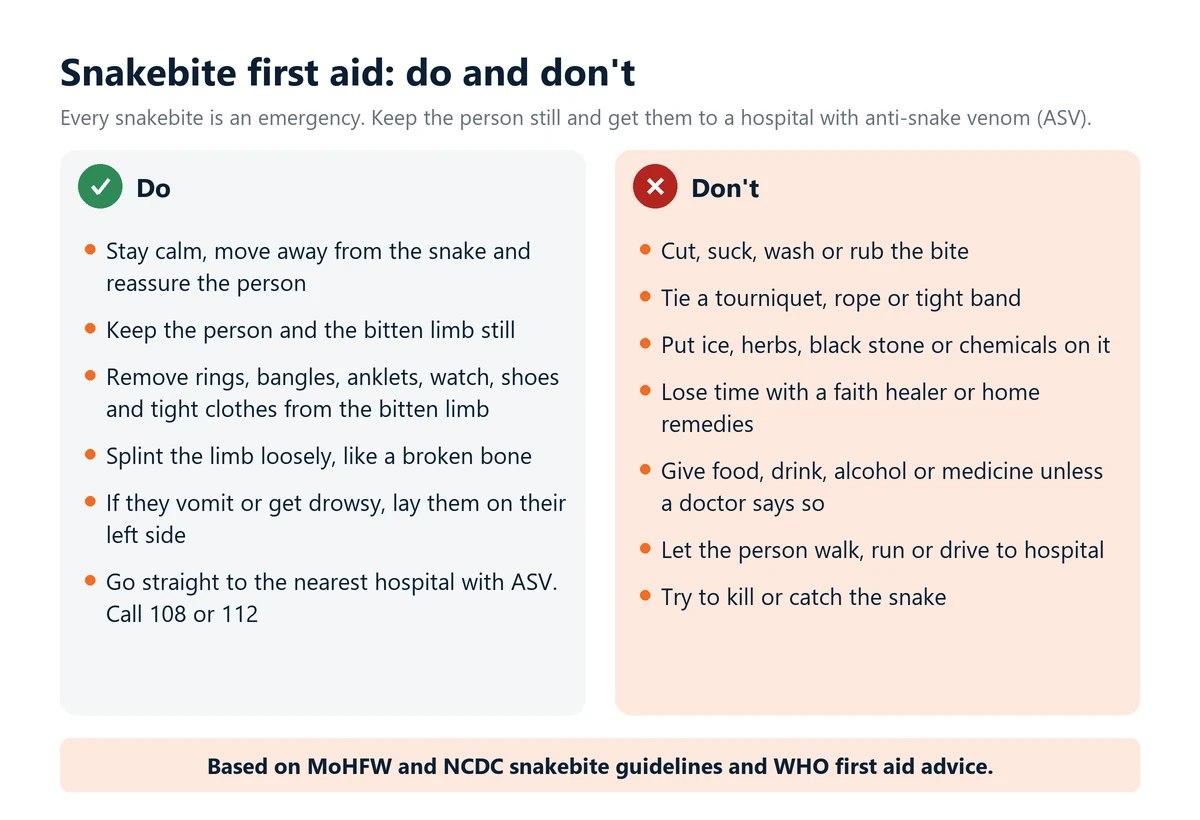
These steps are taken from the Ministry of Health and Family Welfare (MoHFW) Standard Treatment Guidelines for snakebite and the National Centre for Disease Control (NCDC) do’s and don’ts. WHO gives the same core advice.
- Move away from the snake and keep everyone else away. Do not try to chase, kill or catch it.
- Stay calm and reassure the person. Around 70% of snakebites in India are from non-venomous snakes, and even after a venomous bite, death is not immediate. Panic and running about make things worse.
- Keep the person still, and above all keep the bitten arm or leg still. Do not let them walk, run or drive to hospital.
- Remove rings, bangles, anklets, watches, shoes and tight clothing from the bitten limb straight away. The limb may swell, and anything tight can then cut off the blood supply like a tourniquet.
- Splint the limb the way you would for a broken bone, so that the joints cannot bend. A plank, a stick, a folded newspaper or a piece of cardboard will do. Tie it on loosely with cloth; it must not press on the limb or block the blood flow. Do not raise the bitten limb up high.
- Lay them on their left side in the recovery position if they vomit, feel drowsy or are being carried, with the mouth turned down so the airway stays clear. WHO notes that many people die on the way to hospital because they were carried flat on their backs.
- Leave the bite alone. Do not wash, rub or squeeze it, and leave any blisters as they are.
- Nothing by mouth. No food, water, tea, alcohol or medicine unless a doctor tells you to give it.
Get to hospital, and do not wait for symptoms
- Call 108 for an ambulance, or 112 for any emergency. If an ambulance will take long, use whatever transport is fastest and safest: a car, an auto, a boat or a stretcher.
- On a motorbike, which is often the only option in a village, the person must not ride. Seat them between the rider and a third person who sits behind and holds them.
- Go to the nearest health facility, PHC, CHC or hospital, preferably one that keeps ASV. Do not stop at a faith healer or a quack on the way. The national guidelines say every suspected snakebite should be admitted and watched for 24 hours, even if the person looks fine.
- Watch for danger signs on the way and tell the doctor about them: swelling spreading up the limb, drooping eyelids, double vision, difficulty swallowing, speaking or breathing, bleeding from the gums or nose, stomach pain, vomiting or weakness in the limbs.
- If the person stops breathing, start CPR if you have learnt it and keep going until help takes over. Our basic first aid guide explains CPR, shock and the recovery position.
- Tell the doctor the time of the bite, where it happened, what the person was doing and anything already done to them, including any band or herbal paste.
What not to do
Traditional first aid for snakebite is still common in India. The ICMR-funded survey found that 61.7% of the victims it tracked were given a tourniquet or a pressure bandage before reaching care. The national guidelines and NAPSE are clear that these practices do more harm than good:
- Do not tie a tourniquet, rope, string, belt or tight cloth above the bite. It does not stop the venom, it can cause gangrene and loss of the limb, and it gives a false sense of safety that delays the trip to hospital.
- Do not cut the wound or suck out the venom, by mouth or with any device. Cutting causes bleeding and infection, and suction removes no useful amount of venom.
- Do not put ice or cold packs on the bite, and do not use electric shock, heat or burning on it.
- Do not apply herbs, black stones, chemicals or any paste, and do not let anyone inject or apply ASV on the wound itself.
- Do not go to a faith healer or try home remedies first. No traditional remedy has been shown to work, and the delay can be fatal.
- Do not try to kill or catch the snake. It wastes time and can lead to a second bite. If you can take a photo from a safe distance without delay, fine. If the snake is already dead, do not touch it with bare hands, because even a dead snake’s head can still bite.
What about a pressure bandage?
You may have seen videos from Australia showing a tight crepe bandage wrapped up the whole limb. India’s Standard Treatment Guidelines do not ask the public to do this. They say a crepe bandage may be applied only by qualified medical personnel, and only when the hospital is between 30 minutes and three hours away, and that if no trained person is present, you should not try it. NAPSE adds that the benefit of pressure bandages is uncertain and that they may worsen local tissue damage from bites that cause swelling, such as viper bites. WHO, too, recommends the Australian method only for bites by snakes whose venom does not cause local swelling. For a family member or bystander in India, the safe rule is a loose splint, no tight bandage of any kind, and a fast trip to hospital.
The four snakes behind most serious bites
India has more than 300 kinds of snakes, and most of them are harmless. NAPSE says around 90% of snakebites that need treatment in India are caused by four species, often called the “big four”. The anti-snake venom made in India, called polyvalent ASV, is produced against these four:
- Spectacled cobra (Indian cobra): raises and spreads a hood when it feels threatened. It is yellowish-brown in the south and coastal areas and darker, almost black, in central and northern India.
- Common krait: a shiny bluish-black snake with thin, paired white bands across the body. It is active at night.
- Russell’s viper: a thick, heavy snake, brown, reddish or greyish, with three rows of dark, rounded or almond-shaped patches down its back.
- Saw-scaled viper: small, usually less than half a metre long, brown with pale blotches along the body and a mark like a plus sign on top of its head.
Do not waste time trying to work out which snake it was. The national guidelines say the bite marks do not show whether a snake was venomous, and doctors decide treatment from the person’s symptoms and tests. Other venomous snakes also matter in some regions, such as the hump-nosed pit viper in the Western Ghats, and NAPSE lists 23 medically important species in all.
A bite you may not notice: the krait at night
Kraits move about at night and often bite people who are asleep on the floor. A krait bite may leave no visible mark. According to the NCDC protocol for health centres, it often causes no swelling or pain at the bite but can bring on stomach pain and vomiting, followed by drooping eyelids and weakness. If someone who slept on the floor wakes with stomach pain, vomiting, drooping eyelids or difficulty swallowing, especially during the monsoon, take them to hospital at once and tell the doctor that a snakebite is possible.
How to prevent snakebite at home and in the fields
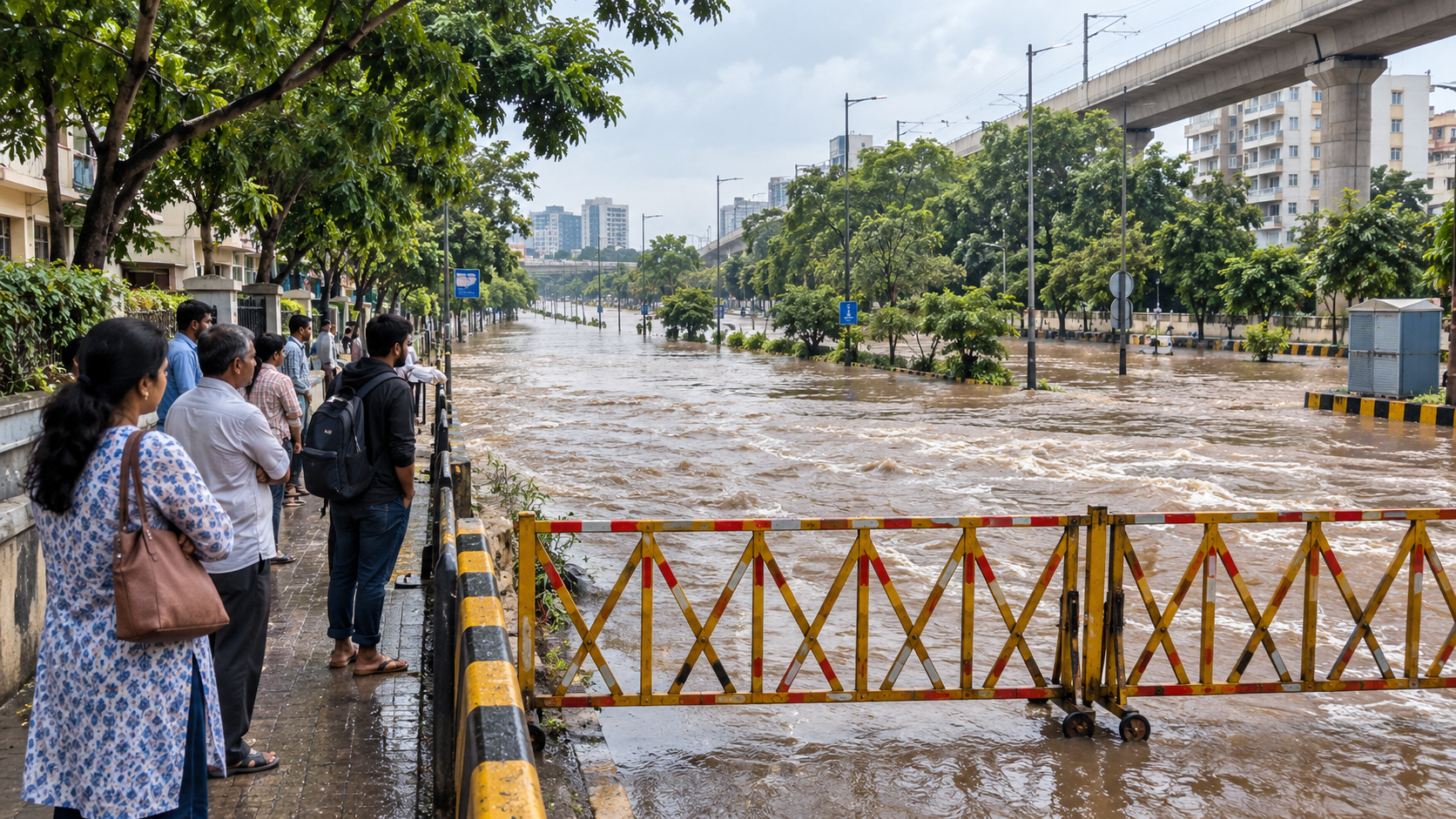
Most snakebites in India happen during the monsoon and after floods, when snakes are forced out of their hiding places, and during ploughing, sowing and harvesting. The ICMR-funded survey recorded 62.1% of bites in the monsoon. The MoHFW guidelines list simple habits that cut the risk:
- Carry a torch at night. Light your path when you walk outside after dark, including to an outdoor toilet. Do not walk where you cannot see the ground.
- Wear footwear and long trousers. Closed shoes or boots protect the feet and ankles in fields and tall grass. Check your shoes before you put them on.
- Sleep off the floor. Use a cot, and a mosquito net tucked well under the mattress. If you must sleep on the ground, tuck the net in under the mat all round.
- Use a stick, not your hands. When cutting grass, collecting firewood or picking up piled leaves, stir the pile with a stick first and give any snake a chance to move away. Never put a hand into a hole or a gap you cannot see into.
- Clear around the house. Remove heaps of rubbish, building material and firewood from near the walls, keep the grass short, clear low bushes, trim branches touching the house and keep plants away from doors and windows.
- Control rats. Seal rat holes, store grain in rat-proof containers and keep animal feed and rubbish away from the house. Snakes come where rats are. Do not keep chickens inside the house.
- Check before you touch. Look carefully at stacks of firewood and cow-dung cakes and inside a mud chulha before handling or cleaning them.
- Leave snakes alone. If you see one, keep your distance, do not corner it and let it go. No chemical or onion has been shown to keep snakes away.
Take extra care when you return home after a flood or clean up debris after a cyclone, because snakes often shelter inside houses, cupboards and rubble; our cyclone safety guide covers the clean-up. If you go trekking or camping, stay on marked paths and step on to logs and rocks rather than straight over them.
What the government is doing
WHO has set a goal of halving snakebite deaths and disabilities by 2030. In 2024 the Health Ministry released the National Action Plan for Prevention and Control of Snakebite Envenoming (NAPSE) with the same target for India. It aims to make ASV available at health facilities, train doctors and health workers, improve ambulance and referral services, set up regional venom centres and map which facilities stock ASV. Health workers now report snakebite cases and deaths through the national disease surveillance portal, and NAPSE notes that efforts are under way to make snakebite a notifiable condition across states.
Do this before the next monsoon
- Find out which nearby government hospital, CHC or PHC keeps anti-snake venom, and save 108 and 112 in every phone at home.
- Keep a working torch by the door and by the bed, and use it every time you step out at night.
- Move children and elderly family members off the floor and onto a cot with a tucked-in mosquito net.
- Clear rubbish, firewood and long grass from around the house and seal rat holes.
- Teach everyone at home the three rules: keep still, no tight band or cutting, straight to hospital.
What needs attention
- Most deaths come from delay: time lost at faith healers, on harmful first aid or waiting for symptoms before going to hospital.
- An ICMR-funded survey found that nearly half of snakebite deaths happened outside hospital, at home or on the way.
- 61.7% of victims in that survey were given a tourniquet or pressure bandage before care, though national guidelines advise against both for the public.
- Kraits bite at night, often people sleeping on the floor, and may leave no visible mark.
- Most bites happen in the monsoon and during farm work, so simple habits like a torch, footwear and a cot prevent many of them.
Controls that reduce risk
- Move away from the snake and keep the person calm and still.
- Remove rings, bangles, watches, shoes and tight clothing from the bitten limb.
- Splint the limb loosely like a broken bone, with no pressure on it.
- Lay the person on the left side if they vomit or feel drowsy.
- Get to the nearest hospital with ASV at once and call 108 or 112.
- Tell the doctor the time of the bite and any new symptoms on the way.
Common unsafe practices
- Tying a rope, string or cloth tightly above the bite.
- Cutting the wound or sucking out the venom.
- Putting ice, herbs, black stones or chemicals on the bite.
- Going to a faith healer or trying home remedies before hospital.
- Letting the person walk, run or drive to get help.
- Waiting for symptoms before going to hospital.
- Chasing, killing or catching the snake.

Leave a comment