
What happened here

Severe Cyclonic Storm Murasu crossed the south Andhra Pradesh coast close to Ongole in the early hours of Tuesday, 3 November 2026, with winds of 100 to 110 km/h gusting to 120, according to IMD. The Hindu reports landfall began at 1 am near Kothapatnam in Prakasam district. Thousands of people were moved to safer places in Andhra Pradesh (about 30,000 planned), and more than 1.60 lakh in Odisha as a precaution. PTI reports thousands of trees uprooted, hundreds of electric poles damaged, fishing boats wrecked and crops damaged in Bapatla and Prakasam. Thatched houses collapsed and residents were stranded in Ongole. At least 19 flights were cancelled. The state disaster authority said no deaths or injuries had been reported so far (Reuters, 9.30 am). Reports differ on whether poles fell. This is a running record, with the toll, surge height and crop loss still to come.
Quick answers
Where and when did Cyclone Murasu make landfall?
Landfall began at about 1 am on 3 November 2026 near Kothapatnam in Prakasam district, about 20 km from Ongole, according to The Hindu. IMD put the crossing between Nellore and Narasapur, close to Ongole, between 3.30 and 5.30 am.
How strong was Cyclone Murasu?
IMD said winds of 100 to 110 km/h gusting to 120 km/h at landfall. The Hindu quotes an observed 110 to 120 km/h at the landfall point.
Were there deaths in Cyclone Murasu?
No deaths or injuries were reported in the sources we opened by the morning of 3 November 2026, and a recheck around midday found none either. That is not a confirmed zero, and we will update this page.
How many people were evacuated?
Andhra Pradesh moved thousands, with no state total reported; Prakasam set up 70 relief centres. Odisha moved more than 1.60 lakh people as a precaution.
What damage did Murasu cause?
PTI reports thousands of trees uprooted, hundreds of electric poles damaged, boats wrecked and crops damaged in Bapatla and Prakasam. Thatched houses collapsed in Ongole. Reports differ on whether poles fell.
What should I do after a cyclone?
Stay indoors until it is declared safe, treat fallen wires as live, avoid floodwater, and do not go to the beach. Call 112 or use the Mana Mitra WhatsApp service on 9552300009 to report problems.
How is Murasu linked to Cyclone Arnab?
Murasu came less than a week after Arnab crossed the Andhra coast on 28 October 2026. They are separate storms, and the ground was already wet.
What happened
Severe Cyclonic Storm Murasu crossed the south Andhra Pradesh coast close to Ongole in the early hours of Tuesday, 3 November 2026. The Hindu reports that landfall began at 1 am near Kothapatnam in Prakasam district, about 20 km from Ongole. The India Meteorological Department (IMD) said the storm crossed between Nellore and Narasapur, close to Ongole, between 3.30 am and 5.30 am, with winds of 100 to 110 km/h gusting to 120 km/h (Oneindia, Rediff-PTI). The Hindu’s live blog says the observed sustained wind at the landfall point was 110 to 120 km/h. At 5.30 am the storm was still crossing, moving at only about 9 km/h and centred about 20 km from Ongole, and the landfall was expected to take about two more hours (The Hindu). Checked on the morning of 3 November 2026 and again around midday; the newest report we could open was updated at 11.58 am, and none of them reports a death or an injury. This is a running record and the figures will move.
It came less than a week after our Cyclone Arnab case study, which crossed the coast near Narsapur on 28 October, and the Gidipabali landslide in Odisha that followed Arnab’s rain.
What the reports say about the damage
- Deaths and injuries: the managing director of the Andhra Pradesh State Disaster Management Authority, Prakhar Jain, said no deaths or injuries had been reported so far, though some trees and electric poles were uprooted (Reuters, 9.30 am); none were reported in any other report we opened. That is a statement about the situation so far, not a confirmed zero. Early cyclone reports are often updated later, so we will recheck.
- Trees and boats: thousands of trees uprooted, hundreds of electric poles damaged, fishing boats wrecked and standing crops damaged in Bapatla and Prakasam districts, many places under sheets of water (PTI, as carried by The Hindu and Rediff). A fisherman from Kothapatnam said around 400 families were moved out of his village, with NDRF help, and that this was the most dangerous cyclone he had seen in 14 years.
- Ongole: several thatched houses collapsed and residents were stranded at Samatha Nagar, and the district administration began evacuating them (The Hindu live blog). A tree fell on the statue of Andhra Kesari Tanguturi Prakasam Panthulu at the Collectorate in Ongole and the statue collapsed. Houses were flooded in Beeramgunta village, Kothapatnam mandal.
- Rain: The Hindu’s live blog said many stations in central and south coastal Andhra Pradesh received around 200 mm within six hours overnight. The measured totals cover a longer period. From 8.30 am on 2 November to 6 am on 3 November, the state disaster authority’s data (published by The Hans India) puts the highest at 198 mm at Naguluppalapadu and 182 mm at Kothapatnam, both in Prakasam, followed by 124 mm at Chirala and 117 mm at Trovagunta; IMD’s figures to 7 am (ETV Bharat, Newsmeter) give 198 mm and 182.3 mm for the same two places. These are totals for about 21 hours, not six. Vijayawada saw waterlogged roads (The Hindu).
- Flights and schools: at least 19 domestic flights were cancelled on Monday, 2 November, at Vijayawada, Tirupati and Visakhapatnam (Oneindia, The Week). Eluru and Cuddalore declared school holidays, and the NTR Collector asked shops to stay shut and people to stay indoors (The Hindu).
Where the reports disagree
- Power poles: Energy department officials told the Chief Minister at 3.30 am that no poles had fallen and no supply was cut anywhere (The Hindu, The Indian Express). The same Hindu live blog and PTI later report hundreds of electric poles damaged. These have not been reconciled; the first was an early-hours status, the second is a later damage report, and we do not know which areas each covers.
- Pole damage forecast: before landfall the Chief Minister’s office said 6,000 to 8,000 electricity poles could be damaged (ETV Bharat live blog). That was a forecast, not a count; no actual number of fallen poles has been published in the reports we opened.
- Wind speed: IMD’s forecast and landfall figure is 100 to 110 km/h with gusts to 120; The Hindu quotes an observed 110 to 120 km/h at the landfall point; The Indian Express says winds touched 150 km/h, which no other report we opened supports.
- Landfall time: The Hindu puts the start at 1 am near Kothapatnam, while IMD’s crossing window as quoted by PTI is 3.30 to 5.30 am. They describe the start and the crossing of the storm centre, which are different things, and the exact moment of landfall is not fixed.
How people were moved out before the storm
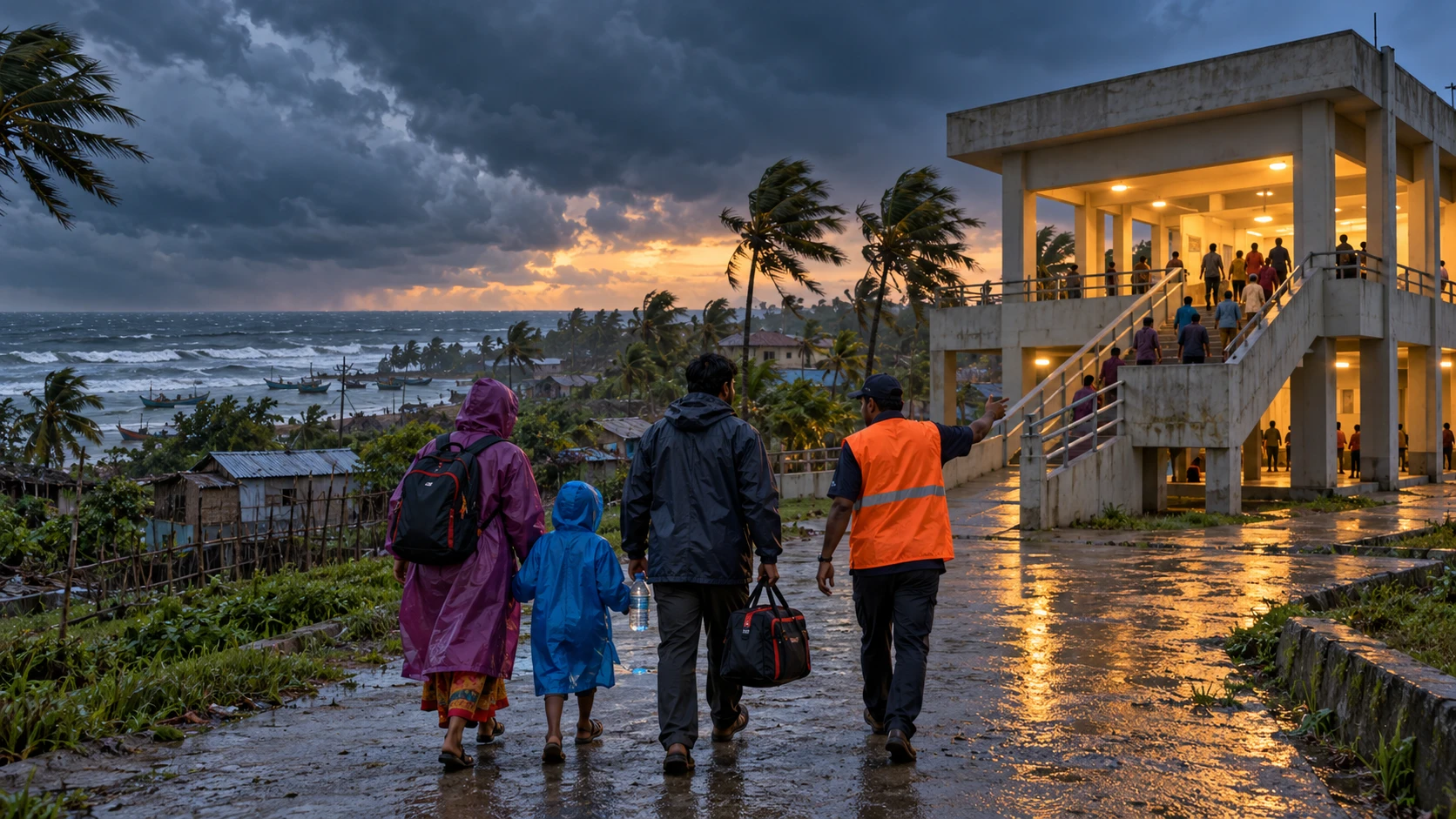
Andhra Pradesh moved “thousands” of people to safer places and planned to move about 30,000 before landfall (Reuters); no outlet we opened gives a final state total or a count of relief camps (Oneindia). In Prakasam, the Collector said 26 villages and 72 habitations in coastal mandals were identified as highly vulnerable and 70 cyclone relief centres set up; pregnant women, lactating mothers, older people and children were shifted first; 1,000 electric poles, repair workers and generators were kept ready; and a toll-free control room was opened at the Collectorate (The Hindu, 2 November). The state released Rs 37 crore to 17 districts for relief (The New Indian Express). NDRF placed 14 teams in Andhra Pradesh and Telangana, three of them brought from Arakkonam in Tamil Nadu (The Hindu), and Tamil Nadu’s Electricity Minister said on 2 November that the state had sent 500 electricity staff in 25 teams, with equipment, to help restore power after the Andhra Pradesh Chief Minister asked for help (PTI via ThePrint, 3.46 pm; The Indian Express and Newstrack give the same figure). We have not seen a report of where they were posted.
In Odisha, where Arnab was still fresh, the government said it had shifted more than 1.60 lakh people to safety in five southern districts, about 1.5 lakh of them in Ganjam, against a target of 3.33 lakh, and pre-positioned more than 300 rescue teams (PTI via The Hindu; The Indian Express; ETV Bharat live blog, evening of 2 November). Light rain was reported there as Murasu crossed.
In Tamil Nadu, torrential rain hit Chennai, Chengalpattu and Tiruvallur from Sunday night, with about 10 to 11 cm at several Chennai stations, schools shut and 11 flights cancelled at Chennai airport on 2 November (The Week; ETV Bharat live blog). No Tamil Nadu casualty was reported in what we opened.
What is not known yet
- Whether anyone has died or been hurt after the ‘so far’ statement of the morning, and the full count of people in relief camps.
- The real height of the storm surge. IMD forecast 1 to 1.5 m above the normal tide, mainly for Bapatla, Krishna and Prakasam; no report we opened gives what was actually seen.
- How many electric poles are down and how many homes are without power.
- The crop loss (reports say extensive damage to standing crops in Bapatla and Prakasam, with no area given) and the number of houses damaged.
What the storm teaches
The lesson visible so far is that early shifting of people worked in the first hours: vulnerable families were moved before the wind rose, and the Chief Minister told people to stay off the roads. After Arnab, the Chief Minister said seven people had died in Andhra Pradesh (IANS and PTI, 29 and 30 October), while Reuters copy of 2 November says at least six; the two figures have not been reconciled, and we have not seen an official breakdown of how each person died. This time the Chief Minister specifically asked people not to come out until obstructions were cleared. The risk now moves from the wind to the aftermath: fallen wires in water, uprooted trees and leaning poles, flooded low ground and weakened walls.
Live or work near Ongole? Our Ongole safety guide lists the emergency numbers, the district fire stations and the main cyclone and flood risks.
Our guides on cyclone safety, live wires and floodwater after a cyclone and floodwater safety cover these steps in full.
What to do if a cyclone is near or has just passed
These are general safety practices, not findings about what went wrong or right in Andhra Pradesh.
- Stay indoors, away from windows, until the authorities say the danger has passed. A calm spell does not always mean the storm is over; the wind can return from the other side.
- Do not go to the beach to watch the sea or film the surge, and do not walk or drive through floodwater.
- Treat every fallen wire as live, and keep well away from water near a fallen wire or a leaning pole. Report it to the electricity company; see our guide on electric wires near homes.
- Use the nearest relief centre if you live in a thatched house, a hut or low ground, and go when asked rather than waiting for the rain to start.
- Keep phones charged and one torch ready. Run a generator only outdoors; generator carbon monoxide safety explains why.
- Who to call in Andhra Pradesh: 112 for emergencies; the State Disaster Management Authority’s helplines 1070 and 18004250101 (as given by the Home Minister, The New Indian Express); and the Mana Mitra WhatsApp service on 9552300009 to report power cuts, fallen trees, collapsed walls and waterlogging (The Hindu, The New Indian Express). Our state-wise helpline list has numbers for other states.
- Check before forwarding. Cyclone videos are often old or from another storm. The Prakasam administration itself asked people to avoid rumours.
- Murasu intensifies into a severe cyclonic storm; schools shut in parts of Andhra Pradesh, Odisha and Tamil Nadu; flights cancelled
- Prakasam sets up 70 relief centres and shifts pregnant women, older people and children; the state releases Rs 37 crore to 17 districts; Odisha moves people from low-lying areas and pre-positions over 300 rescue teams; NDRF places 14 teams in Andhra Pradesh and Telangana
- Landfall begins near Kothapatnam, about 20 km from Ongole (The Hindu)
- The Chief Minister reviews the situation with Collectors; energy officials say no poles have fallen and supply is not cut
- IMD's window for the storm crossing the coast between Nellore and Narasapur
- Storm still crossing at about 9 km/h, centred about 20 km from Ongole; two more hours of landfall expected (The Hindu)
- Reports of thousands of trees uprooted, boats wrecked, thatched houses collapsed at Samatha Nagar in Ongole, and rescue under way; the Union Home Minister calls the Chief Minister
- IMD expects Murasu to weaken into a cyclonic storm by noon and into a deep depression by midnight, with heavy rain continuing
- Measured rain to 6 or 7 am: 198 mm at Naguluppalapadu, 182 mm at Kothapatnam; no death or injury reported in the newest reports opened
Why consequences escalated
- The storm crossed the coast near Ongole with winds of 100 to 110 km/h, gusting to 120, per IMD.
- Thousands of people were moved to relief centres before landfall in Andhra Pradesh, and more than 1.60 lakh in Odisha.
- Thousands of trees, boats and crops were hit; the state disaster authority said no deaths or injuries had been reported so far.
- Reports disagree on whether electric poles fell and on the peak wind.
- The storm surge height, the pole count and the crop loss are not yet reported.
Failures and risk multipliers
- No finding of fault has been made, and none is stated here.
- Whether the early report that no poles fell or the later reports of hundreds damaged is closer to the ground picture is not settled.
- The risk after a storm, such as fallen wires in water, is separate from the landfall and comes later. After Arnab, the Chief Minister put Andhra Pradesh's toll at seven (IANS, PTI) while Reuters said at least six; we have not seen an official breakdown of the deaths by cause.
- Any deaths, injuries or damage reported after the morning of 3 November are not in this version.
Actions that reduce risk
- Stay indoors and off the roads until the authorities say the danger has passed.
- Treat every fallen wire as live and keep away from water near it.
- Move to a relief centre early if you live in a thatched house or low ground.
- Do not go to the beach to watch or film the surge.
- Report power cuts, fallen trees and waterlogging through Mana Mitra on WhatsApp (9552300009) or call 112.






Leave a comment