
What happened here
 1 / 3
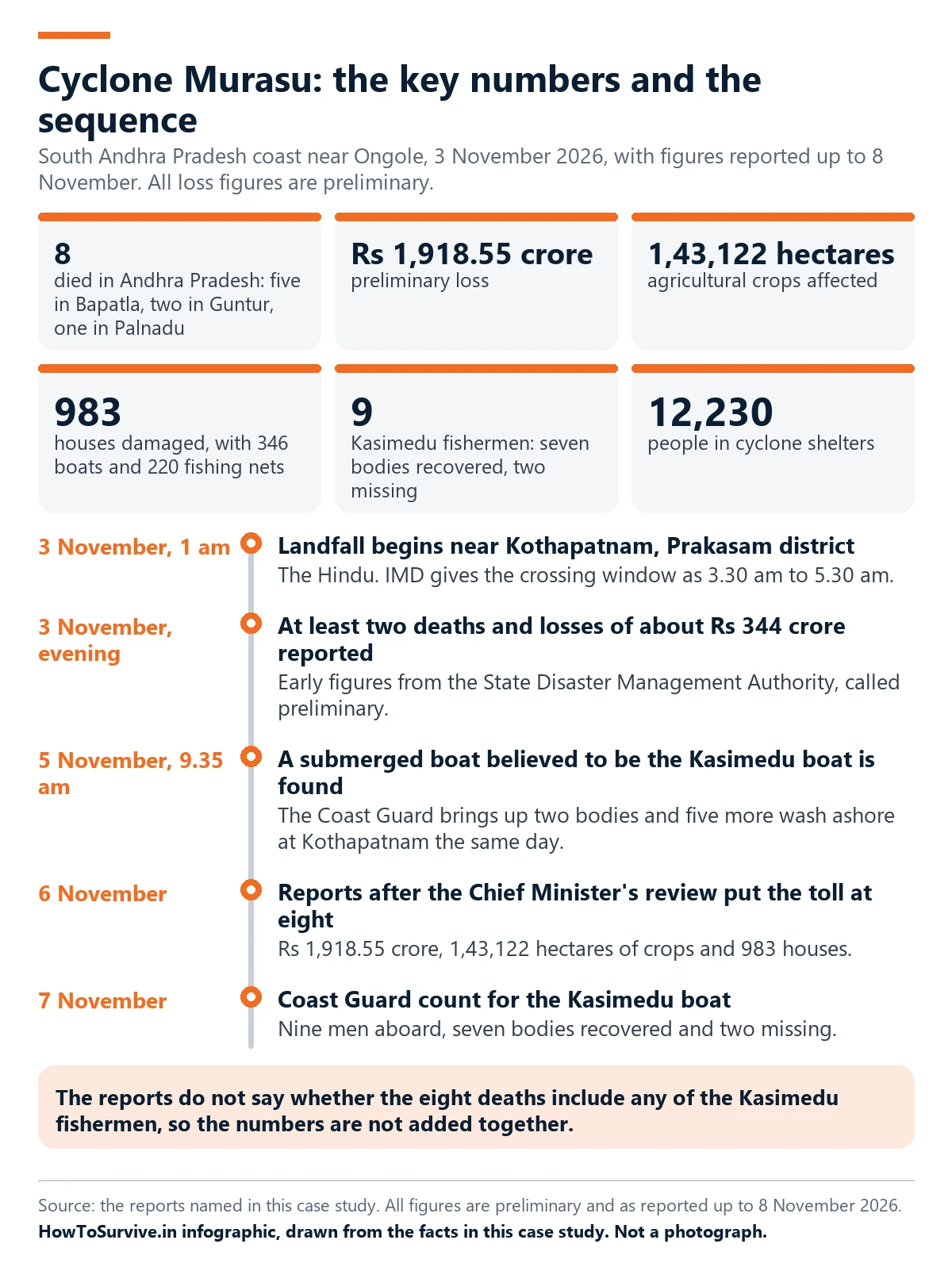
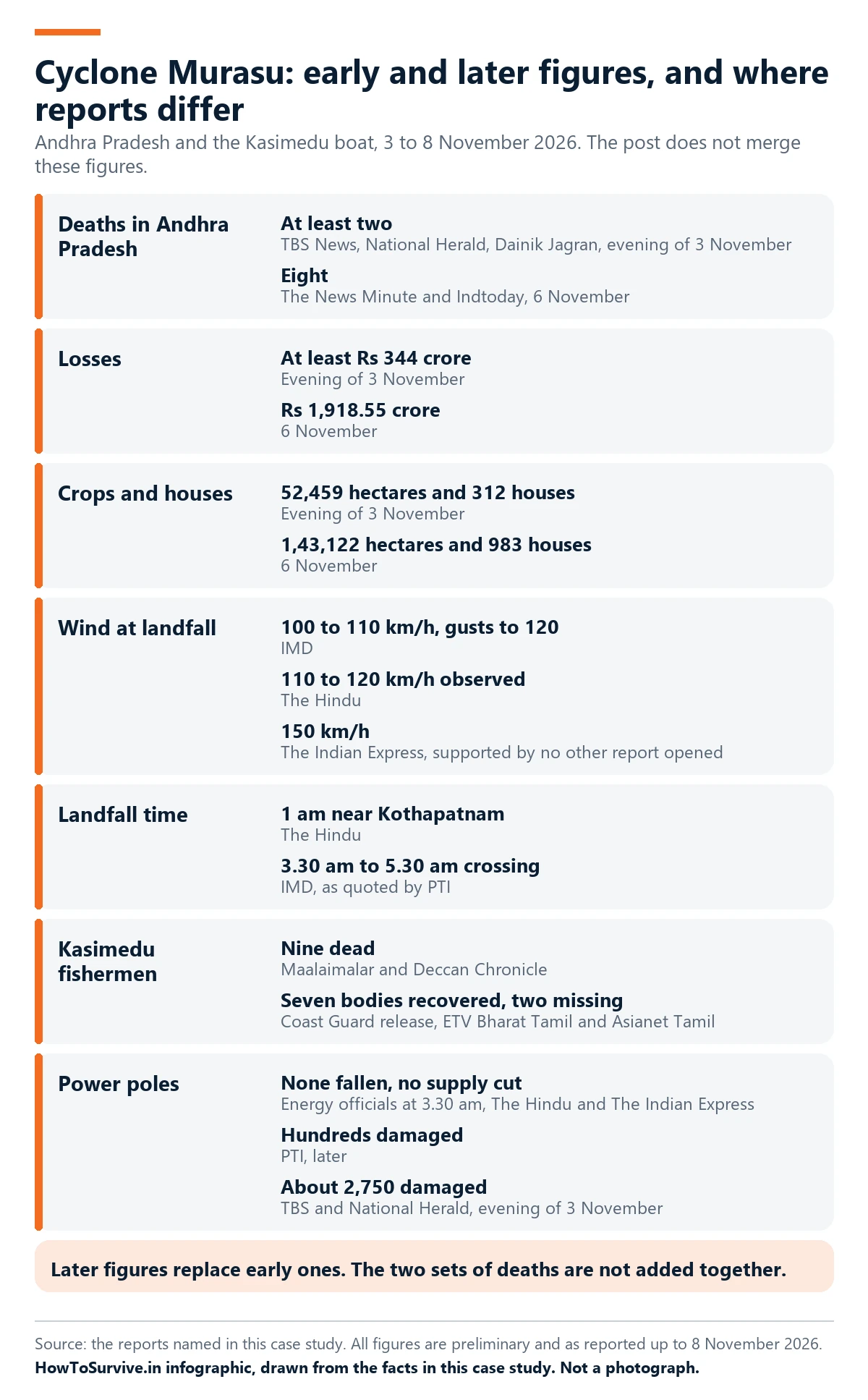
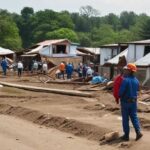
Severe Cyclonic Storm Murasu crossed the south Andhra Pradesh coast close to Ongole in the early hours of Tuesday, 3 November 2026, with winds of 100 to 110 km/h gusting to 120, according to IMD. The Hindu reports landfall began at 1 am near Kothapatnam in Prakasam district. Thousands of people were moved to safer places in Andhra Pradesh (about 30,000 planned), and more than 1.60 lakh in Odisha as a precaution. PTI reports thousands of trees uprooted, hundreds of electric poles damaged, fishing boats wrecked and crops damaged in Bapatla and Prakasam. Thatched houses collapsed and residents were stranded in Ongole. At least 19 flights were cancelled. The state disaster authority said in the morning that no deaths or injuries had been reported so far (Reuters, 9.30 am). That evening its managing director gave at least two deaths, preliminary losses of at least Rs 344 crore and crops on 52,459 hectares affected, as reported by TBS News, National Herald and Dainik Jagran. Reports of 6 November (The News Minute, Indtoday) raise the toll to eight (five in Bapatla, two in Guntur, one in Palnadu), the preliminary loss to Rs 1,918.55 crore, the crop area to 1,43,122 hectares and the damaged houses to 983, with 346 boats; the reports do not say who died or how. Early reports differed on whether poles fell; about 2,750 were later reported damaged. Nine fishermen from Kasimedu, Chennai, who had gone to sea on 29 October were lost off the Andhra coast: ETV Bharat Tamil and Asianet News Tamil say seven bodies were recovered and two men are missing, while Maalaimalar and Deccan Chronicle say nine died; the Coast Guard says they left shelter despite storm warnings and families allege their complaints were not acted on. This is a running record and the figures are preliminary.
Quick answers
Where and when did Cyclone Murasu make landfall?
Landfall began at about 1 am on 3 November 2026 near Kothapatnam in Prakasam district, about 20 km from Ongole, according to The Hindu. IMD put the crossing between Nellore and Narasapur, close to Ongole, between 3.30 and 5.30 am.
How strong was Cyclone Murasu?
IMD said winds of 100 to 110 km/h gusting to 120 km/h at landfall. The Hindu quotes an observed 110 to 120 km/h at the landfall point.
Were there deaths in Cyclone Murasu?
Yes. In Andhra Pradesh eight: five in Bapatla, two in Guntur and one in Palnadu (The News Minute and Indtoday, 6 November 2026). The first figure, on 3 and 4 November, was at least two (TBS News, National Herald, Dainik Jagran). The reports do not say who died or how. Separately, nine fishermen from Kasimedu, Chennai, were lost off the Andhra coast: seven bodies recovered and two missing per ETV Bharat Tamil and Asianet News Tamil, nine dead per other outlets. We do not add the two figures together. The tolls may change. The reports we read on the morning of 3 November had no deaths.
How many people were evacuated?
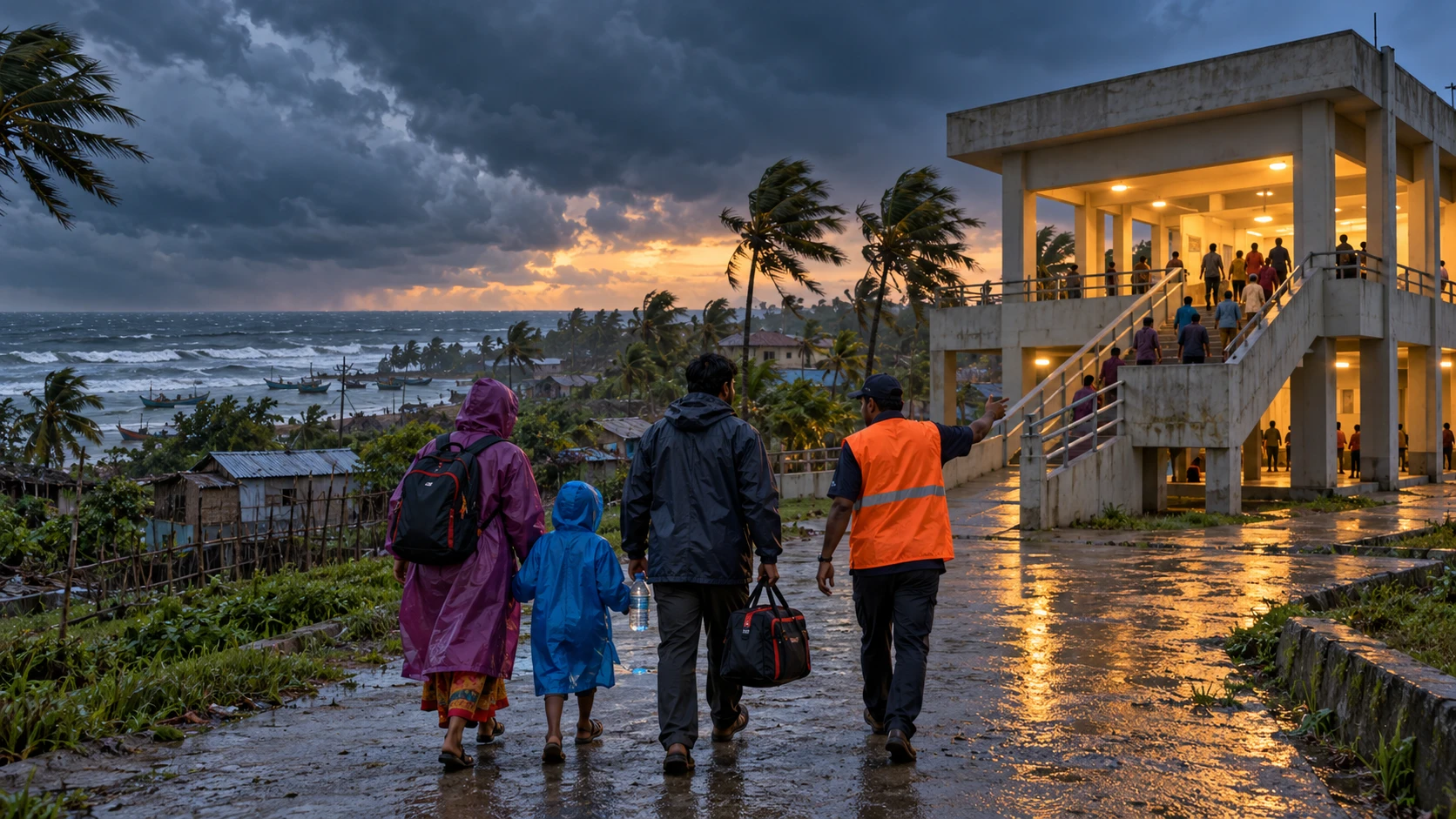
On 3 November 12,230 people were in cyclone shelters in Andhra Pradesh (TBS News, National Herald, Dainik Jagran), and Prakasam set up 70 relief centres. Odisha moved more than 1.60 lakh people as a precaution.
What damage did Murasu cause?
Preliminary losses of Rs 1,918.55 crore, agricultural crops on 1,43,122 hectares, 983 houses and 346 boats (The News Minute and Indtoday, 6 November). The first reports of 3 November said at least Rs 344 crore, 52,459 hectares, 312 houses and about 2,750 electricity poles. PTI also reports thousands of trees uprooted, boats wrecked and crops damaged in Bapatla and Prakasam, and thatched houses collapsed in Ongole. The figures are preliminary.
What should I do after a cyclone?
Stay indoors until it is declared safe, treat fallen wires as live, avoid floodwater, and do not go to the beach. Call 112 or use the Mana Mitra WhatsApp service on 9552300009 to report problems.
How is Murasu linked to Cyclone Arnab?
Murasu came less than a week after Arnab crossed the Andhra coast on 28 October 2026. They are separate storms, and the ground was already wet.
What happened to the Kasimedu fishermen?
Nine fishermen from the Kasimedu harbour in Chennai went to sea on 29 October. The Indian Coast Guard says their boat left shelter at Nizampatnam during the storm despite warnings, reported an engine failure at about 3.30 am on 3 November and was later found submerged; ETV Bharat Tamil reports seven bodies recovered and two men missing. Families say their complaints were not acted on, and the state government has not been quoted in the reports we opened.
What happened
Severe Cyclonic Storm Murasu crossed the south Andhra Pradesh coast close to Ongole in the early hours of Tuesday, 3 November 2026. The Hindu reports that landfall began at 1 am near Kothapatnam in Prakasam district, about 20 km from Ongole. The India Meteorological Department (IMD) said the storm crossed between Nellore and Narasapur, close to Ongole, between 3.30 am and 5.30 am, with winds of 100 to 110 km/h gusting to 120 km/h (Oneindia, Rediff-PTI). The Hindu’s live blog says the observed sustained wind at the landfall point was 110 to 120 km/h. At 5.30 am the storm was still crossing, moving at only about 9 km/h and centred about 20 km from Ongole, and the landfall was expected to take about two more hours (The Hindu). First checked on the morning of 3 November 2026 and again around midday, when none of the reports we opened mentioned a death or an injury. Rechecked on 5 November 2026: see the Andhra Pradesh update below, which reports at least two deaths. Rechecked on the night of 8 November 2026: the Andhra Pradesh toll is now eight and the preliminary loss Rs 1,918.55 crore (first update below), and a Tamil Nadu update adds nine fishermen from Kasimedu, Chennai, dead or missing off the Andhra coast. This is a running record and the figures will move.
It came less than a week after our Cyclone Arnab case study, which crossed the coast near Narsapur on 28 October, and the Gidipabali landslide in Odisha that followed Arnab’s rain.
Update, 8 November 2026 (night): Andhra Pradesh toll now eight, preliminary loss Rs 1,918.55 crore
Reports published on 6 November, after the Chief Minister’s review on Thursday, 5 November, replace the early figure of at least two deaths. The News Minute and Indtoday both say eight people died in Andhra Pradesh because of Cyclone Murasu: five in Bapatla district, two in Guntur and one in Palnadu. Neither gives names, ages or how they died, and we give none. Both put the preliminary loss at Rs 1,918.55 crore.
- Crops: agricultural crops on 1,43,122 hectares, affecting 1,86,063 farmers, and horticultural crops on 6,749 hectares, affecting 12,586 farmers. This replaces the 52,459 hectares reported on 3 November.
- Houses and boats: 983 houses, 346 boats and 220 fishing nets damaged, against the 312 houses of the first reports.
- Power and roads: 871 of 1,103 affected 11 kV feeders had been restored and 232 were left, and 1,493 of 3,946 damaged 11 kV poles were back (Indtoday). Major district roads and state highways damaged over 760 km, with fallen trees cleared at all 206 identified places, and 74 rural roads over about 204 km, with restoration estimated at Rs 92.08 crore (Indtoday and The News Minute).
- Response: 11 SDRF teams, 13 NDRF teams and 390 fire personnel took part (Indtoday and The News Minute).
- Still moving: officials said exact crop-loss estimates would need another 48 to 72 hours, depending on floodwaters receding (Indtoday), so every figure here is preliminary.
The two reports appear to rest on one official briefing, so they are not independent of each other, and neither says whether the eight include any of the Kasimedu fishermen below; we do not add the numbers together. The figures of 3 November further down stay as a dated record of what was known that evening. Last checked: 8 November 2026.
Update, 8 November 2026, Tamil Nadu: nine fishermen from Kasimedu, Chennai, dead or missing off the Andhra coast
Cyclone Murasu has another loss that the Andhra Pradesh figures do not cover. Nine fishermen from the Kasimedu fishing harbour in Chennai went to sea in a mechanised boat on 29 October and did not return. On the evening of 7 November ETV Bharat Tamil carried a statement of the Indian Coast Guard that says seven of the nine bodies have been recovered and two men are still missing; Asianet News Tamil (7 November, 4.02 pm) also gives seven bodies and two missing, and says the search for the two is continuing. Maalaimalar (7 November, 10.09 am) and Deccan Chronicle (7 November, quoting ANI) say nine fishermen died; the Deccan Chronicle copy mentions the recovery of only one body, so the outlets do not give the same count. The Coast Guard’s own release, as the English edition of ETV Bharat reported it on 7 November (5.57 pm IST), puts nine men on the boat, seven bodies recovered and two missing, which is the count we use. We have not named the men. Our separate case study of the Kasimedu boat gives the fuller account.
- What the Coast Guard says happened: as reported by ETV Bharat Tamil, the boat had taken shelter at Nizampatnam port in Andhra Pradesh ahead of the storm and left again on the night of 2 November, while Murasu was crossing the coast and the sea was very rough. The crew reported an engine failure by wireless at about 3.30 am on 3 November, after which contact was lost. The Coast Guard says it first heard of the incident around noon on 3 November and searched with an aircraft from near Chennai, a ship from Krishnapatnam port and coastal radar on 3, 4 and 5 November. At 9.35 am on 5 November a submerged boat, believed to be theirs, was found about 15 degrees 26 minutes north, 80 degrees 14 minutes east, and a Coast Guard ship brought up two bodies near it. Five more bodies washed ashore the same day at Kothapatnam beach, close to where the storm made landfall.
- Why they were at sea: the Coast Guard says it issued repeated weather warnings and advised fishermen not to go out before both storms, and it attributes the loss to the boat leaving shelter despite the warnings. It says the reason the crew left is unclear and suggests they may have taken the lull in the wind at the centre of the storm to mean it had passed, while the storm’s rear half had not. That is the Coast Guard’s suggestion, not something the crew said.
- What the families and the opposition say: Maalaimalar says the men phoned home until 2 November, after which contact was lost, and that the families complained to the police and to fisheries officials but no action was taken. DT Next reports relatives saying the Fisheries Department did not act at once and that the government moved only after they protested. Udhayanidhi Stalin, Leader of the Opposition in the Tamil Nadu Assembly, met the families on 7 November and said the state government should have stopped fishing during the cyclone; an opposition MP, Kanimozhi, asked why nothing was done when the men were reported missing (Deccan Chronicle, quoting ANI). These are the families’ allegations and political statements. In what we opened we found no reply from the state government or the Fisheries Department.
- Relief and demands: Mr Stalin said the state had announced Rs 7 lakh and then about Rs 2 lakh more (Deccan Chronicle, quoting ANI); Maalaimalar says Rs 7 lakh was promised, Rs 2 lakh has been paid and Rs 5 lakh is still due. The two reports do not describe the sums in the same way. The families want Rs 25 lakh for each household and a government job for one member (Maalaimalar, DT Next).
- Where the reports differ: the count (nine dead in Maalaimalar and Deccan Chronicle; seven bodies and two missing in ETV Bharat Tamil and Asianet Tamil); where the engine failed (Deccan Chronicle, quoting ANI, says near Ramayapatnam port in Andhra Pradesh; ETV Bharat Tamil says mid-sea after the boat left Nizampatnam); and the relief sums.
Are these deaths part of the Andhra Pradesh toll of eight? We do not know. Neither the early figure of at least two deaths, given on the evening of 3 November before any of these bodies were found, nor the later toll of eight says whether it includes any of the seven recovered, so we do not add the numbers together. For boats and fishermen the lesson is plain: once a cyclone warning is out, do not put to sea or leave harbour, and do not take a calm patch in the middle of the storm to mean it is over, because the wind returns from the other side. Report a boat that has lost contact at once to the police, the fisheries office or 112. If you live in Chennai, our Chennai safety guide lists the emergency numbers. Last checked: 8 November 2026.
Andhra Pradesh, 7 November 2026: power restored in many villages, crop assessment nearly done
The Hindu reports that at a review meeting on Saturday, 7 November, officials told the Andhra Pradesh Chief Minister that nearly 92 per cent of the assessment of horticultural crop damage was complete and that the assessment for agricultural crops would be finished by 9 November. They said power had been restored to all villages affected by the earlier cyclone, and that after Murasu restoration was under way in 1,825 villages, with 7,850 damaged poles already repaired. Essential supplies had reached 3.82 lakh affected families, and cases were registered against 204 traders for breaking the government’s price directions. This report gives no new death toll, loss figure or crop area, so it does not change the toll or the losses; the later figures, reported on 6 November, are in the first update above. It does show that the pole count has been overtaken: 7,850 poles repaired is far above the about 2,750 reported damaged on the evening of 3 November, and we have not seen a revised damage figure. This is one outlet. Last checked: 8 November 2026.
Update, 5 November 2026, Andhra Pradesh: at least two deaths reported, losses of about Rs 344 crore (later raised, see above)
On the evening of 3 November the managing director of the Andhra Pradesh State Disaster Management Authority, Prakhar Jain, gave new figures, and three newsrooms carried them: TBS News (3 November, 9.55 pm), National Herald (3 November, 9.43 pm, attributing the figures to PTI) and the English edition of Dainik Jagran (4 November). They report at least two deaths from the cyclone. TBS and Dainik Jagran name Mr Jain as the person who confirmed the deaths; National Herald does not say who confirmed them. None of the reports we opened says who died, where or how, so we give none of those details. The figures are early and the authority itself calls them preliminary.
- Losses: at least Rs 344 crore (TBS, National Herald, Dainik Jagran).
- Crops: 52,459 hectares affected across 15 districts (TBS, National Herald); National Herald adds 132 mandals and names Krishna, Bapatla and Nandyala as the worst hit by crop inundation. Dainik Jagran’s second report rounds the area to “more than 52,000” hectares; it is the same figure rounded.
- Houses and power: 312 houses damaged or affected (National Herald, Dainik Jagran); about 2,750 electricity poles damaged, with Prakasam and Bapatla worst hit for power (TBS, National Herald). TBS says homes were destroyed but gives no number.
- Relief camps: 12,230 people were in cyclone shelters (TBS, National Herald, Dainik Jagran); National Herald adds 171 camps.
- The storm itself: Dainik Jagran says it weakened into a deep depression over coastal Andhra Pradesh after landfall, with the India Meteorological Department expecting a depression by the morning of 4 November.
The three reports appear to rest on one briefing by the authority, so they are not independent confirmations of one another, and we found no separate statement from the state government. This replaces the morning’s position that no deaths had been reported so far (Reuters, 9.30 am), which was accurate at that hour. Last checked: 5 November 2026.
What the reports said on 3 November, before the toll
- Deaths and injuries, morning of 3 November: the managing director of the Andhra Pradesh State Disaster Management Authority, Prakhar Jain, said no deaths or injuries had been reported so far, though some trees and electric poles were uprooted (Reuters, 9.30 am); none were reported in any other report we opened that morning. That was a statement about the situation so far, not a confirmed zero, and it was overtaken the same evening: see the update above.
- Trees and boats: thousands of trees uprooted, hundreds of electric poles damaged, fishing boats wrecked and standing crops damaged in Bapatla and Prakasam districts, many places under sheets of water (PTI, as carried by The Hindu and Rediff). A fisherman from Kothapatnam said around 400 families were moved out of his village, with NDRF help, and that this was the most dangerous cyclone he had seen in 14 years.
- Ongole: several thatched houses collapsed and residents were stranded at Samatha Nagar, and the district administration began evacuating them (The Hindu live blog). A tree fell on the statue of Andhra Kesari Tanguturi Prakasam Panthulu at the Collectorate in Ongole and the statue collapsed. Houses were flooded in Beeramgunta village, Kothapatnam mandal.
- Rain: The Hindu’s live blog said many stations in central and south coastal Andhra Pradesh received around 200 mm within six hours overnight. The measured totals cover a longer period. From 8.30 am on 2 November to 6 am on 3 November, the state disaster authority’s data (published by The Hans India) puts the highest at 198 mm at Naguluppalapadu and 182 mm at Kothapatnam, both in Prakasam, followed by 124 mm at Chirala and 117 mm at Trovagunta; IMD’s figures to 7 am (ETV Bharat, Newsmeter) give 198 mm and 182.3 mm for the same two places. These are totals for about 21 hours, not six. Vijayawada saw waterlogged roads (The Hindu).
- Flights and schools: at least 19 domestic flights were cancelled on Monday, 2 November, at Vijayawada, Tirupati and Visakhapatnam (Oneindia, The Week). Eluru and Cuddalore declared school holidays, and the NTR Collector asked shops to stay shut and people to stay indoors (The Hindu).
Where the reports disagree
- Power poles: Energy department officials told the Chief Minister at 3.30 am that no poles had fallen and no supply was cut anywhere (The Hindu, The Indian Express). The same Hindu live blog and PTI later report hundreds of electric poles damaged. These were not reconciled on 3 November; the first was an early-hours status, the second a later damage report. By the evening PTI, as carried by TBS and National Herald, gave about 2,750 damaged poles, so the early-hours status no longer holds.
- Pole damage forecast: before landfall the Chief Minister’s office said 6,000 to 8,000 electricity poles could be damaged (ETV Bharat live blog). That was a forecast, not a count; the later count of about 2,750 damaged poles is in the update above.
- Wind speed: IMD’s forecast and landfall figure is 100 to 110 km/h with gusts to 120; The Hindu quotes an observed 110 to 120 km/h at the landfall point; The Indian Express says winds touched 150 km/h, which no other report we opened supports.
- Landfall time: The Hindu puts the start at 1 am near Kothapatnam, while IMD’s crossing window as quoted by PTI is 3.30 to 5.30 am. They describe the start and the crossing of the storm centre, which are different things, and the exact moment of landfall is not fixed.
How people were moved out before the storm
Andhra Pradesh moved “thousands” of people to safer places and planned to move about 30,000 before landfall (Reuters); no outlet we opened gives a final state total or a count of relief camps (Oneindia). In Prakasam, the Collector said 26 villages and 72 habitations in coastal mandals were identified as highly vulnerable and 70 cyclone relief centres set up; pregnant women, lactating mothers, older people and children were shifted first; 1,000 electric poles, repair workers and generators were kept ready; and a toll-free control room was opened at the Collectorate (The Hindu, 2 November). The state released Rs 37 crore to 17 districts for relief (The New Indian Express). NDRF placed 14 teams in Andhra Pradesh and Telangana, three of them brought from Arakkonam in Tamil Nadu (The Hindu), and Tamil Nadu’s Electricity Minister said on 2 November that the state had sent 500 electricity staff in 25 teams, with equipment, to help restore power after the Andhra Pradesh Chief Minister asked for help (PTI via ThePrint, 3.46 pm; The Indian Express and Newstrack give the same figure). We have not seen a report of where they were posted.
In Odisha, where Arnab was still fresh, the government said it had shifted more than 1.60 lakh people to safety in five southern districts, about 1.5 lakh of them in Ganjam, against a target of 3.33 lakh, and pre-positioned more than 300 rescue teams (PTI via The Hindu; The Indian Express; ETV Bharat live blog, evening of 2 November). Light rain was reported there as Murasu crossed.
In Tamil Nadu, torrential rain hit Chennai, Chengalpattu and Tiruvallur from Sunday night, with about 10 to 11 cm at several Chennai stations, schools shut and 11 flights cancelled at Chennai airport on 2 November (The Week; ETV Bharat live blog). On 2 and 3 November no Tamil Nadu casualty was reported in what we opened; fishermen from Kasimedu, Chennai, who had gone to sea earlier were later reported dead or missing off the Andhra coast, as the Tamil Nadu update at the top describes.
What is not known yet
- Who the eight people reported dead in Andhra Pradesh were and how they died (the reports give the districts, five in Bapatla, two in Guntur and one in Palnadu, but no names or causes), whether the toll will rise, and whether anyone has been injured; no injury figure was found.
- Where the two missing Kasimedu fishermen are, whether the nine include the authority’s two deaths (the reports do not say), and whether any inquiry into the boat’s voyage is held; we found no announcement of one.
- The real height of the storm surge: IMD forecast 1 to 1.5 m above the normal tide, mainly for Bapatla, Krishna and Prakasam; no report we opened gives what was actually seen.
- How many homes are still without power; the 2,750 damaged poles are a preliminary count.
- The final crop loss and house damage; the figures in the update above are preliminary, and the authority says they may change as field assessments finish.
What the storm teaches
The lesson visible so far is that early shifting of people was a large effort: vulnerable families were moved before the wind rose, 12,230 people were still in shelters on 3 November, and the Chief Minister told people to stay off the roads. Eight people died in Andhra Pradesh all the same (five in Bapatla, two in Guntur, one in Palnadu), and no report we opened says how, so we draw no conclusion from those deaths. After Arnab, the Chief Minister said seven people had died in Andhra Pradesh (IANS and PTI, 29 and 30 October), while Reuters copy of 2 November says at least six; the two figures have not been reconciled, and we have not seen an official breakdown of how each person died. This time the Chief Minister specifically asked people not to come out until obstructions were cleared. The Tamil Nadu update above shows a second risk, that of boats at sea during a storm: nine fishermen from Chennai were lost after, the Coast Guard says, leaving shelter despite warnings. The risk on land now moves from the wind to the aftermath: fallen wires in water, uprooted trees and leaning poles, flooded low ground and weakened walls.
Live or work near Ongole? Our Ongole safety guide lists the emergency numbers, the district fire stations and the main cyclone and flood risks.
Our guides on cyclone safety, live wires and floodwater after a cyclone and floodwater safety cover these steps in full.
What to do if a cyclone is near or has just passed
These are general safety practices, not findings about what went wrong or right in Andhra Pradesh.
- Stay indoors, away from windows, until the authorities say the danger has passed. A calm spell does not always mean the storm is over; the wind can return from the other side.
- Do not go to the beach to watch the sea or film the surge, and do not walk or drive through floodwater.
- Treat every fallen wire as live, and keep well away from water near a fallen wire or a leaning pole. Report it to the electricity company; see our guide on electric wires near homes.
- Use the nearest relief centre if you live in a thatched house, a hut or low ground, and go when asked rather than waiting for the rain to start.
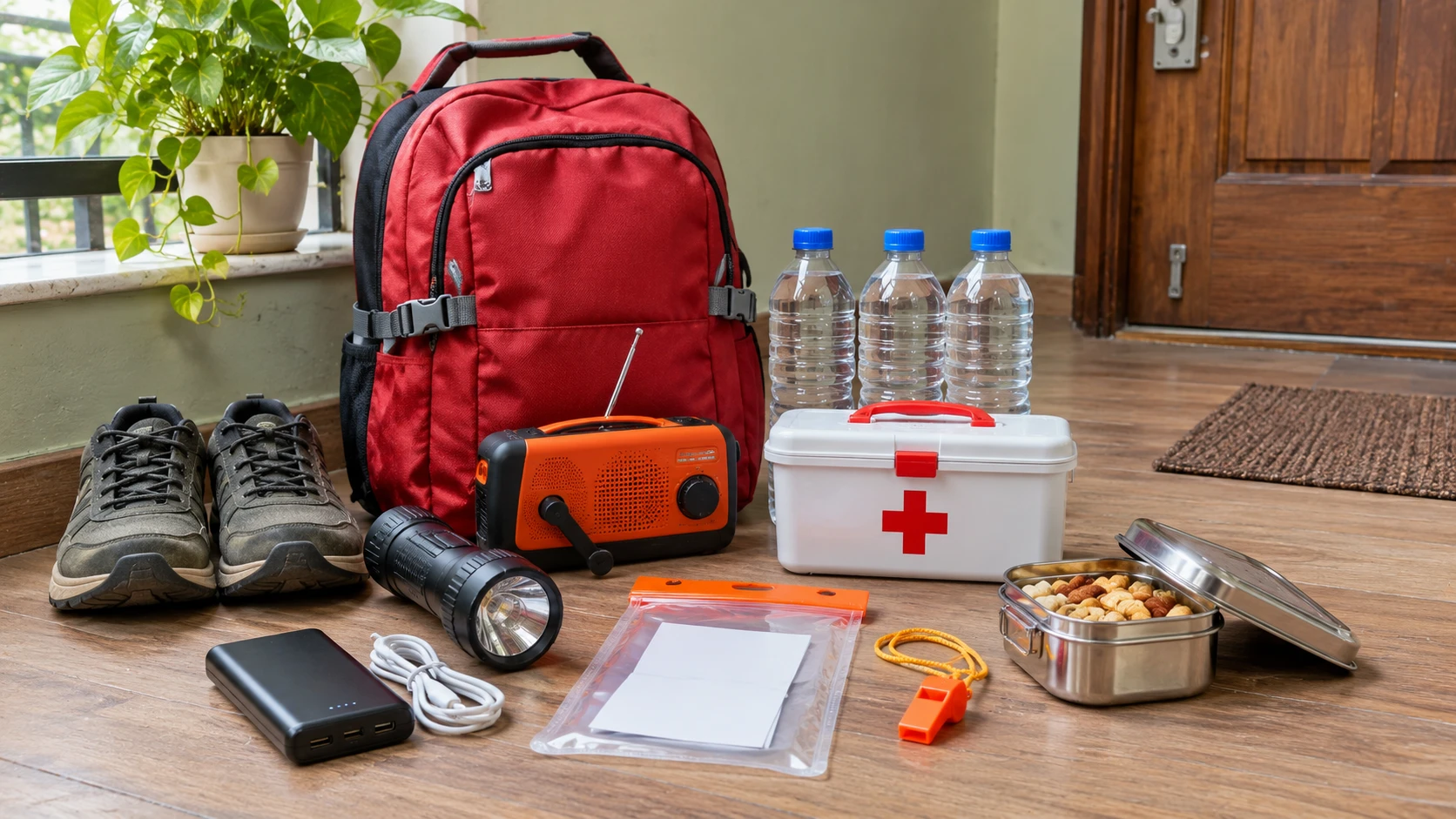
- Keep phones charged and one torch ready. Run a generator only outdoors; generator carbon monoxide safety explains why.
- Who to call in Andhra Pradesh: 112 for emergencies; the State Disaster Management Authority’s helplines 1070 and 18004250101 (as given by the Home Minister, The New Indian Express); and the Mana Mitra WhatsApp service on 9552300009 to report power cuts, fallen trees, collapsed walls and waterlogging (The Hindu, The New Indian Express). Our state-wise helpline list has numbers for other states.
- Check before forwarding. Cyclone videos are often old or from another storm. The Prakasam administration itself asked people to avoid rumours.
- Murasu intensifies into a severe cyclonic storm; schools shut in parts of Andhra Pradesh, Odisha and Tamil Nadu; flights cancelled
- Prakasam sets up 70 relief centres and shifts pregnant women, older people and children; the state releases Rs 37 crore to 17 districts; Odisha moves people from low-lying areas and pre-positions over 300 rescue teams; NDRF places 14 teams in Andhra Pradesh and Telangana
- Landfall begins near Kothapatnam, about 20 km from Ongole (The Hindu)
- The Chief Minister reviews the situation with Collectors; energy officials say no poles have fallen and supply is not cut
- IMD's window for the storm crossing the coast between Nellore and Narasapur
- Storm still crossing at about 9 km/h, centred about 20 km from Ongole; two more hours of landfall expected (The Hindu)
- Reports of thousands of trees uprooted, boats wrecked, thatched houses collapsed at Samatha Nagar in Ongole, and rescue under way; the Union Home Minister calls the Chief Minister
- IMD expects Murasu to weaken into a cyclonic storm by noon and into a deep depression by midnight, with heavy rain continuing
- Measured rain to 6 or 7 am: 198 mm at Naguluppalapadu, 182 mm at Kothapatnam; no death or injury reported in the newest reports opened
- The authority's managing director gives at least two deaths, losses of at least Rs 344 crore, crops on 52,459 hectares, 312 houses, about 2,750 poles and 12,230 people in shelters (TBS News, 9.55 pm; National Herald, 9.43 pm, citing PTI)
- Dainik Jagran's English edition repeats the figures; the system has weakened to a deep depression, with a depression expected by morning (IMD)
- Rechecked: no names, places or causes of the two deaths found; figures remain preliminary
- Nine fishermen leave Kasimedu, Chennai, in a mechanised boat; they shelter at Nizampatnam port ahead of the storm (ETV Bharat Tamil, Deccan Chronicle via ANI)
- The boat leaves Nizampatnam while Murasu is crossing; the crew's last phone calls to families are on this day (ETV Bharat Tamil, Maalaimalar)
- The crew reports an engine failure by wireless and contact is lost; the Coast Guard says it first heard of the incident around noon
- A submerged boat believed to be theirs is found off the Andhra coast; two bodies are recovered near it and five wash ashore at Kothapatnam beach (Coast Guard statement via ETV Bharat Tamil)
- Two more bodies are reported washed ashore, bringing the count to seven, with two fishermen still missing and the Coast Guard and scuba divers searching (ETV Bharat, English)
- After the Chief Minister's review of 5 November, reports give the Andhra Pradesh toll as eight (5 Bapatla, 2 Guntur, 1 Palnadu), losses of Rs 1,918.55 crore, agricultural crops on 1,43,122 hectares, 983 houses and 346 boats (The News Minute, Indtoday)
- The Coast Guard says the boat left shelter despite warnings; seven bodies recovered and two missing (ETV Bharat Tamil and English, Asianet Tamil); the Leader of the Opposition meets the families and demands Rs 25 lakh for each household
- Officials tell the Andhra Pradesh Chief Minister that 7,850 damaged poles are repaired in 1,825 villages after Murasu and that crop assessment is nearly complete (The Hindu)
Why consequences escalated
- The storm crossed the coast near Ongole with winds of 100 to 110 km/h, gusting to 120, per IMD.
- Thousands of people were moved to relief centres before landfall in Andhra Pradesh, and more than 1.60 lakh in Odisha.
- Thousands of trees, boats and crops were hit; in the morning the state disaster authority said no deaths or injuries had been reported so far, and by the evening its managing director gave at least two deaths; reports of 6 November put the Andhra Pradesh toll at eight.
- Reports disagree on whether electric poles fell and on the peak wind.
- The storm surge height is not reported; the pole count (about 2,750) is from the evening of 3 November, while the 6 November figures of Rs 1,918.55 crore in losses and 1,43,122 hectares of agricultural crops are also preliminary.
- Nine fishermen from Kasimedu, Chennai, were lost off the Andhra coast: seven bodies recovered and two missing per ETV Bharat Tamil and Asianet News Tamil, nine dead per other outlets; the Coast Guard says the boat left shelter despite storm warnings and the families allege their complaints were not acted on.
Failures and risk multipliers
- No finding of fault about Andhra Pradesh's preparation has been made, and none is stated here. For the Kasimedu boat, the Coast Guard attributes the loss to the boat leaving shelter despite warnings, and the families and the opposition allege that complaints about the missing men were not acted on; these are statements, not an inquiry's findings.
- The early report that no poles fell was overtaken by later reports of hundreds, and then about 2,750, damaged poles.
- The risk after a storm, such as fallen wires in water, is separate from the landfall and comes later. After Arnab, the Chief Minister put Andhra Pradesh's toll at seven (IANS, PTI) while Reuters said at least six; we have not seen an official breakdown of the deaths by cause.
- Deaths and damage figures reported after the morning of 3 November were added on 5 November 2026 and are preliminary; the revised figures of 6 November were added on 8 November 2026.
- The Coast Guard says it does not know why the crew left shelter and suggests they may have mistaken the lull in the wind at the storm's centre for the end of the storm.
Actions that reduce risk
- Stay indoors and off the roads until the authorities say the danger has passed.
- Treat every fallen wire as live and keep away from water near it.
- Move to a relief centre early if you live in a thatched house or low ground.
- Do not go to the beach to watch or film the surge.
- Report power cuts, fallen trees and waterlogging through Mana Mitra on WhatsApp (9552300009) or call 112.
- Fishermen: do not leave harbour or shelter once a cyclone warning is out, and report a boat that has lost contact at once.






Leave a comment