
Quick answers
Are the checklists free to print and share?
Yes. All four are free PDFs. Print them for your family, your housing society or your office, and share them as they are, with the footer on.
What paper do I need?
Each checklist is one A4 page in portrait, so any ordinary home or office printer will do.
How often should I go through them?
Test smoke alarms every month, and go through the whole set every six months or whenever the household changes, such as a new baby, an elderly parent moving in or a renovation. Family drills are best done twice a year.
Do the checklists replace a first-aid course or a fire audit?
No. They are a quick way to see what you have missed. Hands need practice, so book a practical first-aid and CPR course, and ask a licensed electrician to check old or damaged wiring.
What if the emergency numbers in my state are different?
112 works all over India. Numbers such as 1070, 1077, 1912 and 104 differ from state to state, so look up your own state and write them in on the card.
I only have ten minutes. Where do I start?
Press the test button on your smoke alarms, check the LPG hose and regulator, ask the children to show you the two ways out of the house, and save 112, 108, 101, 1930 and 1906 in every family phone.
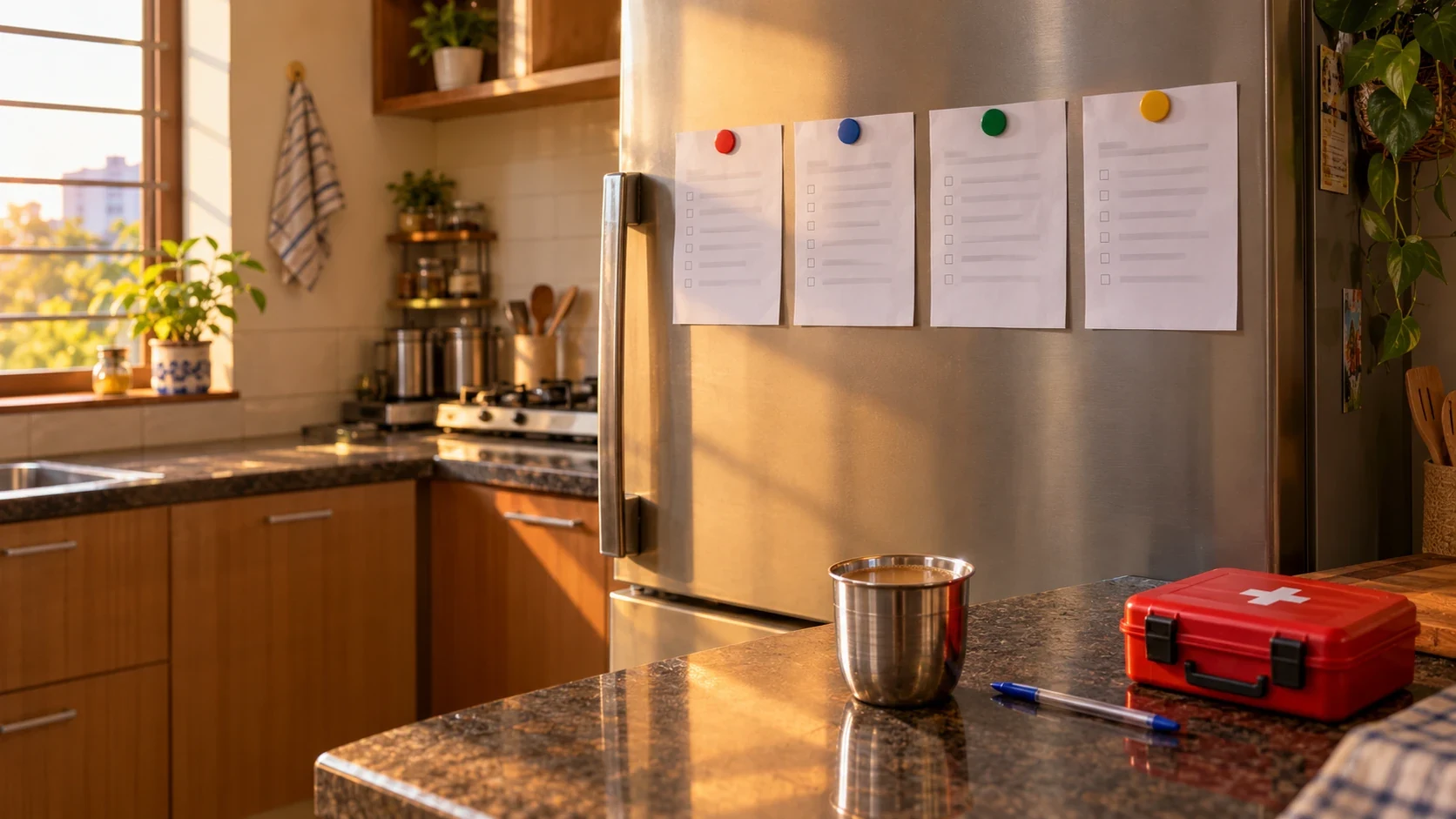
Most families agree that they should test the smoke alarm, look at the gas hose and save a few emergency numbers in the phone. Then the week gets busy and nothing happens. A sheet of paper on the fridge is harder to ignore than a good intention, so we have turned the advice in our own guides into four one-page checklists that you can download, print and tick off.
They are free to print and share with your family, your housing society or your office. Every item comes from a step already published on HowToSurvive.in, and each sheet carries the date it was last checked, 19 October 2026. They do not replace an electrician’s visit, a fire audit by your society or a first-aid course. They help you spot what you have missed.
How to use these checklists
- Print each sheet on A4, portrait, one page each. Any home or office printer will do.
- Walk through the house with a pen. Tick a box only when you have actually looked, not when you feel it is probably fine.
- Fix one unticked box tonight. A cracked gas hose or a missing smoke alarm matters more than a perfect plan that stays on paper.
- Stick the sheet where the family will see it, such as the fridge or near the main door, and go through it again every six months or whenever the household changes.
1. Home fire safety checklist
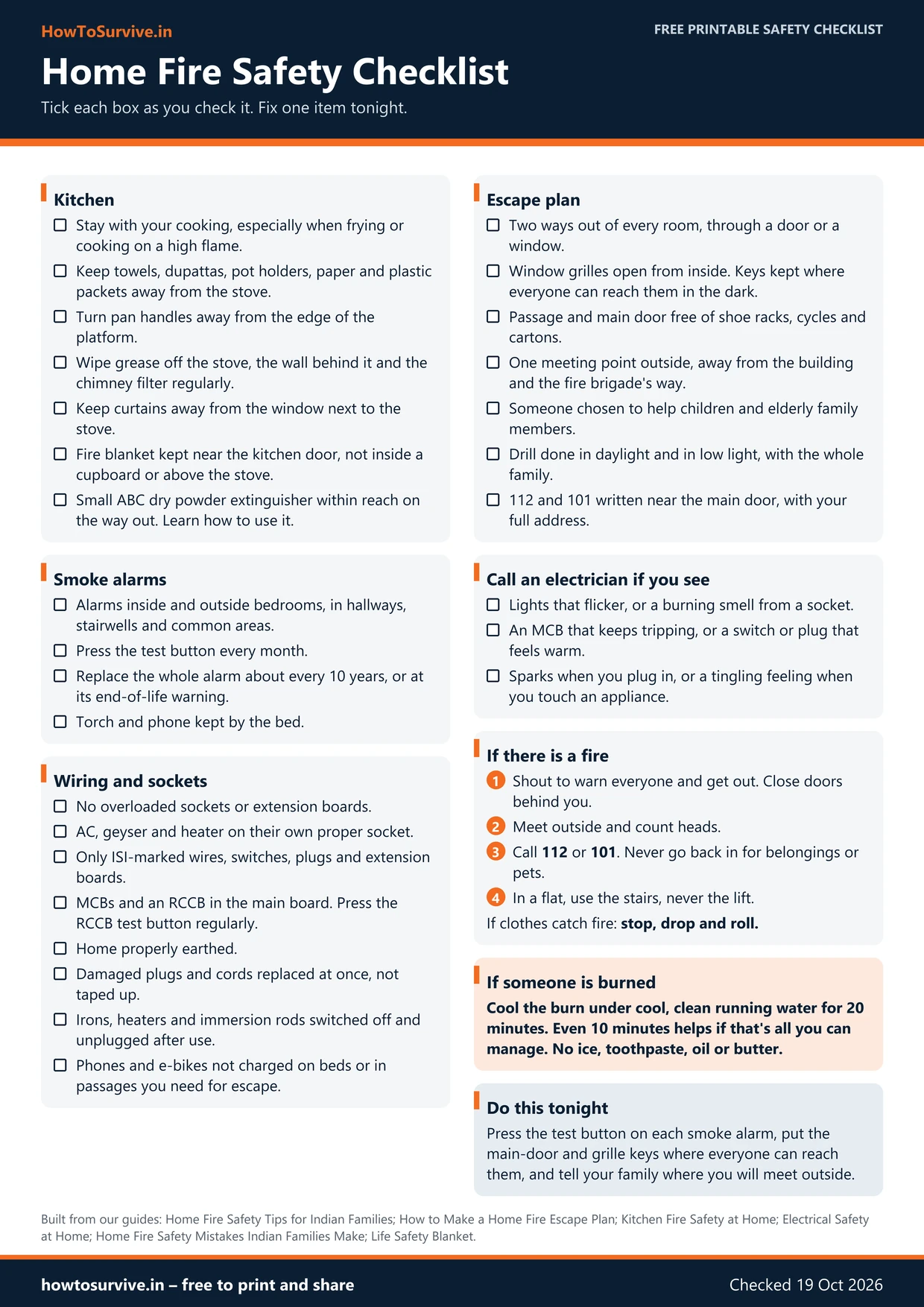
This is the sheet to start with. It covers the kitchen, smoke alarms, wiring and sockets, and your escape plan, followed by what to do if there is a fire and a box for burns. Most of it comes from our guides on home fire safety habits, the home fire escape plan and kitchen fire safety for Indian kitchens. The wiring section follows our guide to electrical safety at home.
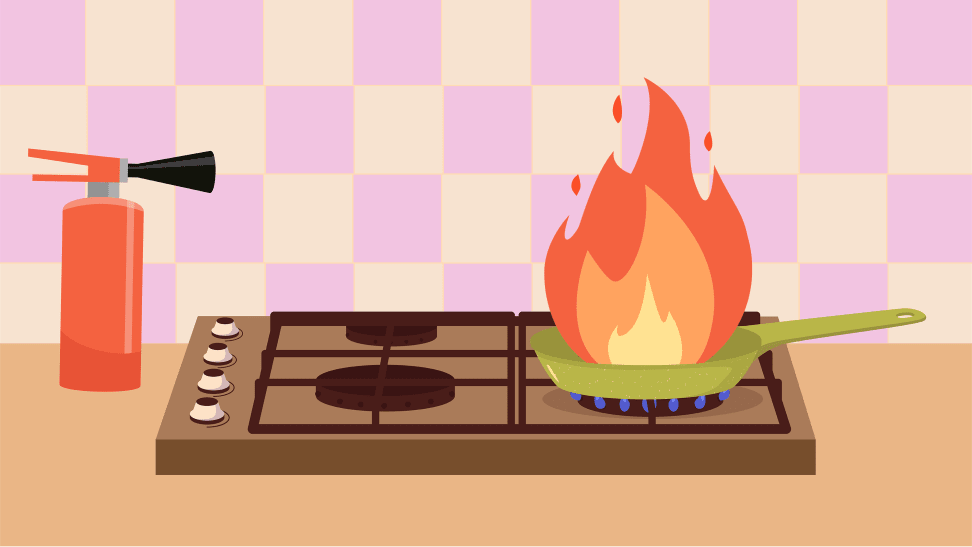
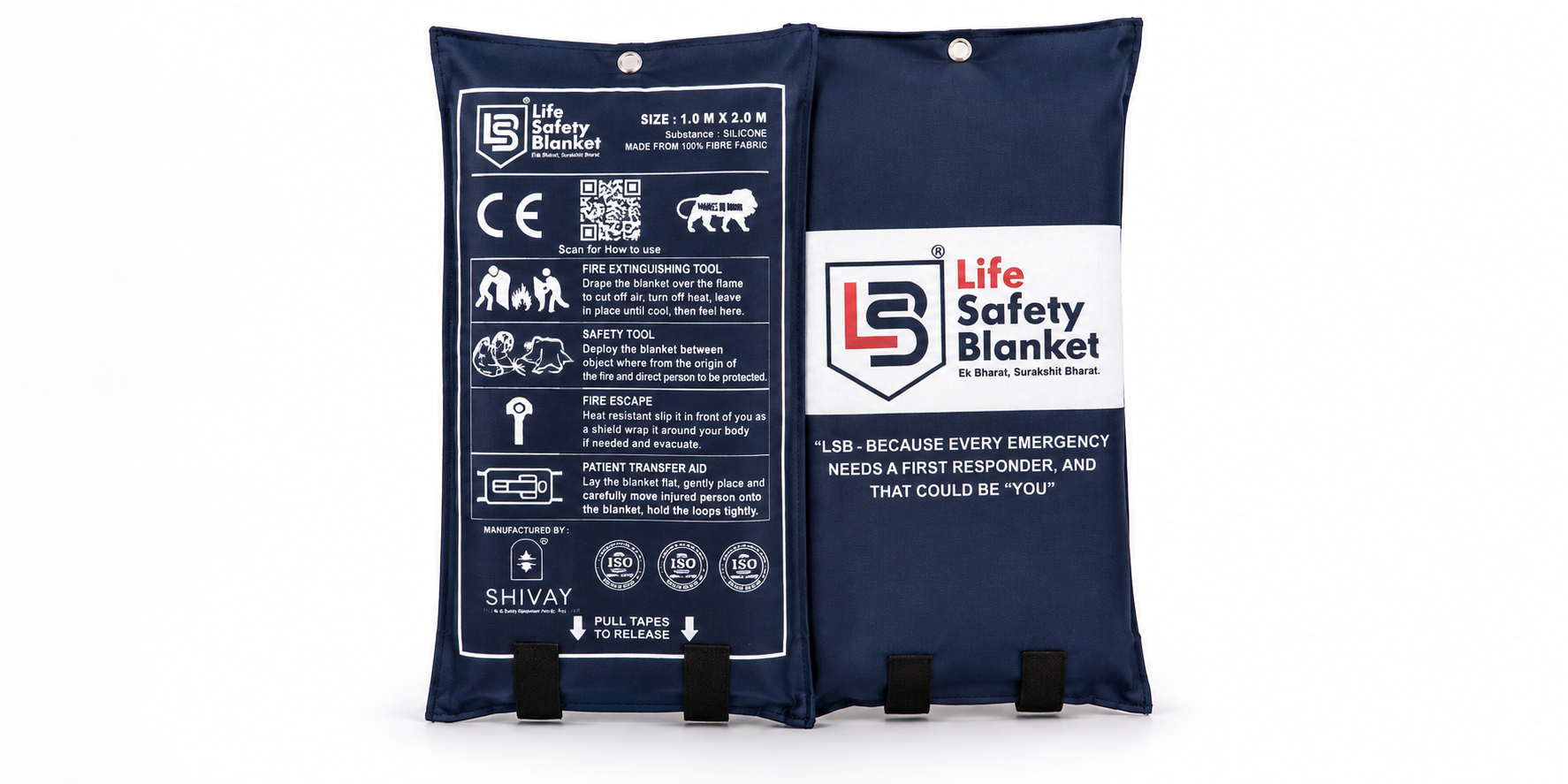
The kitchen section asks you to stay with your cooking, keep dupattas, towels and plastic packets away from the stove, and keep a fire blanket near the kitchen door rather than inside a cupboard. As our guide to the Life Safety Blanket explains, a fire blanket works only if it can cover the whole fire. If the fire is bigger than the blanket, get everyone out and call 112 or 101.
The wiring section is practical: no overloaded sockets or extension boards, ISI-marked plugs and switches, and an RCCB in the main board along with the MCBs. The MCB protects the wiring, and the RCCB protects the person. If lights flicker, a socket smells of burning, or an MCB keeps tripping, call an electrician rather than waiting for smoke.
Download: Home fire safety checklist (PDF), one A4 page, free to print and share.
2. LPG cylinder and gas-leak checklist
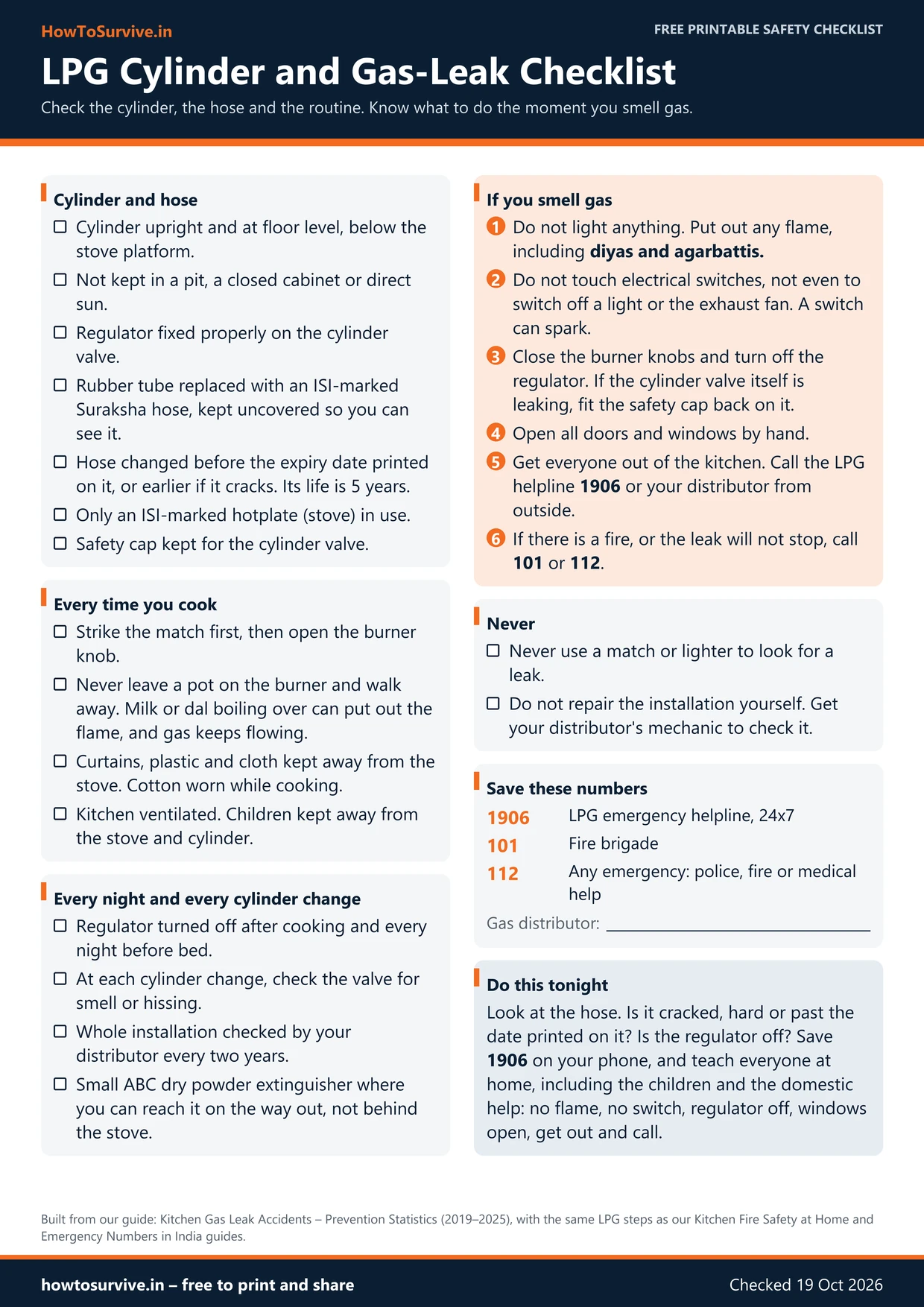
In 2024, NCRB recorded 1,355 fires from cooking gas cylinder or stove bursts, and 1,389 people died in them. Most began with something small and ordinary: a loose regulator, a cracked tube, a pot that boiled over and put out the flame. This sheet checks the cylinder, the hose and your cooking routine, and gives the six steps to follow the moment you smell gas, as set out in our guide to kitchen gas leak accidents.
Two habits are worth starting today. Turn the regulator off after cooking and every night before bed, and look at the hose: is it cracked, hard or past the date printed on it? The sheet also has a line to write in your gas distributor’s number, so it is at hand when you need it.
Two rules cannot be repeated too often: never use a match or lighter to look for a leak, and do not touch a switch after you smell gas, not even the exhaust fan.
Download: LPG cylinder and gas-leak checklist (PDF), one A4 page, free to print and share.
3. Family emergency plan and go-bag checklist
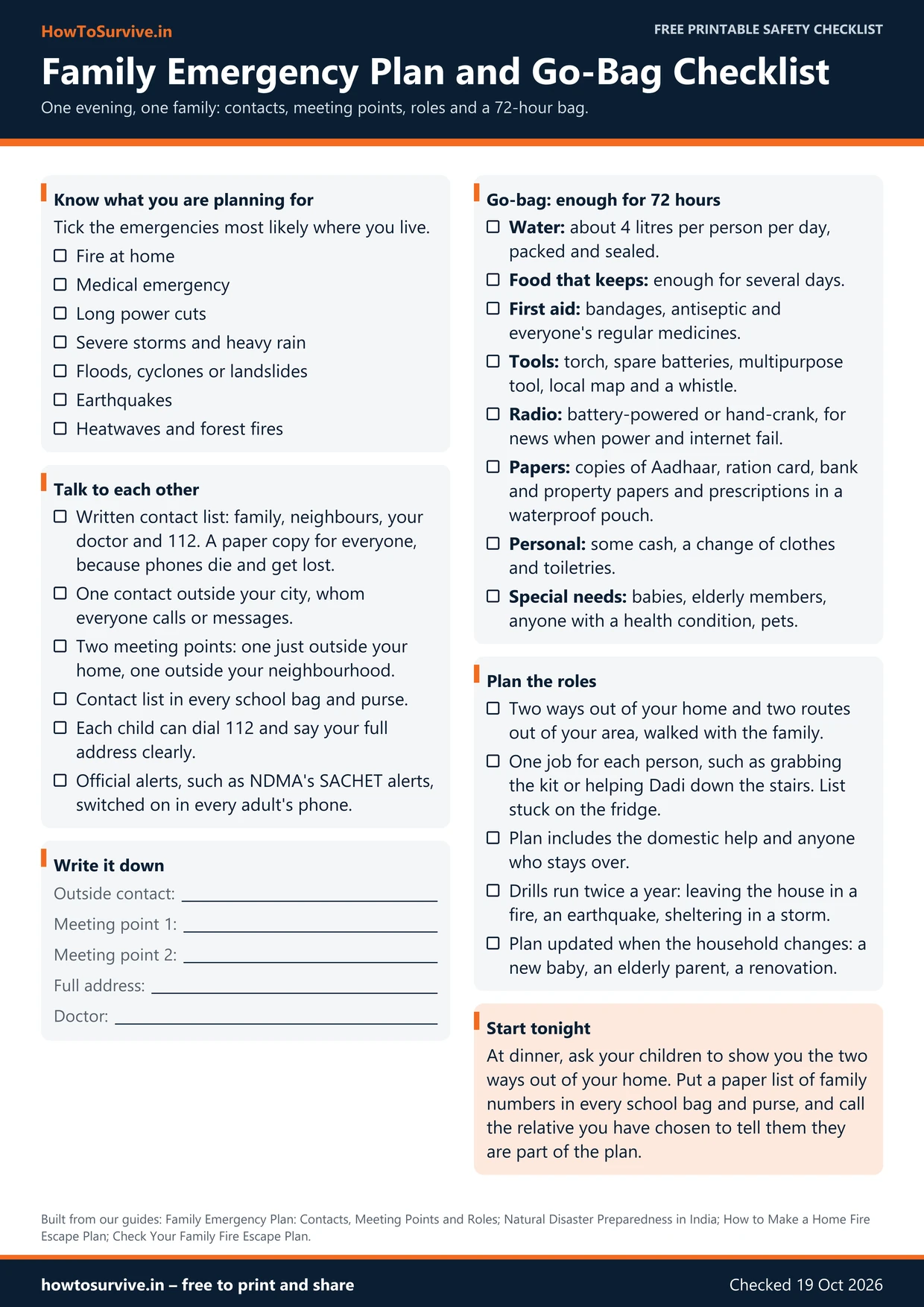
A plan is easier to make on a calm evening than in the middle of an emergency. This sheet follows our guide to the family emergency plan: a written contact list, one contact outside your city, two meeting points, a job for everyone and a go-bag with enough for 72 hours. It leaves lines to write in the names, the meeting places and your full address by hand.
The go-bag list has water (about 4 litres per person per day), food that keeps, first-aid supplies and regular medicines, a torch, a whistle, copies of important papers in a waterproof pouch, some cash, and things for babies, elderly members and pets. Ask your children to show you the two ways out of the house tonight, and teach each of them to dial 112 and say your full address clearly.
Download: Family emergency plan and go-bag checklist (PDF), one A4 page, free to print and share.
4. First-aid kit and emergency numbers card
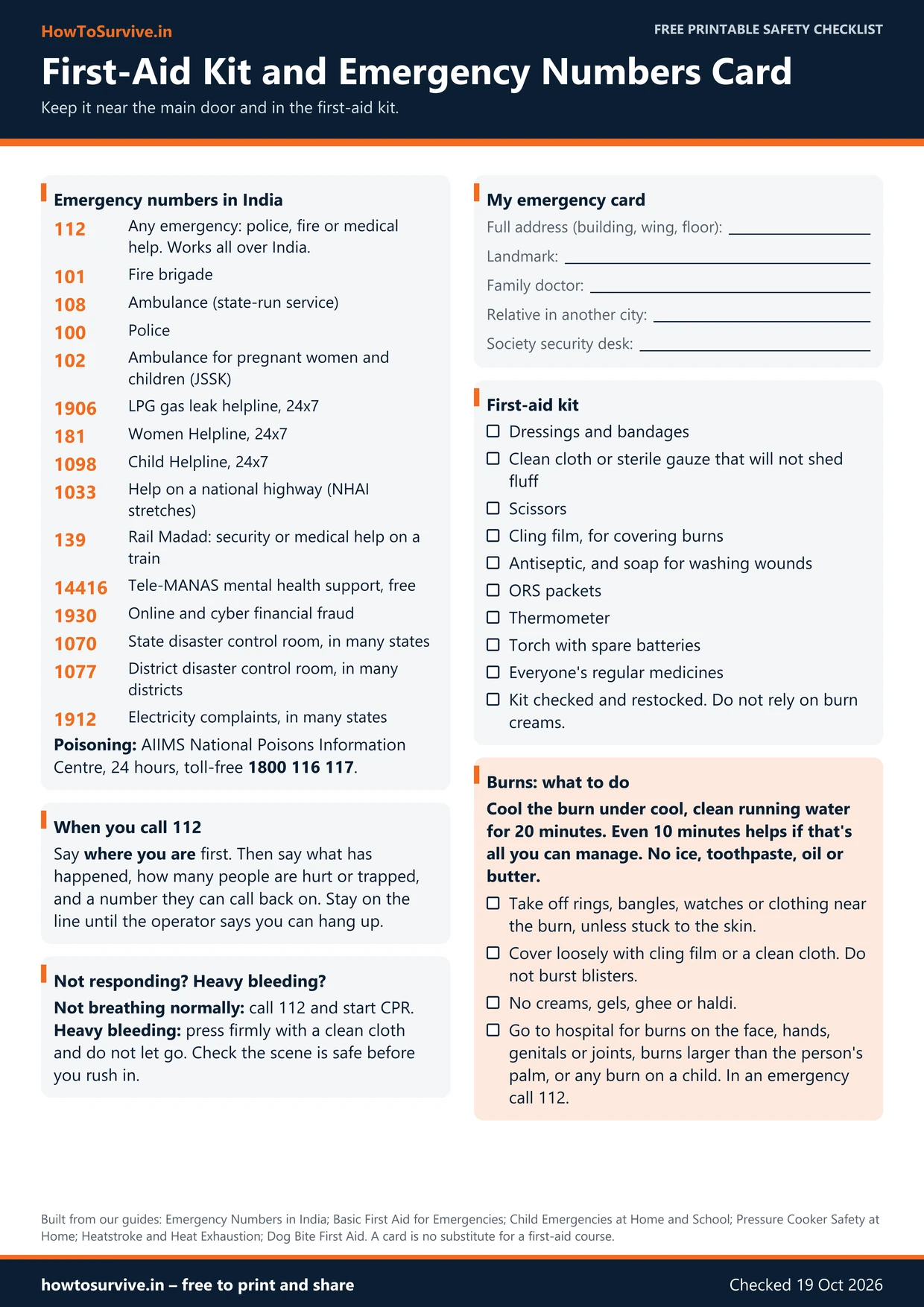
Keep this one near the main door, and put a copy inside the first-aid kit. One half is the list of numbers from our guide to emergency numbers in India, which checked each of them against a government or official source in October 2026, with space to write your own address, landmark and family doctor. The other half is a first-aid kit checklist and a burns box.
If you remember only one number, make it 112. Numbers such as 1070, 1077 and 1912 differ from state to state, so look up your own and write them in.
If you would like some help on your phone as well as on paper, the team behind HowToSurvive.in also builds Bharat101, an independent safety app (not a government service). It has a hold-to-send SOS that shares your live location with your emergency contacts, and lists nearby fire stations, hospitals and police stations. You can get it on Google Play. In an emergency, always call 112 or 101 first.
Burns are common in kitchens: hot tea, dal, the pressure cooker and the iron are on our list of everyday causes. The card uses the same wording as our first-aid guides:
Cool the burn under cool, clean running water for 20 minutes. Even 10 minutes helps if that’s all you can manage. No ice, toothpaste, oil or butter.
Do not rely on burn creams and do not burst blisters. Go to hospital for a burn on the face, hands, genitals or joints, a burn larger than the person’s palm, or any burn on a child. A card is no substitute for practice, so book a practical first-aid and CPR course with the Indian Red Cross Society, St John Ambulance or a trained provider near you, and read our guide to basic first aid for emergencies.
Download: First-aid kit and emergency numbers card (PDF), one A4 page, free to print and share.
If you have only ten minutes
- Home fire: press the test button on every smoke alarm and tell the family where you will meet outside.
- LPG: look at the hose and the regulator, and save 1906 on your phone.
- Family plan: ask the children to show you the two ways out of the house.
- Numbers card: save 112, 108, 101, 1930 and 1906 in every family member’s phone.
Please share the sheets as they are, with the footer on. These checklists summarise guidance already published in our guides. They are general safety information, not a fire audit, medical advice or a compliance certificate. In an emergency, call 112.
What needs attention
- Home is where most fire-accident deaths happen: 3,555 of 5,888 in 2024.
- Small habits start most home fires: unattended cooking, overloaded sockets, old wiring, a cylinder near heat and blocked exits.
- An RCCB protects the person from shock; an MCB protects the wiring from overload. Homes need both.
- Almost every LPG accident can be traced to a loose regulator, an old hose or a flame near leaked gas.
- A family plan works only if everyone has practised it and has a paper copy of the numbers.
- Cool a burn under cool, clean running water; ice, toothpaste, oil and butter make it worse.
Controls that reduce risk
- Print the four sheets and pick one box to fix tonight.
- Press the test button on each smoke alarm every month.
- Turn off the LPG regulator after cooking and every night.
- Write your outside contact, meeting points and full address on the family plan sheet.
- Save 112, 108, 101, 1930 and 1906 in every family phone, and keep a paper copy near the main door.
- Stock the first-aid kit, and learn CPR and burn care in a practical course.
Common unsafe practices
- Ticking a box without actually checking the smoke alarm, hose or lock.
- Keeping the fire blanket or extinguisher in a cupboard or behind the stove, where it cannot be reached.
- Leaving cooking unattended, or leaving a pot on the burner when it may boil over.
- Using a match or lighter to look for a gas leak, or switching a light or fan on or off after smelling gas.
- Keeping the cylinder in a closed cabinet, a pit or direct sun.
- Keeping emergency numbers only in a phone that may be dead or lost.
- Putting ice, toothpaste, oil or butter on a burn.

Leave a comment