
Quick answers
Is fire NOC required for factories in Gujarat?
From 1 April 2027 industrial buildings are on the Third Schedule list of buildings that need a certificate for compliance of the fire safety measures, commonly called the Fire NOC: low and moderate hazard above 500 sq m, high hazard above 50 sq m of built-up area. How existing units will be treated is not stated in the gazette text.
What is the Gujarat fire NOC notification of 2026?
It is the Gujarat Fire Prevention and Life Safety Measures (Amendment) Rules, 2026, notification No. GH/V/198 of 2026, published in the Gazette Extraordinary (Extra No. 298) on 23 October 2026. It replaces rules 22 and 27 and the Third Schedule.
Is fire NOC not required in Gujarat?
It depends on the building. The Third Schedule lists the buildings that need the certificate, and it now includes industrial buildings from 1 April 2027. A building below the thresholds is not on the list, but Note 3 advises owners and occupiers to provide and maintain fire installations anyway.
What are the fire NOC rules for industries in Gujarat?
Industrial buildings: low hazard above 500 sq m, moderate hazard above 500 sq m, high hazard above 50 sq m of built-up area, from 1 April 2027. Rule 22 lists the fire safety matters the standards cover, such as exits, extinguishers, hydrants, alarms and a fire control room.
When do the new Gujarat fire rules start?
The amendment came into force on publication, 23 October 2026. For the industrial building categories, Note 4 to the Third Schedule says the provisions come into force on 1 April 2027.
How to get a fire NOC in Gujarat?
Apply through the Gujarat Fire Safety Compliance Portal. A new building usually needs fire safety plan approval first and the certificate after construction. For industrial buildings the gazette does not yet set out the process, so ask your fire office.
Is there a fire NOC renewal online in Gujarat?
Yes, renewal is handled on the state portal, with a Fire Safety Officer appointed at least two months before the certificate expires under section 12 of the Act. See our guide on the Fire NOC application and renewal process for the steps.
Is there a self declaration form for fire NOC in Gujarat?
We did not find a self-declaration form for industrial units in the notification. The state portal has said that a shorter residential building is left to self-compliance. Check the portal and your fire office.
On 23 October 2026 the Gujarat government published new fire rules in the Extraordinary Gazette. The line most people have picked up is that factories will now need a fire NOC from 1 April 2027. That is close, but the gazette says something a little different, and the difference matters if you own or run a unit. This page goes through what the notification says, who it covers, what starts now and what waits until April 2027, and what you can do this month. For the application side, see our guide to the Fire NOC application and renewal process, and for the national picture, our page on fire safety laws in India.
In short
- The notification. The Gujarat Fire Prevention and Life Safety Measures (Amendment) Rules, 2026 were published in the Gazette Extraordinary (Extra No. 298, Part IV-B) of 23 October 2026, notification No. GH/V/198 of 2026 of the Urban Development and Urban Housing Department. They amend the 2014 Rules made under the 2013 Act.
- What they replace. Among other things, the Third Schedule, which lists the buildings that need a certificate for compliance of the fire prevention, life safety and fire protection measures. People call this certificate the Fire NOC. The gazette does not use that word.
- Industrial buildings are on the list. Low hazard above 500 sq m of built-up area, moderate hazard above 500 sq m, and high hazard above 50 sq m.
- Two start dates. The rules come into force on publication, 23 October 2026. For the industrial categories, Note 4 to the Schedule says the provisions come into force on 1 April 2027.
- Not in the text. The gazette does not say who will inspect factories, what the fee is or how existing units will move across. Ask before you assume.
What the notification changes
Four things. Rule 2 now says that words not defined in the Rules take their meaning from the Act, the Comprehensive General Development Control Regulations (GDCR), the regulations made under section 58 of the Act or the Bureau of Indian Standards. Rule 22 and rule 27 are replaced. And the Third Schedule is replaced.
Rule 22 says what the minimum fire prevention, life safety and fire protection standards cover: access to the building; the number, width, type and arrangement of exits; protection of exits with fire check doors or pressurisation; compartmentation; smoke management; fire extinguishers; first-aid hose reels; automatic fire detection and alarm; a public address system; automatic sprinklers; internal and yard hydrants; pumping arrangements; captive water storage for firefighting; exit signage; lifts; standby power; refuge area; a fire control room; and special fire protection systems for special risks. The detail comes from the GDCR and the state’s regulations.
Two provisos in that rule are worth knowing. Where the bye-laws or regulations say nothing for a class of building, the Director can ask the owner or occupier to follow international standards specified by the Fire Prevention Wing. And the Government can, by order and for reasons recorded in writing, relax, modify or cancel a requirement for special areas, or for buildings that were built or were under construction before these rules began. A separate sub-rule lets the Regional Fire Officer or the Chief Fire Officer ask for additional measures, again with reasons in writing.
Rule 27 covers temporary structures such as mandaps, shamiyanas, tents and pandals. Their fire standards follow IS 8758:1993 and the state regulations on access, open space around the structure, distance from medium and high voltage lines and hazardous installations, exits, materials, first-aid firefighting, water storage, electrical wiring and trained firefighting staff. The promoter, organiser, owner or occupier has to provide and maintain these measures.
Who needs the certificate now
The new Third Schedule names the following. The thresholds are as printed in the gazette.
- High-rise buildings of 15 m and above, except occupancies or buildings the Schedule particularly excludes.
- Hotel, educational, institutional, business, mercantile, storage, hazardous and mixed-occupancy buildings with a built-up area of more than 500 sq m on any one or more floors, counted together.
- Educational and institutional buildings of 9 m and above. Institutional includes hospitals, nursing homes and mental institutions with beds, with or without an ICU.
- All assembly buildings, all multilevel car parking and all fuelling stations.
- Buildings with more than 300 sq m of incidental assembly occupancy on any floor, and buildings with two or more basements or one basement of more than 500 sq m.
- Industrial buildings. Low hazard, built-up area more than 500 sq m. Moderate hazard, more than 500 sq m. High hazard, more than 50 sq m. These start on 1 April 2027.
Updated 28 October 2026. The 22 January 2021 Third Schedule (notification No. GH/V/9 of 2021) did name industrial buildings, by the hazard classes of the national building code: light hazard at 15 m and above, moderate hazard above 500 sq m of covered area and high hazard above 50 sq m, plus all hazardous buildings. The 2026 list names them again, with low hazard now at more than 500 sq m instead of a 15 m height. How does the 2026 list compare with the one of July 2021? The July 2021 Third Schedule (notification No. GH/V/68 of 2021, dated 8 July 2021, a copy of which is on the state fire portal) had no industrial rows, and its hazardous-buildings row was limited to hazardous buildings not covered under the Factories Act, 1948. The 2026 list names industrial buildings, and its hazardous row carries no Factories Act wording in the text we read. It also names fuelling stations, which we did not see in the 2021 list, and counts built-up area cumulatively where the 2021 list spoke of floor area. That comparison is ours; the state has not published one.
What starts when
Rule 1(2) brings the amendment into force on the date of publication, 23 October 2026. Note 4 then says that for the industrial building categories, the provisions of the rules come into force on 1 April 2027. So on the text, the other rows of the Schedule and the new rules 22 and 27 apply already, and industrial buildings get about five months.
One thing the note leaves open. It says the provisions of the rules, not only the certificate. We cannot tell whether that covers the rule 22 standards for industrial buildings as well as the certificate. Ask your fire office in writing.
Fire NOC or certificate?
Most people, and most news reports, say Fire NOC. The gazette’s words are “certificate for compliance of the fire prevention, life safety and fire protection measures”. Gujarat’s fire portal says the Fire Safety Certificate was earlier called the Fire NOC, and the 2021 Schedule called it a fire safety certificate. So a short form like “Fire NOC for industrial units from April 2027” is fair as a headline, but it is a simplification. It does not tell you what happens to a unit that already holds an older NOC or a factory-licence paper. Ask your office which paper it means.
What the law said before
Updated 28 October 2026. We went back through the earlier papers to see why industrial units were outside the fire department’s certificate list. The short answer is that they were not always outside it, and that the reason for the change in July 2021 is not written in the notification. Here is the chain, with what each paper did for factories.
- 2013, the Act. The Gujarat Fire Prevention and Life Safety Measures Act, 2013 does not exclude factories in the sections we read (1, 2, 12, 18 to 22, 26, 27, 39, 49, 50, 57 and 58). Its original section 12 spoke of every factory appointing a fire safety officer, and let the fire officer report a defaulting factory to the Labour Commissioner for closure. Section 18 puts the duty on the owner or occupier of buildings classified by the regulations, and section 49 says the Act is in addition to other relevant laws.
- 2014, the Rules. The draft rules were published on 20 January 2014; our copy of the final text comes from a legal database, so we have not confirmed the notification number and date of the final Rules. In that text the Third Schedule only classified buildings for fire safety officers. It was not a list of buildings needing a certificate. Rule 21 asked every owner or occupier or every factory to appoint an officer, and rule 23(6) treated an earlier No Objection Certificate as a fire safety certificate, subject to verification.
- 26 November 2020. A Labour Department notification, as summarised by a legal update site (we did not open it), required factories to get a fire NOC from the fire department under the 2013 Act before applying for or renewing a factory licence. A news excerpt links this to the Pirana chemical factory blast in Ahmedabad on 4 November 2020, in which 12 people died.
- 22 January 2021. Gujarat Ordinance No. 3 of 2021 amended the Act. It was later replaced by Gujarat Act 5 of 2021, published on 23 March 2021 and in force from 22 January 2021. The same day, notification No. GH/V/9 of 2021 amended the Rules, and its new Third Schedule did list industrial buildings (see above). Its note said light hazard industrial buildings below 15 m would be covered by the Factories Act, 1948 and its rules.
- 8 July 2021. Notification No. GH/V/68 of 2021 replaced that Third Schedule. The industrial rows were gone, and the hazardous row became hazardous buildings not covered under the Factories Act, 1948. It also deleted three items from the Fourth Schedule, the fire safety officer table; we have not matched those items to industrial buildings. The notification gives no reason.
- 14 July 2021. A Gujarati TV clip carried a headline, visible in its thumbnail, that industries would no longer get fire NOCs from the fire department. We did not watch it in full.
- 6 October 2021. An Urban Development circular, as summarised by a safety news site (we did not open the circular), said factories would take their fire NOC from the Director of Industrial Safety and Health, and that fire departments under local authorities would keep issuing them for residential and commercial buildings. It said fire safety for factories would be carried out under the Factories Act, 1948 through the Inspector of Factories. That summary quotes the July notification with a different number from the official copy, so treat it with care.
- 9 February 2022. A Labour Department resolution, reported by a legal news site on 16 February 2022 (we did not open the resolution), dropped the need for a fire department NOC before applying for or renewing a factory licence. The reason given was that the issue of fire NOCs for industries was yet to be resolved by the government.
- December 2023. The Gujarat Fire Prevention and Life Safety Measures Regulations, 2023 (Gazette Extra No. 348 of 13 December 2023, notification No. GH/V/233 of 2023) and the Second Amendment Rules, 2023 (No. GH/V/245 of 2023, dated 14 December 2023). One list in the regulations still speaks of hazardous buildings not covered under the factory act 1948. We read only the first page of the 2023 amendment rules, which replaces the licensed agency application form.
- 20 July 2026. A news report said the government had decided to make the Urban Development Department the sole authority for factory fire safety and NOCs, with an industrial fire safety wing, and that a notification was expected. It said the 2021 arrangement under the Labour Department had caused delays and about five years of confusion, because that department lacked firefighting equipment, machinery and trained staff. We have not seen the order.
- 23 October 2026. The amendment rules replace the Third Schedule again. Industrial buildings return to the list, from 1 April 2027.
So why were industrial units outside the list? On the papers we could open, from 8 July 2021 the Third Schedule simply carried no industrial rows, and its hazardous row left out buildings covered by the Factories Act. The notification does not say why. A summary of an October 2021 circular says factory fire safety was to be handled under the Factories Act through the factory inspectorate, and the July 2026 report says the Labour Department, which held that job, lacked the equipment and staff, so approvals were delayed. Neither of these is a statement of reasons in the notification itself.
What the factory law says. Section 38 of the Factories Act, 1948 requires every factory to take all practicable measures to prevent an outbreak of fire and its spread, to provide safe means of escape and the equipment and facilities for extinguishing fire, and to make sure workers know the escape routine. The state can make rules, and the Chief Inspector can order extra measures. Rules 66 and 66-A of the Gujarat Factories Rules, 1963 cover means of escape and fire protection. The provisions we read set duties on the factory and do not describe a certificate from the fire department.
What we could not confirm. The reason for the July 2021 change; the texts of the 26 November 2020 notification, the 6 October 2021 circular, the 9 February 2022 resolution and the July 2026 order; and the final 2014 Rules notification. A figure of more than 15,000 factories without a fire NOC, said to come from a High Court affidavit, appeared only in a search excerpt, so we have not used it. No official page we opened gives a trigger for the October 2026 amendment, and the Gujarati reports do not name one. A Gujarat High Court public interest case on fire safety was reported on 7 August 2026, but that report does not mention factories. For existing industrial units, the gazette text says nothing beyond the 1 April 2027 date.
The position for factories, in short
Not a clean one. In July 2021 the Schedule’s hazardous-buildings row excluded buildings covered by the Factories Act, and a Gujarati TV report of 14 July 2021 said the fire department would no longer give fire NOCs to industrial units. A news report of 20 July 2026 said the state had made the Urban Development Department the sole authority for factory fire NOCs, with a separate industrial fire safety wing to be set up, and that a notification was expected shortly. The October rules do not say who will issue or inspect for industrial buildings, so we cannot say whether this is the notification that report meant. Until the state spells it out, ask your fire office and the factory inspectorate (the Directorate of Industrial Safety and Health) what each expects from you.
Where the rules come from
The parent law is the Gujarat Fire Prevention and Life Safety Measures Act, 2013 (Guj. 11 of 2013). Section 18 puts the duty to provide fire prevention and life safety measures on the owner, or the occupier where the owner cannot be traced, of buildings classified by the regulations, and to keep them in working condition at all times. The certificate is issued under section 21, and section 27 deals with temporary structures. Section 57 lets the government make rules, with a proviso that lets it skip previous publication when immediate action is needed. The notification says it used that proviso. The technical detail sits in regulations; the state fire portal carries the Gujarat Fire Prevention and Life Safety Measures Regulations, 2023 (Gazette of 13 December 2023).
What you can do now
If you run an industrial unit in Gujarat, these five months are for getting ready. Take the rule 22 list and look at each item in your own premises.
- Measure first. Write down the built-up area of every building in the unit, floor by floor. Then ask your fire office how it will class your process as low, moderate or high hazard. The Gujarat regulations we read do not define the three terms; they send you to the national building code for words they leave out, and the 2016 code (since replaced by the 2026 standards) splits industrial buildings into low, moderate and high hazard and leaves the decision to the authority. The 50 sq m mark for high hazard is small. A small unit that handles solvents or chemicals should not assume it is outside.
- Exits. Count them, measure the width, check that doors open the right way and that nothing is stacked in the way. Look at fire check doors and exit signs too.
- Extinguishers. The right type for what you actually burn, within date, mounted where people can reach them, and staff who have used one. Our fire extinguisher chooser helps you match the type to the fire.
- Hose reels, hydrants, pump and water storage. Run the pump, open a hydrant, check the tank level and the standby arrangement. Our guide on keeping fire systems working after approval covers the routine.
- Detection, alarm and public address. Press a call point and see who hears it. If the alarm panel shows a fault, fix it before anyone asks.
- Sprinklers and smoke management. Where your process or storage calls for them, check they are fitted, charged and not blocked by new racking.
- Standby power and the fire control room. Test the generator on load, not just start it. A larger unit should know where its fire control room is and who sits in it.
- Special risks. Solvent stores, gas cylinders, dust, boilers and battery rooms are what rule 22 means by special risks. Ask whether they need their own system.
- Run a drill. Our fire drill kit has sheets for a drill that takes about half an hour.
- Keep one file. Building plan, past fire certificates or NOCs, the factory licence, the last inspection reports and your maintenance records. Whatever process the state announces, you will need most of this.
The industrial accidents already on our site
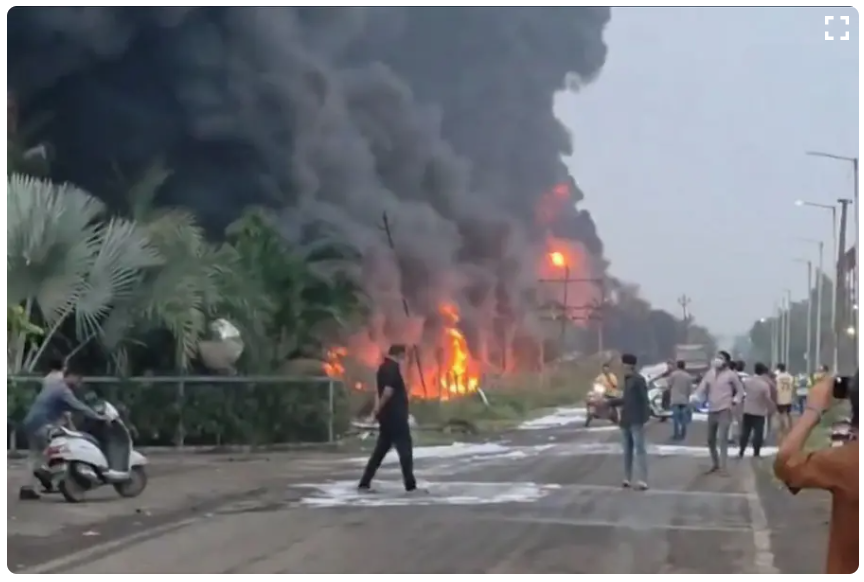
Gujarat’s factories have had a hard month. Four workers died in a blast at a dye unit in Chhatral GIDC on 15 October (Chhatral GIDC blast), and five in a reactor blast at a pharma unit in Saykha GIDC, Bharuch, on 16 October (Saykha GIDC reactor blast). A boiler-area fire at a dyeing unit in Surat on 13 October hurt workers (Surat Krishan Silk Mill fire). If you operate in one of those cities, our Surat, Ahmedabad, Vadodara and Bharuch safety guides list the local fire stations and emergency numbers.
We cannot say whether any of these would have gone differently under the new Schedule. The cause in each is still under investigation, and early reports on the Chhatral unit said it held a fire NOC. That is worth remembering. A certificate records that the systems were there and working on one day. It does not run the plant safely. In another state, an officer said the unit in our Farrukhabad tyre factory fire report had no NOC. The paper and the practice both matter.
What we could not confirm
- How your unit will be classed as low, moderate or high hazard. We did not find the three terms defined in the Gujarat regulations we read.
- Who will issue and inspect for industrial buildings, the fee, the application process, any deadline or provisional certificate for existing units, and any appeal. The gazette text we read says nothing on these.
- Whether Note 4 delays only the certificate or also the rule 22 standards for industrial buildings.
- Some Gujarati reports mention an undertaking from organisers of gatherings above 50 people, guards and gate widths for pandals, and sealing for non-compliance. We did not find these in the amendment text, so we have not relied on them.
- The legal effect of the Gujarat Ease of Doing Business Act, 2026, which was reported issued on 23 September 2026. The bill proposed to remove references to the National Building Code from sections 2 and 18 of the Fire Act. We read the bill, not the gazetted Act.
- A public copy on the state fire portal. Its rules page, last updated on 28 July 2026, did not list the 2026 amendment on 28 October. We read the Gazette PDF itself.
- We found no Instagram, Facebook or LinkedIn video we could open and match, so the videos below are from YouTube.
Do this today
Write down the built-up area of each building in your unit, find your last fire inspection report and put one question to your fire office in writing: how will my unit be classed, and what do I need to file before 1 April 2027? Keep the reply. Checked 28 October 2026.
What needs attention
- The new Third Schedule lists high-rise buildings of 15 m and above and a set of special buildings, now including industrial buildings and all fuelling stations.
- Industrial thresholds: low hazard more than 500 sq m, moderate hazard more than 500 sq m, high hazard more than 50 sq m of built-up area.
- Note 4 says that for the industrial building categories the provisions of the rules come into force on 1 April 2027; rule 1(2) brings the rest into force on publication.
- Rule 22 lists the matters the minimum standards cover, from exits and extinguishers to a fire control room and special risk systems.
- The Government may relax, modify or annul requirements by order, with reasons in writing, for special areas or for buildings built or under construction before the rules began.
- The gazette text does not say who issues the certificate for industrial buildings, the fee or the transition for existing units.
Controls that reduce risk
- Measure the built-up area of every building in the unit.
- Ask the fire office in writing how your process will be classed and what to file before 1 April 2027.
- Check each rule 22 item on site: exits, extinguishers, hose reels, detection, sprinklers, hydrants, pump, water storage, signs, standby power, fire control room.
- Test the systems and keep the records.
- Run a drill.
Common unsafe practices
- Reading the 1 April 2027 date as the start of everything; the other rows and the new rules 22 and 27 apply from 23 October 2026.
- Assuming a small unit is outside because of its size; the high hazard mark is only 50 sq m.
- Assuming an old NOC or factory-licence paper settles the matter.
- Treating press summaries as the rule text; some reported details are not in the amendment.
- Waiting for the fire office to chase you instead of asking in writing how your unit will be classed.





Leave a comment