
What happened here
 1 / 3
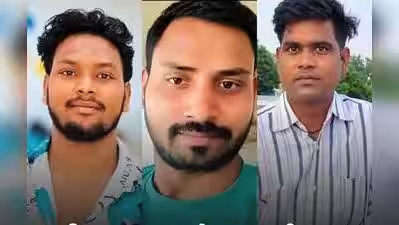
1 / 3 Three men died after entering a deep, fast-moving section of the Sai River during a Ganesh idol immersion. Reporting indicates that the incident developed into a rescue chain: one man got into difficulty and two others entered the water in successive attempts to help.
Quick answers
What happened in the Sai River drowning during Ganesh immersion in Lucknow?
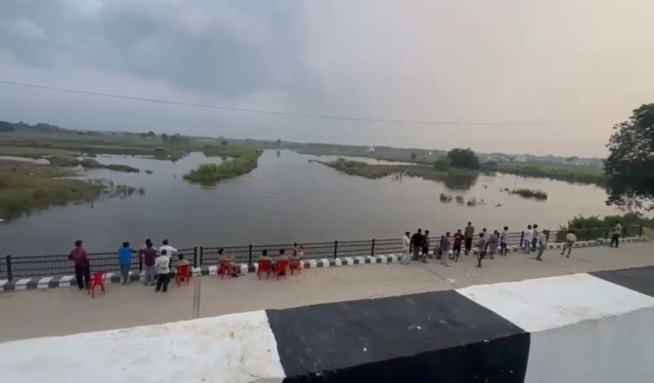
On 22 September 2026, three men died after entering a deep, fast-moving section of the Sai River near Jabraila Bridge in Mohanlalganj, Lucknow, during a Ganesh idol immersion. All three bodies were recovered by 23 September.
How did one drowning turn into three deaths in the Sai River?
According to reporting, one man moved into deeper water and began drowning, and two others entered one after another to help him. All three disappeared in the strong current, a recognised rescue-chain drowning pattern.
Should I jump into a river to save someone who is drowning?
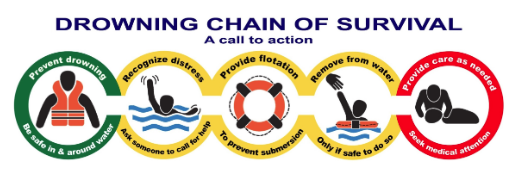
Do not enter for a direct rescue unless trained, equipped and supported. Shout for help, call 112, keep the person in sight, and reach with a pole or throw a rope or buoyant object from land.
What should I do if I get swept into a river current?
Float on your back with feet downstream where possible and angle toward a safer bank. After any rescue, get a medical assessment because drowning complications can develop later.
A celebration entered moving water
At about 5 pm on 22 September 2026, a group from Sisendi reached the Sai River near Jabraila Bridge in Lucknow’s Mohanlalganj area for a Ganesh idol immersion. Reporting identifies the three men who died as Dheeraj, 35, Hariprasad, 40, and Pramod, 22.
How one emergency became three
According to the later Times of India account, Dheeraj moved into deeper water and began drowning. Hariprasad entered to help him and also got into difficulty. Pramod then entered the river, after which all three disappeared in the strong current. This is a recognised drowning pattern: an untrained person attempts a direct rescue, is grabbed or overwhelmed, and becomes another casualty.
The search and recovery
Initial reports described an active search for two missing men after one body had been recovered. Later reporting on 23 September confirmed that all three bodies were recovered. The operation involved SDRF personnel and local divers using a boat, hooks, life jackets and other flood-rescue equipment. One report placed the SDRF team at about 20 personnel and said it arrived roughly 40 minutes after receiving information.
What the record does not establish
The reviewed reporting establishes the deaths, general sequence and recovery operation. It does not provide a surveyed water depth, measured current speed, a final administrative inquiry, or proof that a formally supervised immersion point with barriers and rescue cover was operating at that exact location. Those details must not be invented.
Why direct entry is dangerous
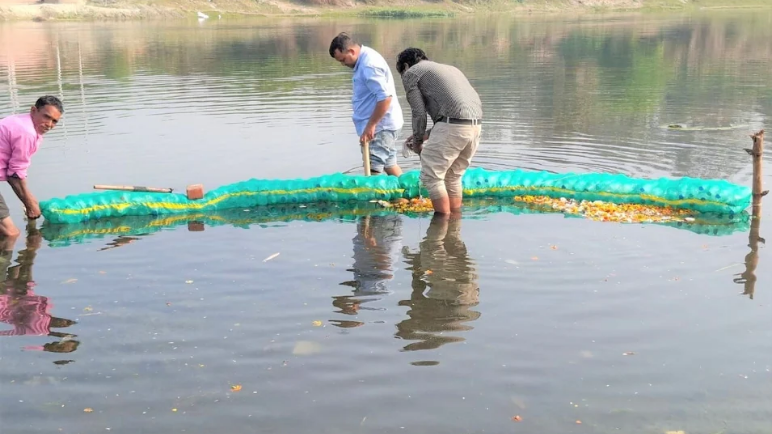
A person in moving water may submerge suddenly, move away from the bank or pull a rescuer under. Clothing, an idol, an uneven riverbed and low visibility add difficulty. A safe response starts from land: alert trained rescuers, extend or throw a buoyant aid, keep visual contact and avoid entering unless trained, equipped and supported.
What organisers should change
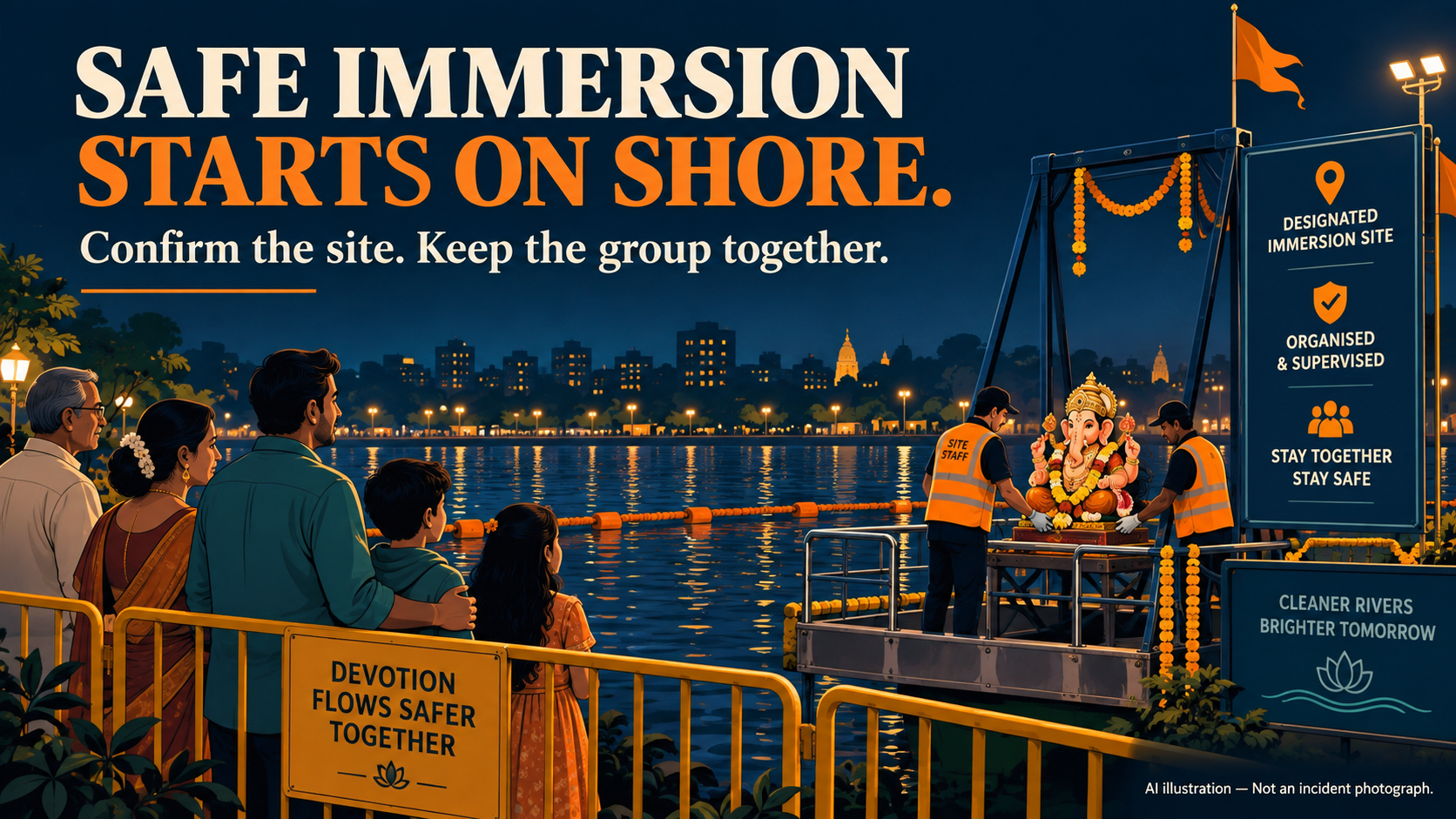
Immersion activity should be restricted to assessed and barricaded points with controlled access, adequate lighting, clear depth warnings, trained lifeguards or rescue personnel, throw lines, flotation devices and a rehearsed emergency call process. Crowds should remain behind a controlled boundary, and no participant should be permitted to wade into deep or fast-moving water.
- The immersion group reached the Sai River near Jabraila Bridge
- Dheeraj reportedly entered deeper water and began drowning
- Hariprasad and then Pramod entered in attempted rescues; all three disappeared
- Police, local divers and disaster-response personnel began searching
- Early reports confirmed one recovery while two men remained missing
- Reporting confirmed that all three bodies had been recovered and sent for post-mortem examination
Why consequences escalated
- The reported sequence is consistent with a multiple-victim rescue-chain drowning.
- Strong current and an abrupt transition into deeper water were repeatedly described.
- Direct, unsupported entry exposed would-be rescuers to the same hazard.
- Bystanders reportedly avoided further entry after recognising the current and depth, preventing additional potential casualties.
- The reviewed record does not establish whether the site had formal immersion controls, lifesaving equipment or trained shore supervision.
Failures and risk multipliers
- Entering water whose depth and current had not been safely controlled.
- Attempting a direct-contact rescue without flotation, a tether or trained support.
- Allowing an immersion activity to depend on spontaneous bystander rescue.
- Treating visible surface conditions as proof that a river section is safe to enter.
- Repeating early search-stage information after later recovery reporting became available.
People closest to the evidence
“Three youths drowned in the Sai River near Jabrela Bridge in Lucknow's Mohanlalganj area while immersing a Ganesh idol”
Hindustan Times video report · Early search-stage report; later reports confirmed all three recoveries · Source ↗
Actions that reduce risk
- Use only an officially assessed and supervised immersion point.
- Keep participants out of deep or fast-moving water using barriers and controlled access.
- Position trained rescue personnel with throw lines, reach poles, buoyancy aids and lighting.
- Brief organisers and participants before entry and stop the activity if current, depth or visibility is unsafe.
- If someone is drowning, call for professional rescue, maintain visual contact and reach or throw from land.
- Do not enter for a direct rescue unless trained, equipped and supported.

Leave a comment