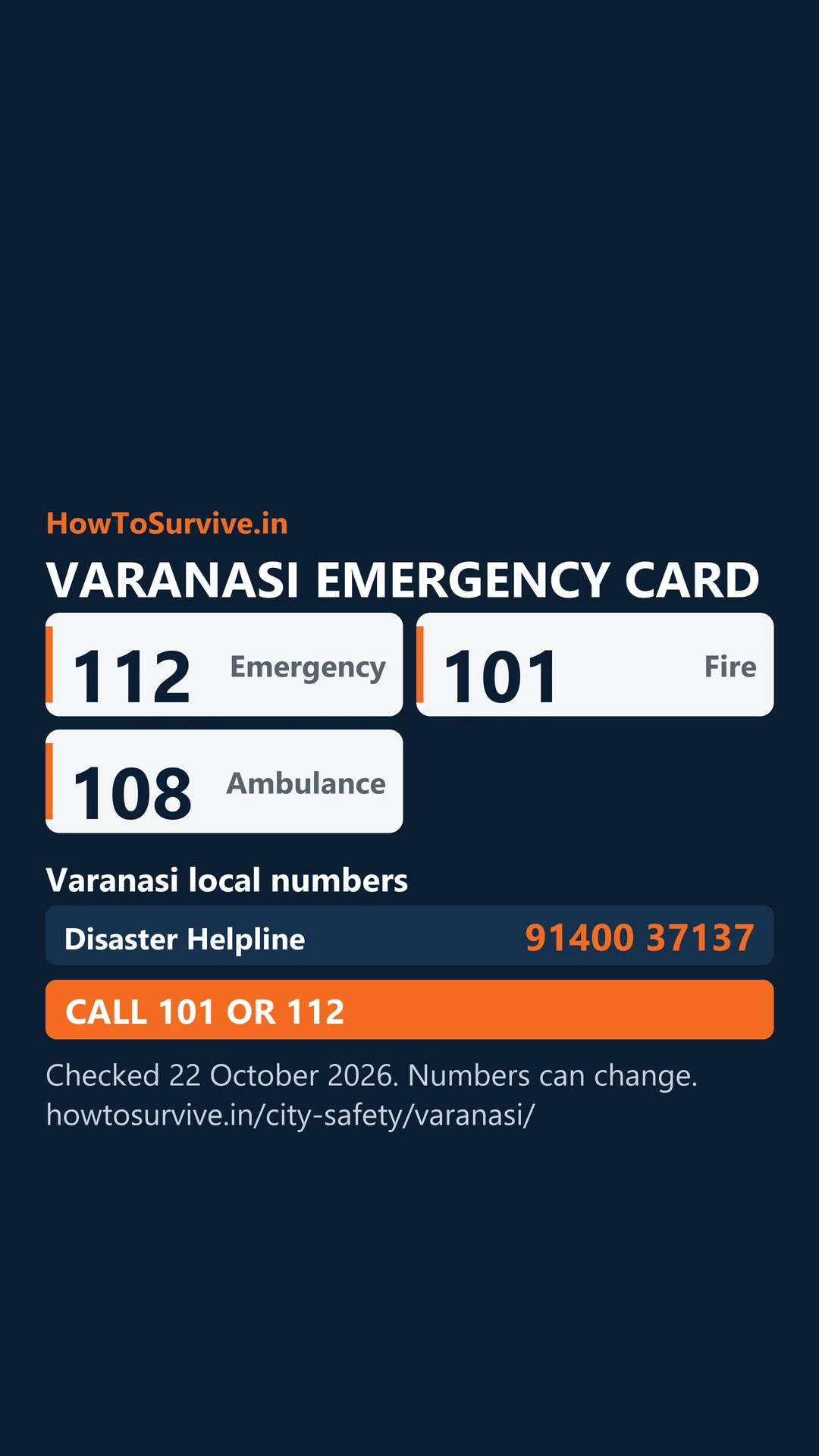
Varanasi is an old city on the Ganga, and most of its risks come from that: lanes too narrow for a fire tender, ghats that go under water every monsoon, and crowds that can swell to lakhs in a day. This guide puts the emergency numbers and the main local hazards on one page, with dated examples from the city. There is no verified list of fire stations for Varanasi, so none is printed; in an emergency, call 112 or 101.
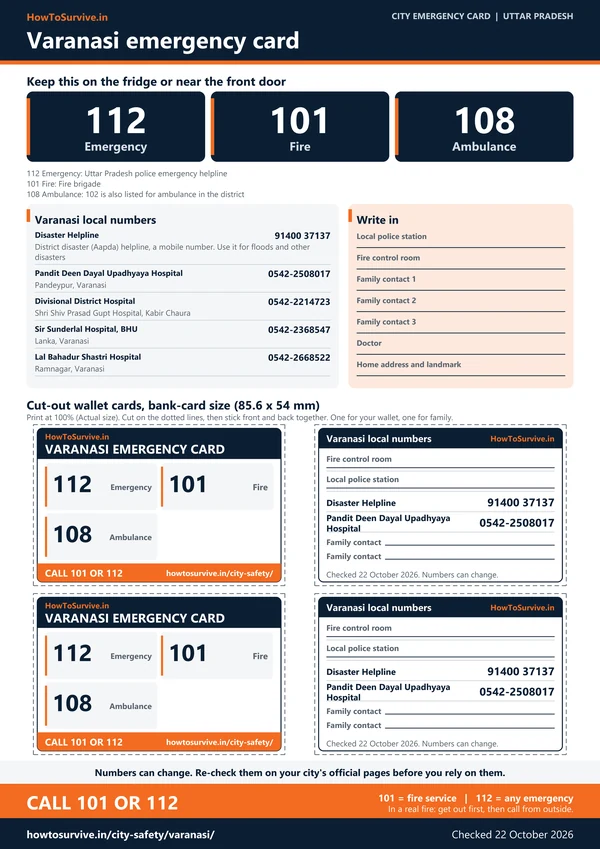
112: Uttar Pradesh police emergency helpline · 101: Fire brigade · 108: 102 is also listed for ambulance in the district
Take these numbers with you
Print the Varanasi emergency card for the fridge or the front door, and cut out the wallet cards. It holds 112, 101, the ambulance and police numbers. This guide has no local numbers yet, so there are blank lines to write your local fire station, police station and nearest hospital, and your family contacts.
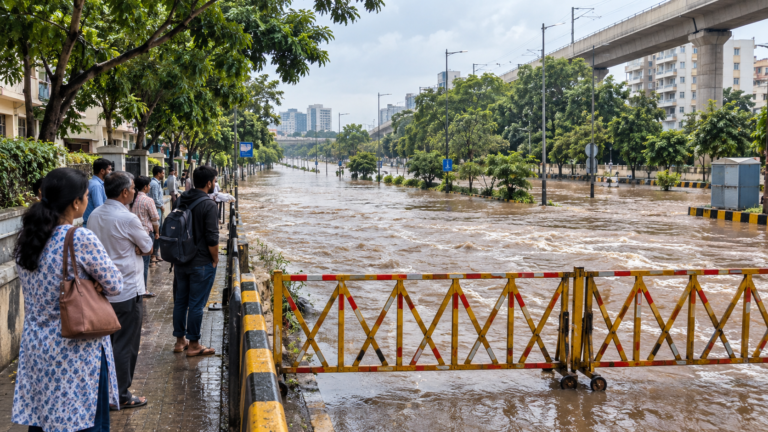
On the morning of 4 August 2025 the Ganga stood at 72.1 metres at Varanasi against a danger mark of 71.262 metres, and ghat workers said every ghat was under water. Boat movement on the river was banned as a precaution. On 2 September 2026 the river crossed the warning level of 70.26 metres, reaching 70.29 metres, and all boat operations were suspended again, with people asked to keep away from the ghats and strong currents. The highest flood level on record is 73.90 metres.
Cremation ghats in high water
When the river rose at the start of August 2025, Manikarnika and Harishchandra ghats went under. Cremations at Manikarnika moved to rooftops, where only about ten bodies could be burnt at a time, and at Harishchandra to a narrow lane that took two or three at a time. Families waited for long hours for their turn, mainly at the street cremations. Dashashwamedh and Sheetla ghats, and the spots where the Ganga aarti is held, were flooded too.
Boats on the Ganga
On 31 January 2025, two boats collided near Maan Mandir Ghat and one of them capsized with six people on board. An NDRF team rescued one person alive, and the other five managed to save themselves before help arrived. Boat operations are suspended whenever the river rises, so do not argue with a boatman who refuses to go out in high water.
Narrow lanes in the old city
On 3 July 2007, fire started in the basement godowns and shops of a three-storey house at Raja Darwaja in Chowk. The lanes were so narrow that the fire tenders took almost four hours to put it out, and the 60-year-old landlady was taken to hospital with severe burns. Many old-city lanes are still too tight for a tender, so the first few minutes depend on the people already there.
Temple, house and parking fires
On the night of 9 August 2025, fire broke out during decoration and puja with cotton at the Atma Vishweshwar Mahadev temple near Sankatha Mata temple in Chowk, and nine people were seriously burnt. The flame of a lamp offering was reported as the cause. On 21 April 2026, a fire inside a house in Bhelupur was followed by a gas cylinder blast and one person was burnt. On the night of 29 November 2024, over 150 two-wheelers burnt in the parking stand at Varanasi Cantt railway station, with no casualties, and a committee was formed to look into it.
Festival and pilgrim crowds
In mid-February 2025, with devotees coming after the Prayagraj Maha Kumbh, an estimated six to seven lakh people prayed at Kashi Vishwanath every day and the queues ran beyond five kilometres. Schools up to Class 8 were shut until 22 February, vehicle movement in the city was restricted, and about 700 CCTV cameras and drones watched the temple and ghats. VIP darshan was suspended from 25 to 27 February for Maha Shivratri, and more than one crore devotees were reported in the first 17 days of the month.
Under-construction structures near busy roads
On 15 May 2018, at about 4 pm, a girder of an under-construction flyover in Varanasi fell on the busy road below. Between 15 and 18 people died, depending on the report, and many were injured. Whenever a flyover or building is being built over a road, treat the area below it as a danger zone and stay out of the work area.
Summer heat
On 20 May 2026, Varanasi was reported at 45 to 46 degrees Celsius during a severe heatwave across north India, and people on the roads covered themselves with umbrellas and cotton cloths. Pilgrims standing in queues or walking the ghat steps in the afternoon sun are the most exposed.

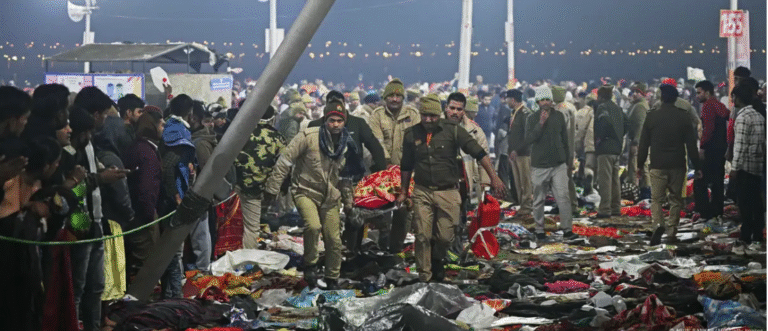 Stampedes at Religious Gatherings in India: Recent Tragedies and How to Stay Safe
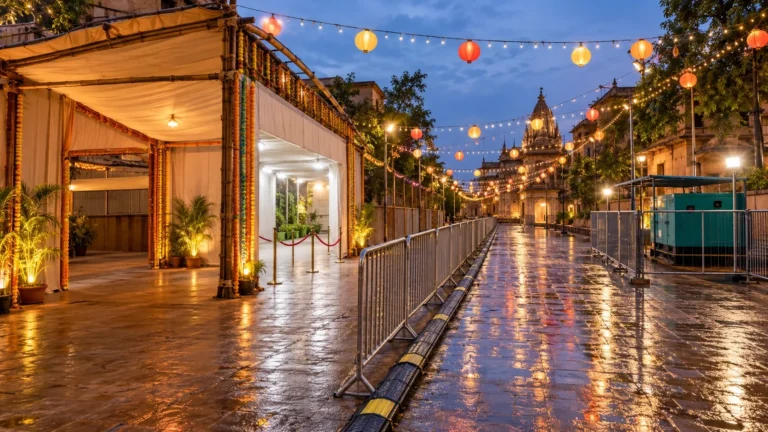 Pandals, Melas and Festival Crowds in India: How to Stay Safe in a Crowd
 Flood Safety in India: Before, During and After a Flood